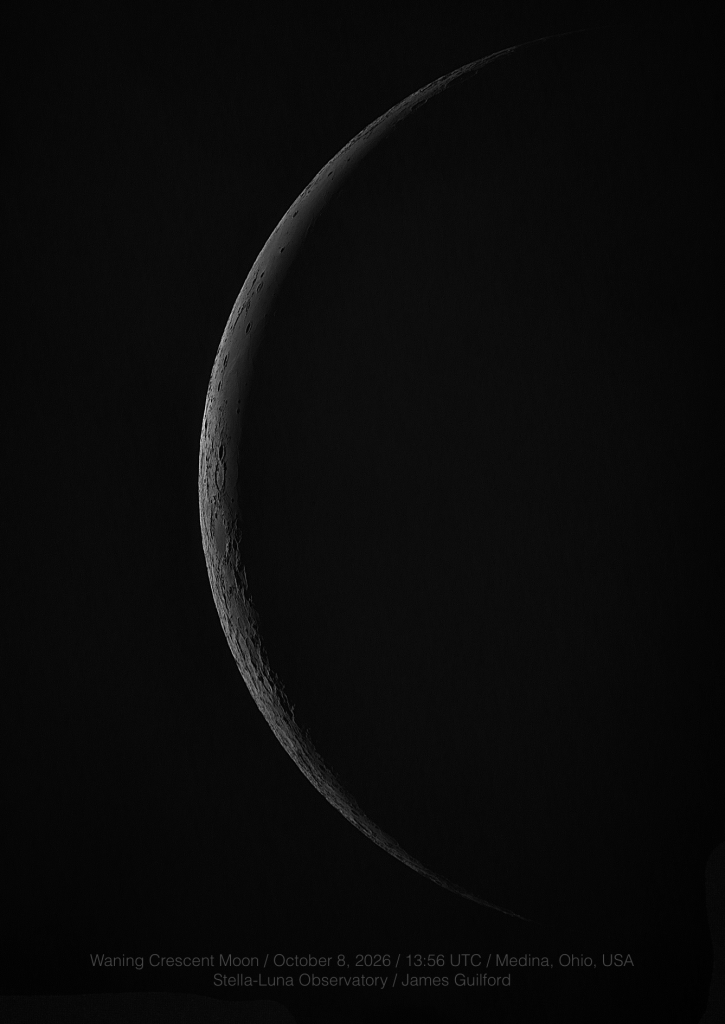
Behold, the Five Percent Moon! Not without some difficulty, we were able to capture this morning’s waning Crescent Moon (27.45 days old) during daylight — the only time of day we can view this Lunar phase from our observatory. Moon was invisible to the unaided eye and, through the eyepiece, appeared as a ghostly fingernail trimming on a bright, powder blue sky background. Very low contrast. Video capture software had difficulty with this one giving us limited frames to stack, yet here it is!
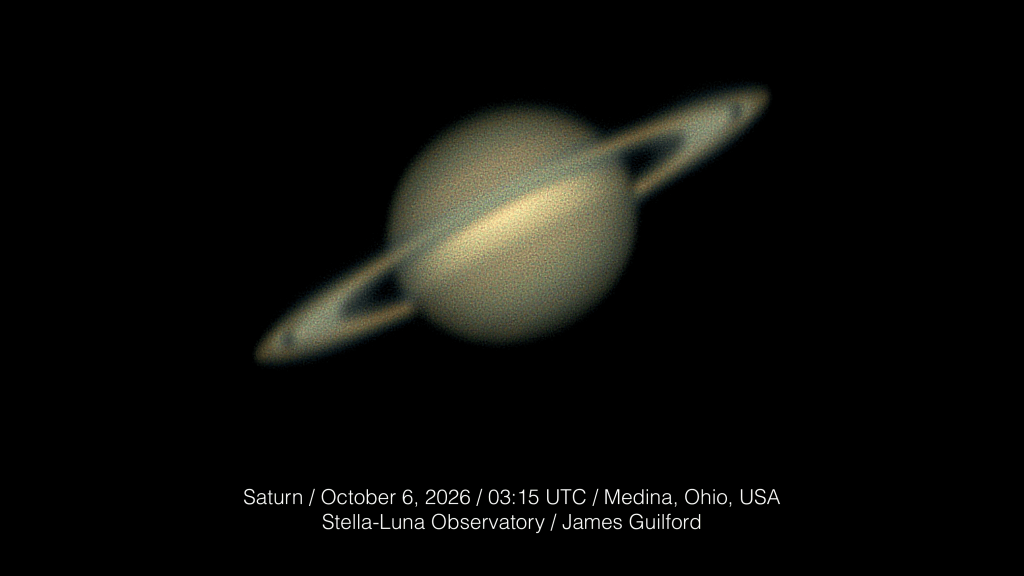
We had a busy astronomical night and morning: Last night (October 5) we went for Saturn once again. Sky forecasts called for Average seeing with poor transparency; what we got was Fair to Poor seeing and poor transparency. Still, we imaged ’cause you’ve got to keep trying! Here’s Saturn from about 11:15 PM EDT Monday.
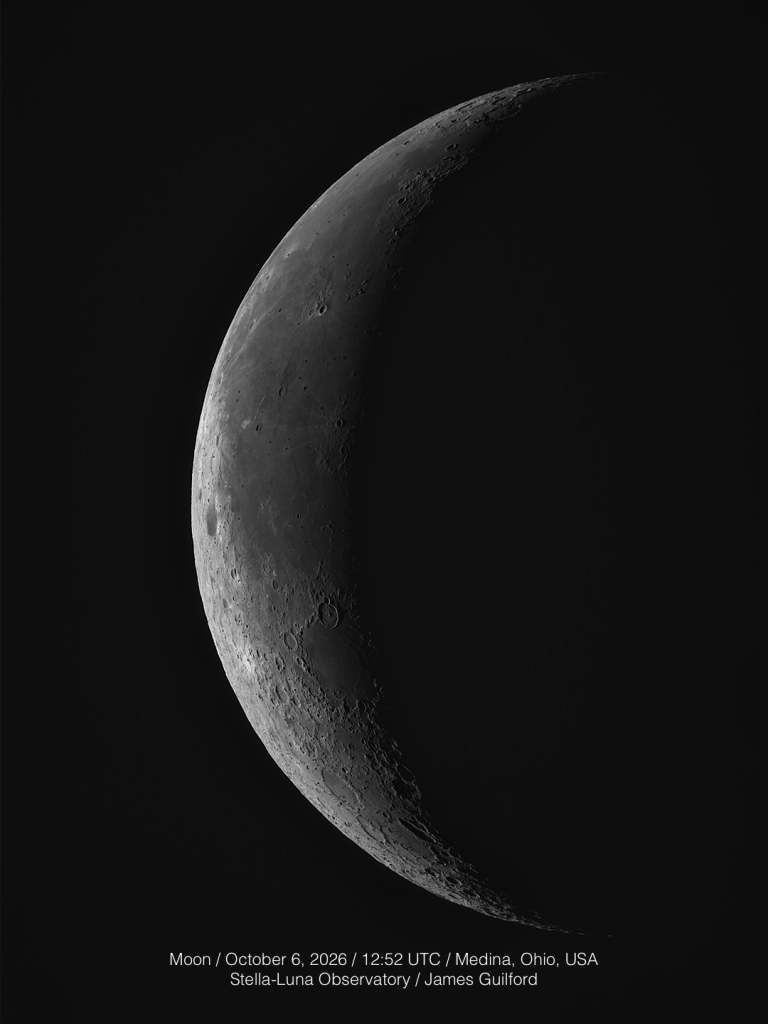
Earth’s Moon imaged during daylight hours October 6, 2026.
While we were unable to image the October 6 occultation of Jupiter, we did image both Moon and Jupiter in the bright morning sky. Here’s the waning crescent Moon as it appeared around 9:00 AM EDT. Still nearby following the end of occultation was planet Jupiter, so we went for that as well.
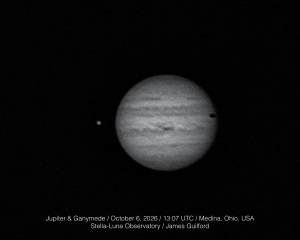
Jupiter with Ganymede, one of its four Galilean Moons, imaged during daytime, October 6, 2026.
The bright dot on the left is Jupiter’s moon Ganymede, and the black dot on the planet’s right-hand limb is Ganymede’s shadow!
Viewing a bright planet like Jupiter by eye is possible during the daylight hours, IF you can find it with your telescope! Our image was recorded with an emphasis on infrared light which increased contrast, turning the bright blue sky black.
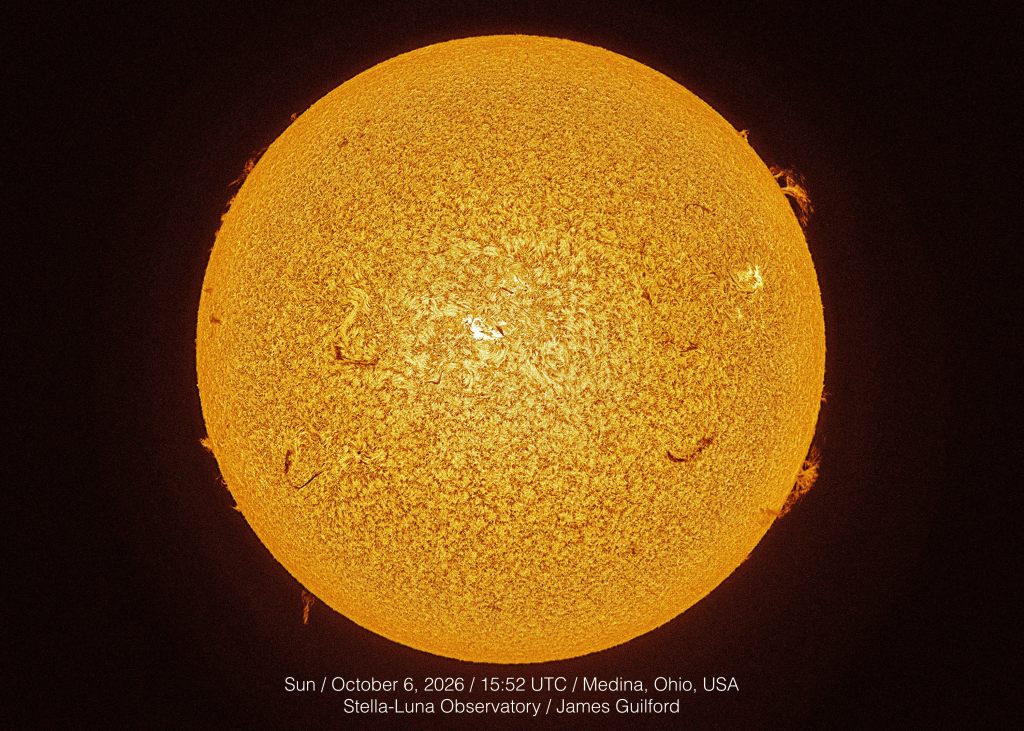
The Sun, imaged in hydrogen-alpha light showing our star’s chromosphere and numerous prominences, as they appeared October 6, 2026. False color added.
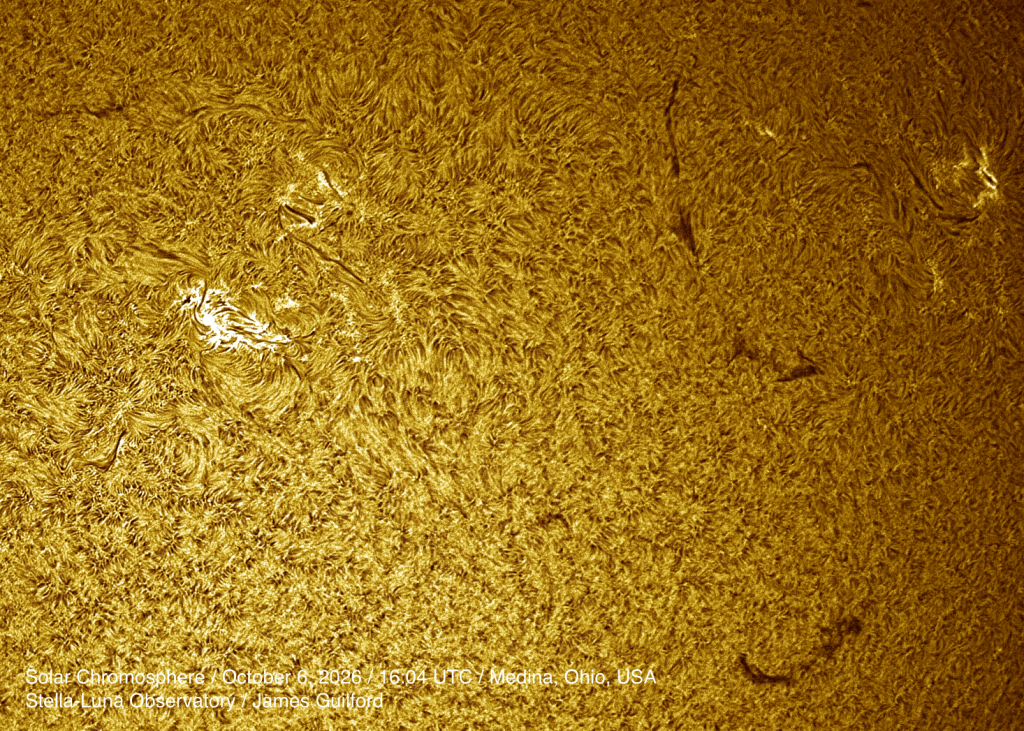
Later, around 11:30 AM, it being a sunny day, we set up for solar imaging. While our nearest star is officially at low activity levels, there was plenty to see. A number of impressive prominences lined the Solar limb, and close-up views of the surface revealed a maelstrom of plasma shaped by intense magnetic fields. The bright patch near the center of the Solar disk is active region 4549 which, today, issued a full-halo CME toward Earth. There may be auroras October 9. Yep, a busy day.
A closeup view of the Solar chromosphere, imaged in hydrogen-alpha light, as it appeared October 6, 2026. False color added.
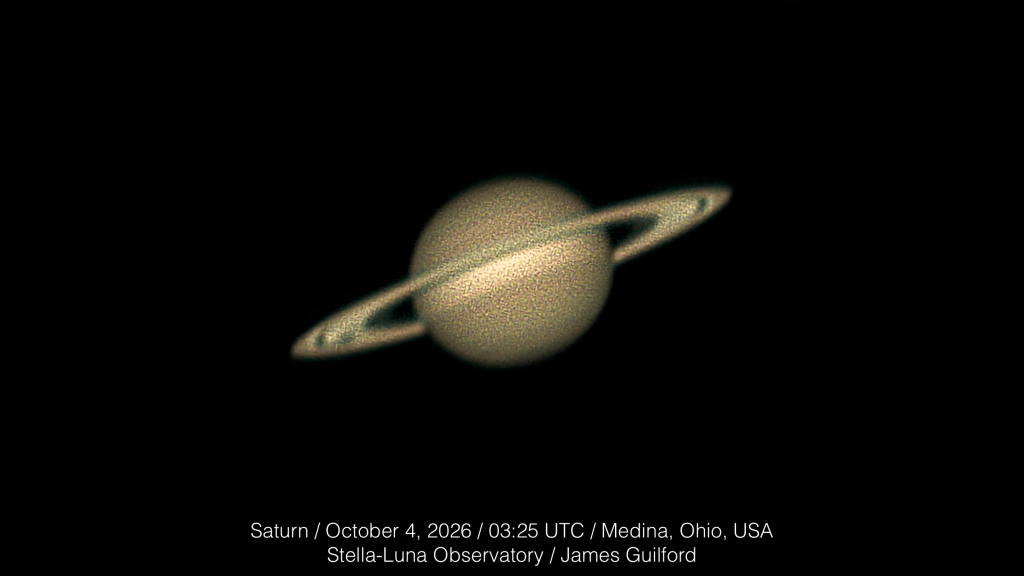
Planet Saturn on “opposition day”, October 4, 2026. The dark blotch within the rings on the right-hand side of this image was caused by a meteoroid impact. Image credit: James Guilford
Saturn early on “opposition day” was a bright yellowish “star” to the unaided eye as we viewed it close to midnight, Eastern Daylight Time. To the telescope, however, it shown in all its glory, bright and bearing rings! Recently discussed in astronomy circles was the dark blotch and distorted Cassini Division line (left-hand side here) within the ring system, and we were happy to be able to capture that detail. The ring was apparently struck by a meteoroid that caused a cascading effect resulting in a large-scale disruption, broadly categorized as a spoke. Distance from Earth to Saturn at the time this image was recorded was about 1.3 billion kilometers, taking light about 70 minutes to reach us here. Opposition is the point in our orbits when a line from Sun to Saturn would go straight through Earth, and when the two worlds are about as near each other as they can get.
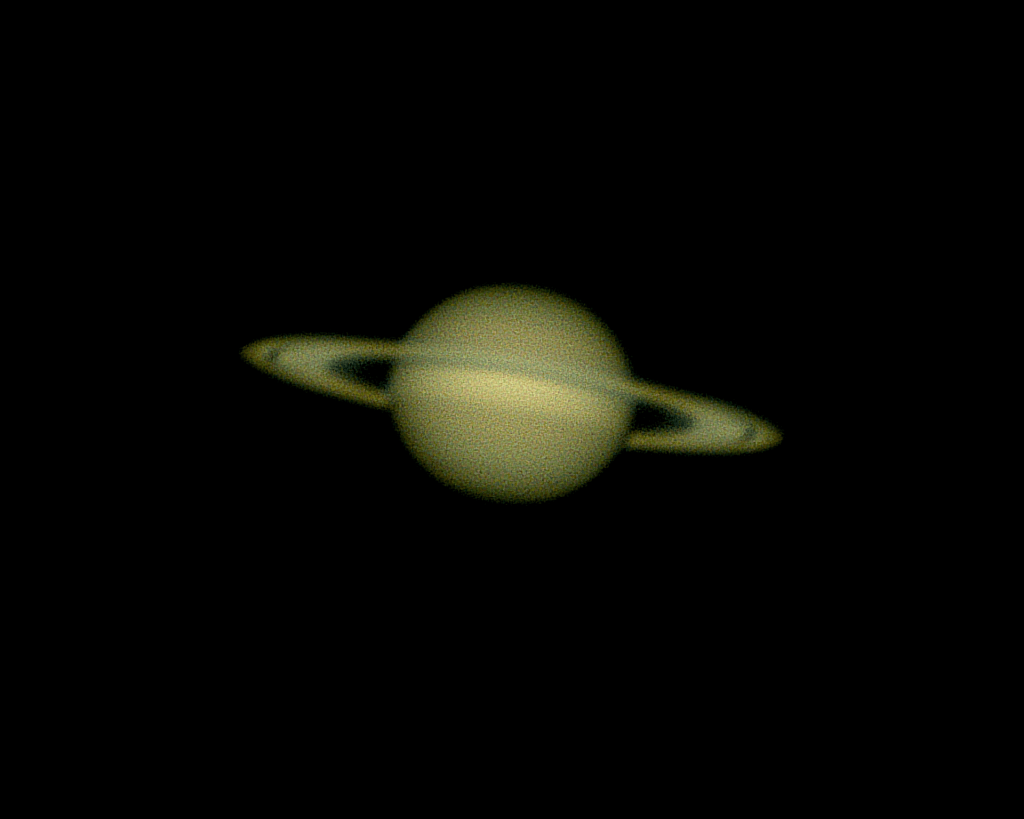
Saturn, September 29, 2026. Not the best you, or we, have ever seen but this image represents considerable progress in our planetary imaging efforts.
Our best effort at imaging Saturn does not compete with others we have seen online but we’re making progress. The effort two days prior was so bad we couldn’t bear to share it! We’re hoping for quieter air (better seeing) in the coming days as the ringed world approaches opposition – that will help immensely. Unsteady air is a problem in itself, also contributing to difficulties in achieving good focus. Still, this soft image of the ringed world shows some banding in the planetary atmosphere, a hint of the ring shadow across the globe, and the Cassini Division — the dark gap within the ring plane. In the meantime, under upcoming days of cloudy skies, we’ll be working on technical improvements under the dome.
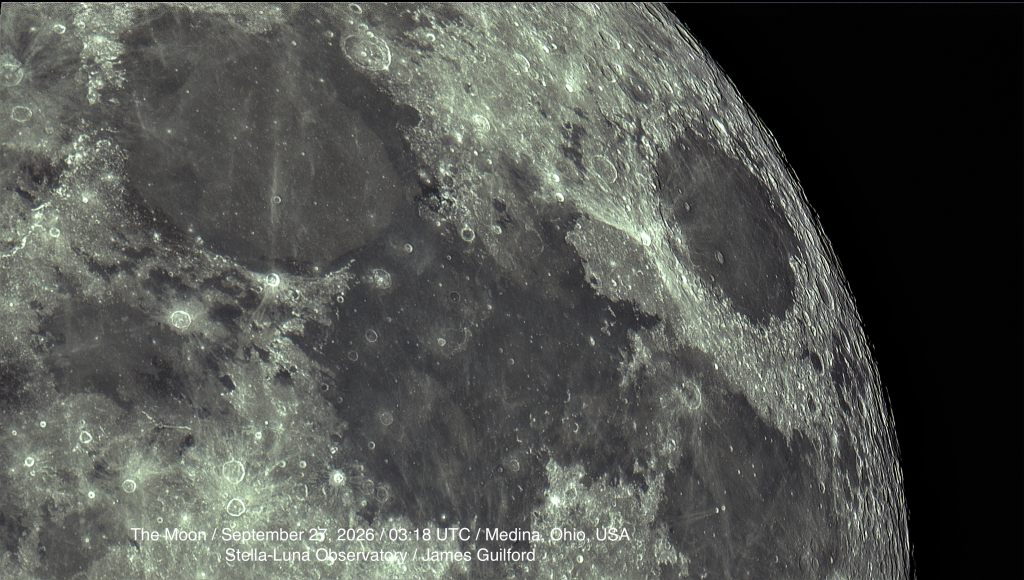
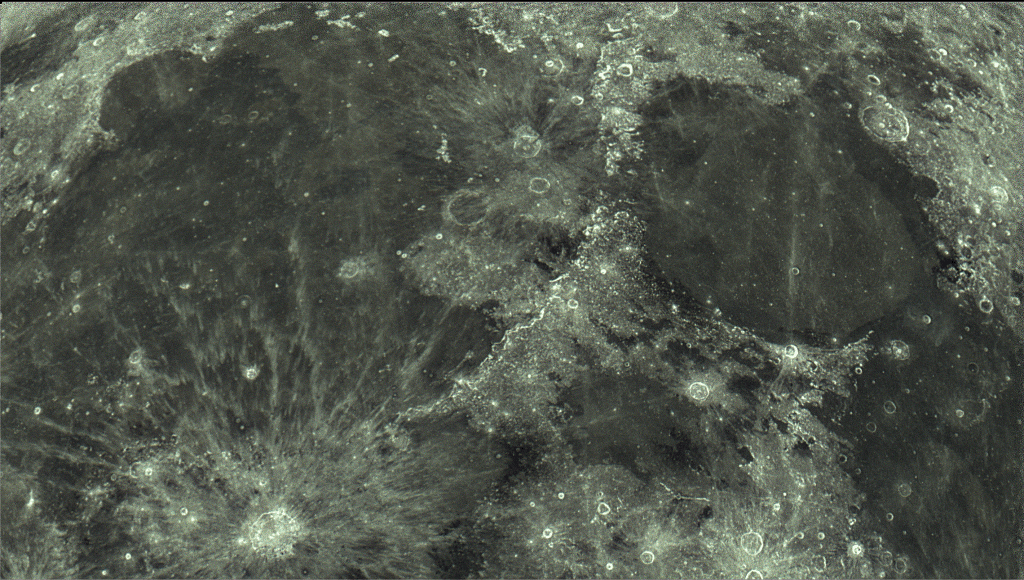
The First Light image from our new planetary camera turned out to be a picture of Earth’s own Moon. The ZWO ASI 715MC camera came recommended as a good match for our Askar 151 refracting telescope. Pictured is a portion of Moon’s northeast quadrant centered upon lunar sea features. September 26, 2026.
First light for our new planetary camera was Earth’s Moon. The camera was really intended for use in capturing image data of, well, planets. Moon was available before Saturn showed up and so became the target. Poor seeing contributed to our later first efforts at Saturn being not so impressive.
Moon’s Mare Imbrium (left), with adjoining Mare Serenitatis (right), and Mare Tranquillitatis (lower right). The bright Apenninus mountains point the way to crater Copernicus, spidery ejecta rays forming an expansive pattern. The color tint is residual from a UV/IR cut filter that was used in imaging with the one-shot color camera.
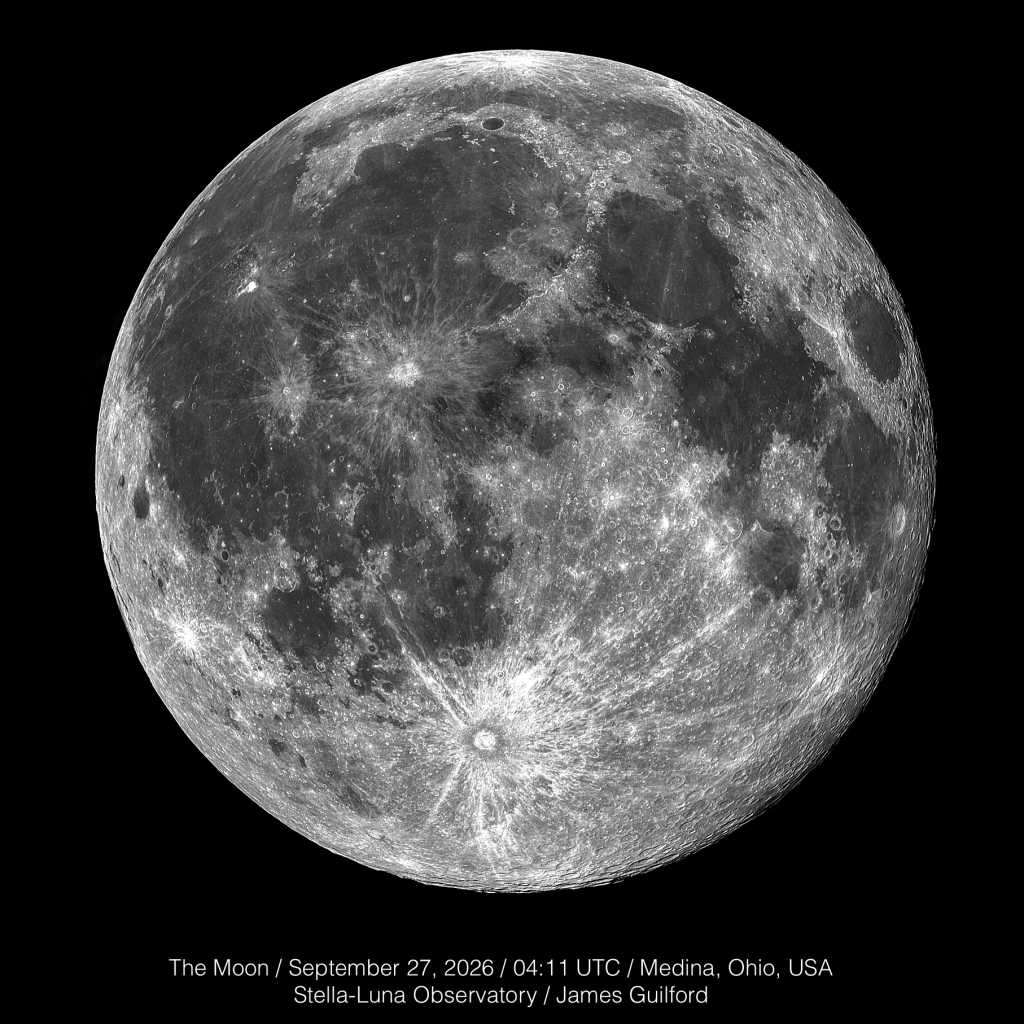
The large, circular dark area on the left side of this picture is Mare Imbrium — the Sea of Showers — as it appeared the night of September 27, 2026. There is much to see in that area making it one of our favorite spots on our Moon. It’s also a popular landing site for lunar exploration: Russia’s Luna 2 & 17, China’s Chang’e 3, and the U.S. Apollo 15 touched down there. Observing Moon during its Full phase is a different experience from other times. During that phase, sunlight is striking the Lunar surface from directly overhead with the Sun from over our shoulders, so to speak. That means few shadows to highlight crater walls, mountains, rilles, etc. Take a look at our two images above and notice — most craters are seen as circles, or Oes; we see the tops of the crater rims without any shadows to illustrate their depth — an interesting effect, though fully understandable.
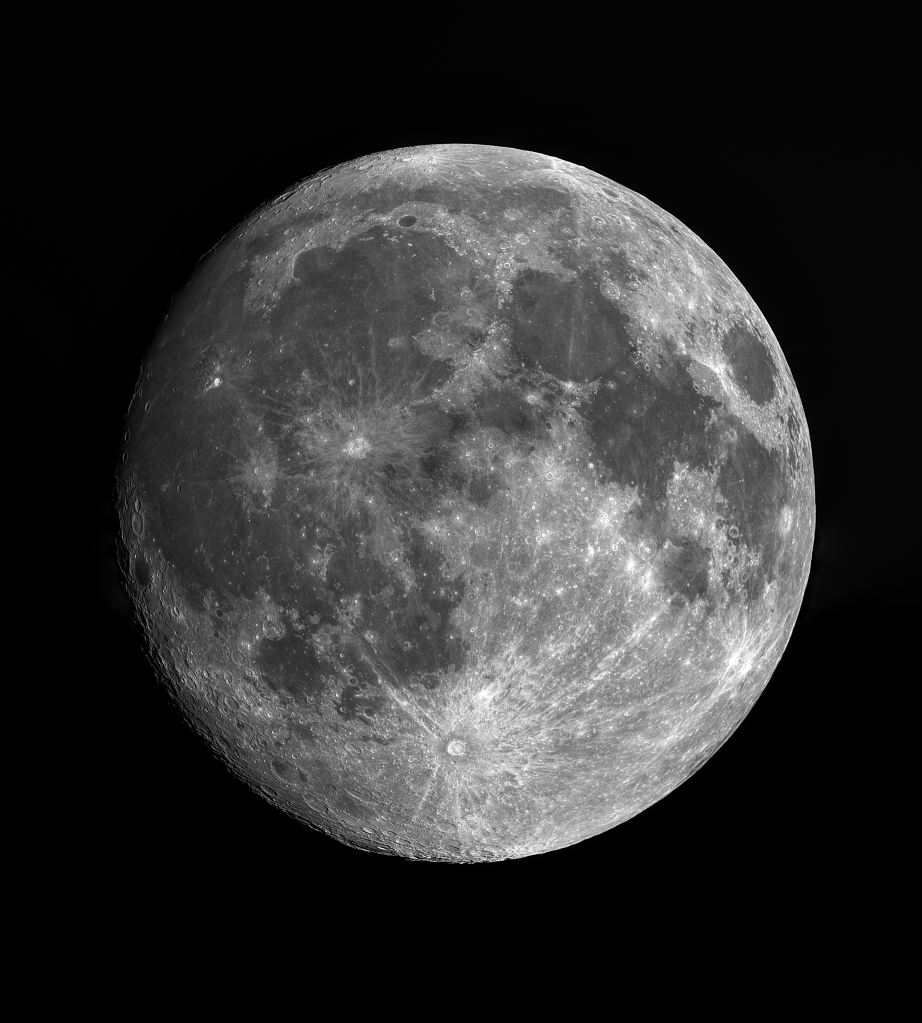
The Full Harvest Moon as it appeared the night of September 26, 2027 is shown in this two-panel image. Image contrast and other adjustments highlight crater ejecta rays which, outside of Lunar seas, are the most prominent features visible during a Full Moon.
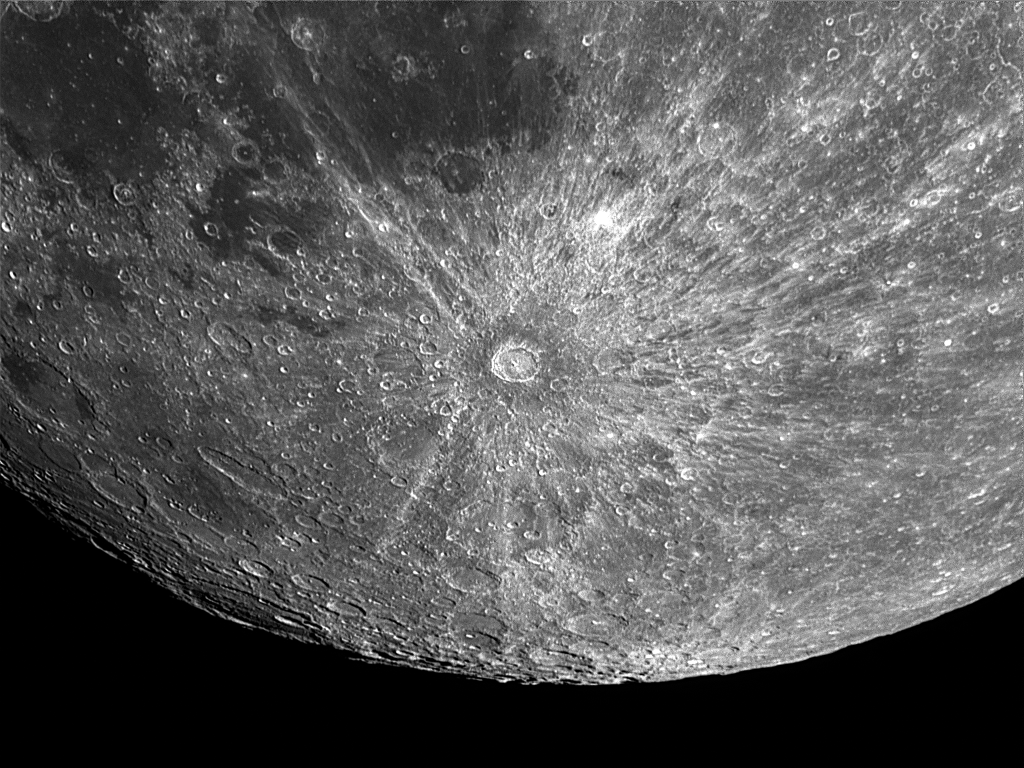
Big Splats. Our image of Earth’s Full Moon has been processed to emphasize the ejecta rays projecting from newer craters. The ejecta networks are composed of material splashed out — ejected — from the points impacted by asteroids, or comets across the darker regolith surface. Most prominent here is crater Tycho in the southern portion of our picture. The crater itself is around 53 miles (85 km) in diameter, and about 3 miles (4.7 km) deep. The impact that created crater Tycho excavated and ejected heavy materials that resulted in a multitude of secondary craters — perhaps a warning to future human denizens of our Moon to have a very strong roof, just in case!
A full-disk image of Earth’s Moon as it approached its Full phase the night of September 24, 2026. Image Credit: James Guilford.
Last Night’s Waxing Gibbous Moon. Ejecta rays are particularly visible, radiating from their originating craters in this two-panel portrait of the 97% illuminated Moon. Particularly notable are the rays surrounding crater Tycho in the lower, southern region. Although Tycho, about 53 miles in diameter (85 km), is located amongst a multitude of other craters, many of them larger, its sharp edges, with high albedo and bright ejecta rays blanketing the darker regolith, make the feature quite prominent.
Although seeing was only fair (visible shaking in the telescopic view) the original photographic image is rich in detail displaying many craters large and small, the Lunar “seas” and crater Tycho with its ejecta ray network. The crater was formed an estimated 108 million years ago, freshly excavating bright material from beneath the Lunar surface and splashing it across the older, darker surrounding areas. The rays are impressive in their expanse, some reaching a length of more than 930 miles (1,500 km). Numerous, smaller, “satellite” craters resulted from the same impact that formed Tycho.
Crater Tycho in Moon’s southern hemisphere, September 24, 2026. Fair to poor seeing conditions reduced the clarity of close-up Lunar views somewhat that night. Image Credit: James Guilford.
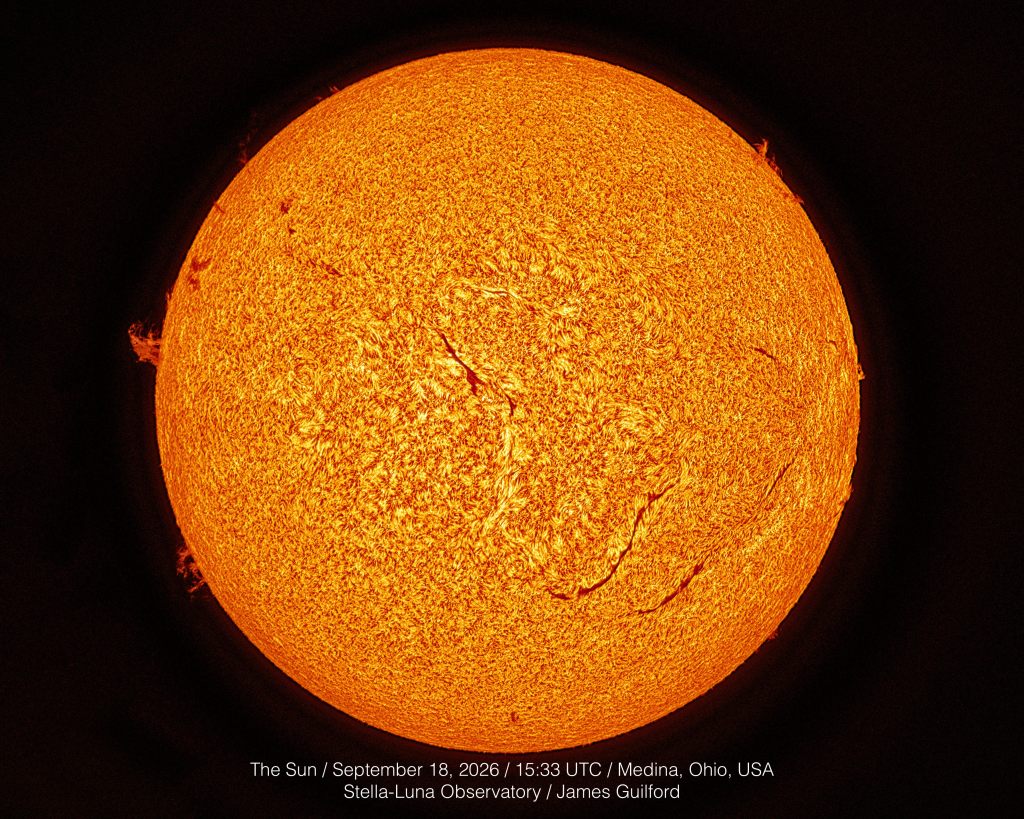
Sun via hydrogen-alpha light displays the roiling plasma of the chromosphere, dark filament structures floating in several areas, and prominences large and small along the limb. False color added during processing. September 18, 2026, by James Guilford.
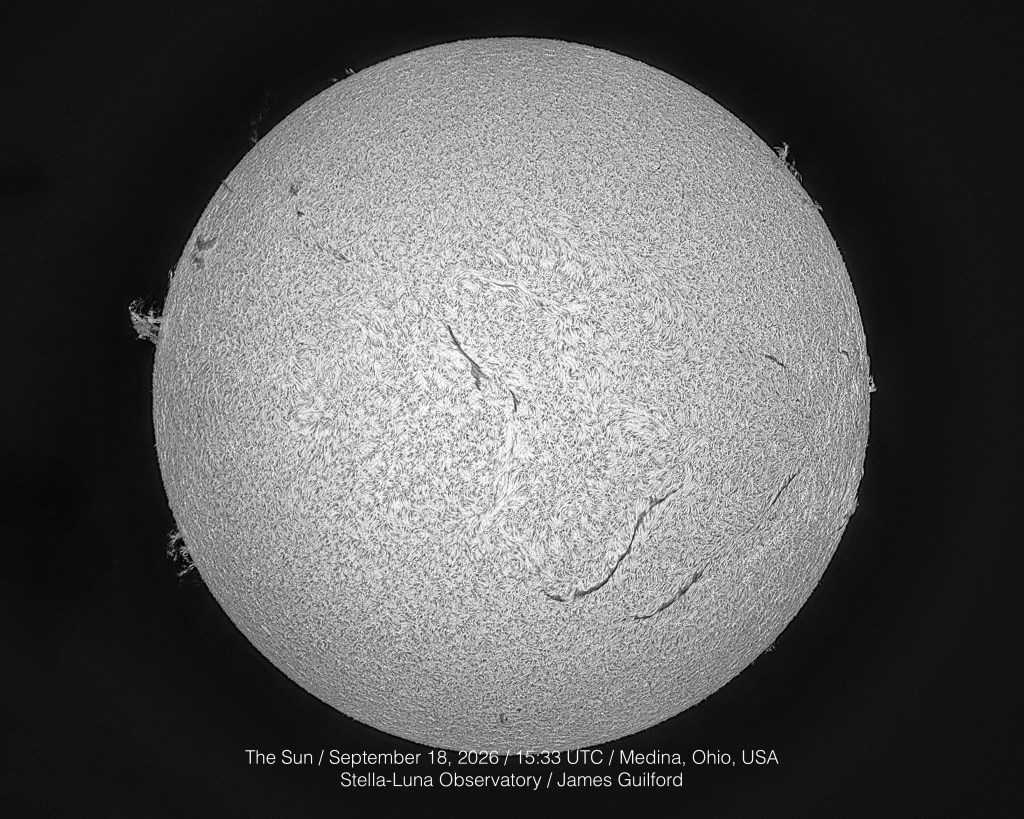
A clear morning sky, a rarity lately, allowed solar observing and experimentation with new settings for image capture. While the quieting Sun in white light showed no sunspots in the photosphere, the chromosphere, viewed via hydrogen-alpha (Ha) light, was a busy place. Prominances large and small were visible around the Solar limb, filaments floated above the roiling plasma surface, and despite shaky seeing conditions, spicules were recorded all along the limb.
We started out, some time ago, employing the lucky imaging technique via .AVI video recordings and using exposures in the double-digit millisecond range, and video gain set at zero or at very low single-digit levels; early experience seemed to indicate that was the way. Listening to how others approach imaging, we tried reducing the exposure/shutter speed to mid or low single-digits, and boosting video gain into low triple-digits. We saw improvements in both image quality and ease of processing! We still have much to learn and to refine, and working with Ohio’s less-than-optimal sky conditions is … challenging … but we’re getting there.
Tech Info: Telescope – Sky-Watcher Heliostar 76Ha, Camera – ZWO ASI183MM Pro, UV/IR Cut Filter, Exposure – 5ms, Gain – 117. Video frames stacked in ASI VideoStack. Color image processed in PixInsight + Solar Toolbox. Monochrome processed in Pixelmator Pro.
Sun via hydrogen-alpha light displays the roiling plasma of the chromosphere, dark filament structures floating in several areas, and prominences large and small along the limb. This image was processed via a different workflow from that of the duplicate image at the top of this article. No false color added. September 18, 2026, by James Guilford.
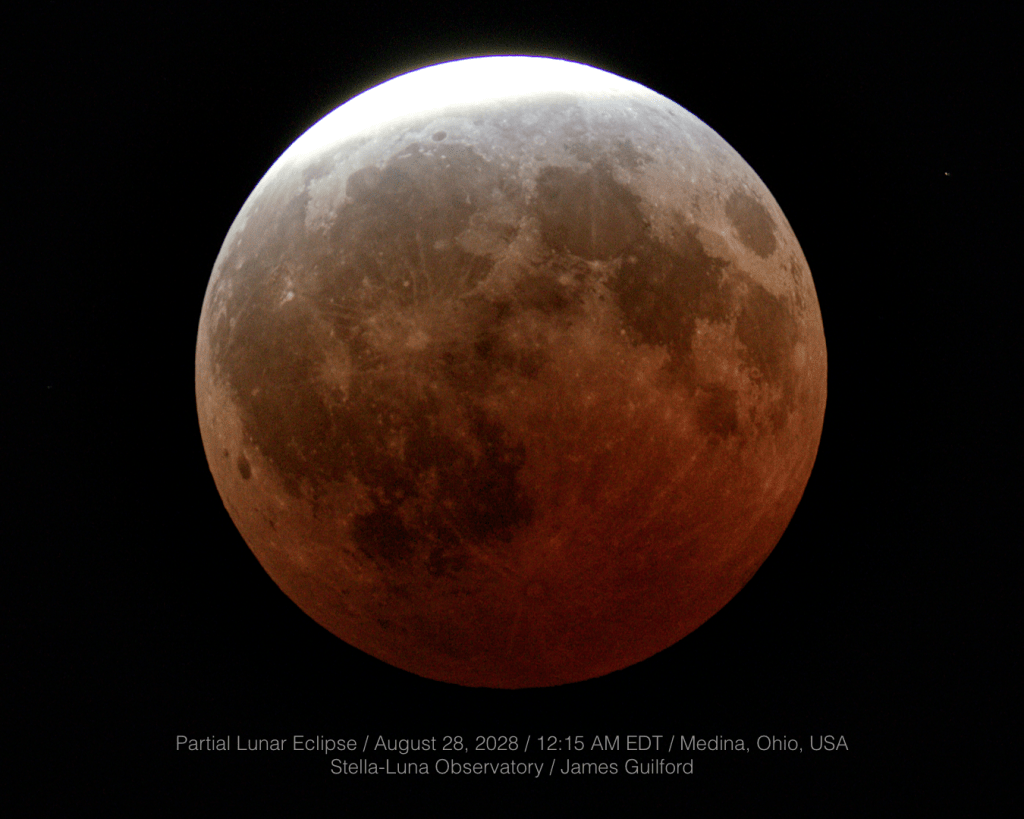
A stack of images taken two minutes after the eclipse peaked (delayed due to cloud cover) illustrates the approximate 96 percent eclipse. The brightest area at top is direct sunlight, the gray area beneath it is penumbral shadow, with transition to the coppery-colored umbral shadow where no direct sunlight reaches the lunar surface.
The August 27 – 28 partial lunar eclipse was enjoyable to watch but presented some challenges to photograph. Before nightfall, we set up a modestly sized telescope, the Askar 103APO, outside the observatory. The scope has a shorter focal length, less magnification, which would allow its camera to record the entire disk of Moon during the eclipse. The large observatory telescope, with nearly twice the focal length, would show less of the lunar disk because of its higher magnification. This outdoor setup seemed like a good idea and it was, in principle. But Moon and nearby trees presented our first challenge of the night.
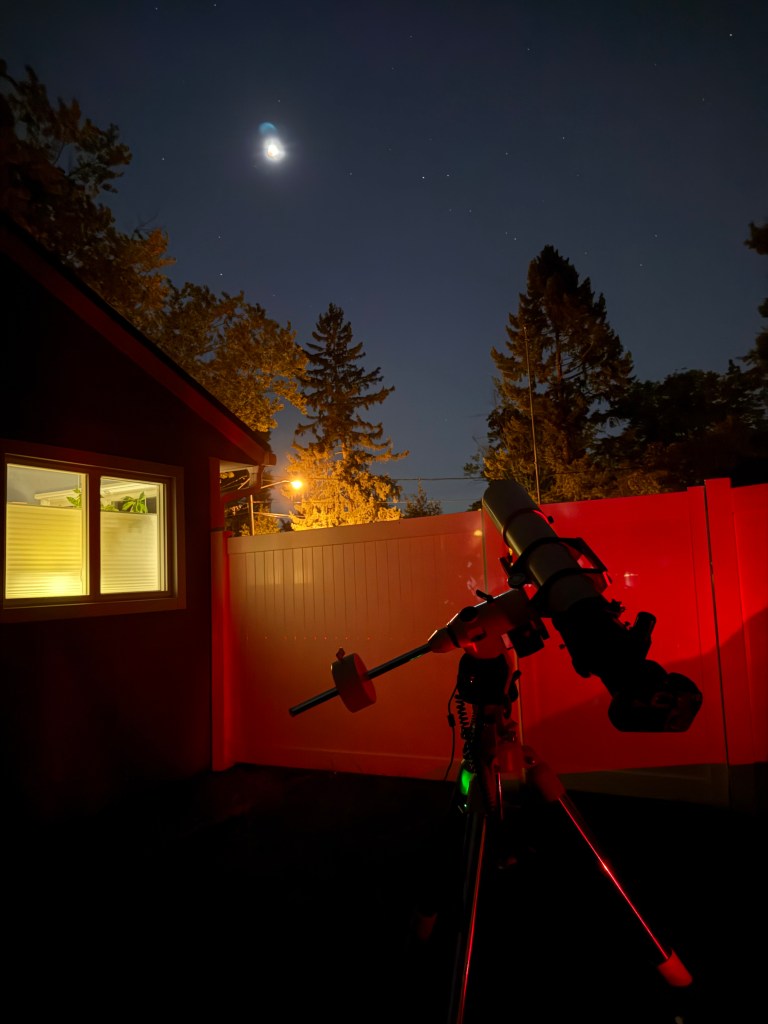
Trees blocked the view from the observatory so a telescope was set up in a more hospitable site. A 100-foot extension cord allowed utility power to run the telescope mount. A blue lens flare is visible above the bright dot that is Moon.
Moonrise was at 8:01 PM EDT and its altitude from the horizon was going to be fairly low. The mature neighboring trees are quite tall and wide. The combination was not good and, as Moon climbed higher and eclipse time approached, time was running out. From the vantage point of the telescope outside the observatory, Moon would be behind the trees during the entire first half of the event. We had to move it.
Scouting out a new location that allowed a clear view of the sky, we located one near enough to facilities to connect to utility electric power. In darkness we moved the imaging setup.
The dark umbra of Earth’s shadow was already taking a substantial bite out of the night’s full Moon as we finished setup at the new location. We were impressed at how well our old (ca. July 2005) Meade LXD75 mount performed, tracking accurately with minimal alignment; it was a real champ! One camera automation accessory did not function as expected so we removed it and ran the Canon EOS 7D Mk. 2 camera manually. Things went well from that point on with an unobstructed view of a clear sky and a darkening Moon. The night was quiet and mild, not even a jacket was necessary, as we gazed at the dimming Moon and listened to night sounds.
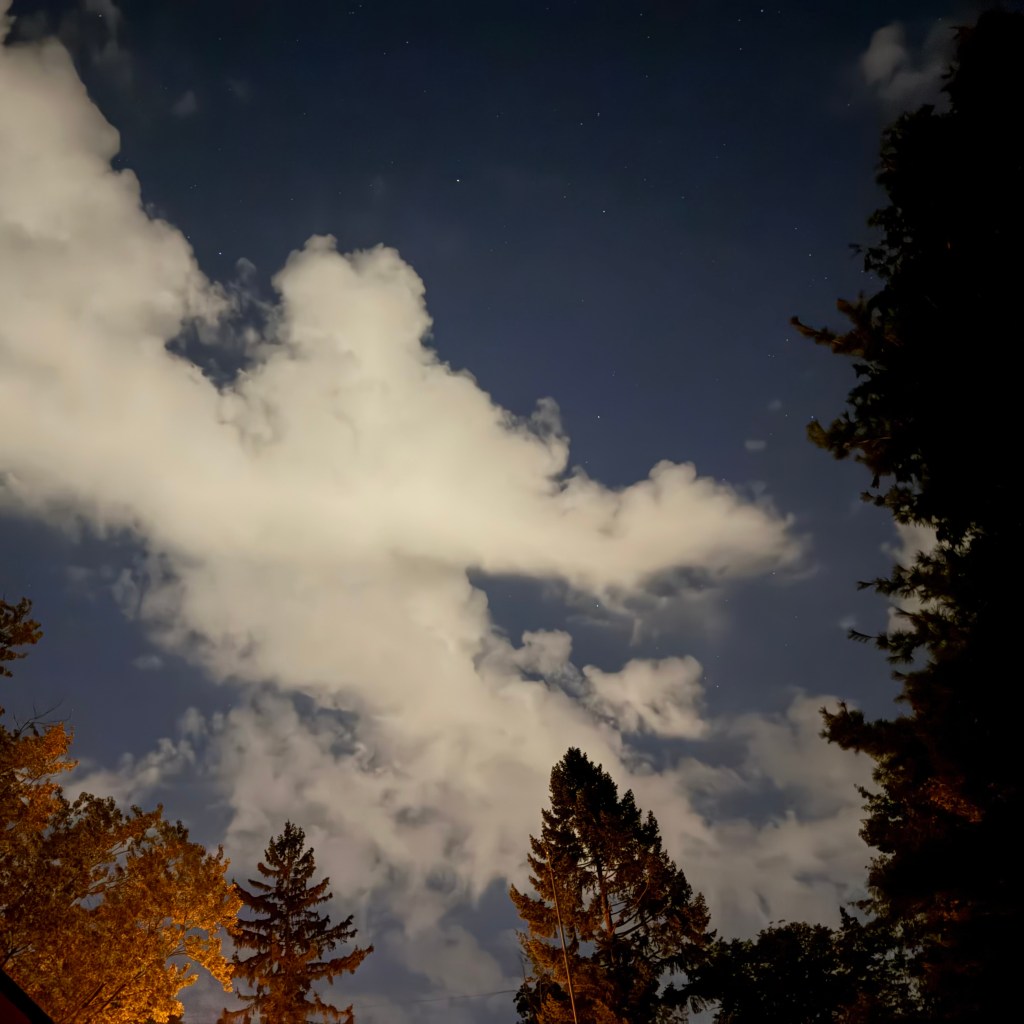
This was to be a partial eclipse, meaning not all of the lunar disk would be within the deep umbra — a bright sliver of sunlight would be seen at one edge, while the opposite side of the disk would be dark, and hopefully colorful. Peak coverage was to be reached at 12:13 AM EDT. It was about 20 minutes before peak when we spotted it: a bank of clouds drifting in from the north, illuminated by ground-based light pollution, headed in to spoil the night!
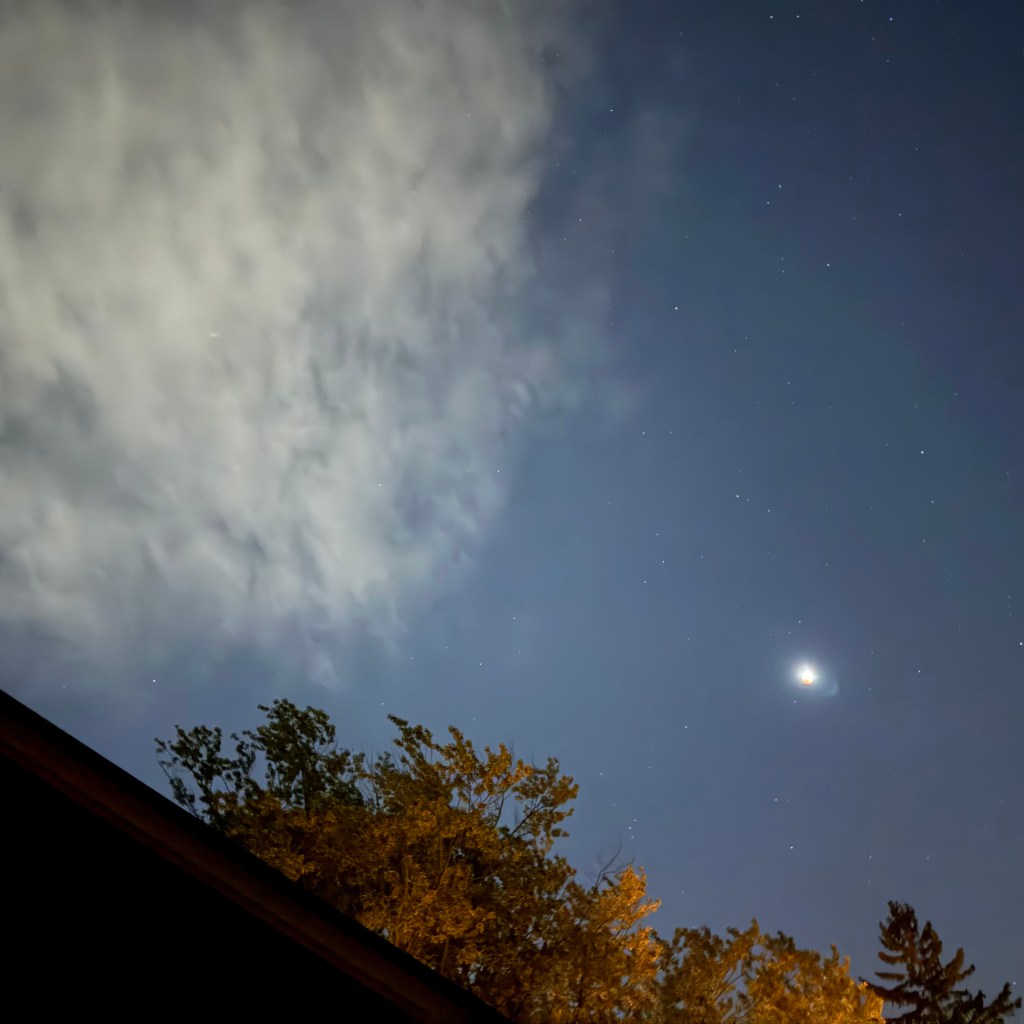
A bank of clouds approached the eclipsing Moon as the hour of peak eclipse neared. A lens flare is visible to the lower right of the bright lunar dot, and a view stars can be seen in the sky.
That is how it goes, sometimes. Clouds, missteps, or mishaps spoil an otherwise exciting occasion. It doesn’t help to curse the clouds but that did not help to stop the whispered oaths! Happily, gaps were present in the cloudy mess, clear sky visible through them, hopefully allowing peeks at the eclipse. The clouds arrived, mostly blocking but indeed occasionally teasing glimpses at the then fully-developed event. We made images from about two minutes before the peak, and images from about two minutes after, but nothing from the peak moment.
Peak eclipse, at 12:13 AM EDT. Very, very eclipsed as the clouds obscured the view. Gaps in the cloud cover allowed images to be made before and after the astronomical peak coverage was reached.
An extended period of clarity followed, as the cloud bank continued on its southbound journey. We shot more images of the eclipsed Moon, rapidly changing exposure settings, seeking to record a wide range of graphic data against future processing efforts before the scene changed much. Imaging done, we took one last look, parked the telescope, then stowed and secured gear for the night. It was late and we had daytime promises to keep.
So that was another lunar eclipse in the books. There was frustration, to be sure, but there were rewards. There won’t be another lunar eclipse visible here until January 12, 2028 (a weak partial eclipse), with the next total lunar eclipse on June 26, 2029. One has the opportunity to see just so many eclipses in their lifetime, so we try and see every one we can!
P.S. At 12:30 AM, the diminishing eclipse became visible from the spot where we first set up the small telescope. And the sky was clear.
Late on the night of August 27, Moon will resemble this view of the March 14, 2025 lunar eclipse. Photo by James Guilford
The night of August 27 – 28, 2026 brings an opportunity for eclipse viewing: a deep partial lunar eclipse. Just shy of a total lunar eclipse, the night’s Full Moon will be deep within Earth’s shadow, 96 percent covered by Earth’s dark inner shadow or umbra.
Given clear skies, we are in a favorable position to see the eclipse in its entirety. In Northeast Ohio, the eclipse begins at 9:24 PM as Moon edges into Earth’s soft outer shadow or penumbra. At 10:34 PM the show really begins with Earth’s deep umbra visibly darkening the edge of the lunar disk. Maximum eclipse begins at 12:13 AM, August 28 with the southern portion of Moon very dark and its northern edge relatively bright; hopefully, coppery coloration will be visible on areas of the lunar disk between.
Moon continues its movement through Earth’s shadow, reversing the eclipse process. The partial eclipse ends at 1:52 AM, and the penumbral eclipse ends at 3:02 as the bright Full Moon shines. If you are eclipse watching from a location other than ours, you can check out TimeAndDate.com which can calculate event timings for your spot on the map.
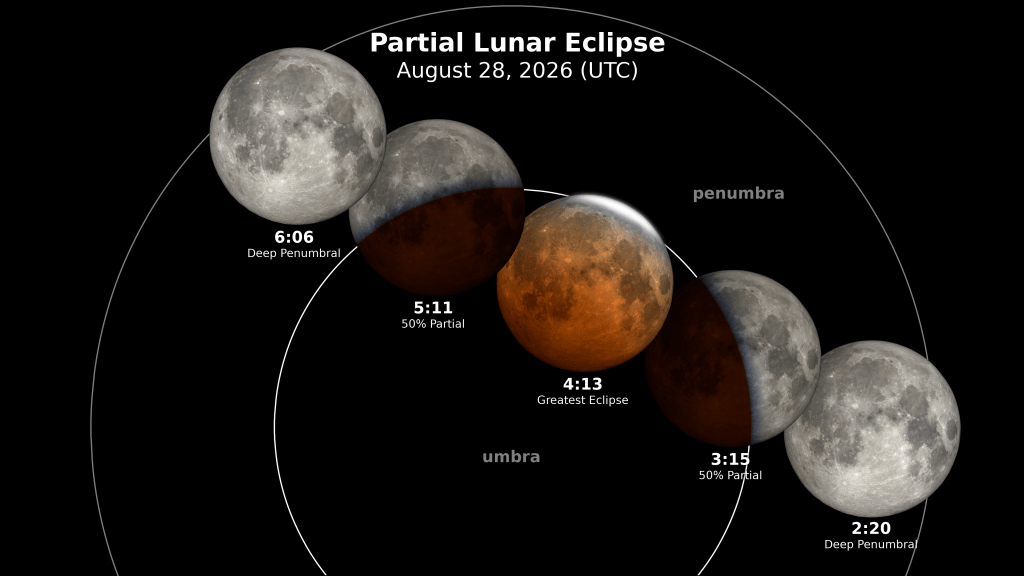
Partial eclipse timings and projected appearances are giving in this graphic, with time expressed as UTC. Graphic Credit: NASA Scientific Visualization Studio
A lunar eclipse occurs when the moon’s orbit carries it through the shadow cast into space by Earth. A solar eclipse occurs when the moon’s orbit carries it between Earth and Sun and Moon’s shadow falls upon Earth’s surface. Unlike solar eclipses, lunar eclipses are perfectly safe to view with no special precautions needed — it’s moonlight — and no telescope is required. Binoculars may add to the experience but are also not required for lunar eclipse watching.
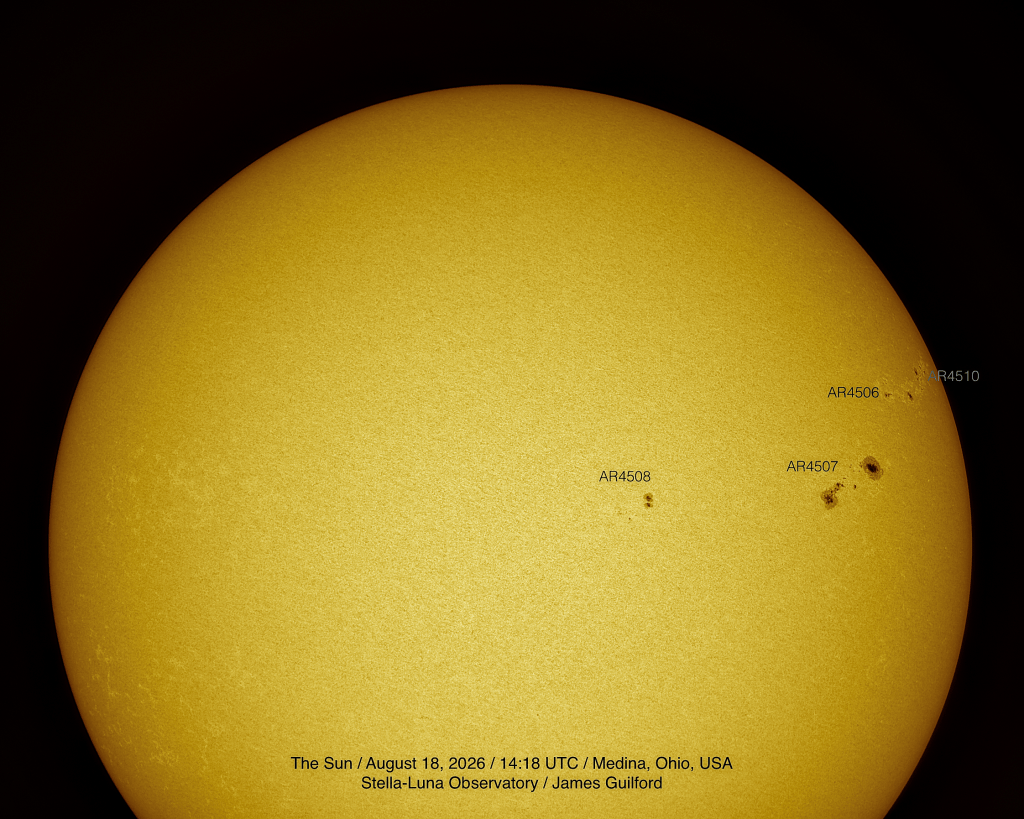
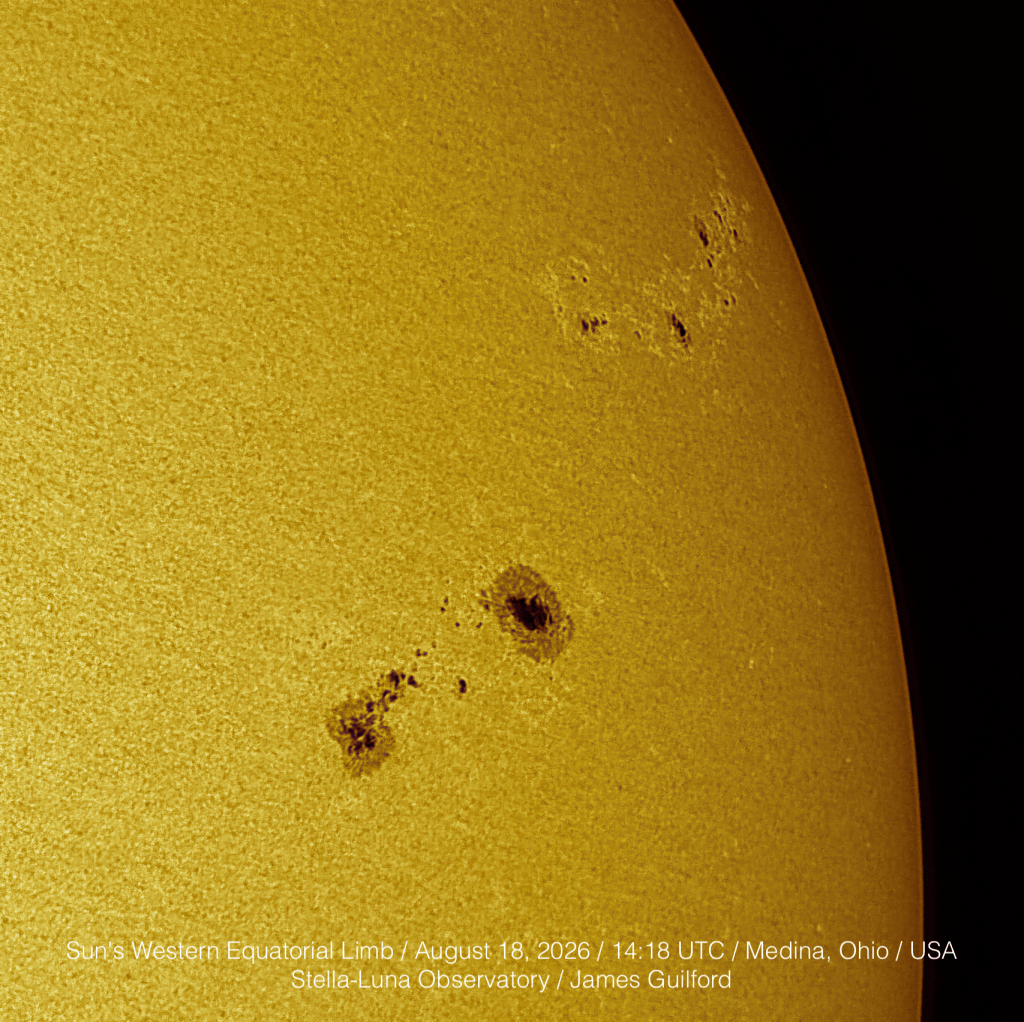
We observed several active regions, all in the western hemisphere, no sunspots in the eastern hemisphere, and all were confined to the solar equatorial area. This solar cycle appears to be fading away. White light Baader film solar filter, with false color applied in processing. August 18, 2026.
Skies, time, and tech finally aligned allowing us to observe Sun this morning. With mid-summer behind us, Sun clears the trees later these days meaning we observe later with more turbulent air — only fair seeing today! Still, we imaged four active regions with spots, all headed toward the western horizon. There were no sunspots in the eastern hemisphere, and the active regions were confined to the solar equatorial area. This solar cycle appears to be fading away.
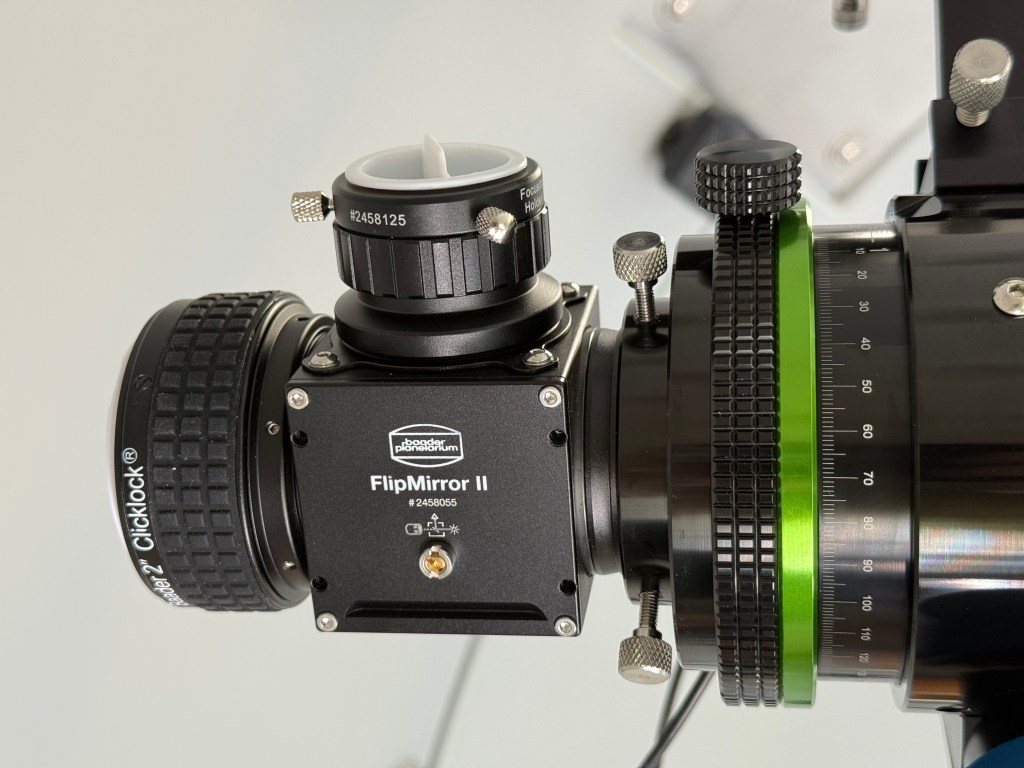
Aiding the day’s observations, and the equipment’s first light, was the addition of our new Baader Planetarium FlipMirror 2. We found that the flip mirror we used with the Vixen Cassegrain telescope had too much extension — we needed something more compact to achieve focus and have a little room for adjustment. Setting up the Baader FlipMirror was a challenge. The main component, containing the mirror, is shipped with adapter rings only — no nosepiece, eyepiece holders, or anything else. While the bare-bones component is versatile, selecting the correct set of add-ons was a worrisome exercise (components are not cheap) and the retailer offered no assistance when asked. After a good deal of shuffling between the owner’s guide, the product box illustrations, and the Baader and retailer’s websites, we made our selections. Happily our purchases were correct. The FlipMirror really is a well-made and even superior product.
The Baader FlipMirror 2 connected to the telescope focuser. Clicklock eyepiece holder/clamp, and focusing eyepiece holder are sold separately
Why a flip mirror? Those devices allow two, or more, observation or imaging pieces to be attached to the telescope at once: a camera and an eyepiece, two eyepieces and differing angles, two cameras (we suppose), with only the twist of a mirror-flipping knob to switch between them. In fact, the Baader device has a third connection place, located on the underside of the mirror box, for addition of a guide camera! The mirror never covers the light path for an attached off-axis guide camera … an interesting feature.
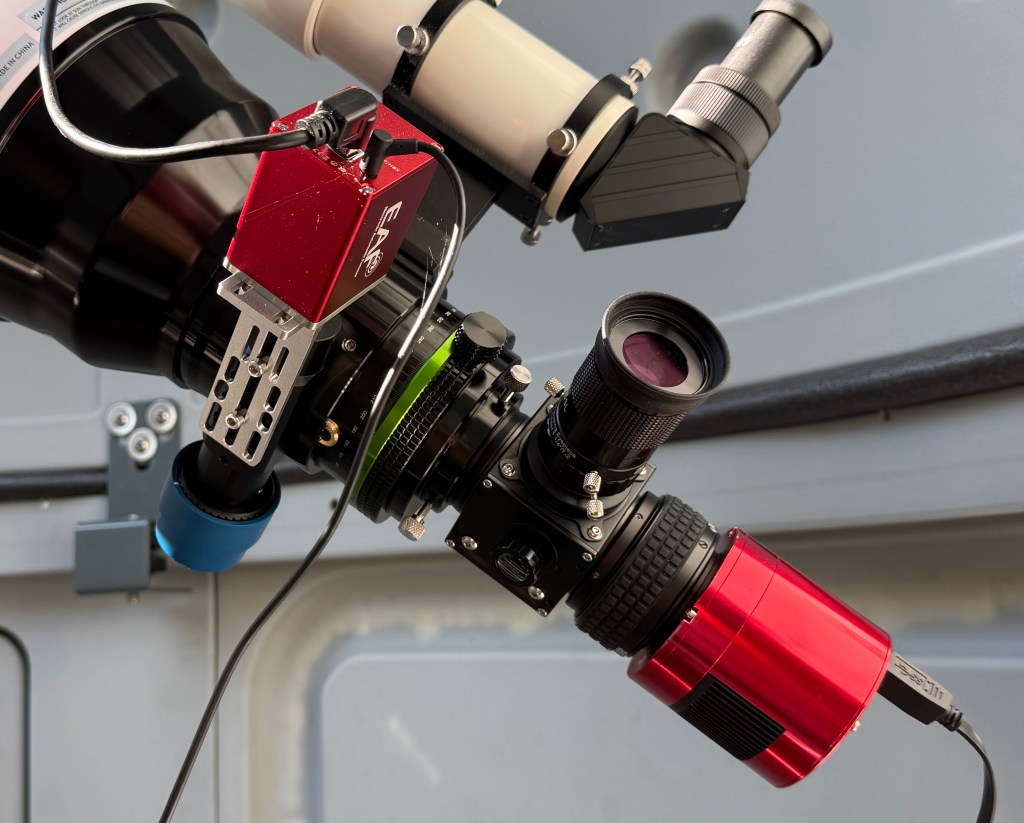
The Baader FlipMirror 2 installed and in use with eyepiece and camera connected.
At any rate, we were able to easily center Sun in the field of view using the eyepiece, flip the mirror out of the way to allow a direct light path to the camera, and image. Centering the sun was no big deal but using an eyepiece to center distant stars, planets, etc. is made much easier through its use. It’s also nice to just take a look, observing directly with one’s own eyes!