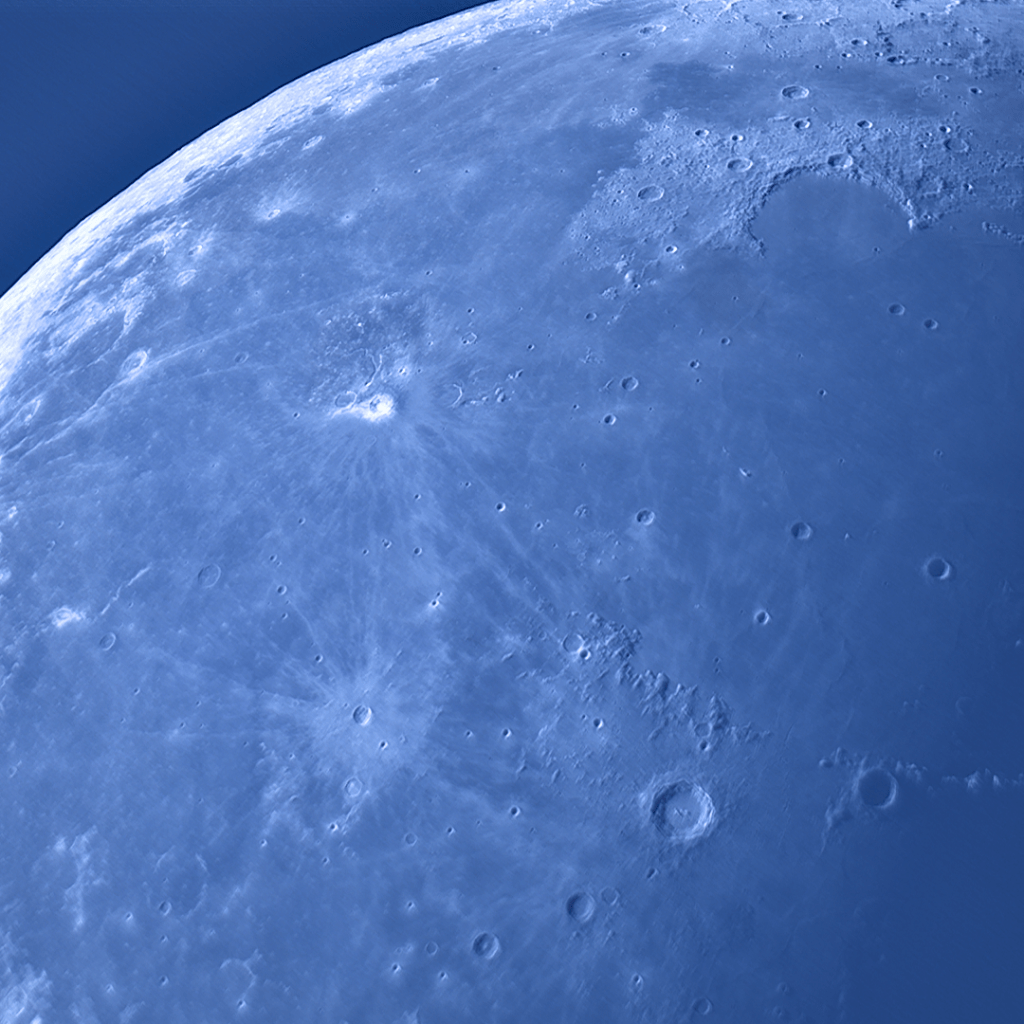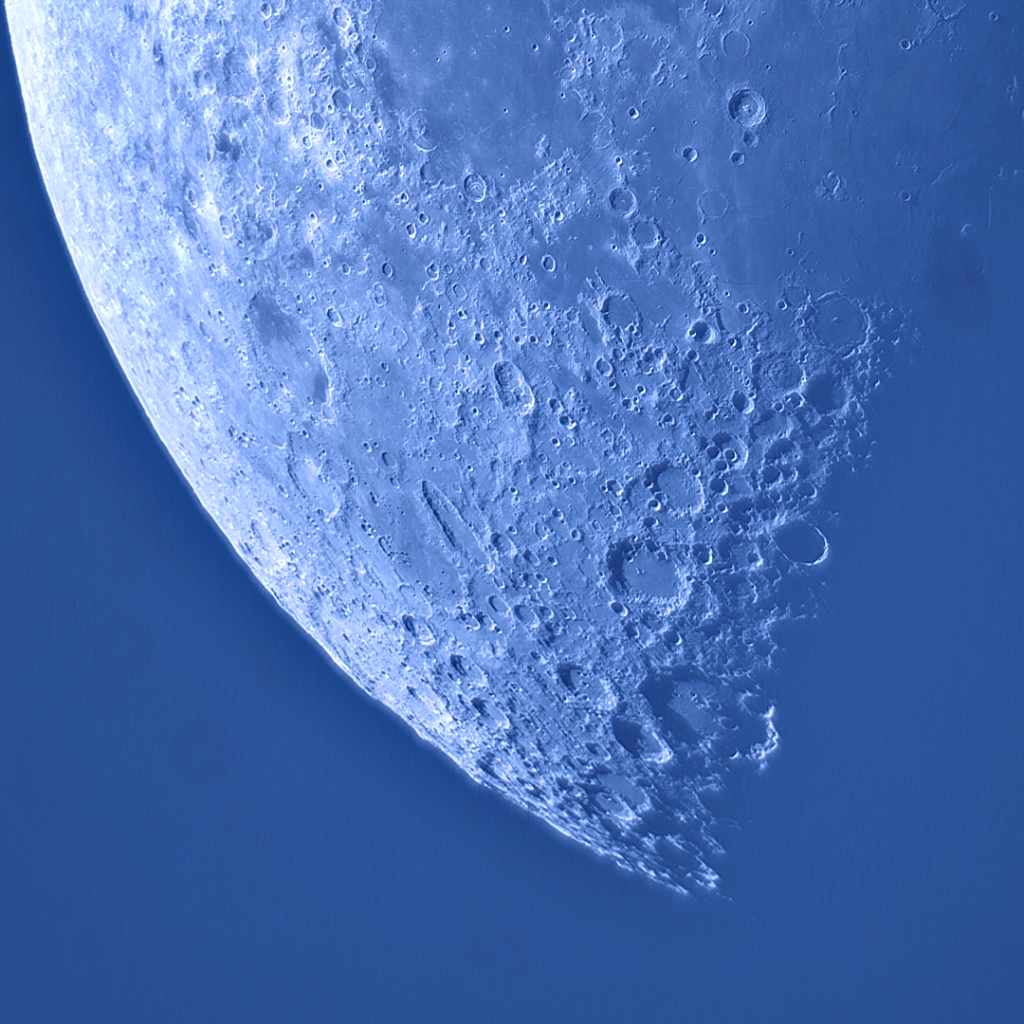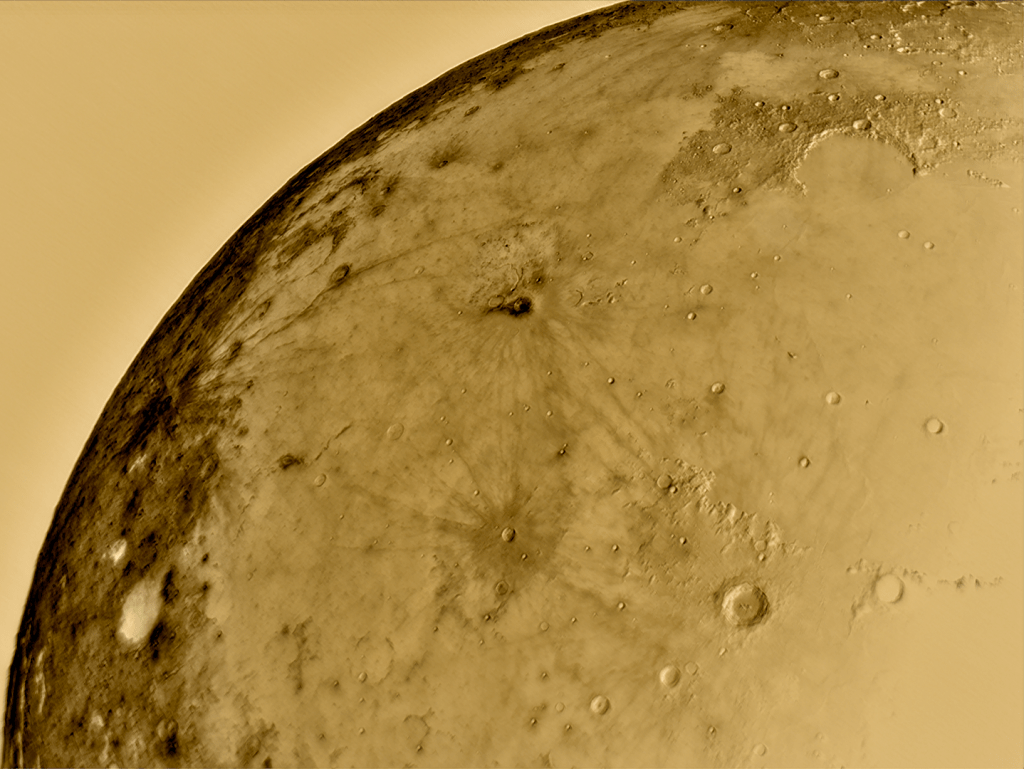
The northwest quadrant of Earth’s Moon, viewed during morning daylight reveals many wonderful details with an appearance that differs from nighttime views in more than just color. A few points of interest: The crater with impressive ejecta rays at lower left is Kepler; to its right is large, distinctive Crater Copernicus with its central peaks. Just above Copernicus are the peaks of Montes Carpatus. The bright spot at upper left is Crater Aristarchus with Herodotus, just to its left. Finally, at the upper right corner, is the distinctive C-shape of Sinus Iridium.
This morning, before stowing equipment for the duration of upcoming days of cloudy weather, we aimed the 11-inch scope at Earth’s waning gibbous Moon. Images were captured at about 7:50 AM EDT, after the sky had turned to blue, lending its color to Moon as viewed from Earth.
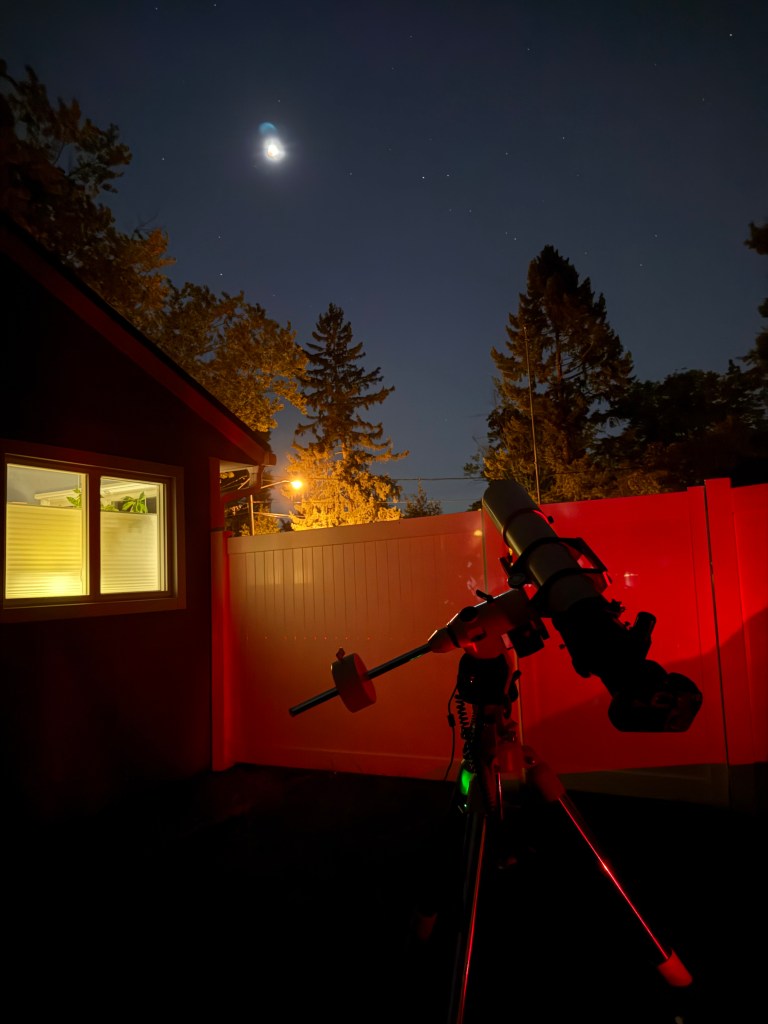
Celestron 11-inch telescope is shown aimed at Moon — a tiny white dot — in the clear, blue morning sky.
The big Celestron SCT remains in need of adjustment or, possibly, overhaul but does deliver some pleasing results! We’ve been struggling but have not yet achieved best acceptable collimation, so the scope hasn’t spent much time on the permanent pier in the observatory.
The sort of flaw that one will see from telescopes that are out of collimation — alignment of the light path within the telescope — is stars that look a bit like comets, and focus difficulties. After several efforts we are not where we need to be with the C11 to use it as our primary observatory instrument.
Unfortunately, due to lack of space, we can have only one telescope at a time on a permanent mount beneath the dome. We are considering next steps which include acquisition of a new primary telescope, upgrading of the mount, and means of mounting two instruments at a time on the pier.
As mentioned, cloudy, rainy weather is expected to be the rule for the week ahead so the telescope is parked, and accessories stowed. We’ll be working a bit on our meteor camera and thinking about where to go from here.
Our favorite image from the morning’s “Daytime Moon” efforts shows Moon’s heavily-bombarded southwest quadrant: craters, within craters, within craters. As with the other blue sky image shown here, this one is darker and more vivid than its actual appearance; we couldn’t resist giving the picture a bit more “snap” to bring out detail.
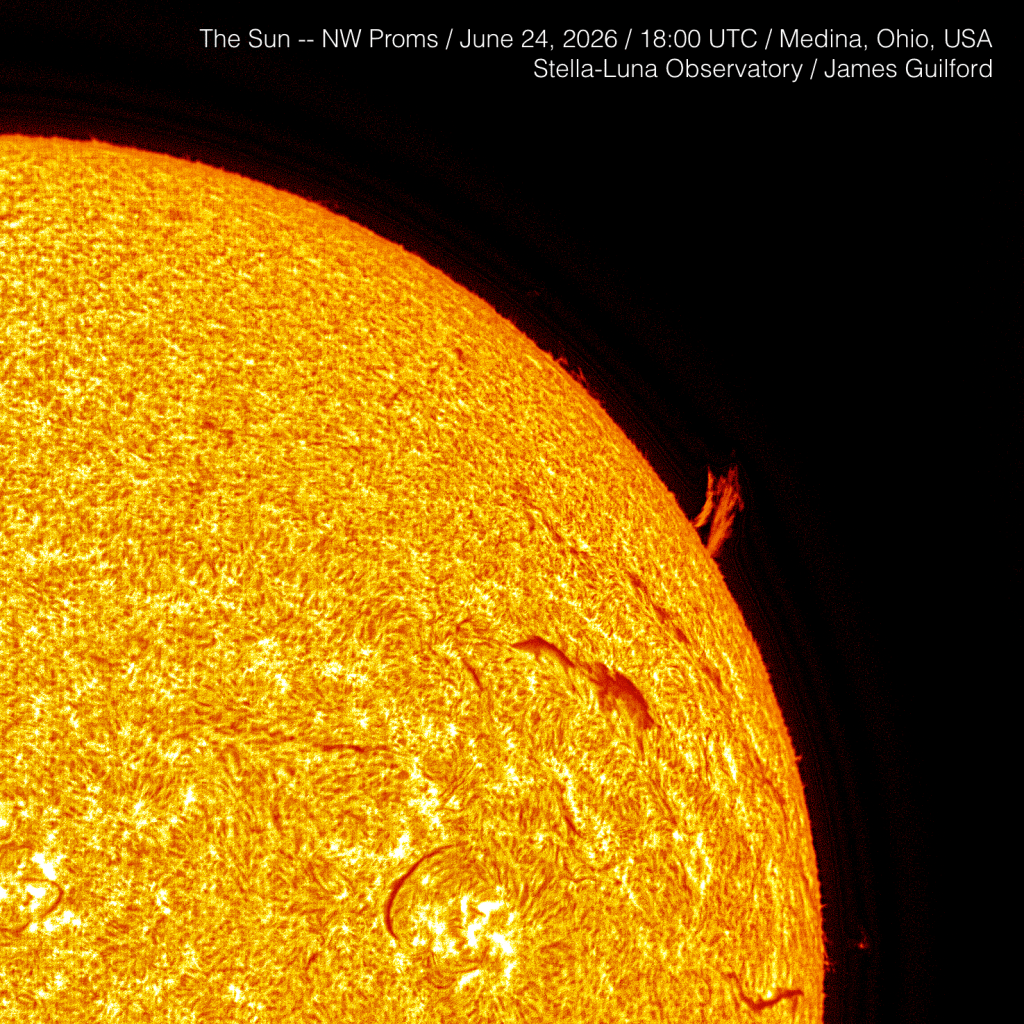
This image of the northwest quadrant of Earth’s Moon shows the image as a photographic negative — amber in color, not blue as in a previous post. Ejecta rays are especially visible around Crater Kepler, near the center of this picture. We enjoy images like this because they feel like a throwback to the early days of astrophotography, and because they tend to reveal delicate details — I mean, just look at the ejecta rays around the craters, especially Kepler just below center of this picture.
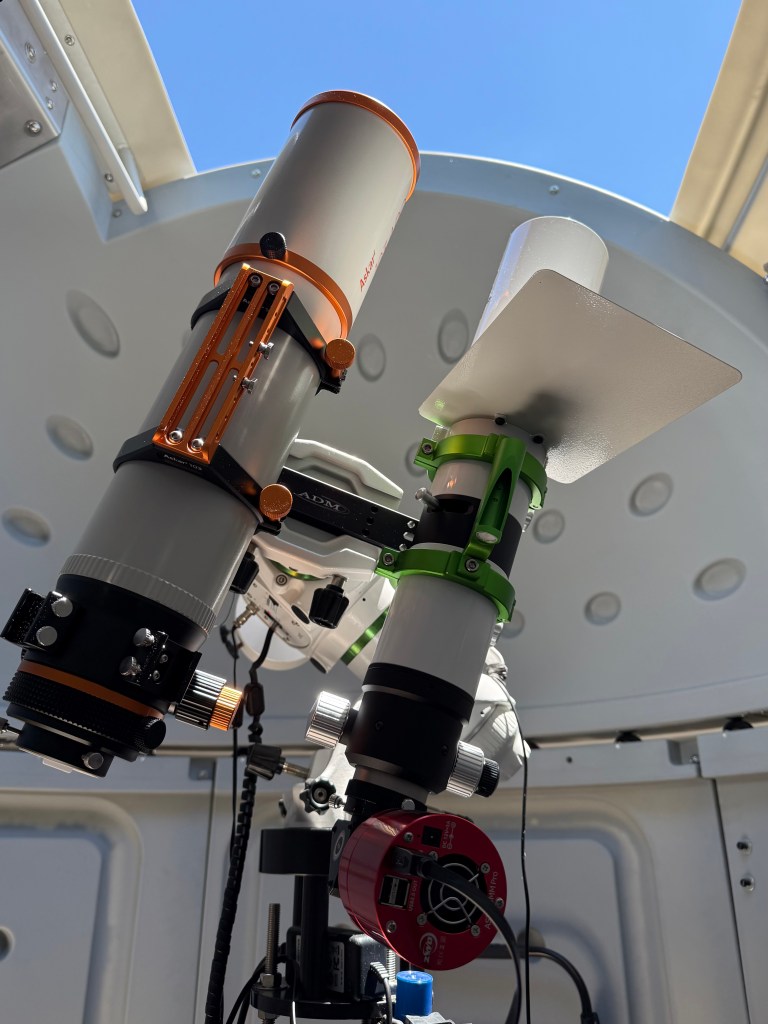
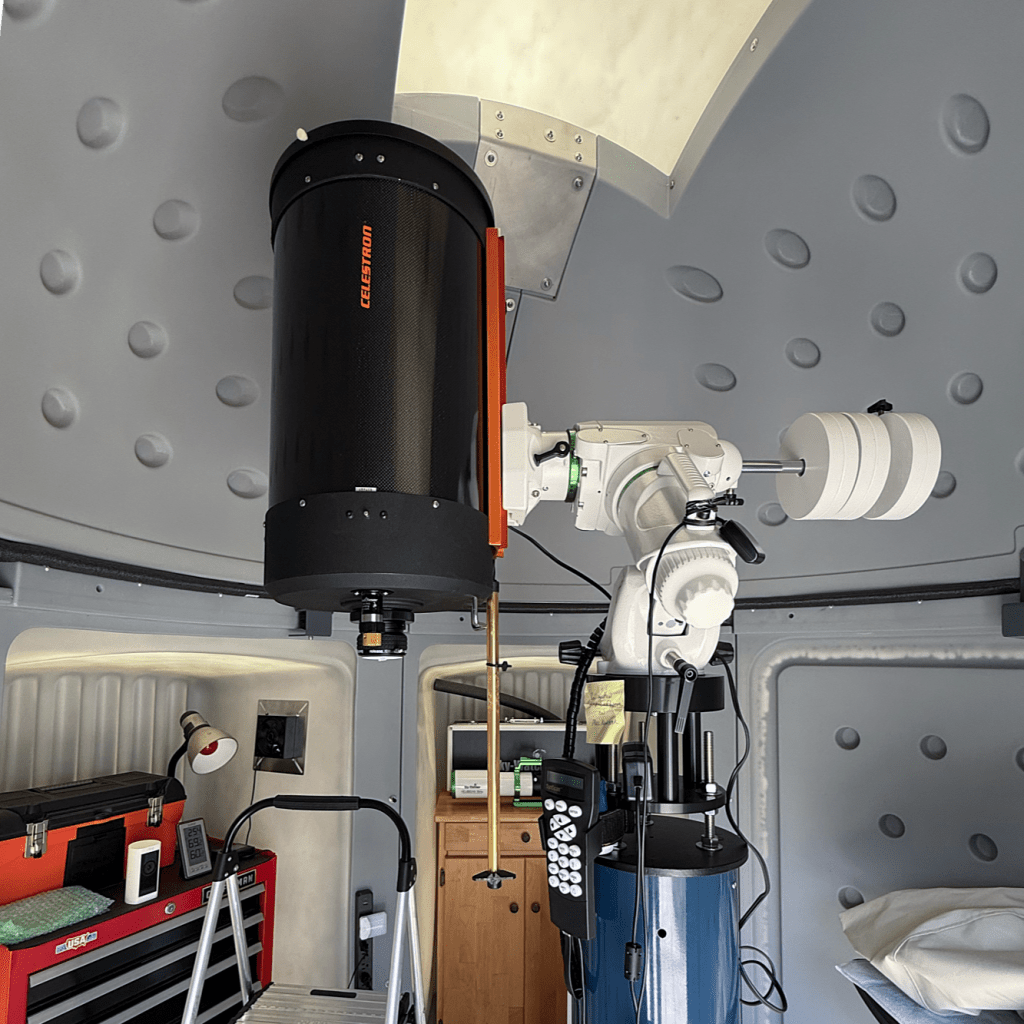
The Celestron C-11 telescope immediately after installation on the observatory mount, pointing straight up during balancing efforts.
Last night we finally had an opportunity to check out the C-11 in the observatory. The 24-year-old scope had languished in storage for maybe a year or more after daytime collimation efforts without real world tests.
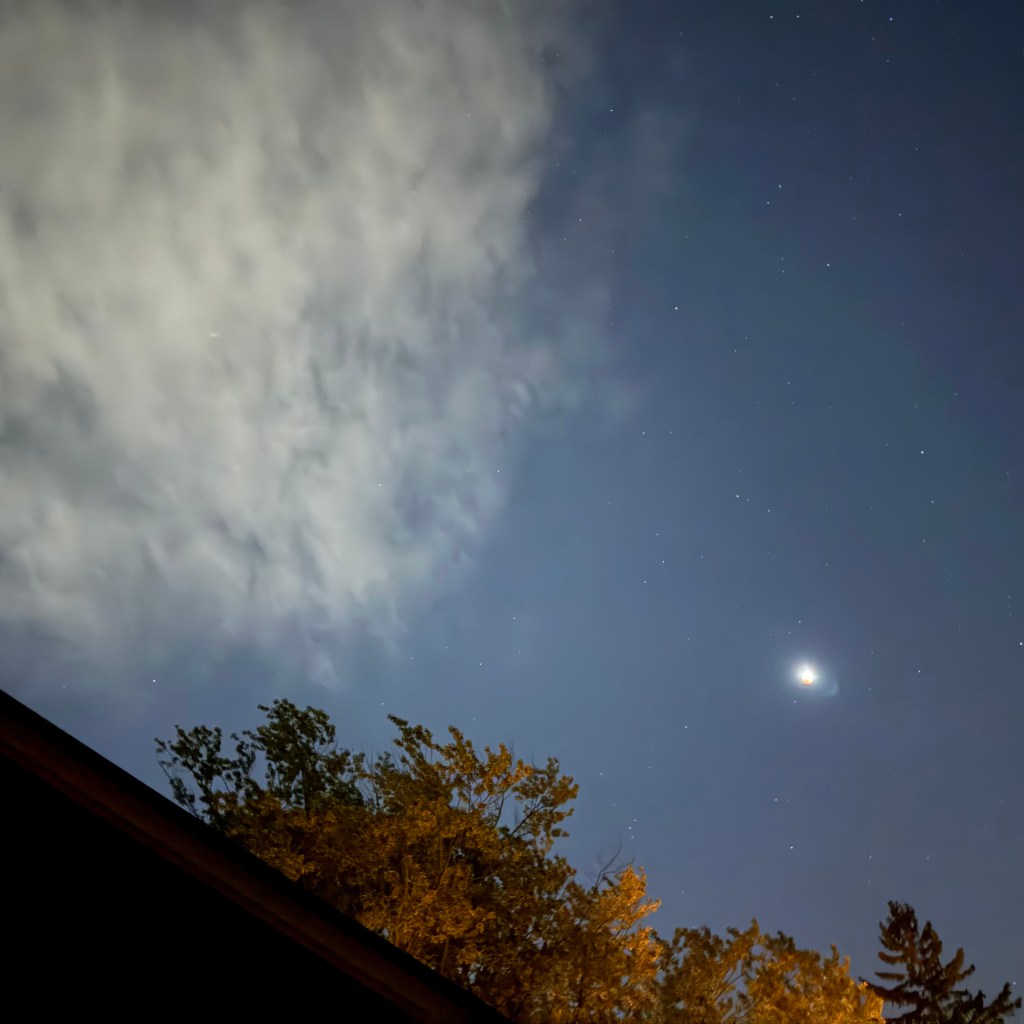
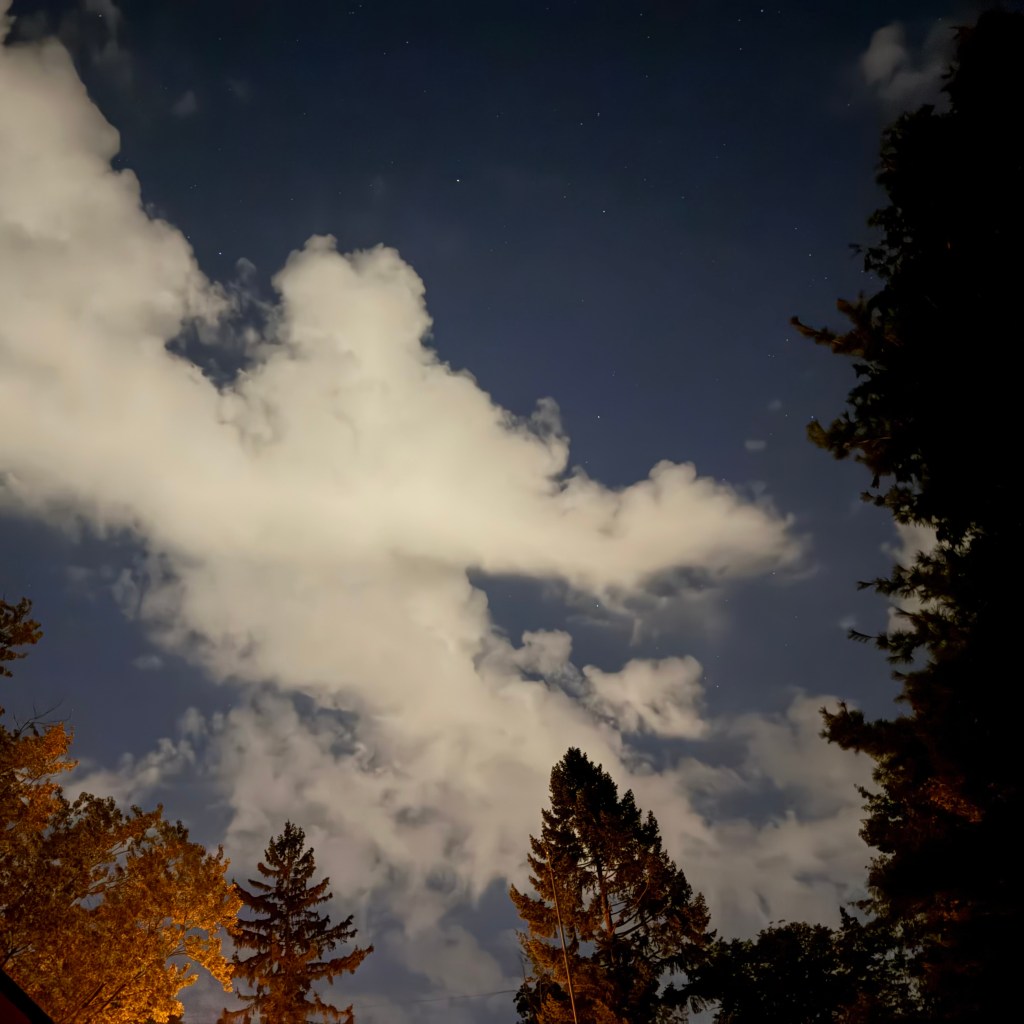
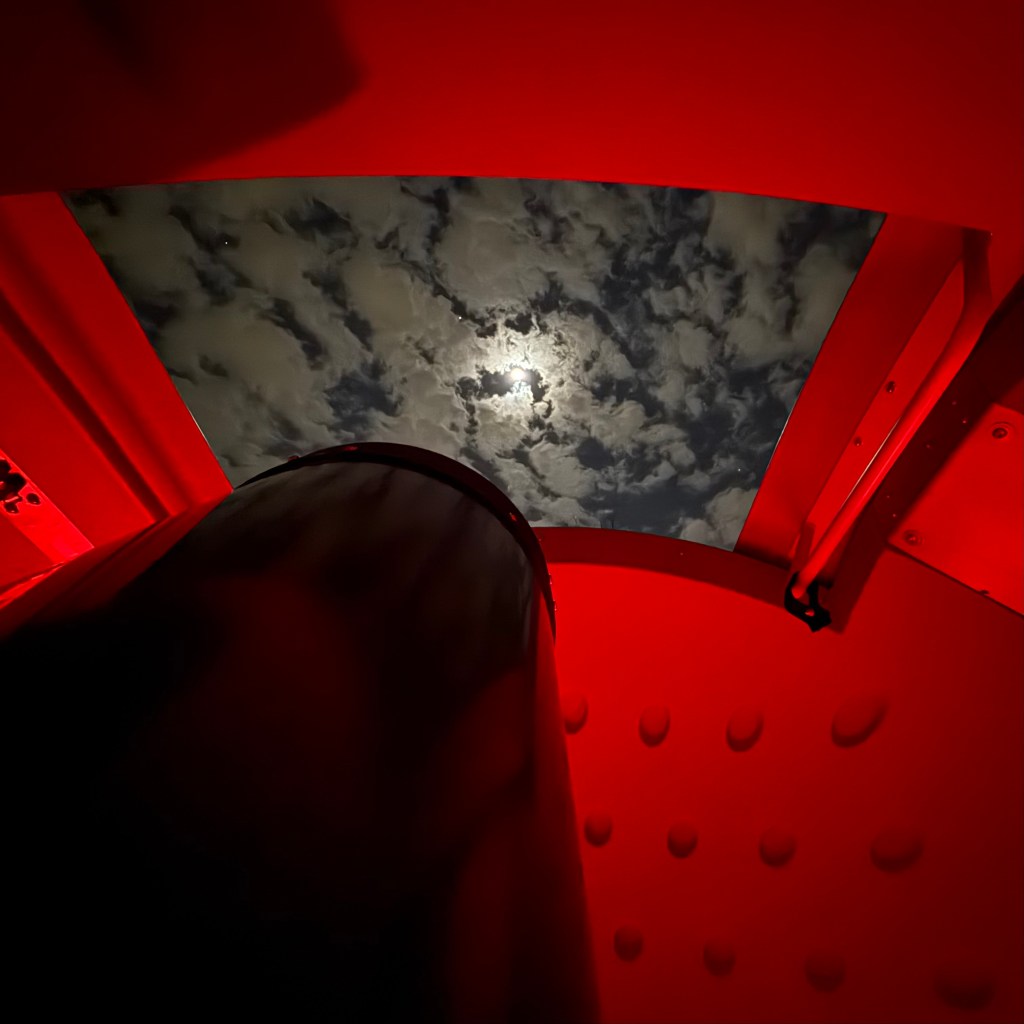
The black tube of the telescope points up, through the red-illuminated dome interior, towards a mostly-cloudy sky. Our First Quarter Moon shines brightly through the clouds. A bright speck of light is visible above and to the left of Moon; it’s planet Jupiter and clouds closed in before we could take a look through the telescope!
The sky was mostly clear until, of course, we opened the dome. Viewing Moon through “sucker holes” between clouds, things looked great. We attached the DSLR and shot some tests; things looked okay, if a bit dark through the viewfinder, though not outstanding. Clouds closed in solidly before we could reinstall an eyepiece and take a really critical look. We closed up. Checking the images on the computer we discovered all of them out of focus.
There is the possibility the camera did not interface well on the telescope. Perhaps the atmosphere in those sucker holes was shaky. We’ll check again and collimate on the next clear night.
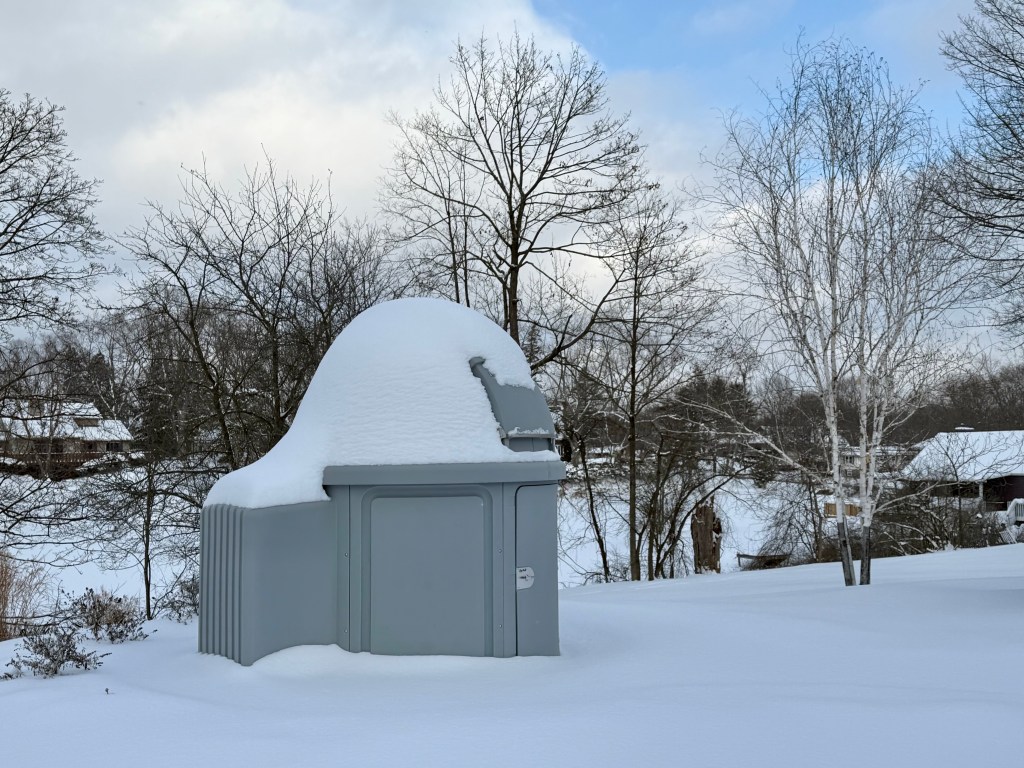
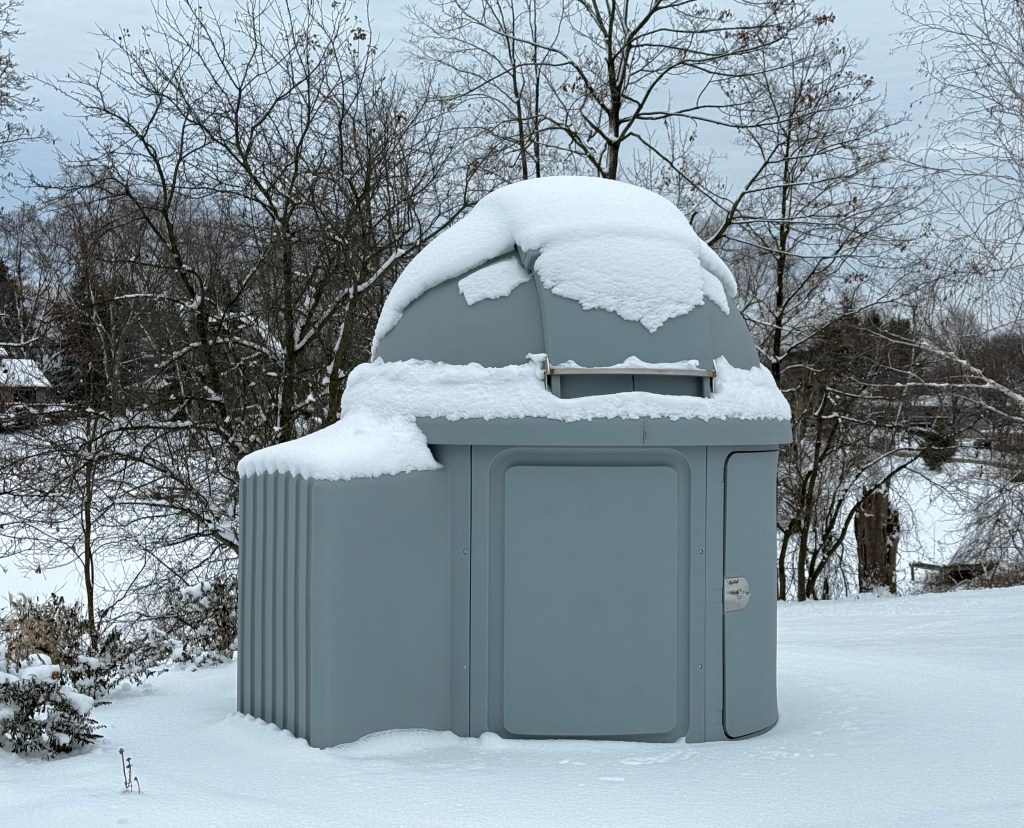
The gray observatory is surrounded by accumulated and drifting snow. The dome itself wears an extra dome of accumulated snow.
Recent arctic-air frigid weather has brought real winter weather to our region for the first time in a few seasons. Snowfall over the past 48 hours amounted to 10 or 12 inches of light, flaky, fluff. Nighttime below-zero low temperatures have erased any thought of going out; skies have been cloudy, anyway, preventing guilt and regret. So the dome remains sealed though pointed to the south for midday solar observations. If we ever see Sun again.
First Winter: Stella-Luna with a coating of snow, some of which is sloughing off, closed up and waiting for the occasional day or night with clear skies.
With overcast skies, overnight temperatures of about 9°F, and five-plus inches of snowfall over the past 48 hours, we’re pretty much buttoned down. Of course, changeable as weather is, they’re forecasting sunshine tomorrow, and 47° with rain by Thursday! Yeah, you saw “sunshine” mentioned but we have a healthy level of doubt where clear skies lately are concerned. In the meantime, there is snow to shovel and birds to watch… Oh! That’s a red-bellied nuthatch!
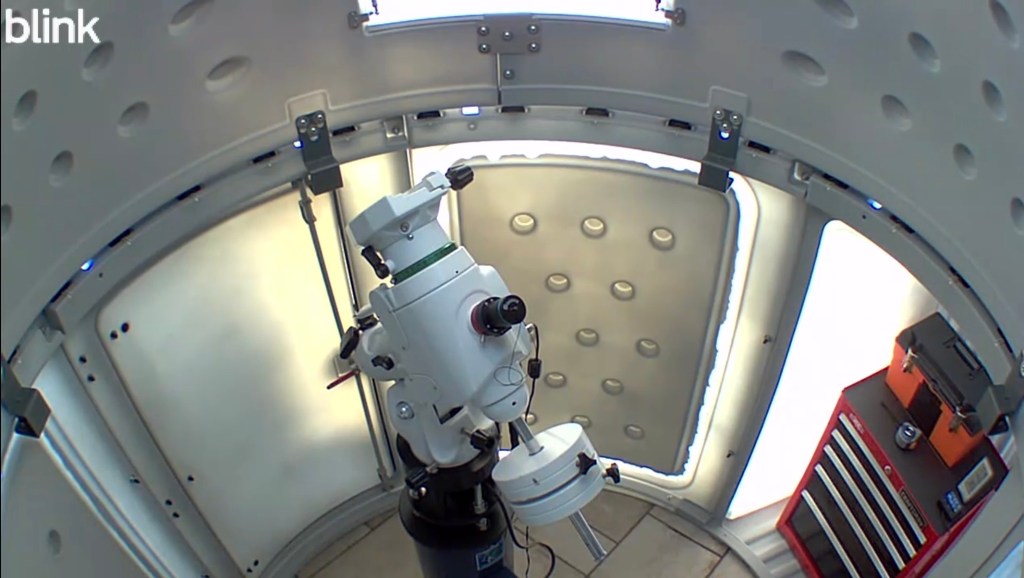
Observatory interior showing the telescope mount without telescope, the instruments having been stowed awaiting better sky conditions. After some test runs we’re still deciding on which scope might be designated as the “permanent” observatory instrument; some shopping is also happening.
The observatory, with a dusting of snow on its dome, sits with a background of snow-encrusted trees. Lake effect snowfall resumed after this photo was made.
The first snow of the season arrived overnight producing, for the observatory, a beautiful daytime scene. Ground heat cleared the pavers around the structure but continued cold weather will change that — we’ll likely have to start shoveling soon. Several days of snow chances lie ahead with clear skies are expected during the day on Thursday, November 13.
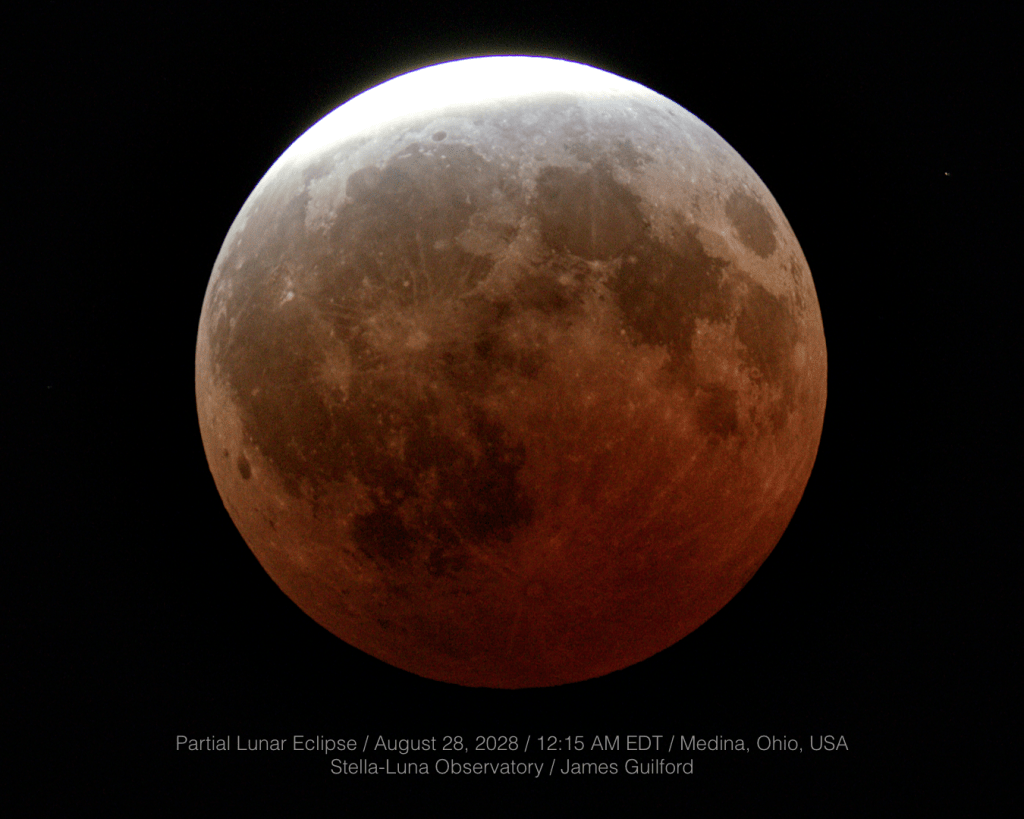
November 3, 2025 — The air was still and the moon so bright and clear tonight, we had to open up the observatory long enough to take a peek and a pic! Moon was 92% illuminated in its waxing gibbous phase, lighting the landscape around us, no flashlight required. Technical: Askar 103 APO telescope, TeleVue Powermate 2X Barlow, Canon EOS 5D Mk. 4 DSLR, single exposure.
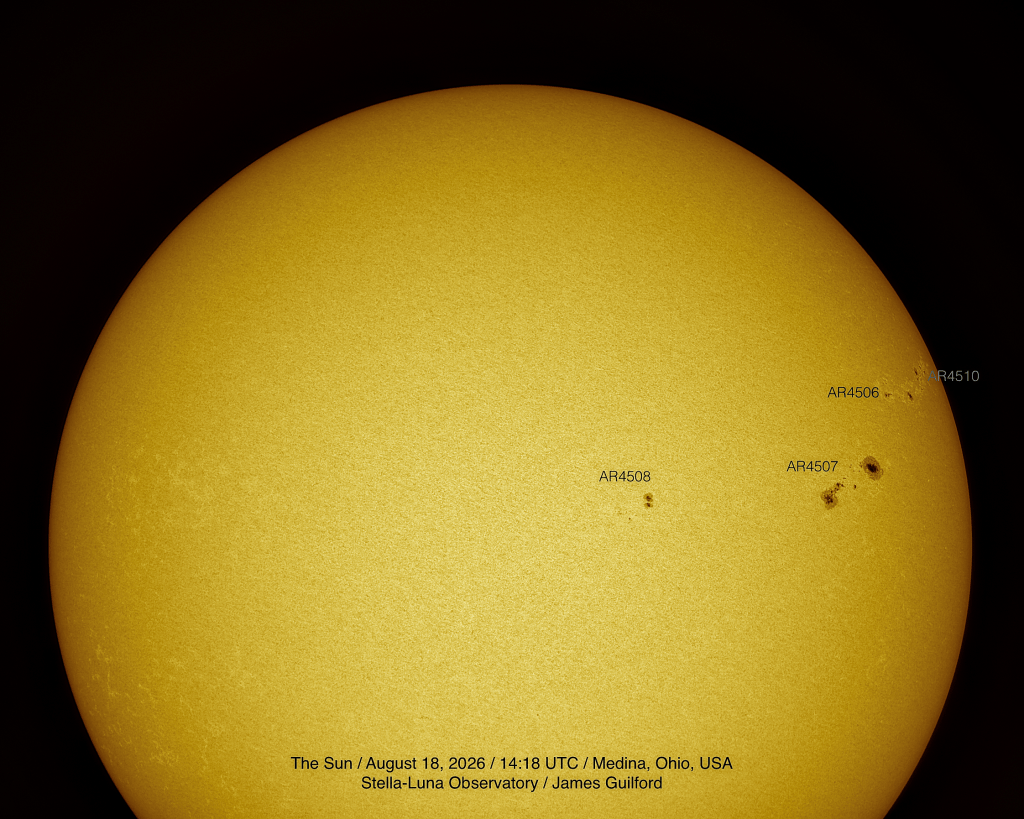
October 20, 2025 — So how well does the Meade LXD75 6-inch achromat fit under the dome? Actually, pretty well! Shooting the sun this afternoon was (outside of seeing conditions) not bad. The scope is about four feet in length, not counting imaging and observing add-ons, and the objective end swings well inside the dome. Access to the eyepiece and camera was good. Not much room to get past the visual end, however, so we’ll see! Main thing is, it fits. Pretty much.
A big blue canopy set up to provide shade for work assembling the observatory dome that sits beneath it. Once assembled, the dome, weighing in at 350 pounds complete, will need to be manually lifted, moved, and placed atop a yet-to-be-assembled curved base wall.
The big Saia freight truck pulled up in front in the early afternoon July 10. The ready-to-assemble (RTA) observatory had arrived on two pallets weighing about 625 pounds each. After struggles getting it off the truck, aided by its very helpful driver, and with unexpected help from a neighbor, we stowed the base wall components in the garage. I moved the dome halves myself to a patio space adjacent to the observatory site where they are to be assembled.
Withering hot weather and a severe summer cold (ironic?) halted progress on the observatory dome assembly for several days. This afternoon, July 14, hoping to dive into the work tomorrow morning, I set up a canopy for sun protection. The portable shade along with a good electric fan ought to help extend the day’s work time until I can’t stand the heat!
It has been a long, and bumpy road but, at long last, our SkyShed POD-S observatory structure is arriving! Delivery is set for tomorrow, July 10, via freight truck. Wrangling the large and heavy parts of the RTA (ready-to-assemble) building from street to site will be challenging but I think / I hope I can manage it. One looming problem: once put together, hoisting the assembled dome to rest upon the round base wall is a task that I’m uncertain how we’ll accomplish — the thing will weigh 350 pounds! I’ll need several strong people to help lift the dome but don’t know where they’ll come from.
In the mean time, I’ve assembled a collection of tools and materials required for the assembly, the building permit is in place, and so we forge ahead.
A design rendering of the SkyShed POD-S Mark 4 – Tall observatory. Image Credit: SkyShed Observatories.
Following the evaporation of our first observatory deal we revisited our pre-purchase research from two years ago. We quickly settled upon the SkyShed Observatories POD-S Mark IV in this project reset. Today we placed our order and paid for the ready-to-assemble kit.
While we were originally hoping for fiberglass construction, the POD-S is built from double-walled polyethylene — much the same as plastic garden sheds. The material actually provides some advantages over other construction but presents an interesting issue: daytime IR heating. It seems white poly is translucent to infrared light (solar heat rays) which causes the interior to heat up. We chose a light gray color which, while not the classic choice for a dome or observatory, we are told will allow less of interior heating, as it blocks more IR than the white color reflects. This flies in the face of the usual reflective white or metallic silver specified for observatories but those buildings aren’t made of polyethylene.
We don’t have production or delivery schedule information at this time (the order’s brand-new) but there are other things to do such as acquiring a new building permit, pulling electrical wire to the telescope pier site, building a warm/control room in a nearby shed.