A little flip helps a lot

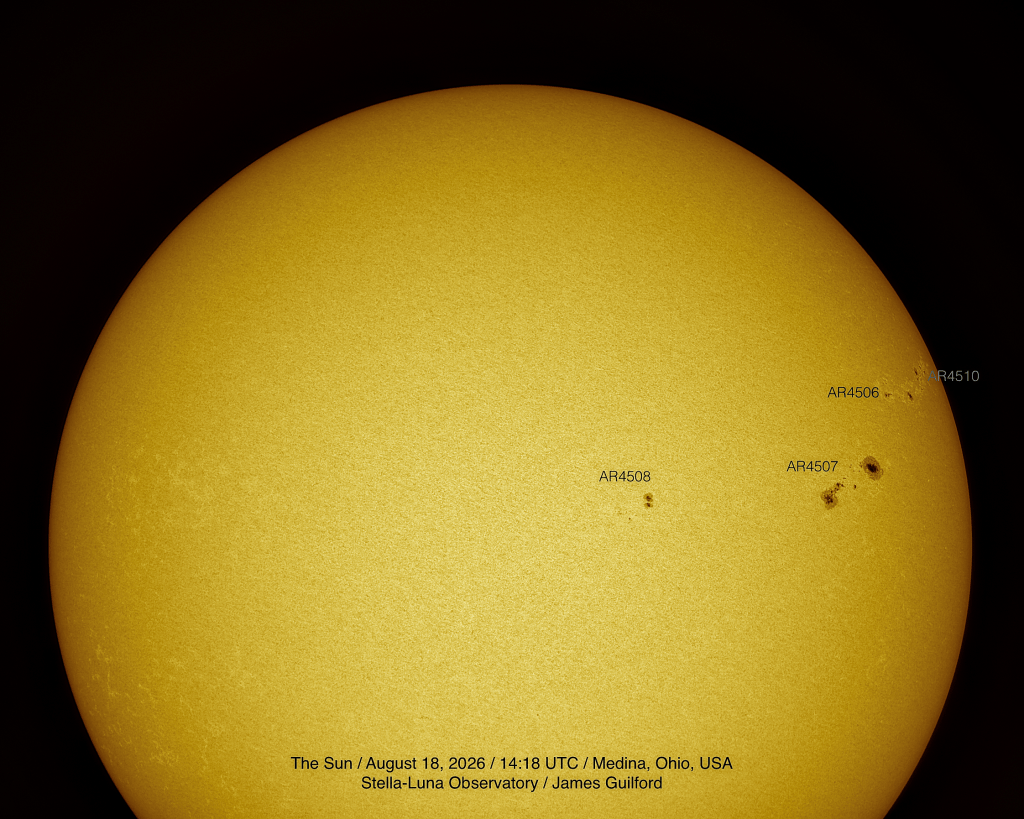
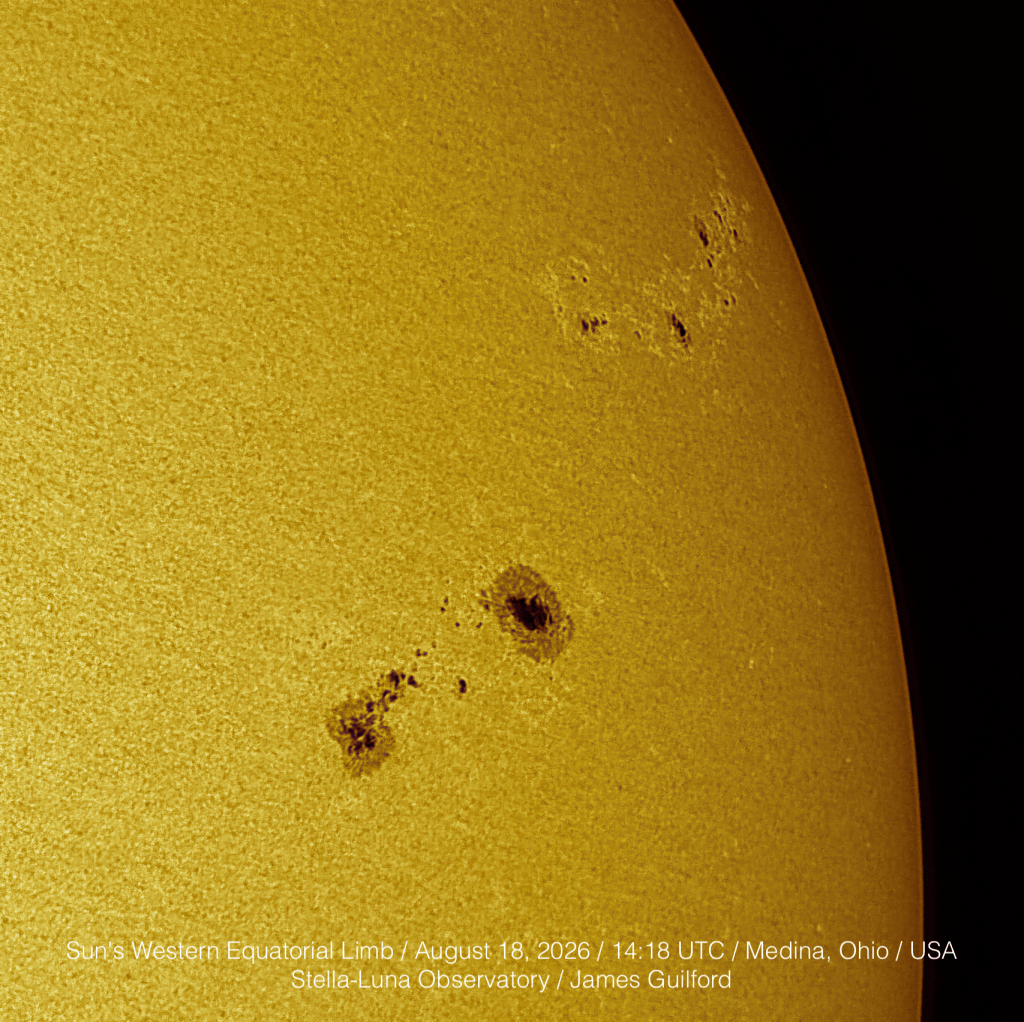
We observed several active regions, all in the western hemisphere, no sunspots in the eastern hemisphere, and all were confined to the solar equatorial area. This solar cycle appears to be fading away. White light Baader film solar filter, with false color applied in processing. August 18, 2026.

Skies, time, and tech finally aligned allowing us to observe Sun this morning. With mid-summer behind us, Sun clears the trees later these days meaning we observe later with more turbulent air — only fair seeing today! Still, we imaged four active regions with spots, all headed toward the western horizon. There were no sunspots in the eastern hemisphere, and the active regions were confined to the solar equatorial area. This solar cycle appears to be fading away.
Aiding the day’s observations, and the equipment’s first light, was the addition of our new Baader Planetarium FlipMirror 2. We found that the flip mirror we used with the Vixen Cassegrain telescope had too much extension — we needed something more compact to achieve focus and have a little room for adjustment. Setting up the Baader FlipMirror was a challenge. The main component, containing the mirror, is shipped with adapter rings only — no nosepiece, eyepiece holders, or anything else. While the bare-bones component is versatile, selecting the correct set of add-ons was a worrisome exercise (components are not cheap) and the retailer offered no assistance when asked. After a good deal of shuffling between the owner’s guide, the product box illustrations, and the Baader and retailer’s websites, we made our selections. Happily our purchases were correct. The FlipMirror really is a well-made and even superior product.
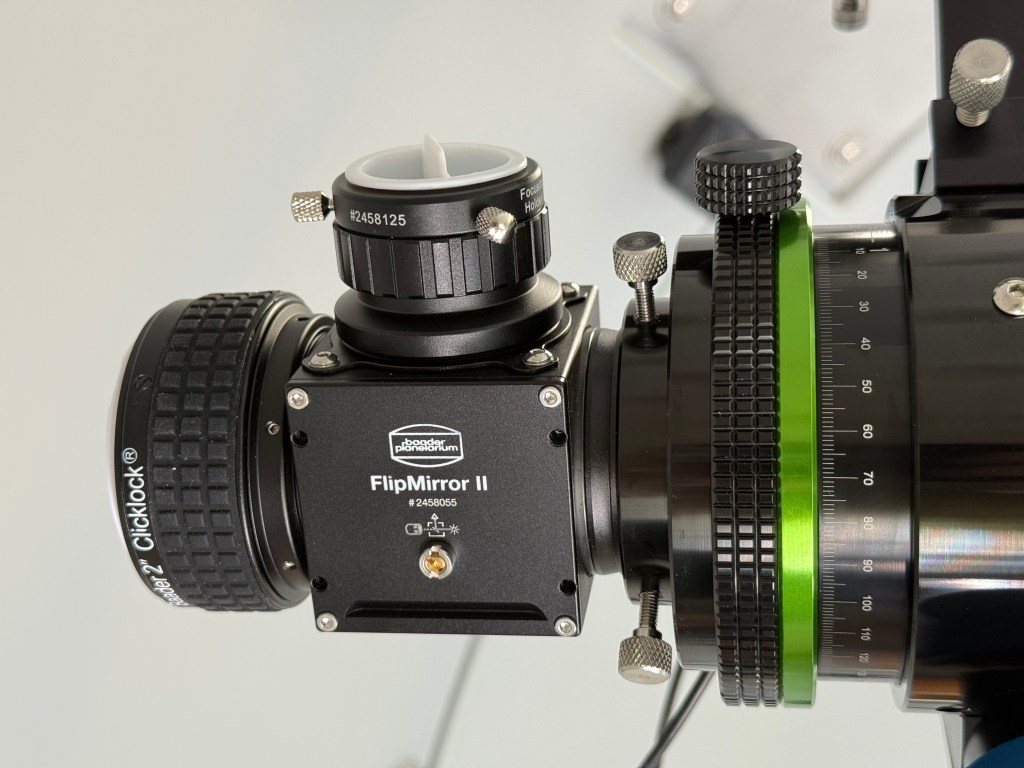
The Baader FlipMirror 2 connected to the telescope focuser. Clicklock eyepiece holder/clamp, and focusing eyepiece holder are sold separately

Why a flip mirror? Those devices allow two, or more, observation or imaging pieces to be attached to the telescope at once: a camera and an eyepiece, two eyepieces and differing angles, two cameras (we suppose), with only the twist of a mirror-flipping knob to switch between them. In fact, the Baader device has a third connection place, located on the underside of the mirror box, for addition of a guide camera! The mirror never covers the light path for an attached off-axis guide camera … an interesting feature.
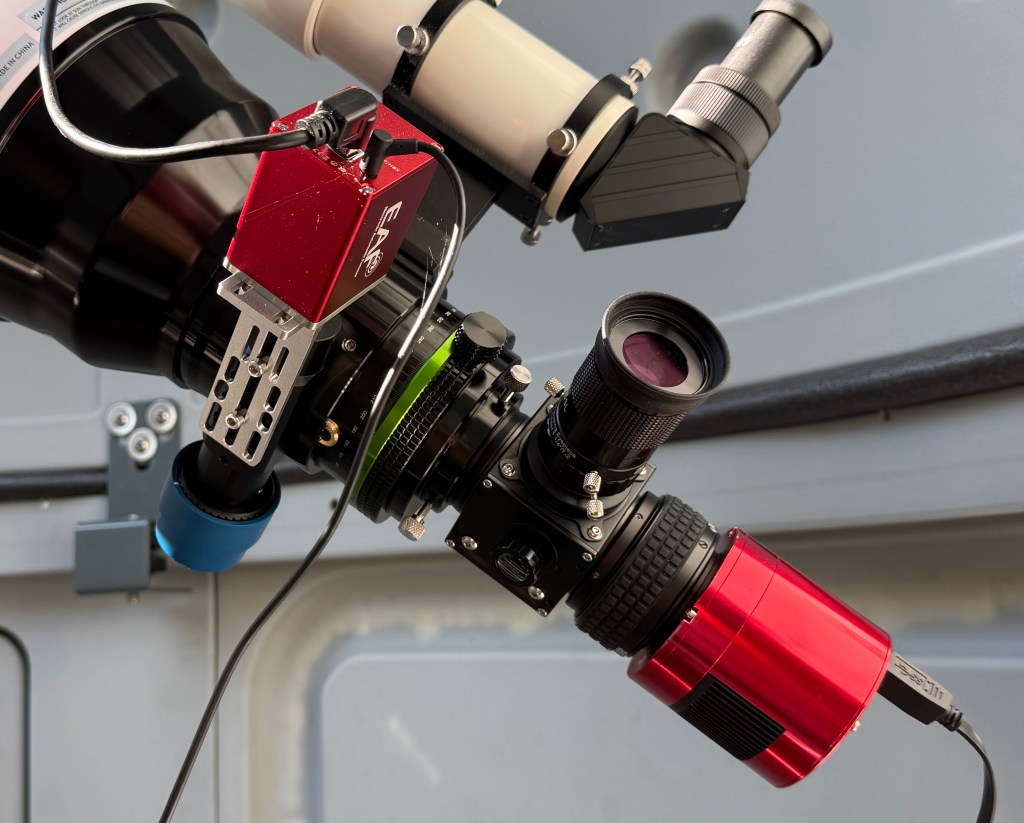
The Baader FlipMirror 2 installed and in use with eyepiece and camera connected.

At any rate, we were able to easily center Sun in the field of view using the eyepiece, flip the mirror out of the way to allow a direct light path to the camera, and image. Centering the sun was no big deal but using an eyepiece to center distant stars, planets, etc. is made much easier through its use. It’s also nice to just take a look, observing directly with one’s own eyes!

A near disaster

The Vixen VC200L Modified Cassegrain telescope on a good evening in 2020. The Sky-Watcher mount now sits atop a permanent pier inside the observatory, no longer on the grass.

On July 12, we had just finished installing the Vixen telescope on to a new rack that attached to our Sky-Watcher mount, and were fine-tuning the system’s balance when it happened. There, in front of us, out of reach for rescue, the telescope slid along its railing, down the new rack like a skier down their ramp! Horrified, we watched as it cleared the bottom of the mount, plunged five feet to the floor, bounced, and landed upon its side just outside the observatory door!

Expecting the worst, we lifted the poor thing up and looked down the tube to check the primary mirror … and it was intact. The outside of the tube showed a long, thin scratch and a little scraped spot, and the finder ring was loose and ajar but looked repairable. A set screw for the visual back had sheared off. Fortunately, the finder scope was undamaged, and the flip mirror eyepiece accessory had not been installed so it escaped the crash. Apparently the telescope, which slid bottom end first, struck the polyethylene observatory door threshold, bouncing from there possibly softening the impact — a bit better than directly hitting the concrete floor!

The next day, after thoroughly examining the OTA, straightening out the finder rings, and removing the offending mount rack, it was time to see whether we could see. It being daytime we clamped the scope directly to the solid Sky-Watcher mount atop its pier, attached the solar filter, and aimed skyward. Surprisingly, the two large sunspots present could be seen clearly in full-disk viewing and the edges of Sun looked good; the telescope was actually usable! Higher magnification and later imaging were not as impressive. After dark we attempted photography of M57 — the Ring Nebula — to look at star shapes. Not surprisingly the stars showed distinct signs of a telescope out of collimation. The scope needs work.

We will attempt collimation soon after we receive a replacement visual back for the telescope but would really prefer to have the instrument checked and serviced by professionals.

UPDATE July 30 — The VC200L telescope sustained mechanical damage to its focuser, that part of the scope apparently having struck the ground first; the mechanism operates roughly and shifts the image during operation. Collimation appears possible through we were unable to perfect that alignment. And, thus far, we have been unable to locate any source for professional repair. VIXEN let us know that the scope could be sent to their facility in Japan for evaluation and repair but we feel the transportation cost along with repair charges would be impractical. The instrument is now in storage as we contemplate its future.

A little scare, a quick fix

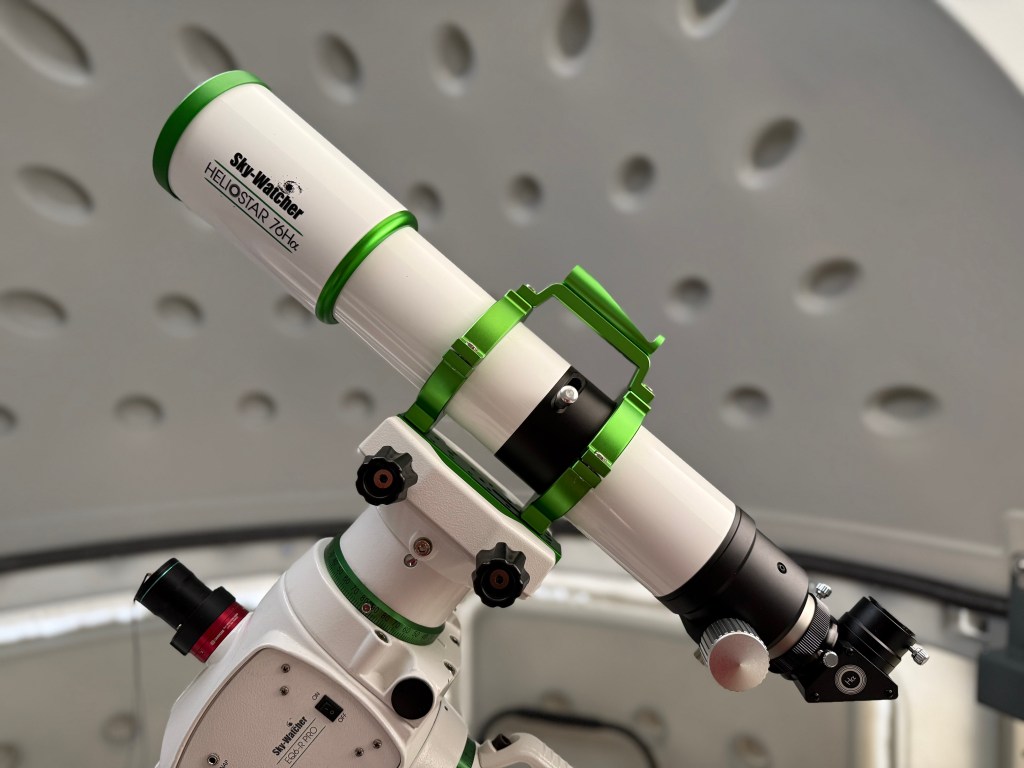
Our Sky-Watcher HelioStar 76Ha Solar telescope mounted on the observatory’s permanent mount. The focuser, for those new to these things, is operated via the silver knob seen at the lower end of the telescope. Photo by James Guilford.

A couple of days ago, during a rather ambitious solar imaging session, the focuser on our Sky-Watcher HelioStar 76Ha telescope failed. And by failure, we mean the specialized diagonal that holds an eyepiece or camera would not stay put! The focuser would barely move the assembly and, once released, the diagonal plus camera would … zzzzzzip! … slide outward as far as it could. As one might expect, that sort of thing makes the telescope worthless. Disappointment? Disaster?

Contacting Agena Astro, the telescope’s seller, their rep. reminded us that the unit was still under warranty and supplied contact information for Sky-Watcher USA’s Support. Sending off an email describing the issue we waited a reply. “Sounds like the focuser might need to be adjusted,” came the reply a short time later. “Don’t worry we have a lot of adjustment with this focuser.” Adjusting three screws on the telescope, as instructed, and within five minutes the system was working good as new!

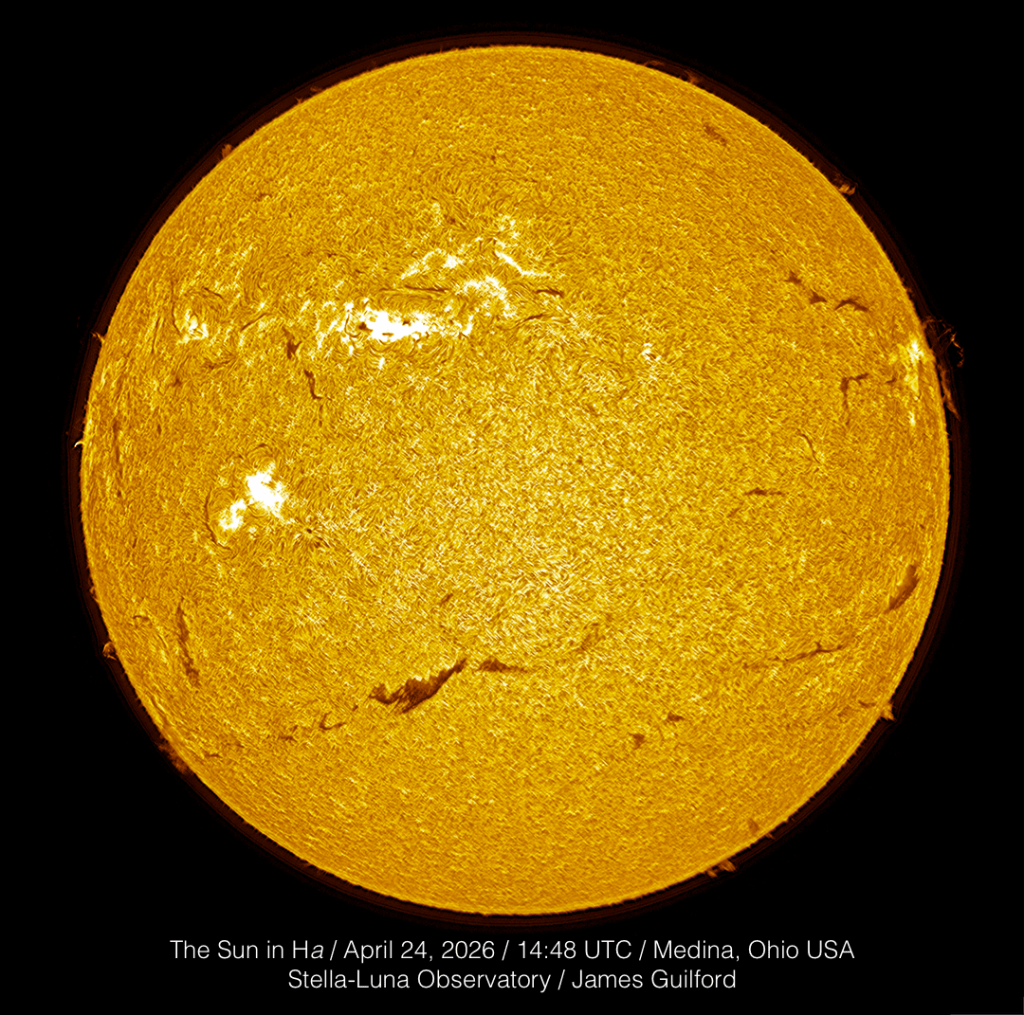
The Sun as it appeared via hydrogen-alpha light on April 24, 2026; as imaged using the Sky-Watcher HelioStar 76Ha Solar telescope, and a ZWO ASI monochrome camera. False color applied. Image by James Guilford.

So there was a little scare. Excellent support provided by the retailer and the manufacturer. A quick fix. And we were able to take advantage of excellent conditions today, making images of our local star! Thanks go out to Agena Astro and Sky-Watcher USA!

It fits! Pretty much.

October 20, 2025 — So how well does the Meade LXD75 6-inch achromat fit under the dome? Actually, pretty well! Shooting the sun this afternoon was (outside of seeing conditions) not bad. The scope is about four feet in length, not counting imaging and observing add-ons, and the objective end swings well inside the dome. Access to the eyepiece and camera was good. Not much room to get past the visual end, however, so we’ll see! Main thing is, it fits. Pretty much.