
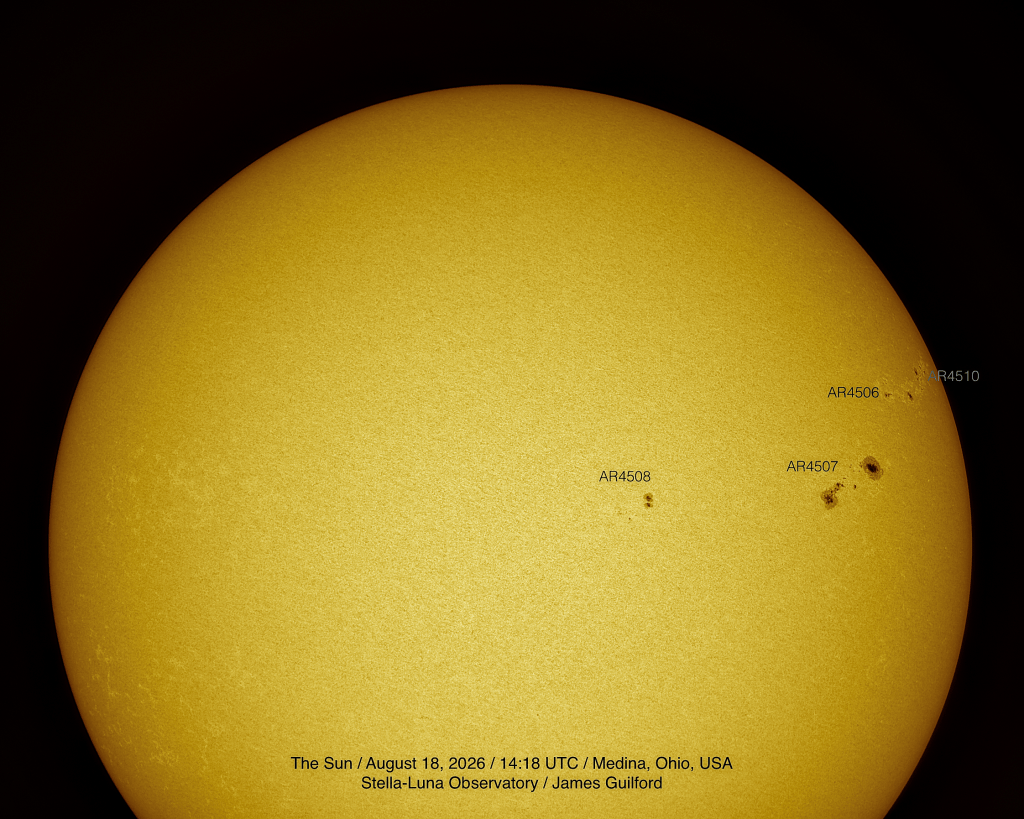
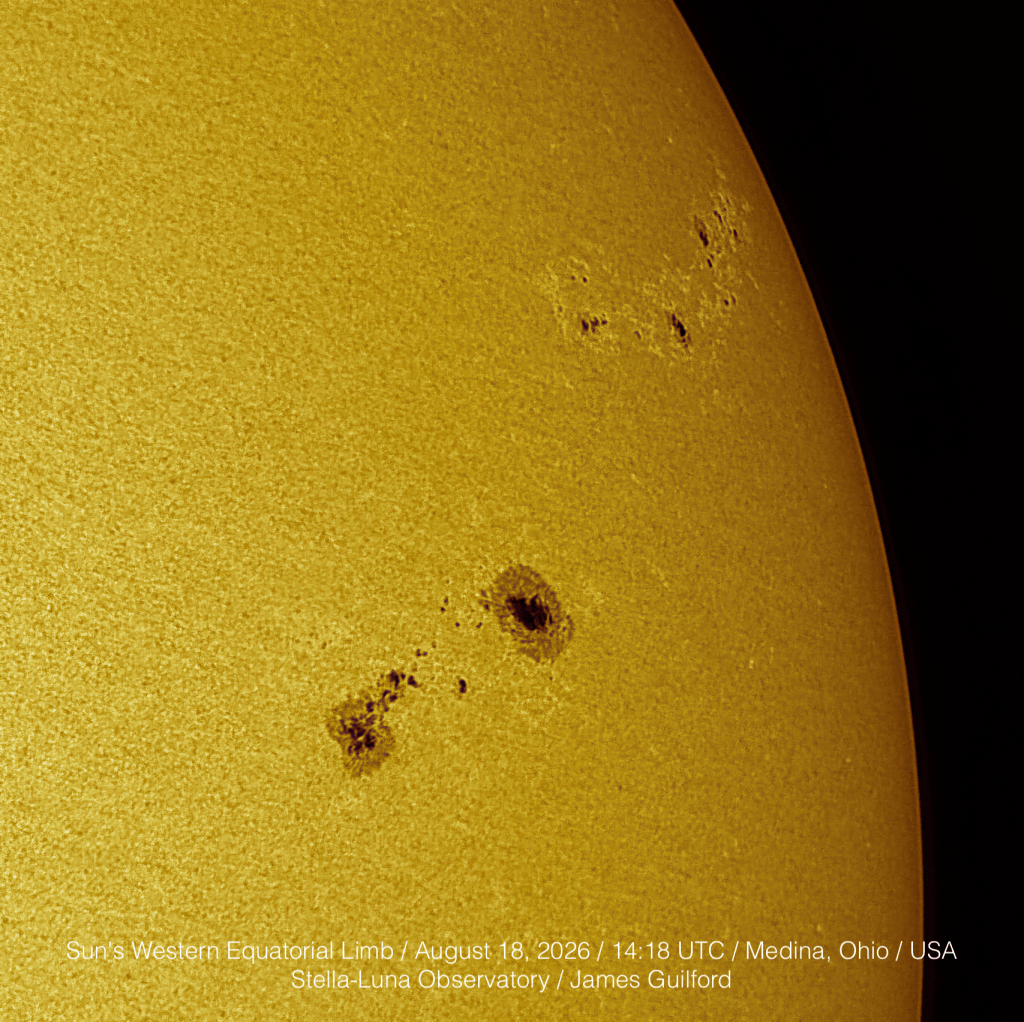
Skies, time, and tech finally aligned allowing us to observe Sun this morning. With mid-summer behind us, Sun clears the trees later these days meaning we observe later with more turbulent air — only fair seeing today! Still, we imaged four active regions with spots, all headed toward the western horizon. There were no sunspots in the eastern hemisphere, and the active regions were confined to the solar equatorial area. This solar cycle appears to be fading away.
Aiding the day’s observations, and the equipment’s first light, was the addition of our new Baader Planetarium FlipMirror 2. We found that the flip mirror we used with the Vixen Cassegrain telescope had too much extension — we needed something more compact to achieve focus and have a little room for adjustment. Setting up the Baader FlipMirror was a challenge. The main component, containing the mirror, is shipped with adapter rings only — no nosepiece, eyepiece holders, or anything else. While the bare-bones component is versatile, selecting the correct set of add-ons was a worrisome exercise (components are not cheap) and the retailer offered no assistance when asked. After a good deal of shuffling between the owner’s guide, the product box illustrations, and the Baader and retailer’s websites, we made our selections. Happily our purchases were correct. The FlipMirror really is a well-made and even superior product.
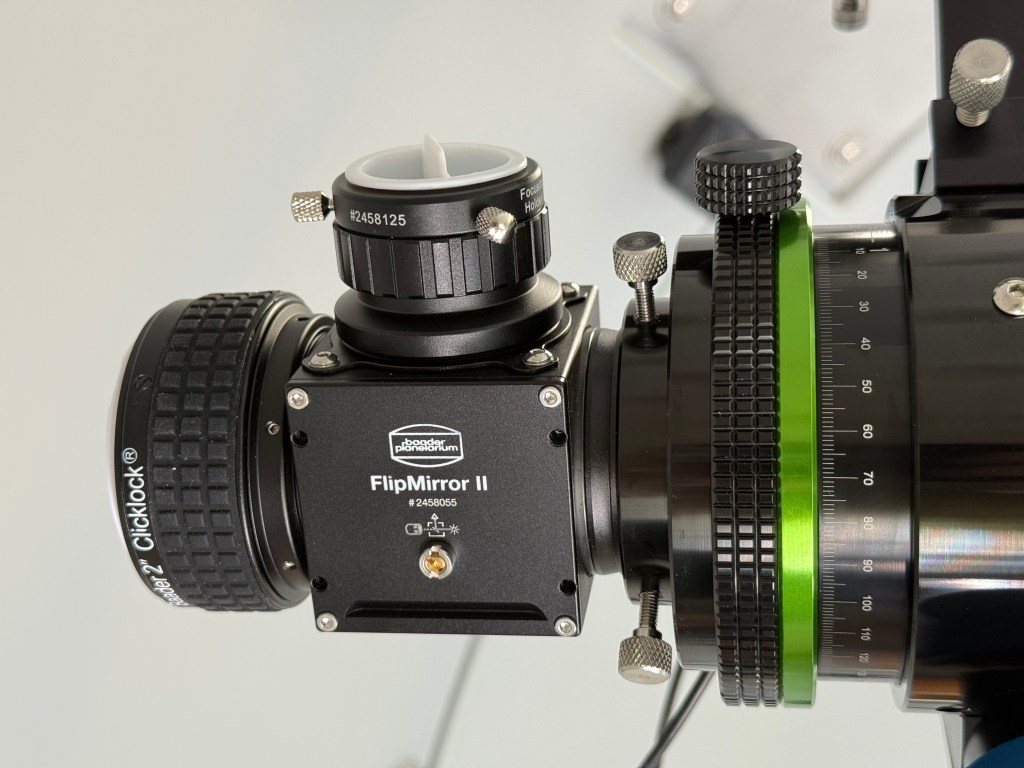
Why a flip mirror? Those devices allow two, or more, observation or imaging pieces to be attached to the telescope at once: a camera and an eyepiece, two eyepieces and differing angles, two cameras (we suppose), with only the twist of a mirror-flipping knob to switch between them. In fact, the Baader device has a third connection place, located on the underside of the mirror box, for addition of a guide camera! The mirror never covers the light path for an attached off-axis guide camera … an interesting feature.
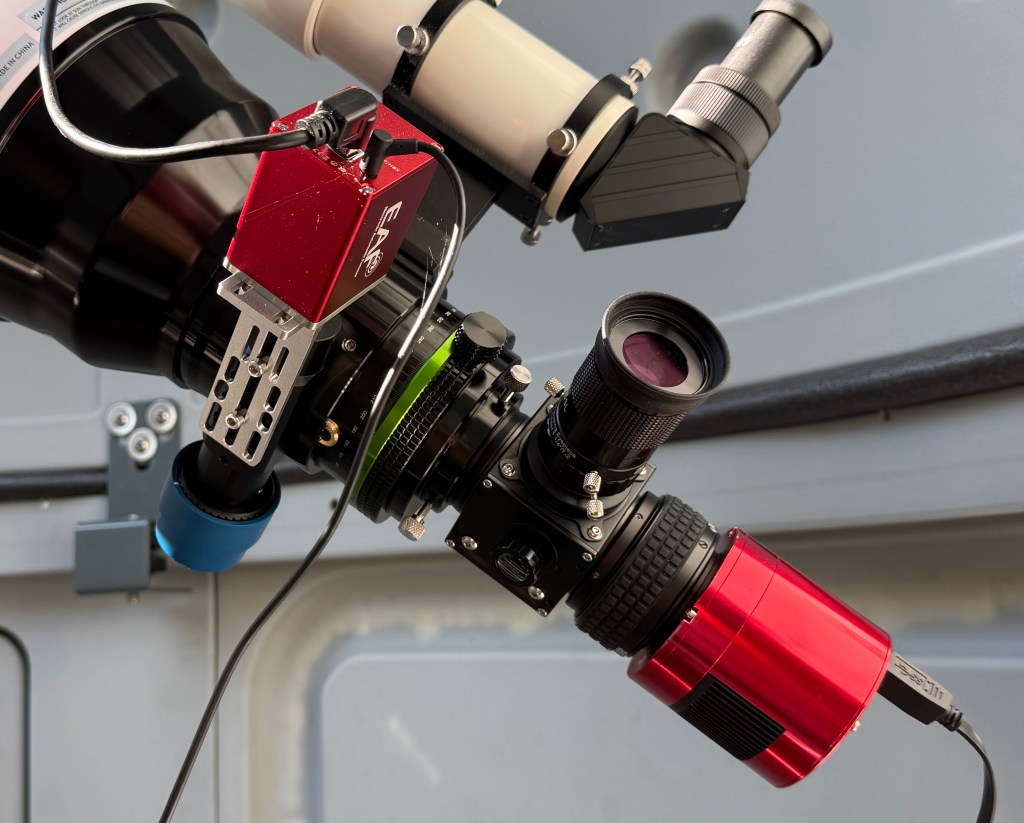
At any rate, we were able to easily center Sun in the field of view using the eyepiece, flip the mirror out of the way to allow a direct light path to the camera, and image. Centering the sun was no big deal but using an eyepiece to center distant stars, planets, etc. is made much easier through its use. It’s also nice to just take a look, observing directly with one’s own eyes!

