
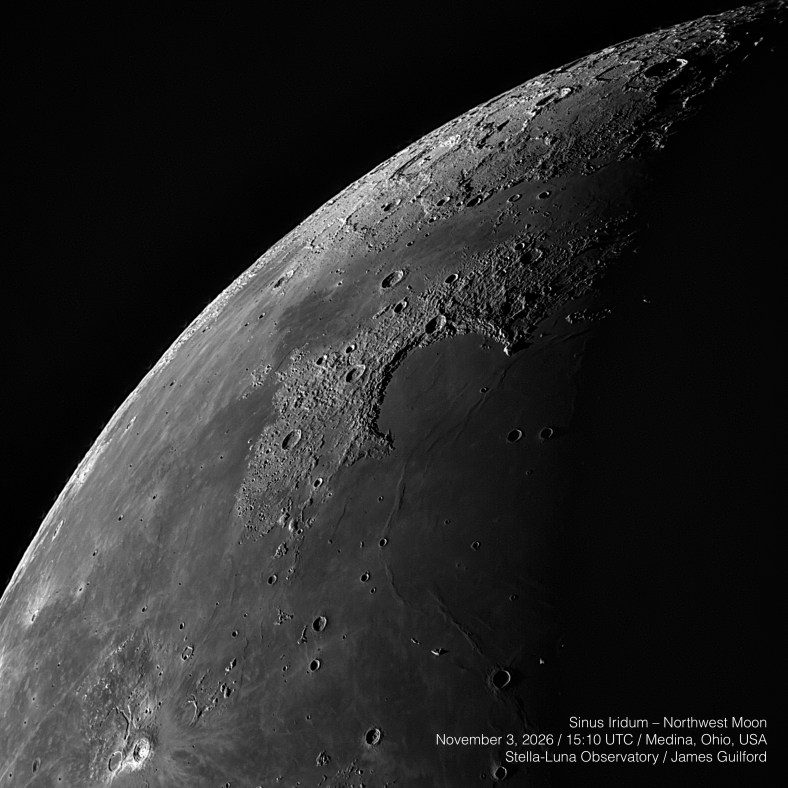
A look at Sinus Iridum as sunlight wanes there

We’re pretty happy with this picture of Sinus Iridum, “Bay of Rainbows”, and part of the Mare Imbrium region of Earth’s Moon. This is another daytime shot, often the only time we can observe certain Lunar phases. With winds picking up due to changing weather conditions, seeing was only fair to average – attempts to use higher magnification were not rewarded.

Sinus Iridum is an inlet, of sorts, to the great Mare Imbrium, “Sea of Showers”, located within the much larger Imbrium Basin. The basin was formed when our dear neighbor in space, our Moon, was struck by a protoplanetary body during the Late Heavy Bombardment period of Solar System history. Imbrium is one of the larger known craters in the Solar System. Sinus Iridum, about 249 km (155 miles) in diameter, was apparently formed by a large impactor, leaving an impressive crater; the southeastern wall of the crater was disrupted when Mare Imbrium was formed, and both areas were flooded with lava forming the smooth plain.

For its interesting features and changing appearance during the Lunar day cycle, Sinus Iridum is a favorite subject for observers and certainly one of ours.
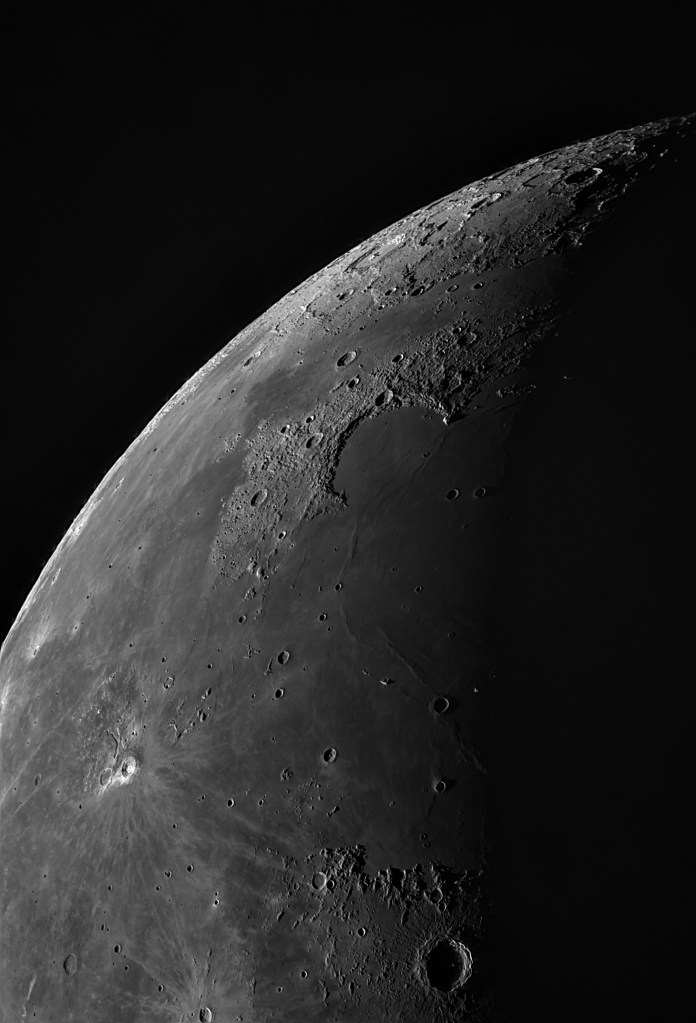
Sinus Iridum, Mare Imbrium, and surroundings in Moon’s northwest quadrant. This image was recorded at 10:10 AM Eastern Standard Time, on November 3, 2023. Too many details to describe here but the bright crater at the lower left is Aristarchus, and the large, dark crater near the bottom of the frame is Copernicus. The picture at the top of this post is cropped from this image.

Mare Imbrium, morning here, evening there

Mare Imbrium, the Sea of Showers, as it appeared during Moon’s Last Quarter phase on the morning of August 5, 2026. The distinct crater with spidery ejecta lines radiating from it is Copernicus. With a diameter of about 711 miles, Imbrium is one of the largest craters in the Solar System. A colossal impact from a protoplanetary object during the Late Heavy Bombardment produced the huge ring nearly four billion years ago. Image Credit: Stella-Luna Observatory / James Guilford

Continuing to explore daytime imaging of Moon, August 5 presented us with good skies and a Last Quarter lunar phase. One of our favorite areas to observe is Mare Imbrium, filled with subtle detail and a mountainous arc, the Montes Apenninus defining much of its shape. Last Quarter occurs when the light on Moon’s Earth-facing side has proceeded half way from Full to New — in other words, it’s afternoon or late day at Imbrium. The setting Sun brightly illuminates the mountain tops of Iridium’s eastern edge, along with the eastern walls of craters within or nearby. A “bonus feature” is crater Copernicus, just south of Iridium‘s defining mountains, with its deep, textured walls, central peaks, and expansive ejecta rays. The Sea of Showers has much to offer viewers.