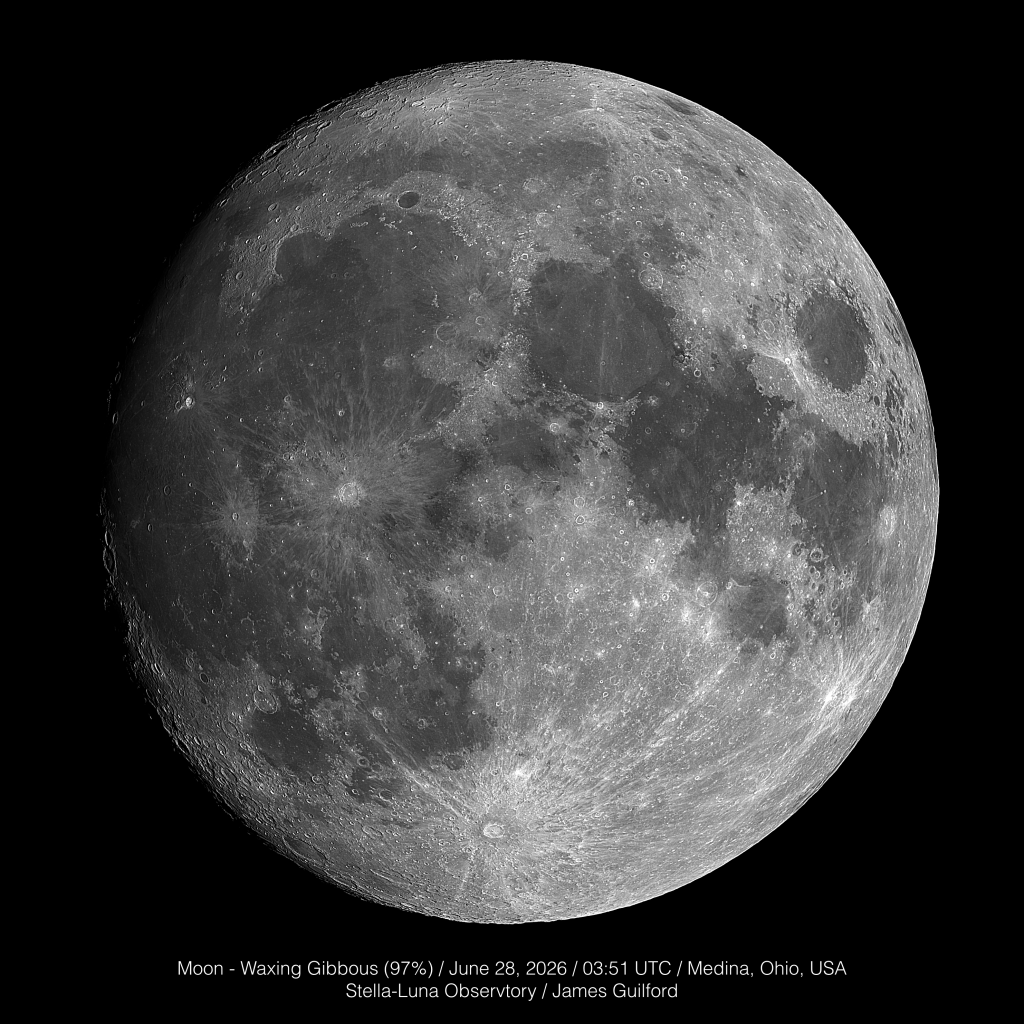
Full disk image of Earth’s Moon at 97 percent illumination, as imaged on June 27, 2026, at 11:51 PM EDT local time! Askar 103 APO refractor, ProPlanet 642 nM IR pass filter.
After recent struggles in an effort to get sharp images from the old C11 telescope, it was a pleasure to observe Earth’s Moon through the Askar 103 APO refractor! Clouds drifted through at various densities but — oh, my! — what a fine view! What the little Askar lacks in focal length, it possesses in sharpness. So we excitedly present this image of our Gibbous Moon!
Crater Copernicus and vicinity, with Moon at waxing Gibbous phase, 97 percent illumination. Askar 103 APO refractor, ProPlanet 642 nM IR pass filter, Tele Vue 2X Barlow. Image Credit: James Guilford
Lunar Crater Copernicus (above), with its expansive web of ejecta rays, dominates this scene captured June 27 (local time). To the left of Copernicus is Crater Kepler, with a smaller but still visible “splat” mark, both contrasting well against the dark field of Mare Insularum. Left still farther, on the terminator, is a figure-eight ring feature formed by Craters Cavalerius (top) and Hevelius (bottom). This is our favorite image from the brief Saturday night session.
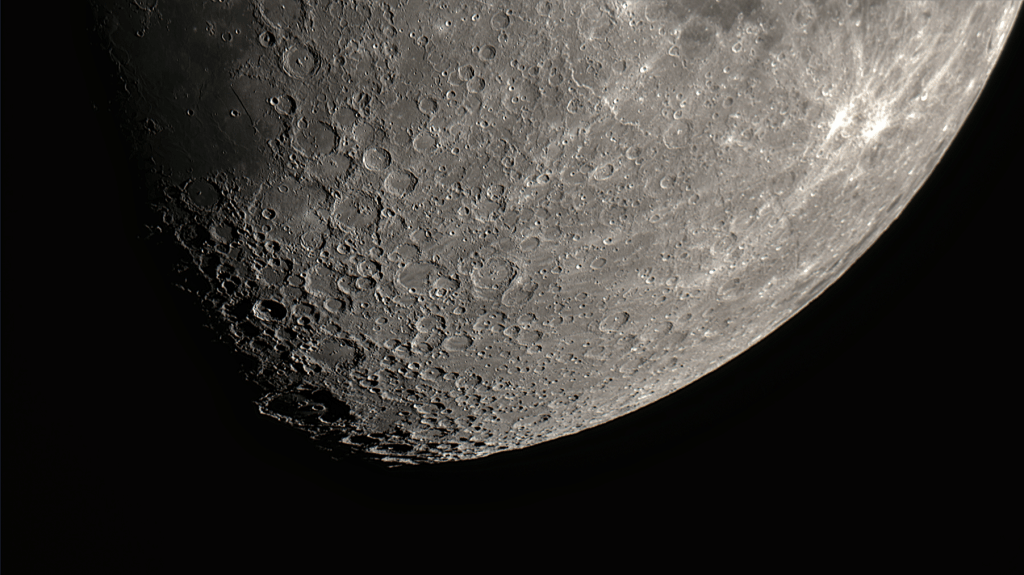
The heavily-cratered south-eastern area of Earth’s Moon is seen here, imaged just before midnight, June 23, 2026. Stella-Luna Observatory / James Guilford
This is the southern end of Earth’s waxing gibbous phase Moon, as imaged late Tuesday night. The heavily-cratered area along the terminator includes Crater Tycho — with a central peak lit by the rising Sun — and the dark circular expanse of Clavius, with the top of its western crater wall extending into the deep shadows of the terminator. We used the old Celestron C11 for this session as we continue to evaluate its performance and condition. We continue to be concerned about whether the telescope’s focus issue is simple collimation or some more serious combination of problems.
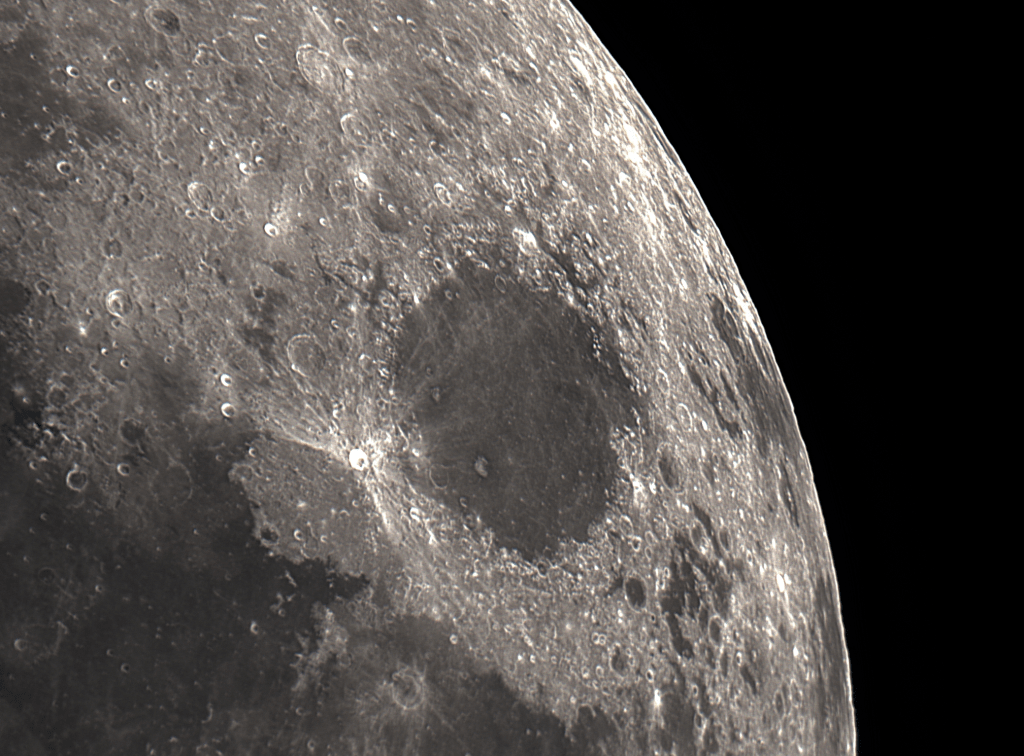
Not in the southern area of our Moon but certainly visible, even without a telescope, is Mare Crisium, shown at the center of this image made light night June 24, 2026. Stella-Luna Observatory / James Guilford.
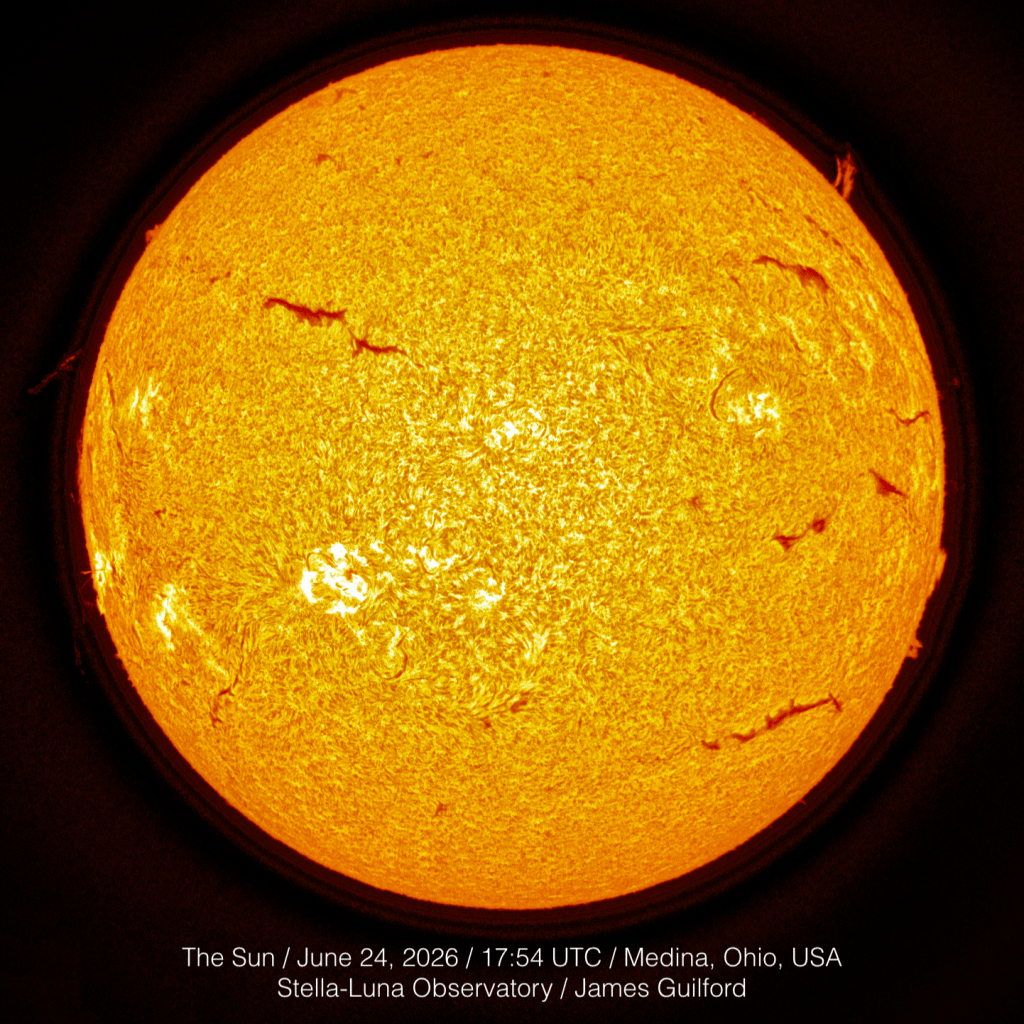
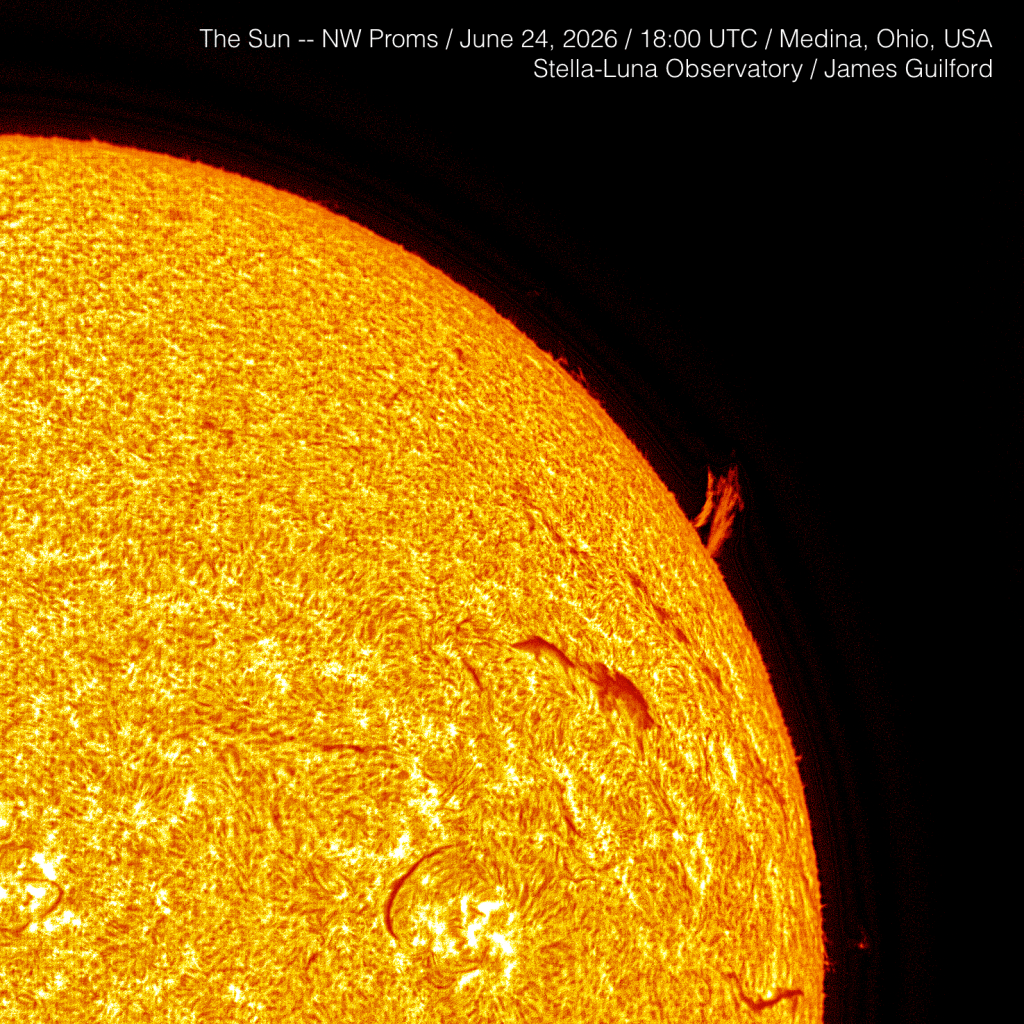
The morning was filled and, though it is best to observe Sun before the heat of the day sets in, the skies were still clear this afternoon so we opened the dome. Happily, there were points of interest, particularly the two plumes of prominences on the northwest rim!
Just emerging over the eastern limb (left edge, above) is a large sunspot which should prove interesting to observe, the next time we enjoy clear skies here!
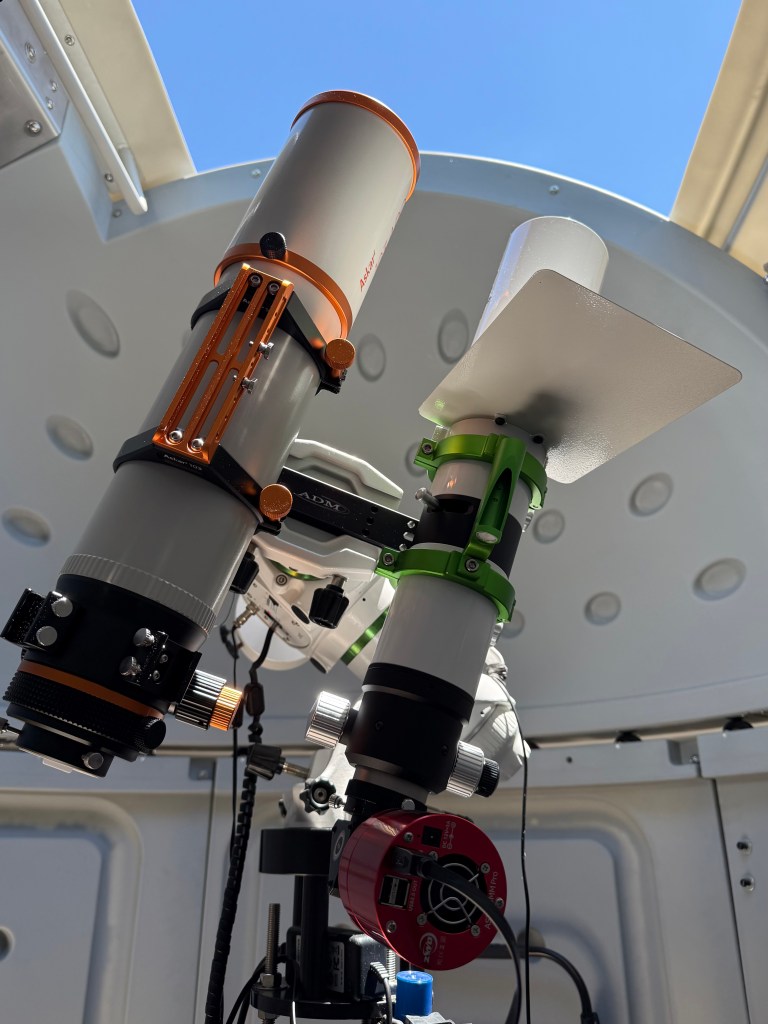
This was also our first use of a new bracket that allows side-by-side mounting and simultaneous use of two telescopes on the pier. The apparatus, made by ADM Accessories, and purchased from High Point Scientific, is sturdily-built and not excessive in weight. Presently we have the Askar 103APO and the Sky-Watcher 76Ha scopes up but will likely experiment with other configurations.
Two telescopes are installed side-by-side on the observatory mount and pier employing an ADM Accessories mounting system purchase from High Point Scientific. The arrangement allows use of two telescopes simultaneously or separately without the need for rebalancing or alignment when switching between them.
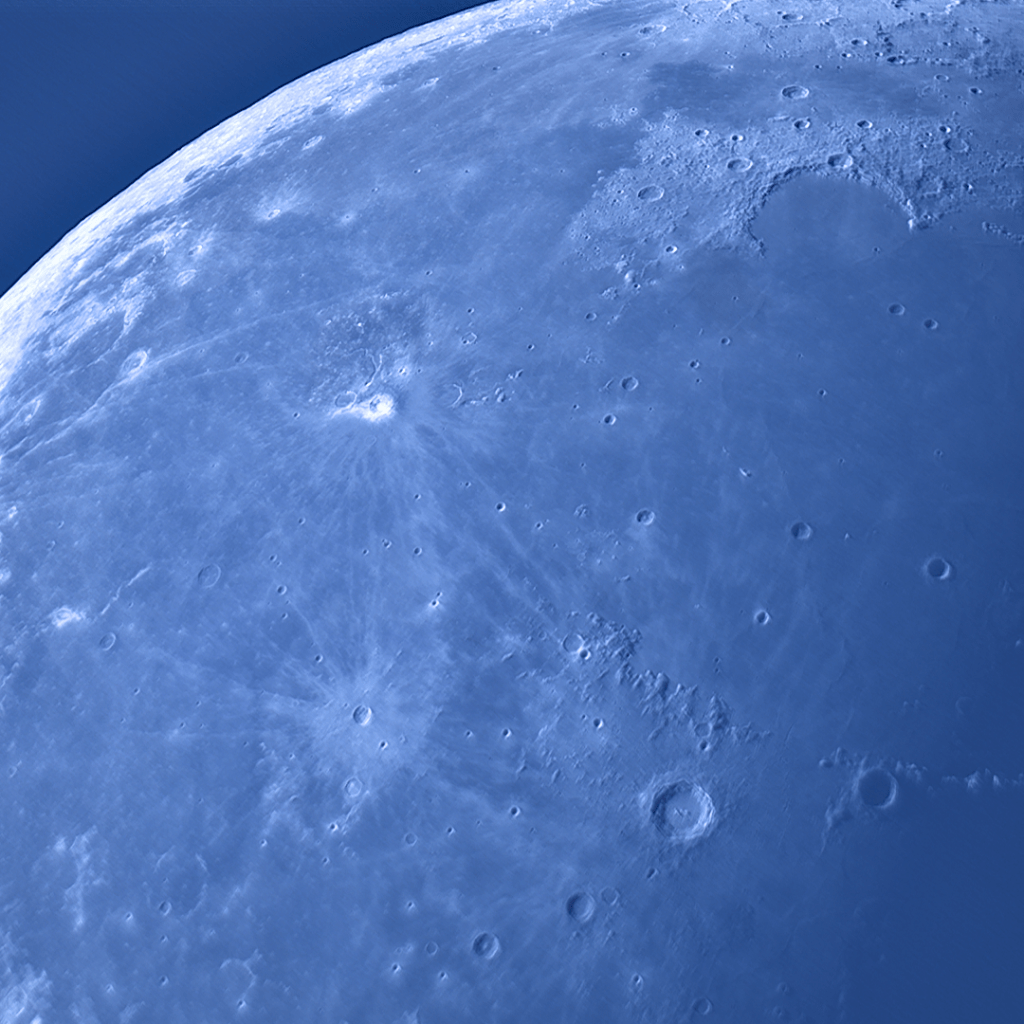
The northwest quadrant of Earth’s Moon, viewed during morning daylight reveals many wonderful details with an appearance that differs from nighttime views in more than just color. A few points of interest: The crater with impressive ejecta rays at lower left is Kepler; to its right is large, distinctive Crater Copernicus with its central peaks. Just above Copernicus are the peaks of Montes Carpatus. The bright spot at upper left is Crater Aristarchus with Herodotus, just to its left. Finally, at the upper right corner, is the distinctive C-shape of Sinus Iridium.
This morning, before stowing equipment for the duration of upcoming days of cloudy weather, we aimed the 11-inch scope at Earth’s waning gibbous Moon. Images were captured at about 7:50 AM EDT, after the sky had turned to blue, lending its color to Moon as viewed from Earth.
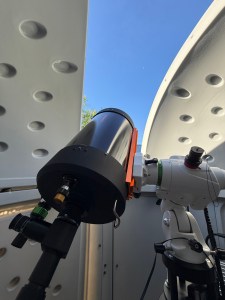
Celestron 11-inch telescope is shown aimed at Moon — a tiny white dot — in the clear, blue morning sky.
The big Celestron SCT remains in need of adjustment or, possibly, overhaul but does deliver some pleasing results! We’ve been struggling but have not yet achieved best acceptable collimation, so the scope hasn’t spent much time on the permanent pier in the observatory.
The sort of flaw that one will see from telescopes that are out of collimation — alignment of the light path within the telescope — is stars that look a bit like comets, and focus difficulties. After several efforts we are not where we need to be with the C11 to use it as our primary observatory instrument.
Unfortunately, due to lack of space, we can have only one telescope at a time on a permanent mount beneath the dome. We are considering next steps which include acquisition of a new primary telescope, upgrading of the mount, and means of mounting two instruments at a time on the pier.
As mentioned, cloudy, rainy weather is expected to be the rule for the week ahead so the telescope is parked, and accessories stowed. We’ll be working a bit on our meteor camera and thinking about where to go from here.
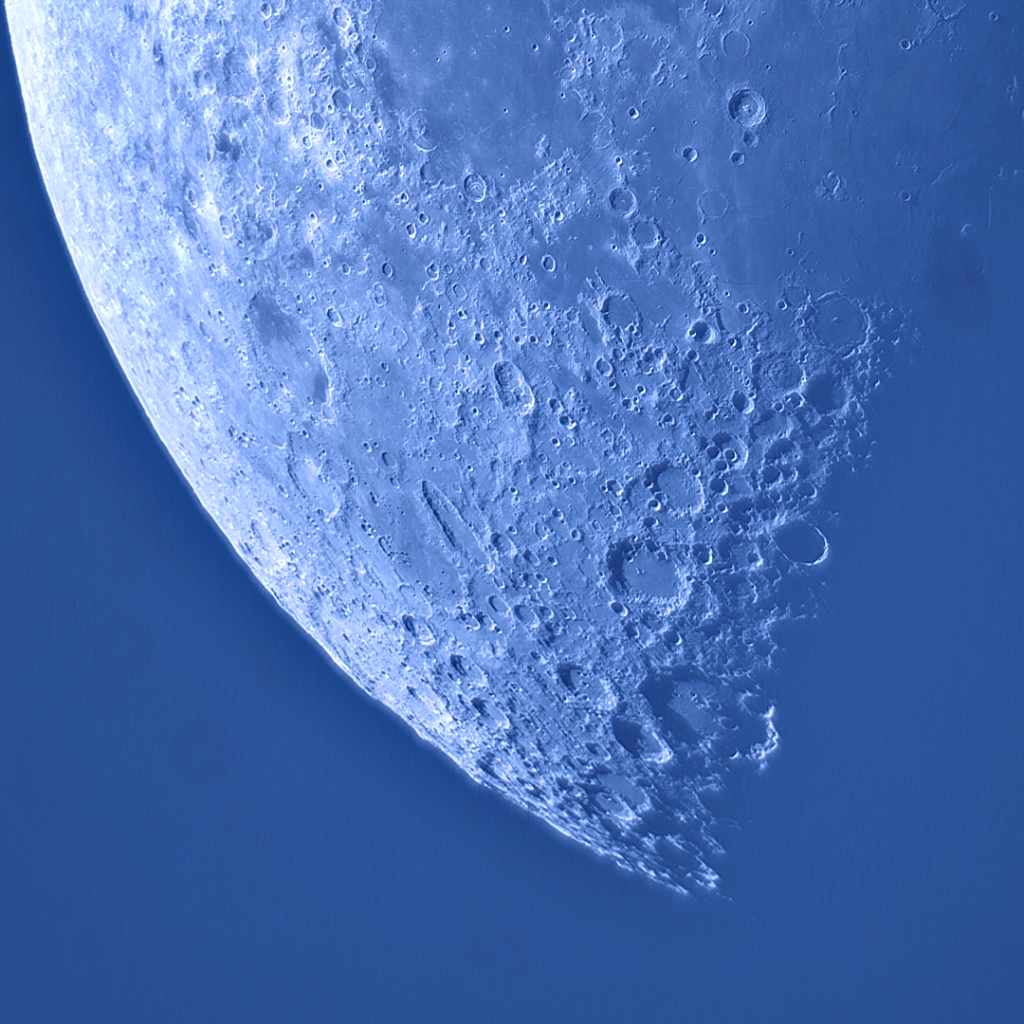
Our favorite image from the morning’s “Daytime Moon” efforts shows Moon’s heavily-bombarded southwest quadrant: craters, within craters, within craters. As with the other blue sky image shown here, this one is darker and more vivid than its actual appearance; we couldn’t resist giving the picture a bit more “snap” to bring out detail.
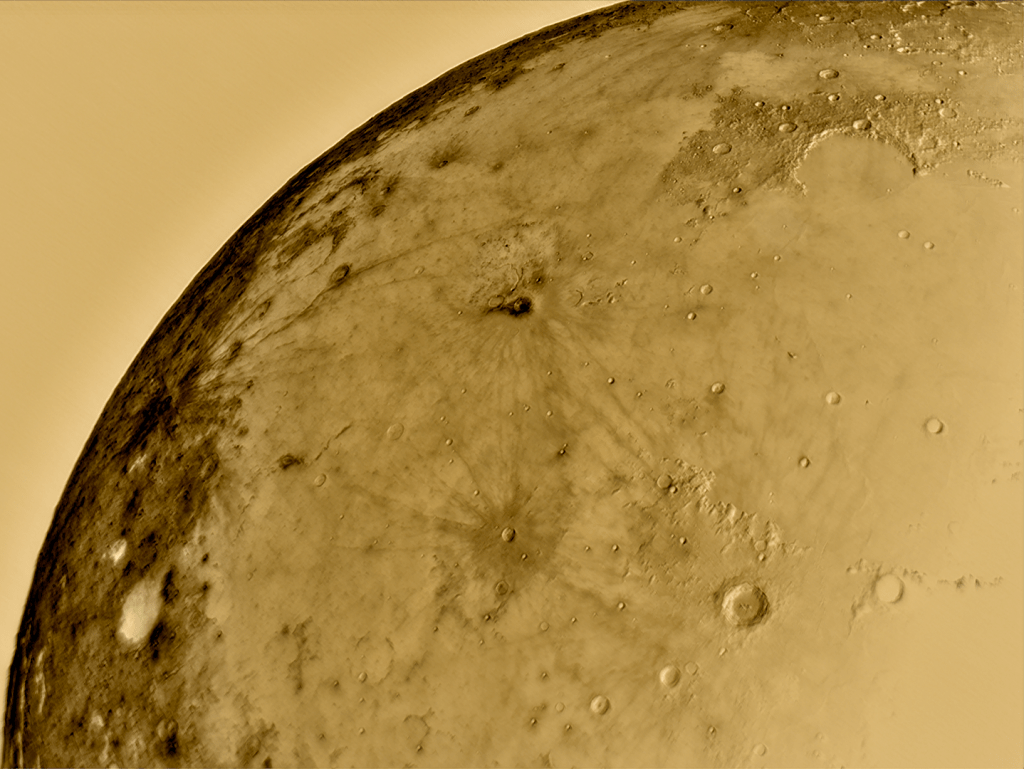
This image of the northwest quadrant of Earth’s Moon shows the image as a photographic negative — amber in color, not blue as in a previous post. Ejecta rays are especially visible around Crater Kepler, near the center of this picture. We enjoy images like this because they feel like a throwback to the early days of astrophotography, and because they tend to reveal delicate details — I mean, just look at the ejecta rays around the craters, especially Kepler just below center of this picture.
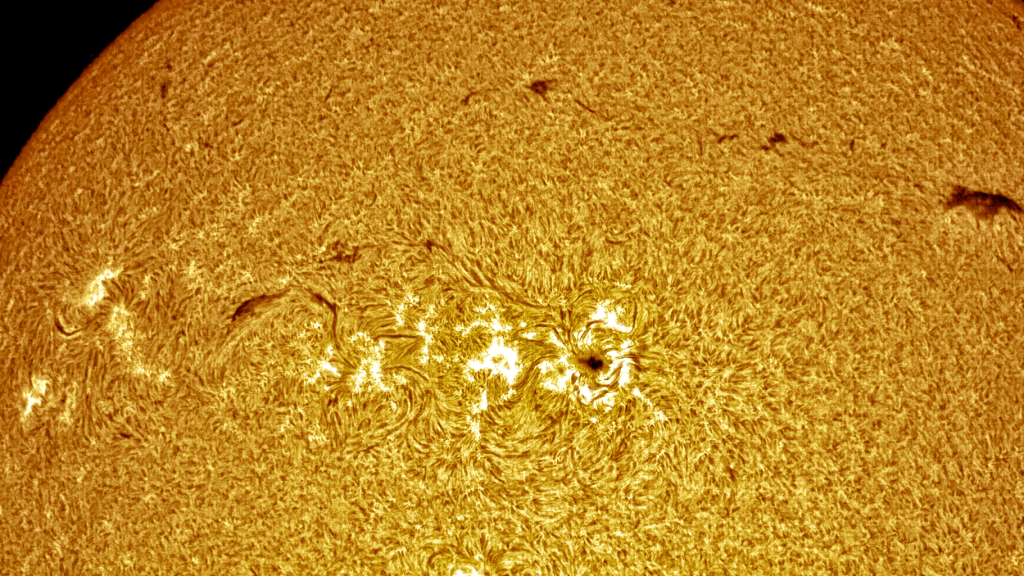
Active Region 4455 as it appeared at 13:55 UTC on June 2, 2026. Viewed via hydrogen-alpha light, the chromosphere has a mottled appearance due to magnetic field lines affecting the distribution of Solar plasma. Image by James Guilford
June 3, 2026 — Multiple flares with associated coronal mass ejections (CMEs) have been observed over the past 24 hours, originating from Solar Active Region 4455, shown here. “Closely-spaced impacts on June 5th could produce strong G3-class geomagnetic storms,” reports SpaceWeather .com, “with auroras in Europe and the USA at mid-latitudes.” Of course, we are expecting cloudy skies, here in Northeast Ohio, when the aurora may occur. #spaceweather#aurora#sun#sunspot#solarastronomy#astronomy
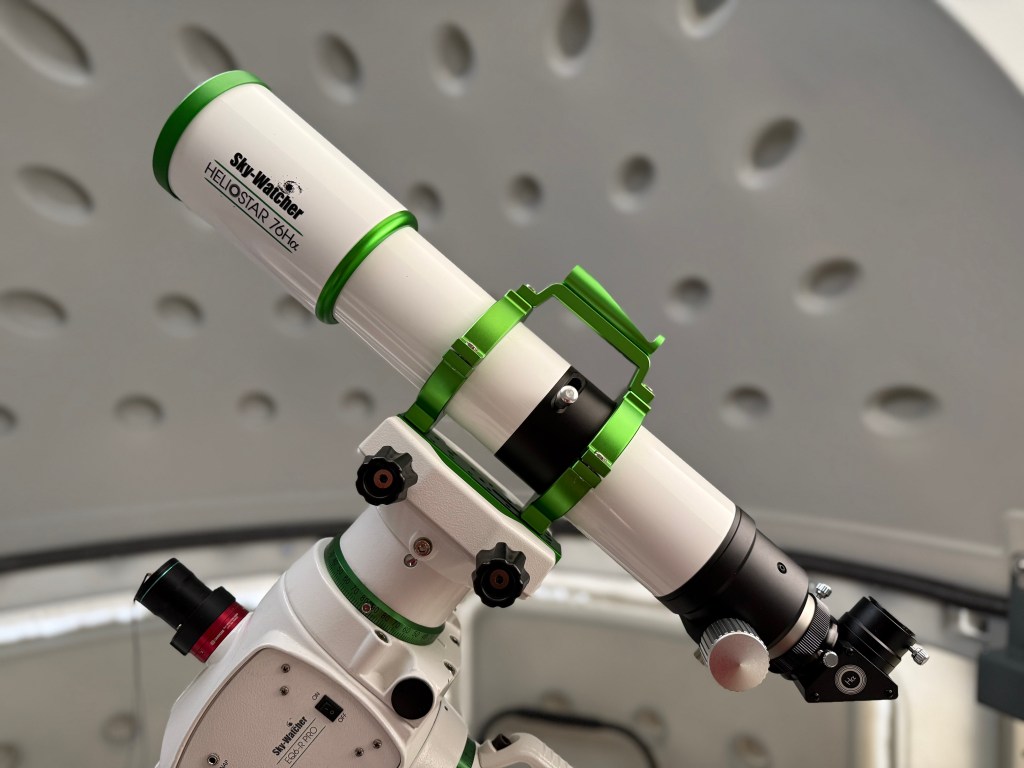
Our Sky-Watcher HelioStar 76Ha Solar telescope mounted on the observatory’s permanent mount. The focuser, for those new to these things, is operated via the silver knob seen at the lower end of the telescope. Photo by James Guilford.
A couple of days ago, during a rather ambitious solar imaging session, the focuser on our Sky-Watcher HelioStar 76Ha telescope failed. And by failure, we mean the specialized diagonal that holds an eyepiece or camera would not stay put! The focuser would barely move the assembly and, once released, the diagonal plus camera would … zzzzzzip! … slide outward as far as it could. As one might expect, that sort of thing makes the telescope worthless. Disappointment? Disaster?
Contacting Agena Astro, the telescope’s seller, their rep. reminded us that the unit was still under warranty and supplied contact information for Sky-Watcher USA’s Support. Sending off an email describing the issue we waited a reply. “Sounds like the focuser might need to be adjusted,” came the reply a short time later. “Don’t worry we have a lot of adjustment with this focuser.” Adjusting three screws on the telescope, as instructed, and within five minutes the system was working good as new!
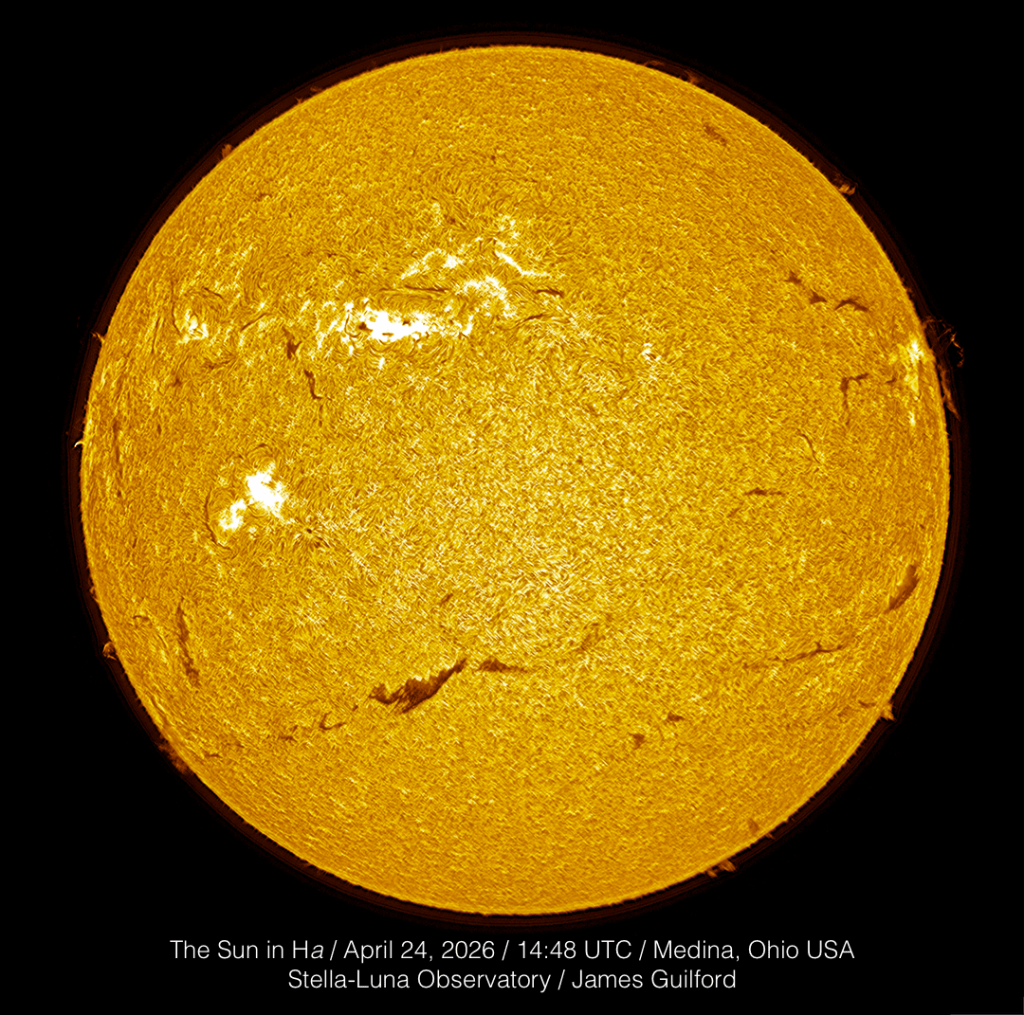
The Sun as it appeared via hydrogen-alpha light on April 24, 2026; as imaged using the Sky-Watcher HelioStar 76Ha Solar telescope, and a ZWO ASI monochrome camera. False color applied. Image by James Guilford.
So there was a little scare. Excellent support provided by the retailer and the manufacturer. A quick fix. And we were able to take advantage of excellent conditions today, making images of our local star! Thanks go out to Agena Astro and Sky-Watcher USA!
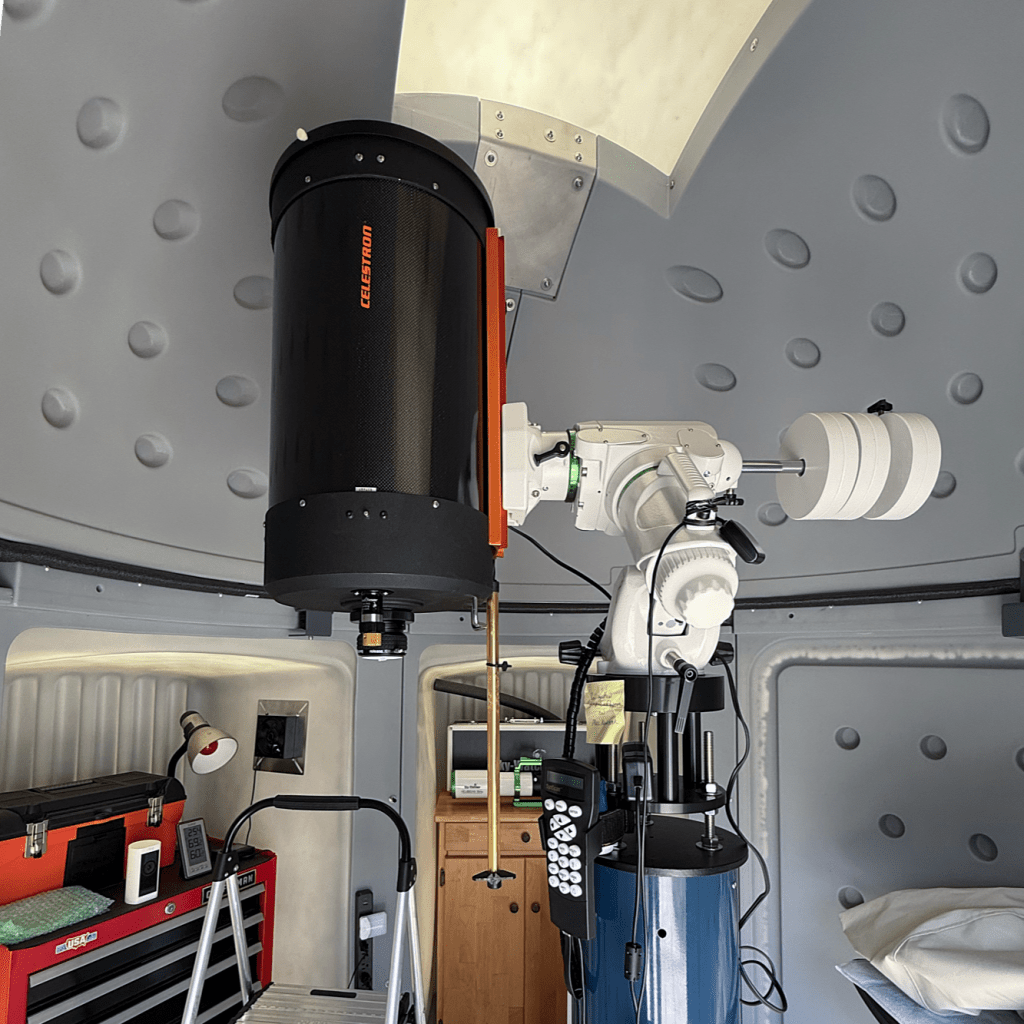
The Celestron C-11 telescope immediately after installation on the observatory mount, pointing straight up during balancing efforts.
Last night we finally had an opportunity to check out the C-11 in the observatory. The 24-year-old scope had languished in storage for maybe a year or more after daytime collimation efforts without real world tests.
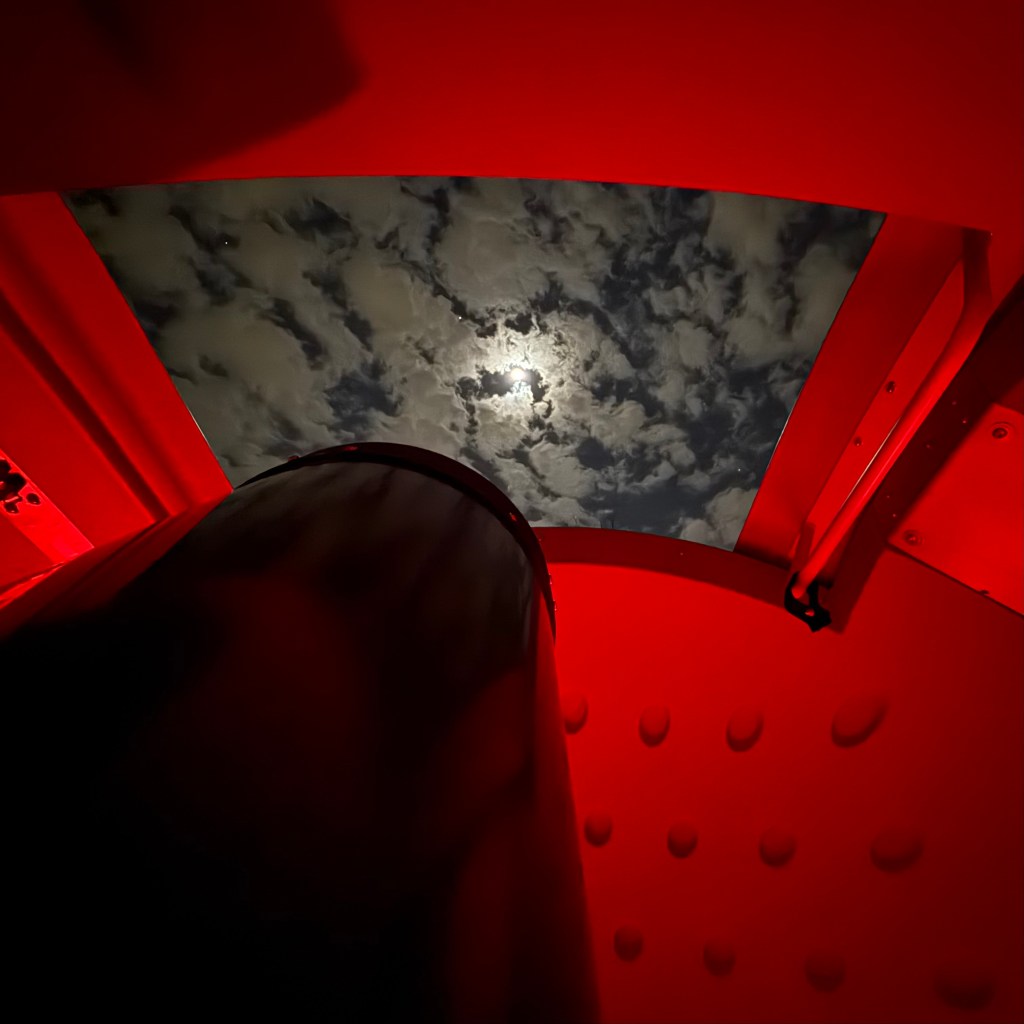
The black tube of the telescope points up, through the red-illuminated dome interior, towards a mostly-cloudy sky. Our First Quarter Moon shines brightly through the clouds. A bright speck of light is visible above and to the left of Moon; it’s planet Jupiter and clouds closed in before we could take a look through the telescope!
The sky was mostly clear until, of course, we opened the dome. Viewing Moon through “sucker holes” between clouds, things looked great. We attached the DSLR and shot some tests; things looked okay, if a bit dark through the viewfinder, though not outstanding. Clouds closed in solidly before we could reinstall an eyepiece and take a really critical look. We closed up. Checking the images on the computer we discovered all of them out of focus.
There is the possibility the camera did not interface well on the telescope. Perhaps the atmosphere in those sucker holes was shaky. We’ll check again and collimate on the next clear night.
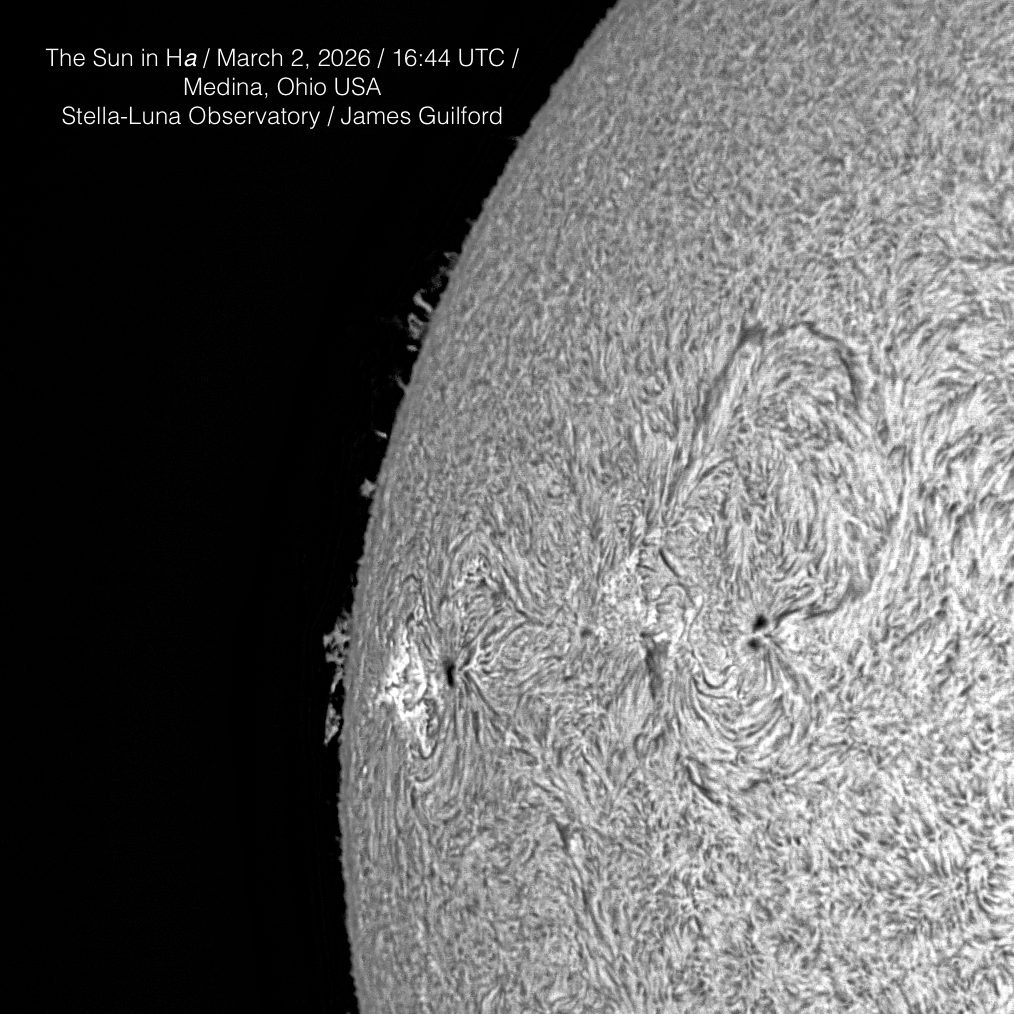
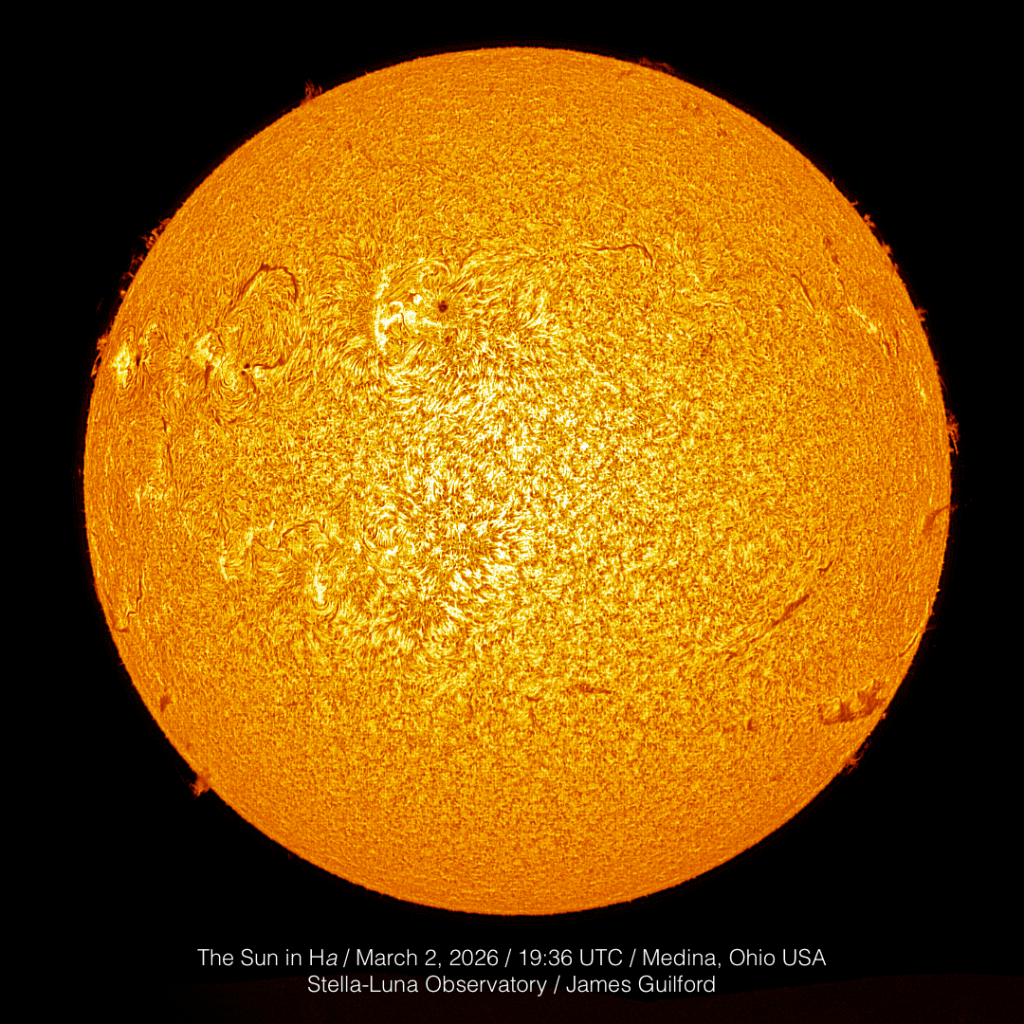
This image depicts the northeast quadrant of our Sun, as recorded the morning of March 2, 2026. The data collected were in hydrogen-alpha light and depict well the turbulent curves in the chromosphere resulting from Solar plasma interacting with strong magnetic fields surrounding two sunspots shown here, left to right: Active Regions 4384 and 4381. Several tenuous prominences are found along the rim of the circle. This is a non-colored monochrome image. // James Guilford, Stella-Luna Observatory
It was the last sunny day expected for, likely, a week so we had to get out and image our Sun. Well, we would have done it anyway! Seeing conditions were forecast to be better than average but at midday, when we have our first clear shot at Sun, the atmosphere was stirred up and shaking our view. Still, the miracle of “lucky imaging” came through and we were able to make passable pictures from the image data. Interestingly, the sunspots at Active Regions 4384 and 4381 are the remnants of the giant sunspot formerly known as AR4366 surviving a trip around the far side of our star! Sunspots, by the way, receive new designations when they are first observed appearing over the eastern horizon even if they were previously observed as they disappeared over the western edge.
Both of these images were the result of data stacked in ASI’s VideoStack application. The image above was then processed only in Pixelmator Pro. The image below was processed in PixInsight/Solar Toolbox, and Pixelmator Pro.
An image of our Sun taken in hydrogen-alpha light reveals a turbulent chromosphere, marked with a few dark filaments. Three sunspots are found in the left-hand portion of the disk though difficult to see via hydrogen-alpha. False color has been added to this image. // James Guilford, Stella-Luna Observatory
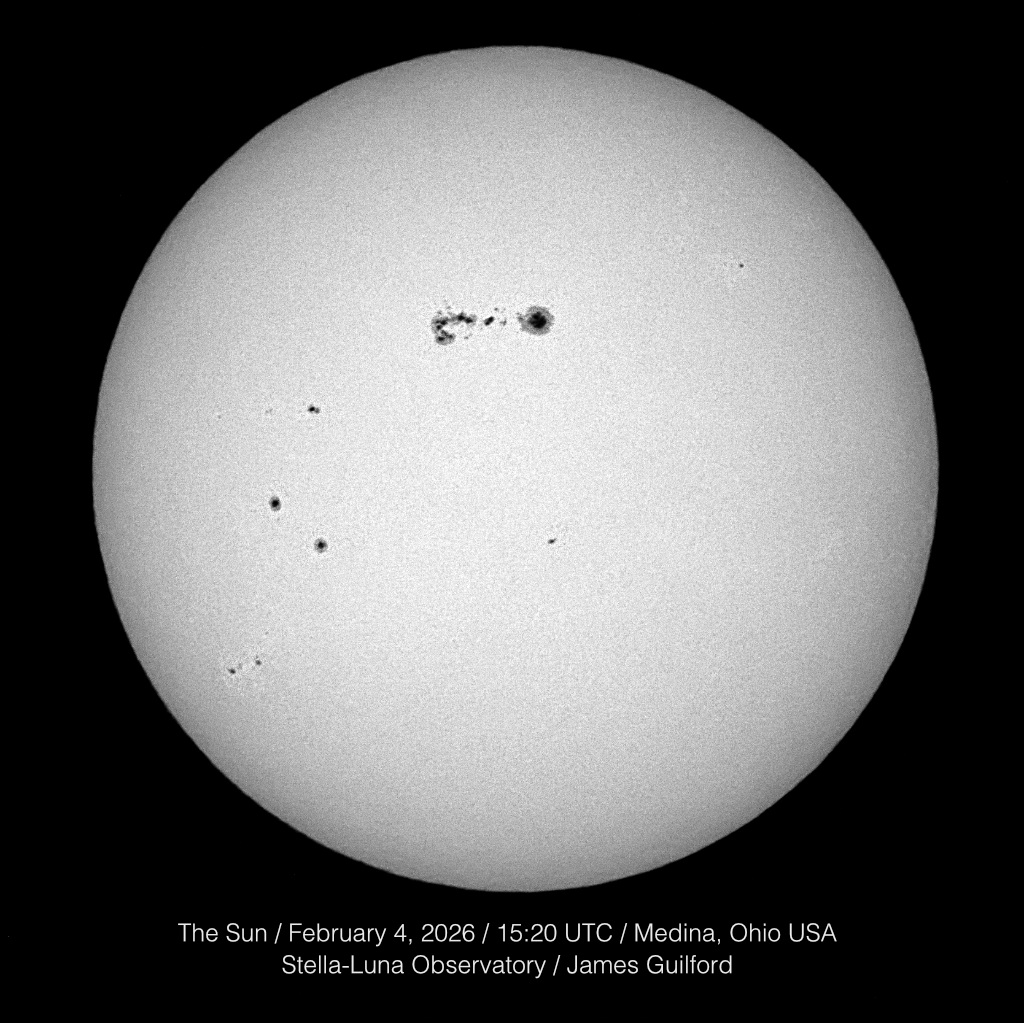
Shown in white light is our Sun as it appeared on February 4, 2026. A large sunspot, designated Active Region 4366, drew much attention as it transited the surface, issuing flares along the way.
On sunny days, this winter, when it’s not bone-shatteringly cold, we’ve been imaging Sun. In white light, we’ve tracked the progress of a couple of impressively-large sunspots as they traversed the Solar photosphere, including one designated Active Region 4366 that drew global attention in late January and early February 2026. We’ve also been observing in hydrogen-alpha (Ha) light.
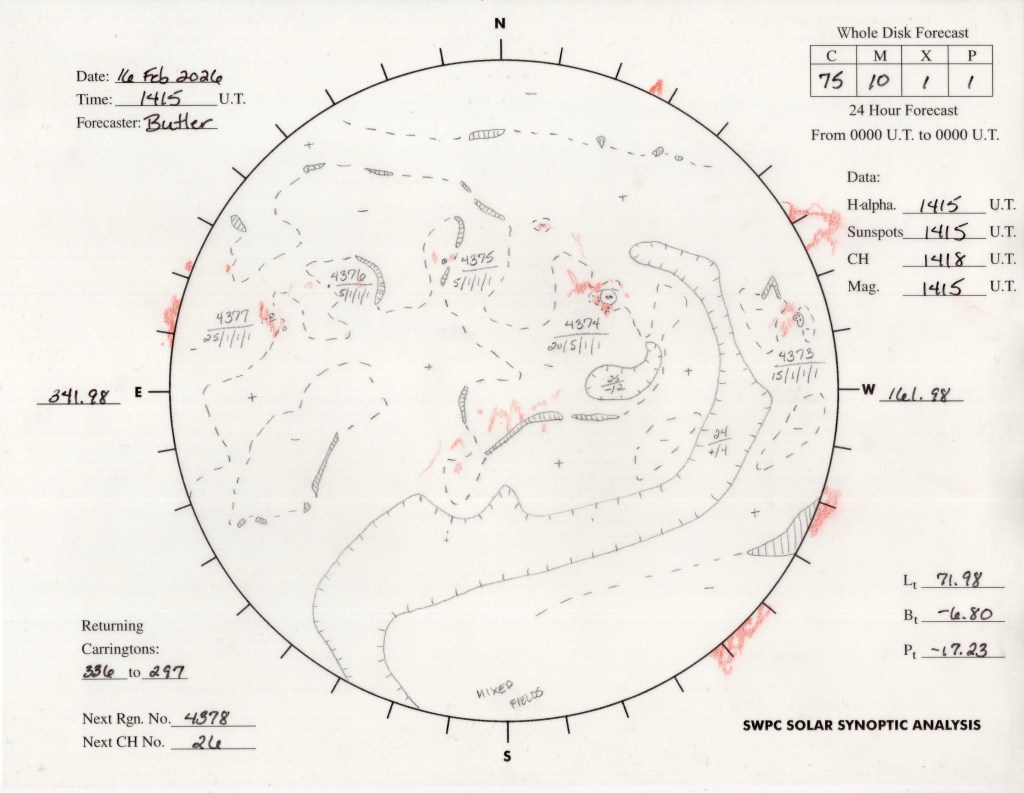
The NOAA SWPC Solar Synoptic Analysis map showing Sun on February 16, 2026.
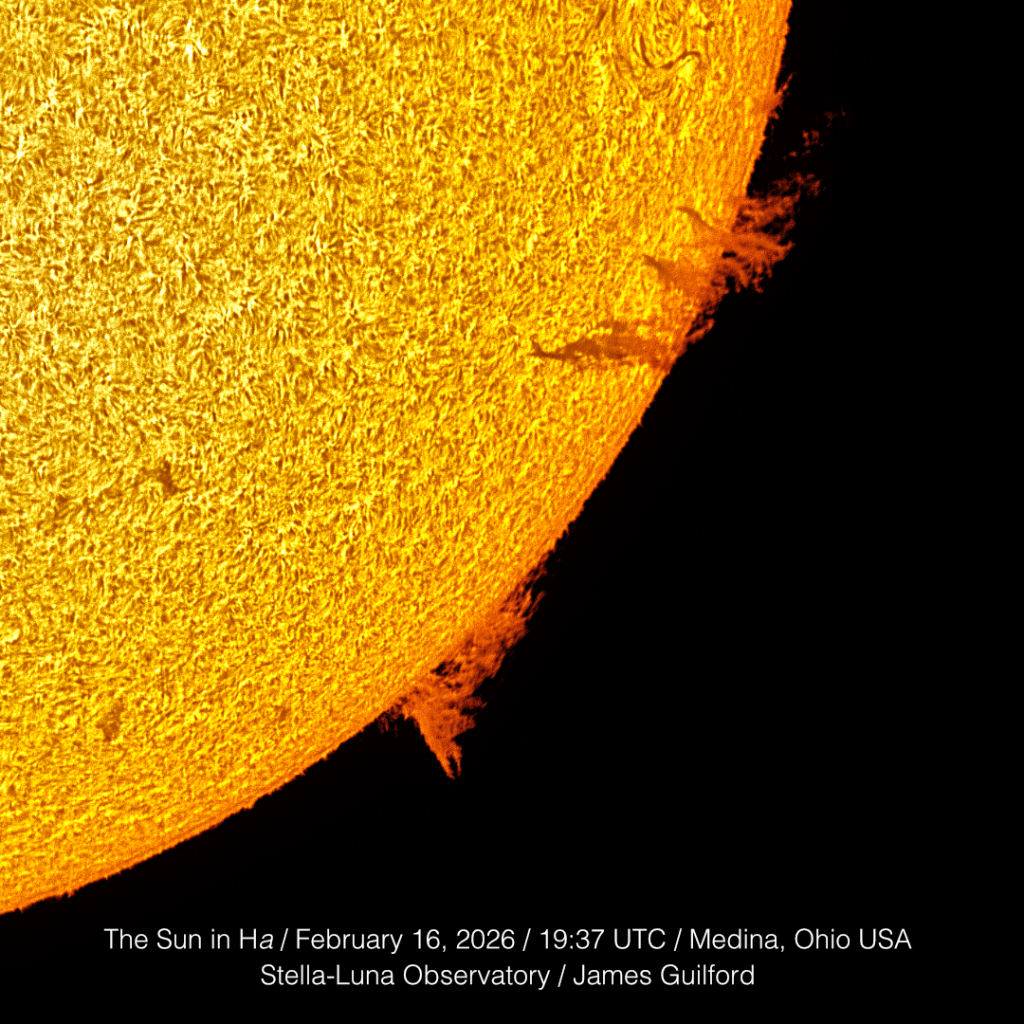
On sunny February 16, we checked the NOAA Space Weather Prediction Center’s daily Synoptic Analysis map for targets of interest. Yes! The map indicated several prominences around Sun’s rim so, a great day to see what was out there.
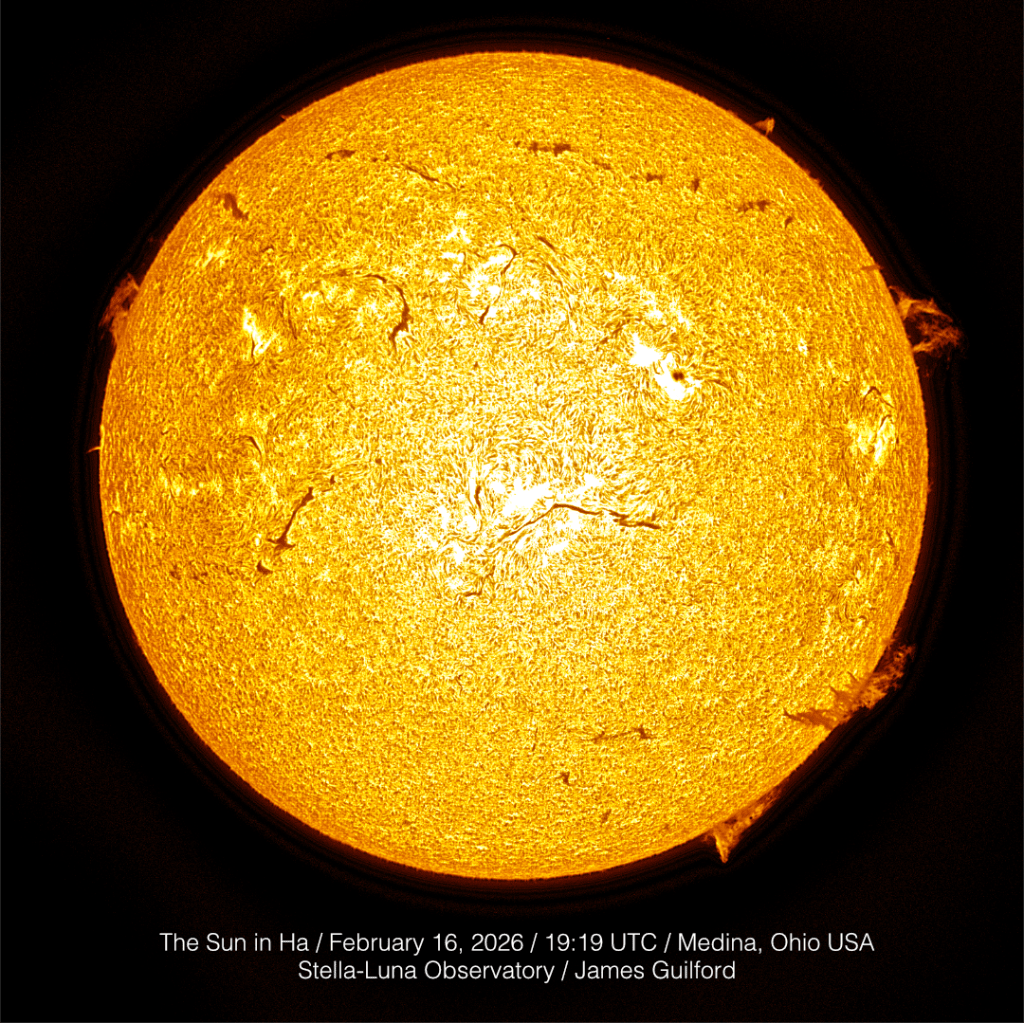
The full-disk image of Sun as it appeared in hydrogen-alpha light. This is a monochrome image original with false color applied. The “filaprom” is located at about the four o’clock position on the disk.
While an arch-shaped prominence at about the two o’clock position was our original target, as soon as we looked through the telescope’s eyepiece we saw it — a filaprom! What’s that? The snake-like features that appear in Ha are called filaments. If a filament bridges the Solar limb, its true nature is revealed: it’s a prominence, appearing as a dark filament when viewed against the bright chromosphere, and as a bright prominence when contrasted against the blackness of space — a filaprom! It was a first for us and delightful to observe!
Close-up view of the filaprom, near the top of the arc. Lower on the curve is a prominence issued from a position just over the Solar limb. Near the left-hand portion of the frame is a filament feature — a prominence viewed against the bright Solar chromosphere.
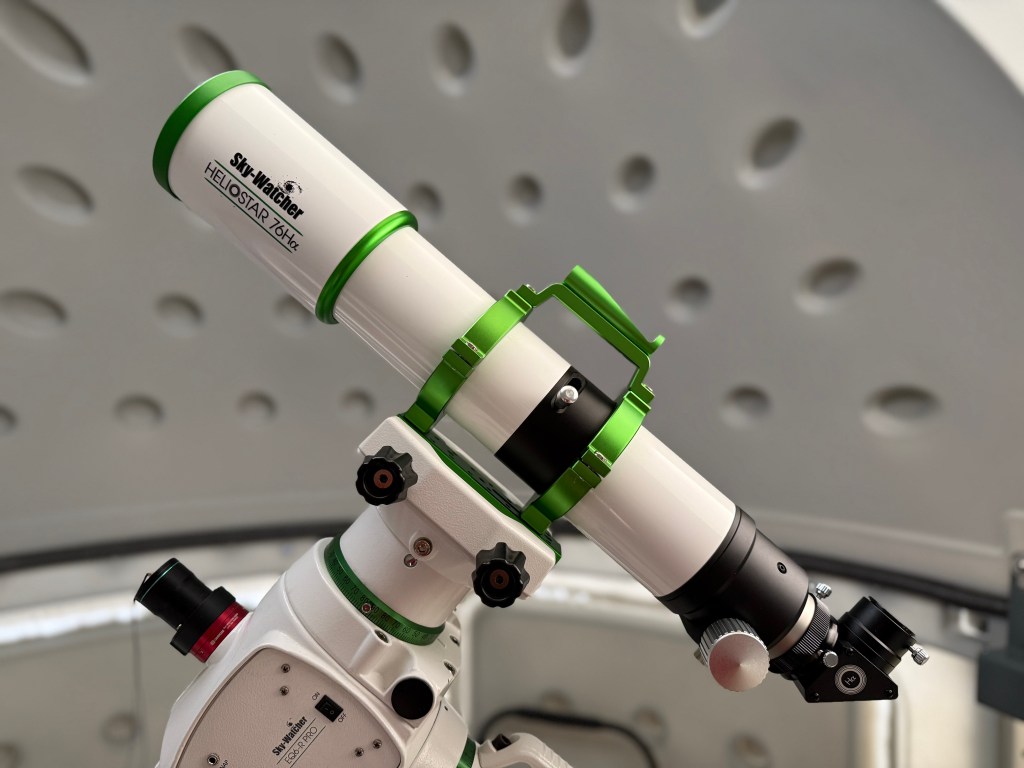
Improvements in instrumentation and processing skills helped with both the capture and depiction of our nearest star’s activities. We recently upgraded to the relatively-new Sky-Watcher Heliostar 76Ha telescope and that has made a huge difference in visualizing the chromosphere. The telescope’s filtering system, with a “single-stack” arrangement, is capable of 0.5 Angstrom or better which really brings out detail — stronger image “signal” produces image data that are easier to process and edit. More about the telescope another time.
The Sky-Watcher Heliostar 76Ha telescope in its parked position beneath the observatory dome.
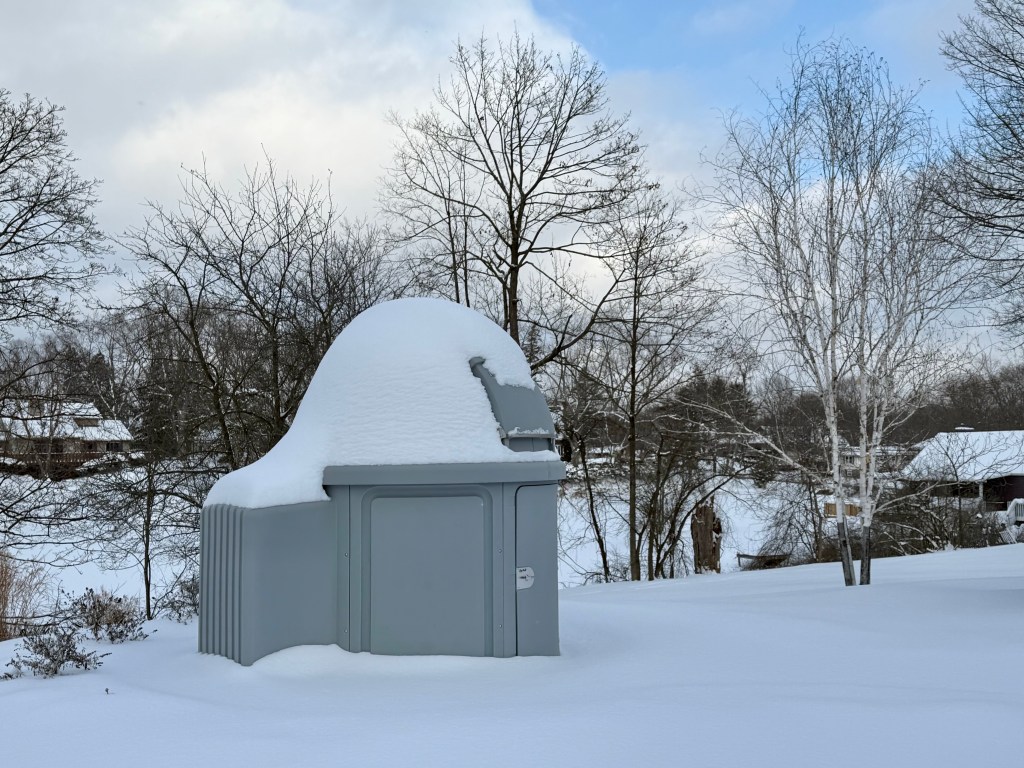
The gray observatory is surrounded by accumulated and drifting snow. The dome itself wears an extra dome of accumulated snow.
Recent arctic-air frigid weather has brought real winter weather to our region for the first time in a few seasons. Snowfall over the past 48 hours amounted to 10 or 12 inches of light, flaky, fluff. Nighttime below-zero low temperatures have erased any thought of going out; skies have been cloudy, anyway, preventing guilt and regret. So the dome remains sealed though pointed to the south for midday solar observations. If we ever see Sun again.


 Stella-Luna Observatory