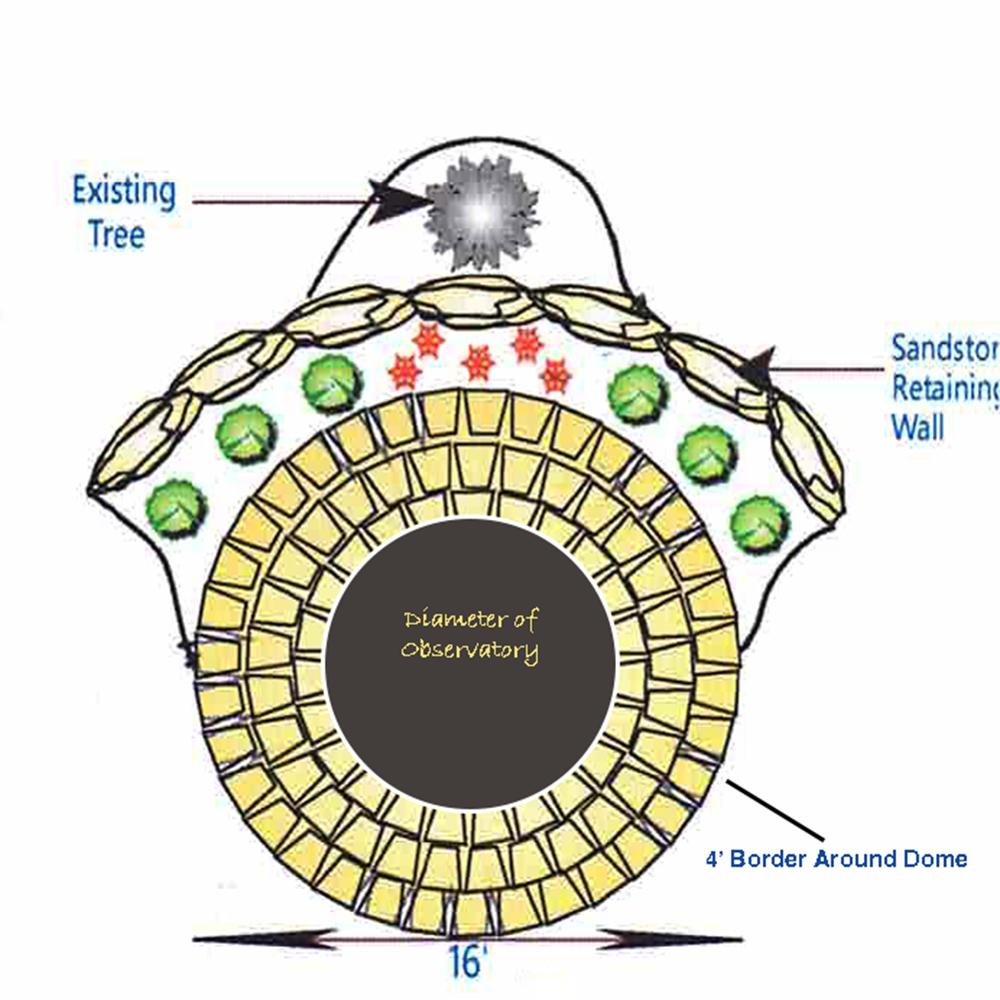
The round patio seen here will form the base and floor of the observatory.
The landscape contractor promised, at the end of last season, that they would return to finish work on our observatory patio. Remaining to be done is installation of polymeric sand in the “grout” lines of the patio pavers. The material will be swept in to fill the gaps between the paver stones with enough getting beneath them to make them stable — the stones rock a bit now when walked upon. We’re told the weather must remain above freezing and the concrete surface beneath the stones must be dry in order for the polymeric sand to properly fill the spaces and cure properly.
One manufacturer wrote this about the benefits of their product: “Polymeric sand is appreciated by paver installers because joints you get from it are durable and even. This eliminates any risk of weed growth and ant infestation that could affect the overall aesthetics and durability of paver projects.” — Techniseal.com
We are likely now beyond freezing temperatures until this fall. Now we await a stretch of dry weather and it may be a while — it has been a very rainy spring!
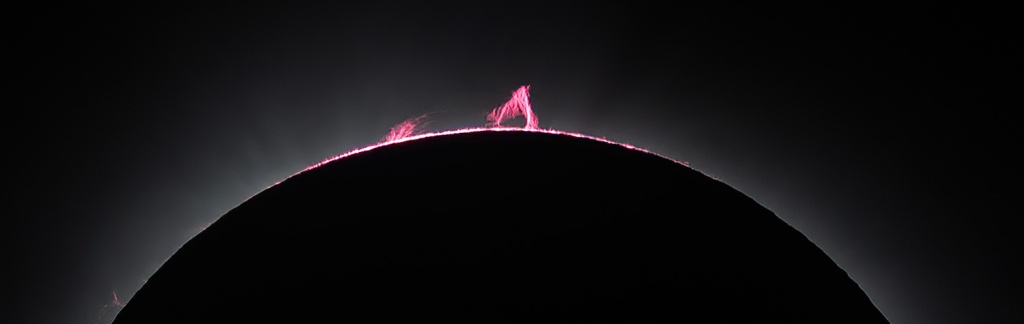
Many eclipse watchers were, with unaided eye, able to see the bright pink or red prominence shown here in our heavily-cropped image of the April 8, 2024 eclipsed sun. The prominences appear red because they are composed primarily of hydrogen which, at high temperatures, emits red light. Image rotated to place the prominence at top for aesthetic reasons. Image Credit: James Guilford / Stella-Luna Observatory.
While we very much wanted to view and photograph Sun’s corona during the April 8 total solar eclipse, a blanket of high, thin cloud covered the area blocking faint details. We were, however, able to observe and image the bright inner corona and prominences (“proms”) along the rim of the eclipsed Sun and what a show it was.
Sun is in the active phase of its 11-year cycle and, during totality, prominences were expected and seen in various sizes and at several sites around the rim. The largest was easily spotted with the unaided eye, causing questions from casual observers as it brightly shined at about the six o’clock position of the eclipse ring as viewed from North America. We were delighted with the images of proms that we were able to acquire!
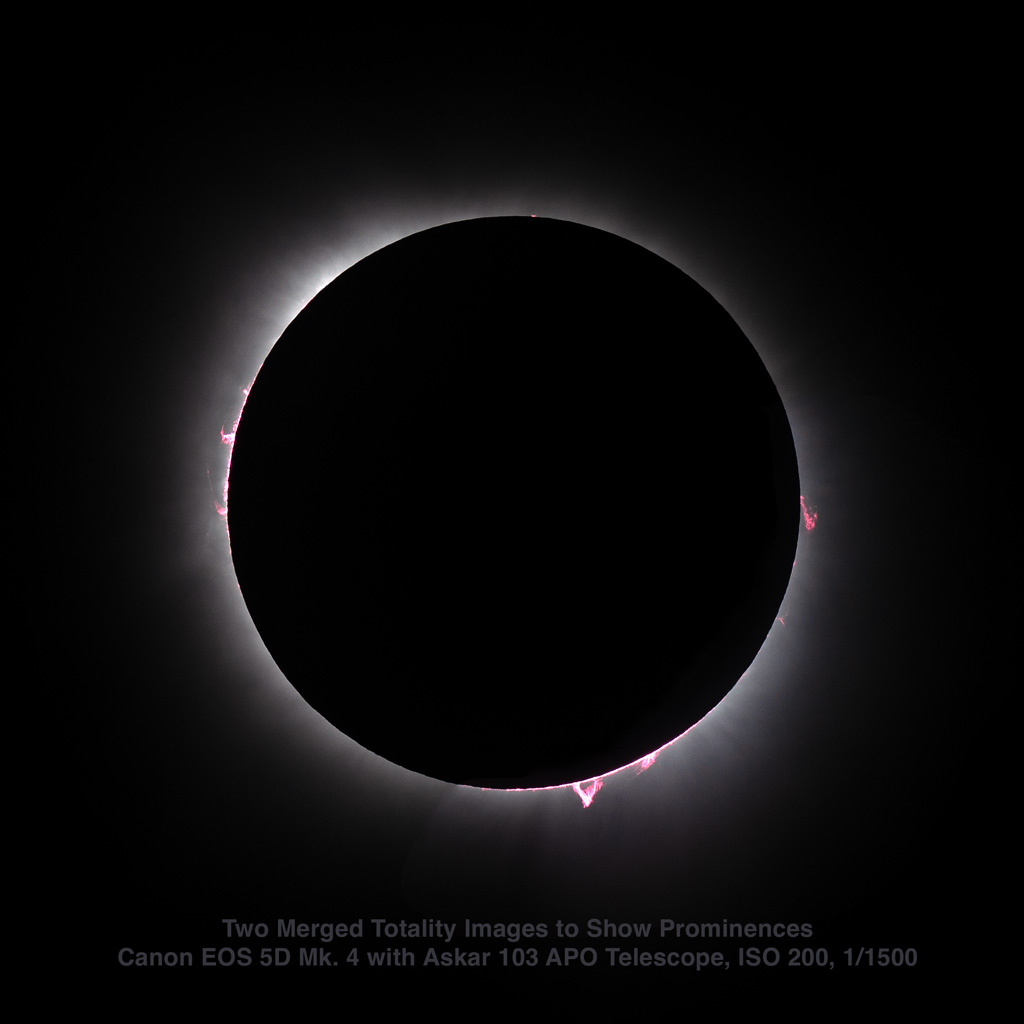
As Moon drifted across Sun during totality it, in turn, covered and exposed different regions of Sun’s limb. To give a fuller impression of prominences seen, we grafted two of our images from totality into one picture; one image was recorded just as totality began, the other as totality was about to end. The resulting picture is not a view one would have had but does correctly illustrate the position and visual size of the proms.
Two images of totality are combined here to illustrate the visual size and placement of promiences exposed during totality of the April 8, 2024 total solar eclipse. The large loop of the prominence near the six o’clock position was easily spotted with the unaided eyes of many, adding to the wonder of their eclipse experience. Image Credit: James Guilford / Stella-Luna Observatory.
Observers in Northeast Ohio were fortunate. Although the morning began with heavy cloud cover, skies cleared and allowed decent viewing of the eclipse in its entirety. Temperature drops were easily felt as bright daylight transitioned to an eerie twilight. As totality began, cheers of awe could be heard from gathered eclipse watchers at a nearby organized event. Automatic street lights illuminated. A robin was heard singing its evening song. Sunset colors lit the horizon about three-quarters of the way around us. In the southwest, beneath the eclipsed Sun, the horizon appeared dark. And then, as bright sunlight returned, first via a brilliant crescent, then by an expanding and warming solar disk, it was over. Those we spoke with were delightedly awestruck having had the experience of a lifetime.
Following are several images of Sun as the eclipse began, during the partial phase, and as it ended. Times are expressed as UTC and were recorded automatically by the camera, set via GPS. Observers in different areas will have seen times that differed from ours and each others due to parallax effects, Moon being much closer to Earth than is Sun.
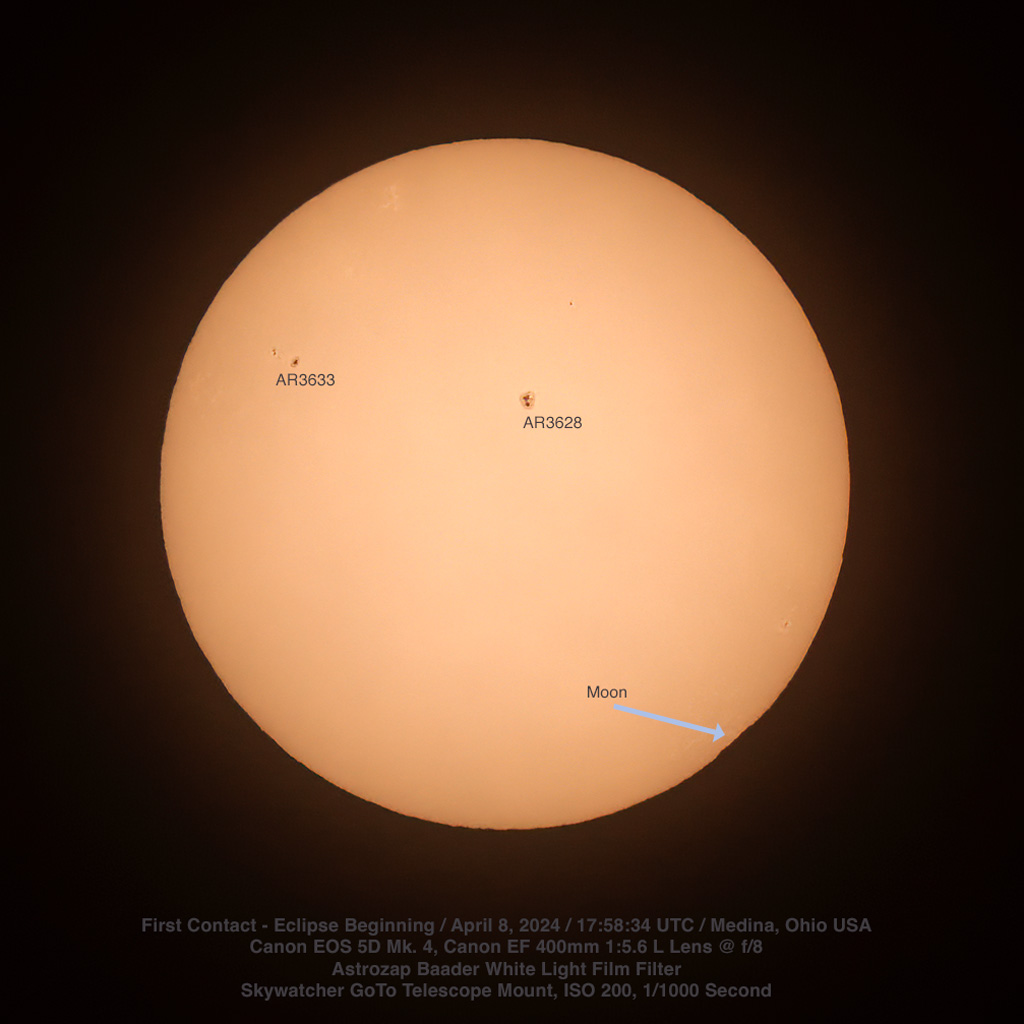
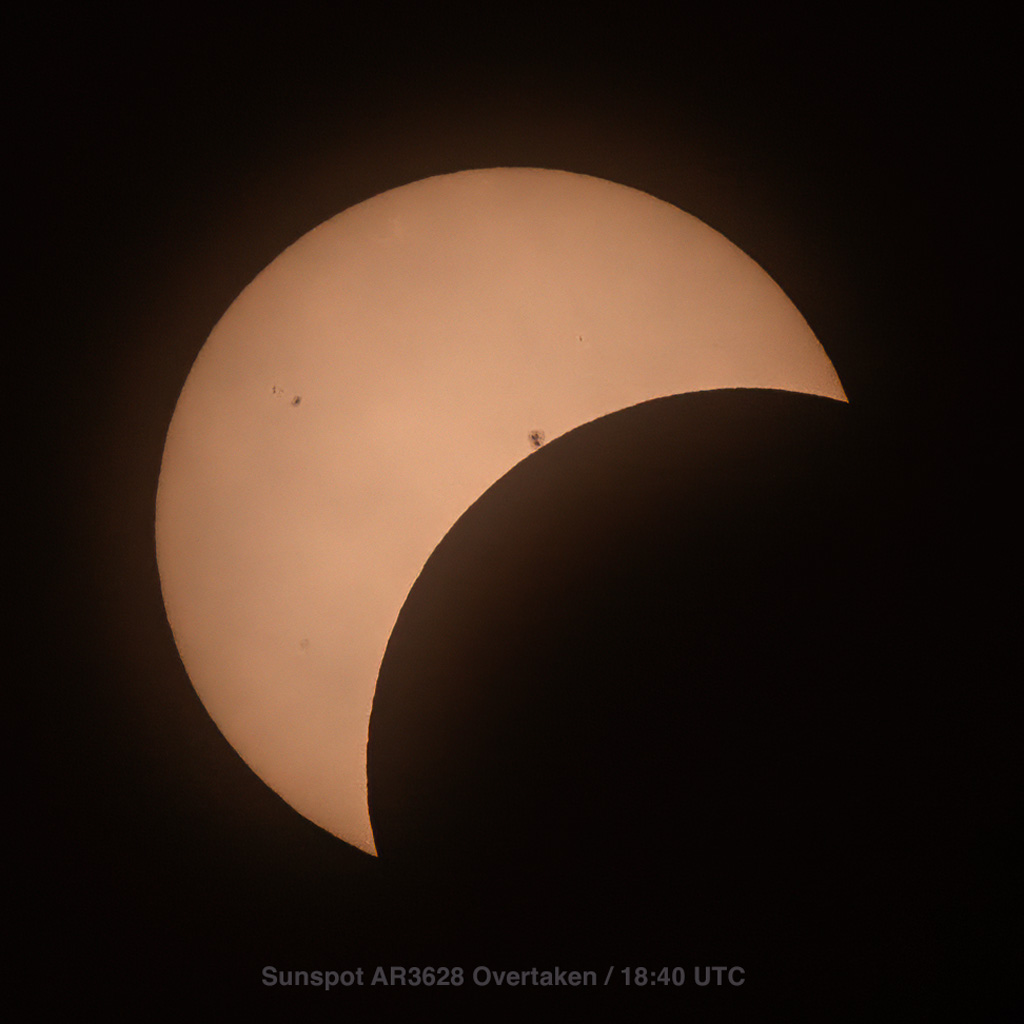
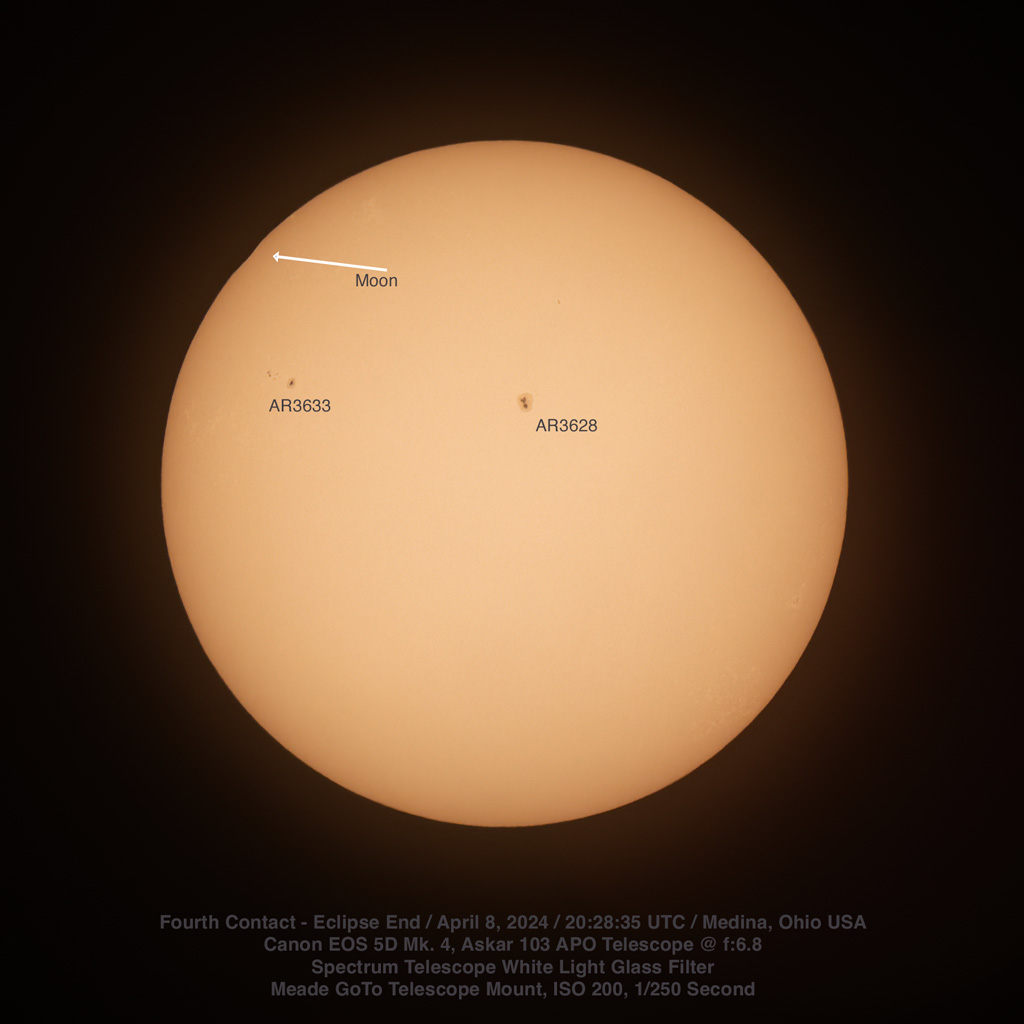
First Contact: The first noticeable encroachment of Moon over the solar disk is shown here. This image was recorded at 17:58:34 and marks the beginning of the eclipse process. Two areas of sunspots are also noted here. Image Credit: James Guilford / Stella-Luna Observatory.Sunspot AR3628 was about to be covered by the silhouetted Moon as the eclipse progressed from the lower right-hand area of this image toward the upper left. This was imaged at 18:40 UTC. Image Credit: James Guilford / Stella-Luna Observatory.Fourth Contact: By this point most casual, and many serious observers, had packed up satisfied with a wonderful eclipse experience. We kept the camera running, just so that this instant could be recorded — the moment when Moon completed its passage in front of Sun, in this picture at 20:28:35 UTC. Image Credit: James Guilford / Stella-Luna Observatory.
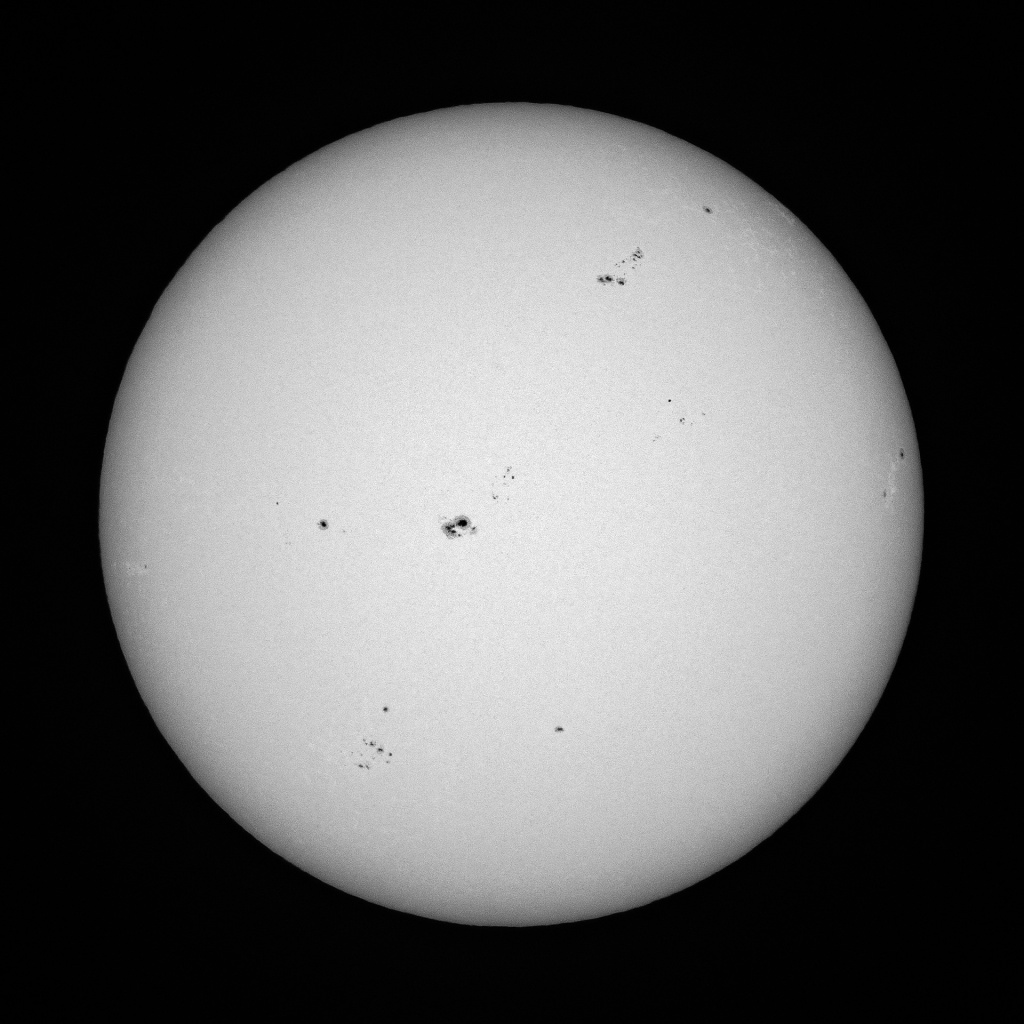
The Sun: March 24, 2024, 15:46 UTC, as seen from Medina, Ohio, USA. Canon EOS 6D Mk. 2, Askar 103 APO telescope @ f/6.8, Spectrum Telescope filter, ISO 250, 1/2000 second.
Taking advantage of a rare day with clear skies, I set up the new-ish Askar 103 APO telescope and got a bit more solar imaging in. The huge sunspot group at the center of the image above is designated AR3615 — it and the isolated sunspot above it (AR3614) exploded in tandem on March 23, directing their CMEs (Coronal Mass Ejections) at Earth. When the CME hit our planet, the result was a severe geomagnetic storm. While not specifically practicing for the upcoming solar eclipse, the experience doesn’t hurt, either! This period of activity makes the sun’s photosphere interesting to observe as features visibly change day-to-day and even more rapidly, if one looks close enough. Sun is nearing the predicted peak of its 11-year cycle of activity which is expected in 2025. That means a couple of more years (at least) of interesting things to see on our nearest star.
On Saturday, October 14, 2023, there will be plenty of buzz about the annular solar eclipse taking place. The eclipse will happen, blue sky or cloudy, dimming the day’s midday light. Here in Medina, Ohio we won’t, however, be seeing the real attraction, the so-called “Ring of Fire”. We will, however, experience a partial eclipse of the sun; about 35 percent of the sun will be obscured by Moon, making Sun a crescent.
Eclipse timings for Medina, Ohio as provided by TimeAndDate.com
What’s an annular eclipse, then? Well, “annular” means ring-shaped, not “annual” as in once a year. The ring, or annulus, we’re talking about here is created by our Moon passing between we Earthbound viewers and Sun covering most, but not all of the solar disk. At its peak, an annular eclipse leaves brilliant ring of sunlight visible, shining around the edges of Moon — the ring of fire. The better-known total solar eclipse occurs when Moon covers all of the solar disk, allowing viewers to see the beautiful haze of Sun’s corona streaming around the dark circle where Moon superimposes Sun.
Solar eclipses take place in three basic varieties: partial, annular, and total and what happens on each occasion is dependent upon the positions of Sun, Moon, and viewer. Why won’t anyone see a total solar eclipse this Saturday? In short, it’s because Moon’s orbit is elliptical, not circular. On an elliptical path Moon will appear larger or smaller from Earth, depending upon Moon’s position on its orbit. We’re fortunate that Moon can so perfectly cover Sun when it’s a bit nearer us, producing glorious total eclipses. But when Moon is a bit farther out for an eclipse and appears smaller, it can’t quite cover all of Sun and that’s when annular eclipses happen.
Moon is near enough to Earth that parallax influences what viewers experience. At the center line of an annular or total eclipse, the full effect of the event may be enjoyed. Stray off that center line (path of annularity, or path of totality) and a partial eclipse is seen. It’s like someone hiding a few steps behind a tree. If the tree is directly in the line of sight of the viewer, the person is hidden. Take a step to one side, however, and the hidden person begins to be revealed. Parallax.
Viewing: Neither those out west nor we here in Ohio can safely view the annular or partial eclipse phases safely without proper gear. ISO-Certified viewers are the gold standard so long as they are undamaged. Eclipse viewing glasses are available from many sources though it’s probably too late to order them in before this weekend’s event. Maybe think about buying some soon for next year’s total eclipse! There is a mix of opinion regarding #14 welder’s glass — they’re probably alright to use if you have them but be careful — welder’s glass comes in different shades and lighter shades may not provide adequate protection!
Do Not Use: Sunglasses of any sort, photographic negatives, Compact Discs, shiny plastic wrapping, etc. for viewing the sun. If you view the brilliant solar disk improperly, damage to your eyes can result and be instantaneous and permanent. If you happen to have solar eclipse glasses from previous events, those would be great to use but examine them first! Hold the glasses close to a bright light source and look for pinholes, scratches, or other damage; if you can see light spots coming through the lenses throw the glasses away!
White light image of Sun. Numerous sunspots can be seen freckling the lightly-textured photosphere. At the east and west limbs of the solar disk may be seen light-colored, jagged tracks called faculae. September 22, 2023. Photo by James Guilford.
September 22, 2023. 17:12 UTC — Shooting Sun today as sunspot AR3435 rotated toward the center point of the disk, viewed from Earth. I also tried my trusty Thousand Oaks Optical Type 2+ glass solar filter on the same setup. I’ve seen some excellent results from the glass filter in the past but there seemed to be a bit of detail lost from the image. Some of the loss may have been from the filter but, perhaps more likely, there may have been a slight shift in focus or instantaneous turbulence in Earth’s atmosphere. I must say, however, while I like the brilliant color of the glass, I love the detail and tonality of the white light film — Astrozap Baader film white light solar filter.
I hope to add a telescope or system to my arsenal, allowing hydrogen-alpha (Ha) viewing and imaging of Sun’s chromosphere and prominences but I have longstanding appreciation for sunspots and hope to also dramatically improve imaging of those features.
These images are single-exposures, not stacked stills or video frames, so I shoot multiple singles aiming for momentary clarity in the atmosphere. I then manually review the frames and select the best single frame(s) for final processing. This day I used a DSLR camera with telephoto lens for the sake of convenience. The same two filters fit my 90mm refractor with a focal length of 1,000mm but using the scope would have meant significant setup; too lazy to do that, I guess.
Technical Information: Tripod-mounted Canon EOS 7D Mk. 2 camera, Canon 400mm f/5.6 L lens with Canon 2X telextender for 800mm and f/11. Mono Image: ISO 500, f/11, 1/1000 sec. Color Image: ISO 500, f/11, 1/800 sec.
The Sun, recorded within minutes of the white light photograph, this time imaged through a glass solar filter which imparted a rich orange color to the picture. September 22, 2023. Photo by James Guilford.
Drawn plan of a patio structure that is to form the base of our observatory. The observatory will be built at the center of the circular paved area while a tapered pathway provides access. An 18-inch Sonotube will form the concrete foundation for a steel pier supporting the telescope.
Today we approved the final design of the patio that will serve as the base of the observatory. With the observatory structure already on-order, it’s now a waiting game. Dates for delivery/construction of these two main components are uncertain, though the landscape work is expected to start in early November. Depending upon how things unfold we may be in a situation where either the observatory arrives before the base construction begins and we rush to assemble before winter, or the base is built and we wait for the observatory. Either way, depending upon timing and weather conditions, the crated components of the structure may wind up overwintering in our garage! We’re running late.
Crater Tycho is featured here, its web of light-colored ejecta radiating in all directions. Celestron C11 telescope with ZWO ASI 294MC Pro camera.
Taking advantage of what seem to be rare clear skies, last night (September 1, 2023) I ran first light trials on the Celestron C11 I was given, in combination with my ZWO ASI color astronomy camera. The telescope, with its decent aperture and long focal length, may become the primary observatory instrument. The results were largely disappointing with no good deep sky results, terrible results from Saturn, and not-so-good images of Jupiter. Even Earth’s Moon, usually an easy target, was barely in focus. It didn’t occur to me to use my Bahtinov mask focus aid — my gear is spread across two buildings and three or four locations! Once built, the observatory should help with organization. I hope to try again this coming week when mild, clear nights are forecast and I hope it is only a matter of technique and not an optical issue.
On the positive side, polar alignment was excellent as was goto control alignment so telescope sky tracking was very good during my efforts — until something caused an unexpected reboot of the telescope controller. I don’t know if dew short circuited a connector or if the connector pulled loose from the handbox but it was disconcerting!
The images shown here are simply interesting to look at, though not the quality I’d normally want to show. The first is youngish Crater Tycho showing off its extensive web of ejecta rays. The second picture includes several lunar “seas” including the “C” shaped Sea of Crisis. Two craters are seen near the left edge of the circle; the lower of those craters is named Picard. No, Star Trekkers, not THAT Picard. Still, a fun fact.
Several lunar seas are shown in this image with the Sea of Crisis, the C-shaped feature, on the right. Within the Sea of Crisis are seen two small dots and the lower of the two is Crater Picard. Celestron C11 telecope with ZWO ASI 294MC Pro camera.
A local landscaping company was contacted to design and quote on a “hardscape” base for the Sirius observatory dome structure. The thinking here is that, since the site is a residential lot, a potential future buyer may or may not want an observatory. Some day, when the property is put up for sale, the observatory structure could be optionally sold and removed, leaving a nice patio feature with a center spot for a table or fire feature for the new owner. In the mean time, the landscaping will make the observatory even more attractive and provide a solid base. We’ll be meeting with the designer soon for some Q&A and tweaks to the design
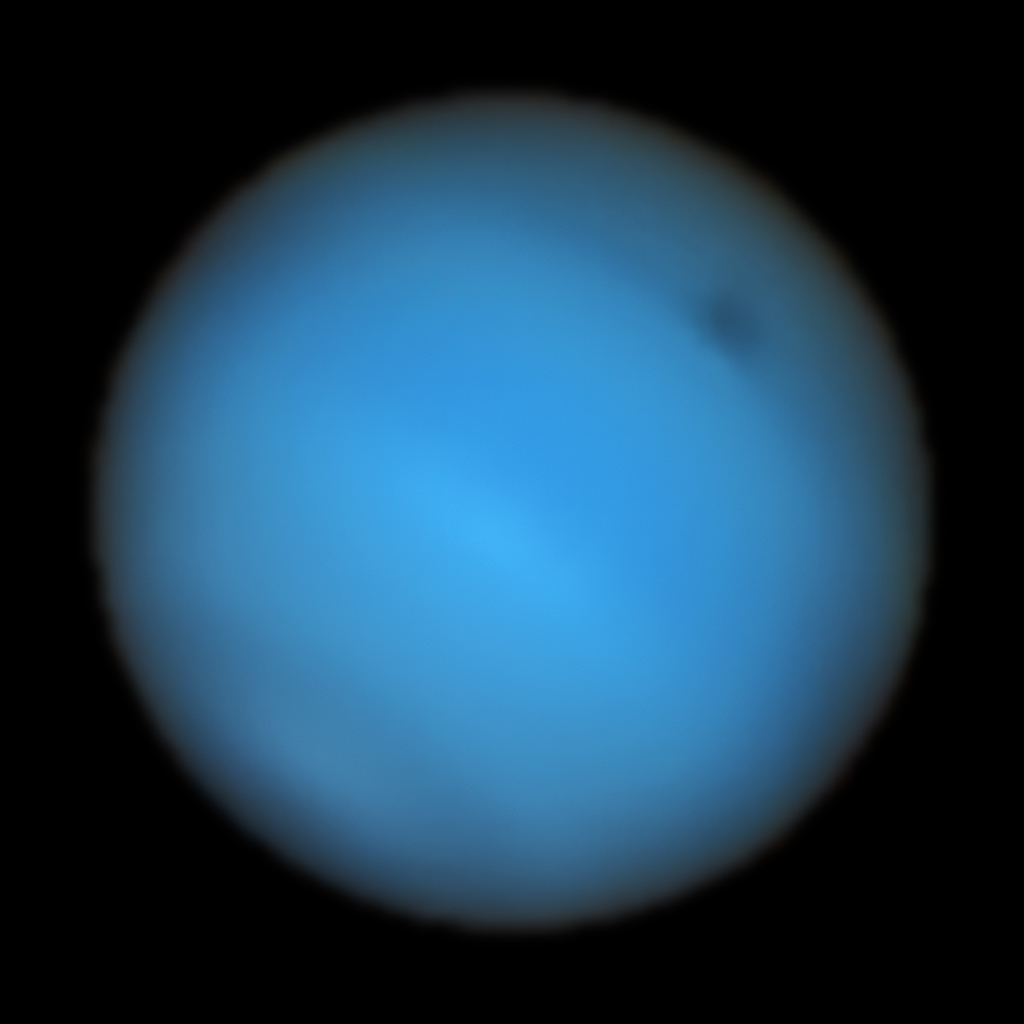
This image shows Neptune observed with the MUSE instrument at ESO’s Very Large Telescope. At each pixel within Neptune, MUSE splits the incoming light into its constituent colors or wavelengths. This is similar to obtaining images at thousands of different wavelengths all at once, which provides a wealth of valuable information to astronomers. This image combines all colors captured by MUSE into a “natural” view of Neptune, where a dark spot can be seen to the upper-right. Credit: ESO/P. Irwin et al.
Using the European Southern Observatory’s (ESO) Very Large Telescope (VLT), astronomers have observed a large dark spot in Neptune’s atmosphere, with an unexpected smaller bright spot adjacent to it. This is the first time a dark spot on the planet has ever been observed with a telescope on Earth. These occasional features in the blue background of Neptune’s atmosphere are a mystery to astronomers, and the new results provide further clues as to their nature and origin.
Large spots are common features in the atmospheres of giant planets, the most famous being Jupiter’s Great Red Spot. On Neptune, a dark spot was first discovered by NASA’s Voyager 2 in 1989, before disappearing a few years later. “Since the first discovery of a dark spot, I’ve always wondered what these short-lived and elusive dark features are,” says Patrick Irwin, Professor at the University of Oxford in the UK and lead investigator of the study published today in Nature Astronomy.
Irwin and his team used data from ESO’s VLT to rule out the possibility that dark spots are caused by a ‘clearing’ in the clouds. The new observations indicate instead that dark spots are likely the result of air particles darkening in a layer below the main visible haze layer, as ices and hazes mix in Neptune’s atmosphere.
Coming to this conclusion was no easy feat because dark spots are not permanent features of Neptune’s atmosphere and astronomers had never before been able to study them in sufficient detail. The opportunity came after the NASA/ESA Hubble Space Telescope discovered several dark spots in Neptune’s atmosphere, including one in the planet’s northern hemisphere first noticed in 2018. Irwin and his team immediately got to work studying it from the ground — with an instrument that is ideally suited to these challenging observations.
Using the VLT’s Multi Unit Spectroscopic Explorer (MUSE), the researchers were able to split reflected sunlight from Neptune and its spot into its component colors, or wavelengths, and obtain a 3D spectrum [1]. This meant they could study the spot in more detail than was possible before. “I’m absolutely thrilled to have been able to not only make the first detection of a dark spot from the ground, but also record for the very first time a reflection spectrum of such a feature,” says Irwin.
Since different wavelengths probe different depths in Neptune’s atmosphere, having a spectrum enabled astronomers to better determine the height at which the dark spot sits in the planet’s atmosphere. The spectrum also provided information on the chemical composition of the different layers of the atmosphere, which gave the team clues as to why the spot appeared dark.
The observations also offered up a surprise result. “In the process we discovered a rare deep bright cloud type that had never been identified before, even from space,” says study co-author Michael Wong, a researcher at the University of California, Berkeley, USA. This rare cloud type appeared as a bright spot right beside the larger main dark spot, the VLT data showing that the new ‘deep bright cloud’ was at the same level in the atmosphere as the main dark spot. This means it is a completely new type of feature compared to the small “companion” clouds of high-altitude methane ice that have been previously observed.
With the help of ESO’s VLT, it is now possible for astronomers to study features like these spots from Earth. “This is an astounding increase in humanity’s ability to observe the cosmos. At first, we could only detect these spots by sending a spacecraft there, like Voyager. Then we gained the ability to make them out remotely with Hubble. Finally, technology has advanced to enable this from the ground,” concludes Wong, before adding, jokingly: “This could put me out of work as a Hubble observer!”
We Saw It! The skies, recovered to blue and sunshine from overnight rain and clouds giving us hope and a spring in our step. As the hour of eclipse approached, so did a generally thin milky layer of clouds. The eclipse was not spoiled, however, and we enjoyed a wonderful view. We sincerely hope you were able to experience the “2024 Great American Eclipse” as well.
The Sun during totality, exposed to show prominences looping from the solar surface. Prominences were seen in several locations along the limb but the one seen here, near the bottom of the disk, was easily seen with the unaided eye. Photo by James Guilford.
————————————————————————–
Eclipse Watching in Medina, Ohio
April skies are notoriously changeable here in Northeast Ohio where we are otherwise in an excellent location for viewing the April 8, 2024 total solar eclipse. In fact, the chances of a clear sky here are only about 37 percent. Ugh! Dedicated eclipse chasers will mostly head to the southwestern U.S. for better chances at clear skies. For those of us not traveling, let’s hope for clear skies here on the Big Day because a total solar eclipse is more than just an awesome sight, it’s an experience! Let’s be prepared.
An Updated List of Resources Appears Near The End of This Article
Time and Eclipses Wait for No One
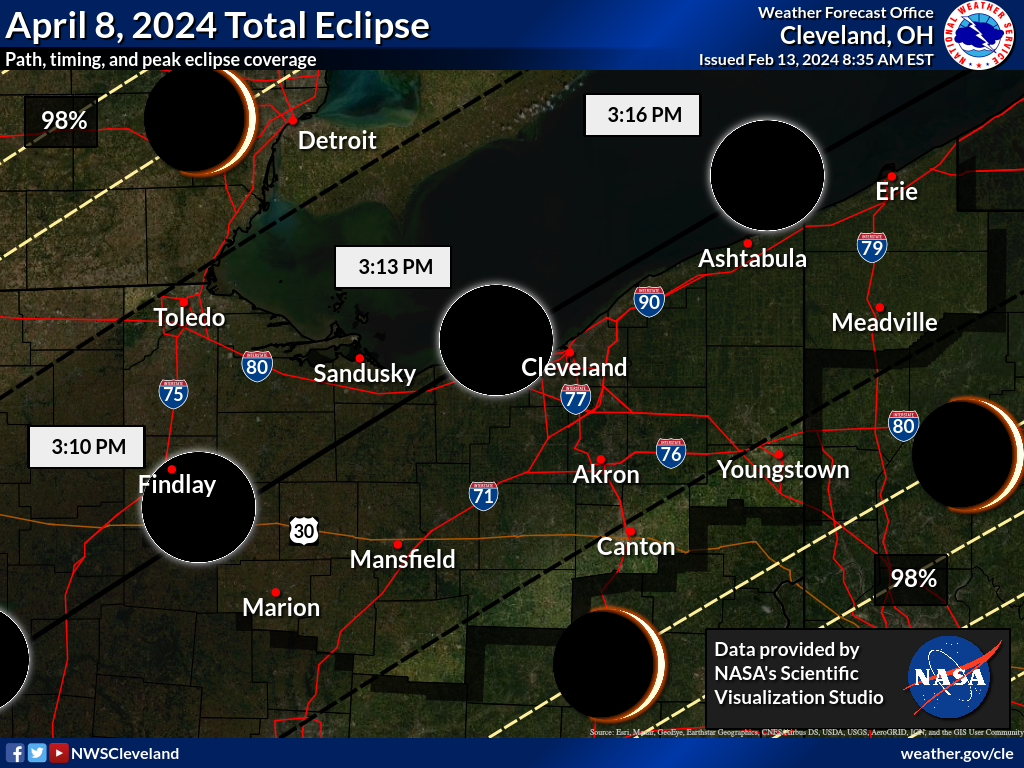
Moon’s shadow will be clipping across Ohio at about 2,100 miles per hour, so the peak period of the eclipse — totality — is fleeting. Medina will experience about 3 minutes and 28 seconds of totality, which is pretty good. If we were in the central line of the path of totality, which passes right through Lorain, we would have 3 minutes and 53 seconds of glorious viewing. Here, courtesy of the U.S. Naval Observatory, are local times for critical points of the eclipse:
Timing in Medina, Ohio (Eastern Daylight Time)
Partial Eclipse Begins — 1:58:38
Totality Begins — 3:13:23
Maximum Eclipse — 3:15:06
Totality Ends — 3:15:51
Partial Eclipse Ends — 4:28:38
☀️ 🌑 ☀️
Sights and Experiences
The eclipse will begin when Moon starts its passage across the solar disk. When viewed through protective filters, a tiny nick will be missing from Sun’s limb. That nick will gradually grow as the partial eclipse phase progresses. Viewed through “eclipse glasses” or other specialty solar filters, Sun will transition from a full disk to, eventually, a slim crescent. Our surroundings will not become dark as night but the light will take on an eerie softness as Sun fades. If, heaven forbid, skies are cloudy, it will be very dark in the path of totality … very dark indeed.
Sunspots may be visible. Dark markings of various sizes and shapes may be seen on the solar disk during the partial phases of the eclipse. Sun is in the most active phase of its regular cycle during which sunspots are common. If they are large enough, sunspots can be seen using eclipse glasses but are best observed through telescopes equipped with solar filters.
The air may feel cooler, birds and other animals may begin evening behaviors. Street lights and other automatic lighting may activate.
Just before totality begins, two interesting effects will be seen, caused by Moon: Baily’s beads are dots of sunlight that will dance along the edge of the blackened moon. The diamond ring effect is a singular burst of sunlight that, combined with the light ring of the now-eclipsed sun, is reminiscent of a shining diamond. Both effects are caused by sunlight shining through the mountainous terrain on Moon’s horizon as it moves into position in front of Sun.
Look around as these things are happening, and watch for shadow bands — dim waves of dark and light that will ripple across the ground immediately before and after totality. The bands are a memorable experience but often missed because most attention will be on the sky above!
During totality — and only during totality — eclipse glasses and solar filters are not needed. In fact, the eclipse will be too dim to be seen through the protective devices. Looking around where they are standing, watchers will notice that it is not as dark as night but something odd is to be seen. Overhead, where the brilliant afternoon sun should be shining, it’s dark but for the glorious total eclipse. Along the distant horizon, there is sunlight — it’s coming from areas outside of Moon’s shadow, away from the path of totality.
Marvel at Sun’s corona as it radiates from the dark circle of moon-covered-sun. It’s a sight not soon forgotten! During totality look for a star-like light to the southwest of the eclipse — it’s planet Venus! To the upper left of Sun’s position is planet Jupiter.
The interesting effects and partial eclipse phases will take place in reverse order as totality ends. Put those eclipse glasses and filters back on immediately — even the crescent Sun is powerful enough to damage unprotected eyes — and don’t forget to turn unprotected cameras away from Sun!
So What’s Happening?
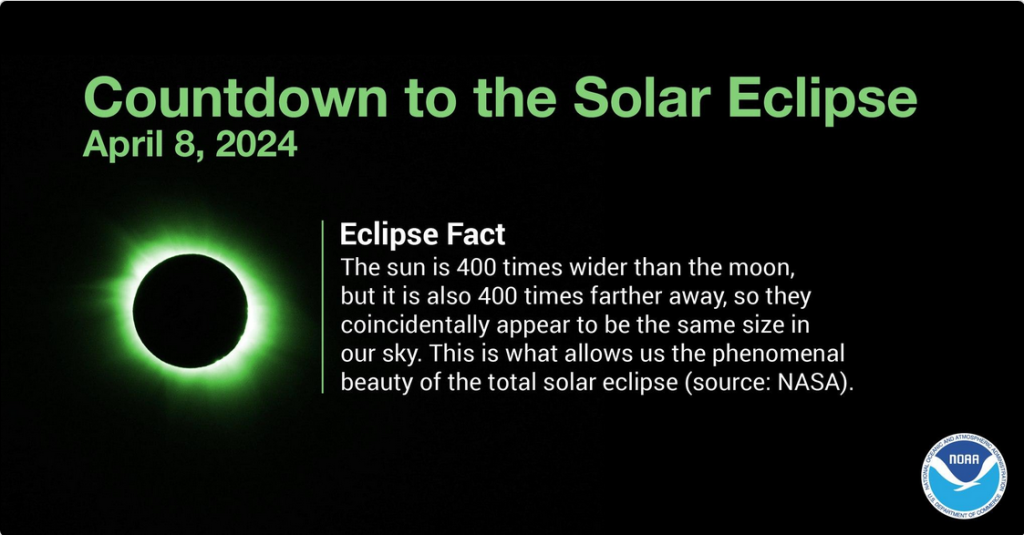
A total solar eclipse occurs when Moon passes between Sun and Earth, causing Moon’s shadow to be cast on Earth’s surface. Moon is at the right distance from Earth that, when it does pass in front of Sun, the fit is nearly perfect, blocking direct sunlight from reaching the surface within its shadow. An annular eclipse happens when Moon’s orbit carries it a bit too far from Earth to cover the solar disk, producing a “ring of fire” — sunlight in a halo around the dark Moon. Most of the time, Moon’s orbit carries it into positions where its shadow “misses” Earth, so there’s no eclipse.
When the moon passes directly between the sun and Earth, a solar eclipse takes place. (NEVER look at the sun during any type of solar eclipse! Looking at the sun is dangerous. It can damage your eyes.) Image Credit: NASA
As mentioned earlier, when totality is reached, Sun’s brilliant light is completely blocked as viewed from within Moon’s shadow. That shielding from brilliant sunlight allows the solar corona to be seen. The corona is a hazy glow surrounding the darkened Sun and is the outermost region of the Sun’s atmosphere, consisting of plasma (hot ionized gas). The corona continually varies in size and shape as it is affected by the Sun’s magnetic field so its appearance differs eclipse-to-eclipse and is of great interest to those who study our nearest star — it also makes totality a unique and awe-inspiring sight.
Eclipse Viewing Safety
Don’t risk your vision! Even when Sun is “mostly” covered by Moon before and after the total eclipse, sunlight will be strong enough to cause permanent eye damage. Sunglasses and other makeshift items are not enough. To look at the sun, use only certified “eclipse glasses” — filters — so you can safely view Sun before and after totality. Here’s a link to sources: https://eclipse.aas.org/eye-safety/viewers-filters — More Information Below
Medina, Ohio Area Resources
Branches of Medina County (Ohio) District Library were distributing eclipse glasses free of charge, one per family, as supplies allow, at the time of this writing. Glasses are easy to share amongst family members, looking one at a time at the partly-eclipsed sun. In fact, it is best for adults to watch children who are using eclipse glasses to make certain they’re wearing them correctly and that can’t be done if the adult is wearing eclipse glasses at the same time — they’re too dark!Library Eclipse Programs
The Medina County Fair Board will be renting out Solar Eclipse Camping sites for campers and motorhomes beginning Friday April 5 thru Tuesday April 9. There will be electric hook-up and restrooms and showers on site. Call (330) 723-9633 or email medinafair@gmail.com to reserve a space. Looking for a place to just park your vehicle to watch the eclipse? You can rent a parking spot for $20 (cash only) at the Community Center parking lot.
Useful Mobile Apps via the AAS
Here you’ll find some of the best eclipse-related apps and software available, as judged by members of the American Astronomical Society (AAS) Solar Eclipse Task Force: https://eclipse.aas.org/resources/apps-software
Solar Eclipse Timer App
Want more precision and audio/voice prompts at critical points of the event? Then this app’s for you! (Included in the AAS list) There are versions for iOS and Android and a small charge to update to the 2024 version ($1.99 for iOS) but it’s worth it if you want a sophisticated digital assistant — be sure and install and update in advance for your observing location! https://www.solareclipsetimer.com/
A Word About “Eclipse Glasses“
Purchase and use only ISO filters and eclipse glasses certified for direct viewing of the sun. This is your vision, and that of your loved ones, we’re talking about here! Sunglasses, smoked glass, Compact Discs, photographic negatives, and other items are not safe for looking directly at Sun! Safe, inexpensive eclipse glasses and filter cards are widely available for this eclipse so should be bought in advance and stored safely away. Read and follow instructions that should be printed on eclipse glass frames. Check the “lenses” for damage such as tears or pinholes and throw the glasses away if any defects are found. The glasses can be kept and used after the event but should be examined before use every time. Remember, too, these often colorfully-framed eclipse glasses may be appealing to children BUT THEY ARE NOT TOYS — they are all that stand between the user and permanent eye damage so do not allow kids to play with them. For more on this subject, see:https://eclipse.aas.org/eye-safety/iso-certification
If you’re using old eclipse glasses, make sure the lenses aren’t scratched or damaged. Check out this video from NASA on how to make sure your glasses are good to go: youtube.com/










 Stella-Luna Observatory