

— Photo by James Guilford

I’ve been shooting Sun images so frequently lately that I’ve neglected the night. While a recent aurora was obscured by clouds (and my sleep schedule) here, and no Perseid meteors spotted (clouds and sleep), Moon put in a nice appearance. Our neighbor in space was very low in our southern sky the night of August 14, which was good and bad. It was good because it can be hard to observe objects high overhead. It was bad because lower to the horizon means more air — and turbulence — between the observer and astronomical objects than if they were overhead. A tripod-mounted telephoto lens and DSLR were used for the capture and a bit of post-processing sharpened things up pretty well.
One of the things I enjoy most when observing Moon is looking along the terminator — the divide between dark and lit areas — at features partly illuminated by, in this case, the rising Sun. Especially noticeable is the arc of light near the upper end of the terminator — the sunlit tops of the Jura Mountains, defining the Bay of Rainbows, off of the grand Sea of Showers or Mare Imbrium.

I continued my practice of daily imaging of the sun for some weeks now. While still deciding precisely how to use and display the images I’m collecting, I’m also trying to standardize how the images are captured and establish a workflow in editing; that is in an effort to give the daily pictures the same overall size and appearance except for details, such as sunspots, where we want to observe changes. It’s not as easy as it may seem, especially when attempting to constantly improve image quality. This ought to become simpler once I have a permanent setup protected day-to-day within an observatory structure.
Sunspots AR3713 and AR3712, the more pronounced of the three large groups, have been interesting to watch as they traversed the visible side of Sun. Today (June 22), braving the morning’s already hot and humid conditions, I went to the extra work of setting up the Vixen VC200L Cassegrain telescope in an effort to achieve high quality images of the two — plus AR3716 — big sunspot groups before they disappear over the western solar limb. Both of the active regions reportedly harbor opposing magnetic energies which could, at any time, reconnect and throw off powerful flares but both have been surprisingly quiet. The next few days will be the last when an outburst from AR3713 or AR3712 might affect Earth.
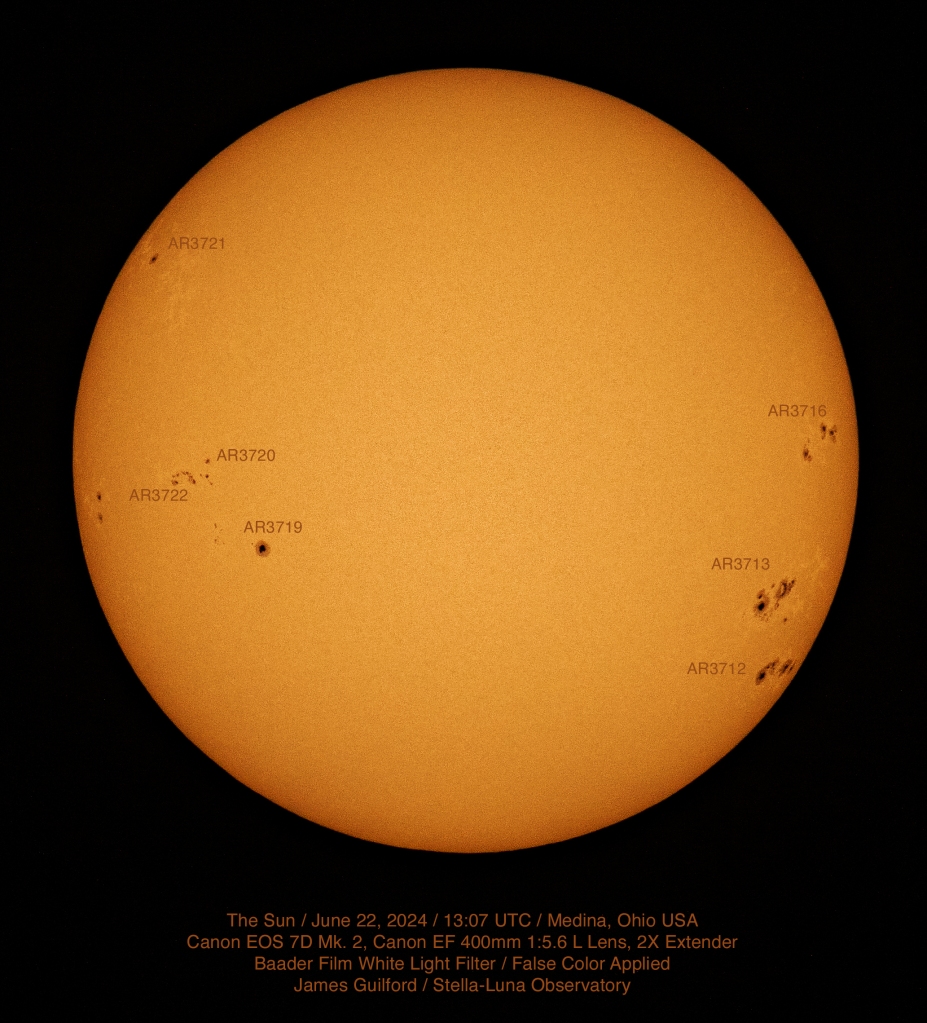

I meant well but still wound up posting new solar images to Instagram and Threads instead of here. Today’s image was particularly pleasing, however, so I’ve posted it in all three places!
Today was another day featuring a cloudy morning and sunny afternoon. This time, however, we experienced excellent seeing for a while — just long enough to record today’s solar portrait. We’re so pleased with the “inset” image that we’re featuring it first — it’s cropped directly from the whole-disk picture. Obviously sunspots AR3713 and AR3712 are dominant features; they also reportedly possess magnetic fields with the potential for M-Class flares.
Doing this the “old-fashioned” way, this image was a single exposure manually selected as best of a larger group of shots. The chosen image is edited to produce the best available picture from the data gathered. Today’s excellent seeing made for an unusually good photo. We’re pretty pleased.


I have been posting solar images on a near-daily basis for some time. I enjoy recording the images and sharing them with the world and Sun is an especially interesting object right now as we near Solar Maximum. Unfortunately, I am not sure the daily postings look all that great on Instagram where, now, our home page looks like a collection of spotted oranges or maybe suspect egg yolks! What to do?
My current thinking is to post only the most interesting images on Instagram and Threads — days when giant sunspots are present, newsworthy, or (eventually, when I get it working) spectacular coronal images — unusually interesting shots. To keep a public repository of the other images — the routine, daily views — a page on this website might be advised. I think I’ll try it.
So a daily posting here, on a solar imaging page, and special stuff also posted on Insta and Threads. Yeah, that sounds about right. Thanks for listening. — JG

Our contractor, taking advantage of a break in the weather, applied Polybind-brand polymeric sand to the observatory’s patio base completing that phase of the project. The space beneath the patio paver stones needed to be dry to allow the sand material to freely flow into all available gaps. Once wetted, the Polybind rapidly cures, sealing out insects and seeds.
Checking with the manufacturer of our Sirius Observatory we learned that production delays will push back our project well into the summer months. Disappointing, to say the least, but good things are worth waiting for. We’re considering now whether to install the steel pier at the center of the base while we wait — with or without a telescope attached, the pier could be covered between uses. With the pier in place, we wouldn’t need to carry out a tripod and mount every time we wish to use the observing pad.
Thinking… thinking…
by James Guilford

It turned out to be a stronger impact than forecast, and the strongest thus far of this solar activity cycle; the geomagnetic storm of May 10 – 11, 2024 produced auroras (Northern and Southern Lights) visible at night from locations nearly pole to pole.

The forecast of possible aurora prompted me to step outside at about 10 PM (EDT), when twilight had faded, to check the skies. At first I saw what I thought might be clouds but knowing auroras can be feeble, I watched. Sure enough, there was movement in those “clouds”.

Glancing overhead I saw what I found hard believe — aurora ray features directly overhead … at 41º latitude, a rare sight, indeed! Rushing back indoors, I pulled together camera, fisheye lens, and tripod and headed back out.

The aurora still presented itself as cloudy streaks with, perhaps, hints of color. Now also armed with my smartphone, I activated its camera and aimed it at the sky. There on the screen, light amplified by the phone’s electronics, glorious, eye-popping colors filled the sky! I’d never before experienced an aurora like it.

Only occasionally, during the time I was out, did the aurora’s color become visible to me; apparently being just below the limits of my, and others’ visual perception. Another local observer noted color was more visible shortly before I stepped outside to check on things — the actual peak of the display must have happened as twilight was ending and before 10 p.m.

I observed and photographed the aurora from shortly after 10:00 until about 11:30 EDT and in that hour or so, the intensity faded and then re-surged before fading away again which was my signal to shut down. I might have stayed out longer but had a commitment for the next day — sleep was needed — so, satisfied I’d seen the phenomenon at its best, I put away the camera gear.

Knowing it would be all over the news, I submitted my most spectacular shot of the night to the local newspaper — a daily that publishes on Saturday but not Sunday. It was too late for the Saturday edition but the editor gave my photo a three-column, Page 1 spot on Monday.

Our Sun is still in its peak activity period, by some accounts it won’t hit solar maximum until some time in 2025, so there may be more auroras in our near future but this was one for the history books!

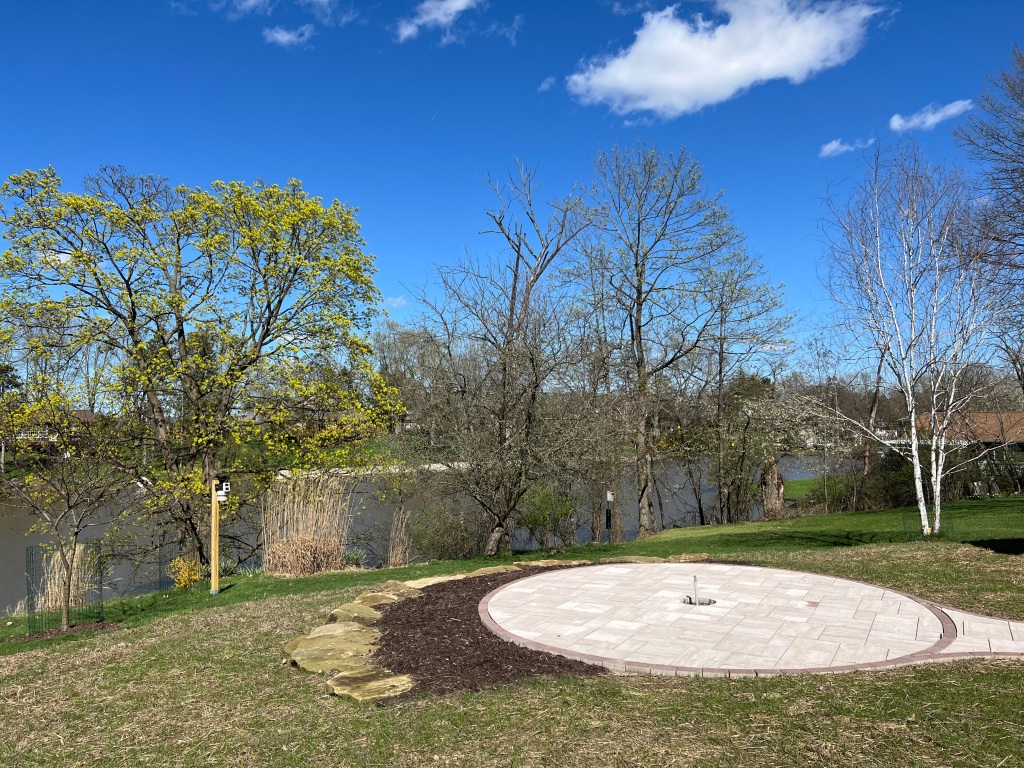
The landscape contractor promised, at the end of last season, that they would return to finish work on our observatory patio. Remaining to be done is installation of polymeric sand in the “grout” lines of the patio pavers. The material will be swept in to fill the gaps between the paver stones with enough getting beneath them to make them stable — the stones rock a bit now when walked upon. We’re told the weather must remain above freezing and the concrete surface beneath the stones must be dry in order for the polymeric sand to properly fill the spaces and cure properly.
One manufacturer wrote this about the benefits of their product: “Polymeric sand is appreciated by paver installers because joints you get from it are durable and even. This eliminates any risk of weed growth and ant infestation that could affect the overall aesthetics and durability of paver projects.” — Techniseal.com
We are likely now beyond freezing temperatures until this fall. Now we await a stretch of dry weather and it may be a while — it has been a very rainy spring!
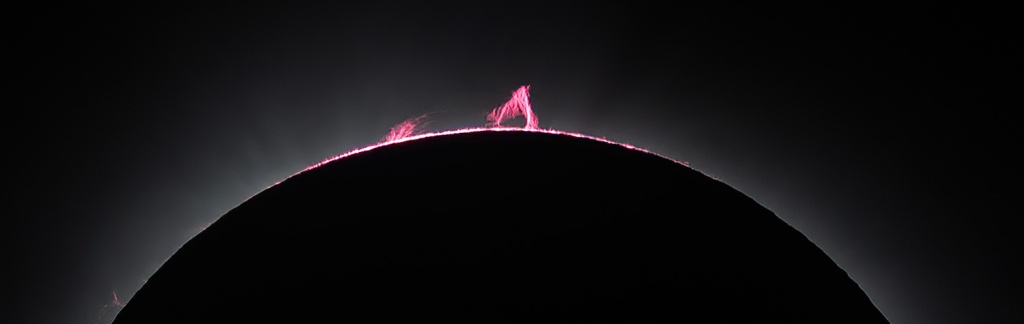
While we very much wanted to view and photograph Sun’s corona during the April 8 total solar eclipse, a blanket of high, thin cloud covered the area blocking faint details. We were, however, able to observe and image the bright inner corona and prominences (“proms”) along the rim of the eclipsed Sun and what a show it was.
Sun is in the active phase of its 11-year cycle and, during totality, prominences were expected and seen in various sizes and at several sites around the rim. The largest was easily spotted with the unaided eye, causing questions from casual observers as it brightly shined at about the six o’clock position of the eclipse ring as viewed from North America. We were delighted with the images of proms that we were able to acquire!
As Moon drifted across Sun during totality it, in turn, covered and exposed different regions of Sun’s limb. To give a fuller impression of prominences seen, we grafted two of our images from totality into one picture; one image was recorded just as totality began, the other as totality was about to end. The resulting picture is not a view one would have had but does correctly illustrate the position and visual size of the proms.
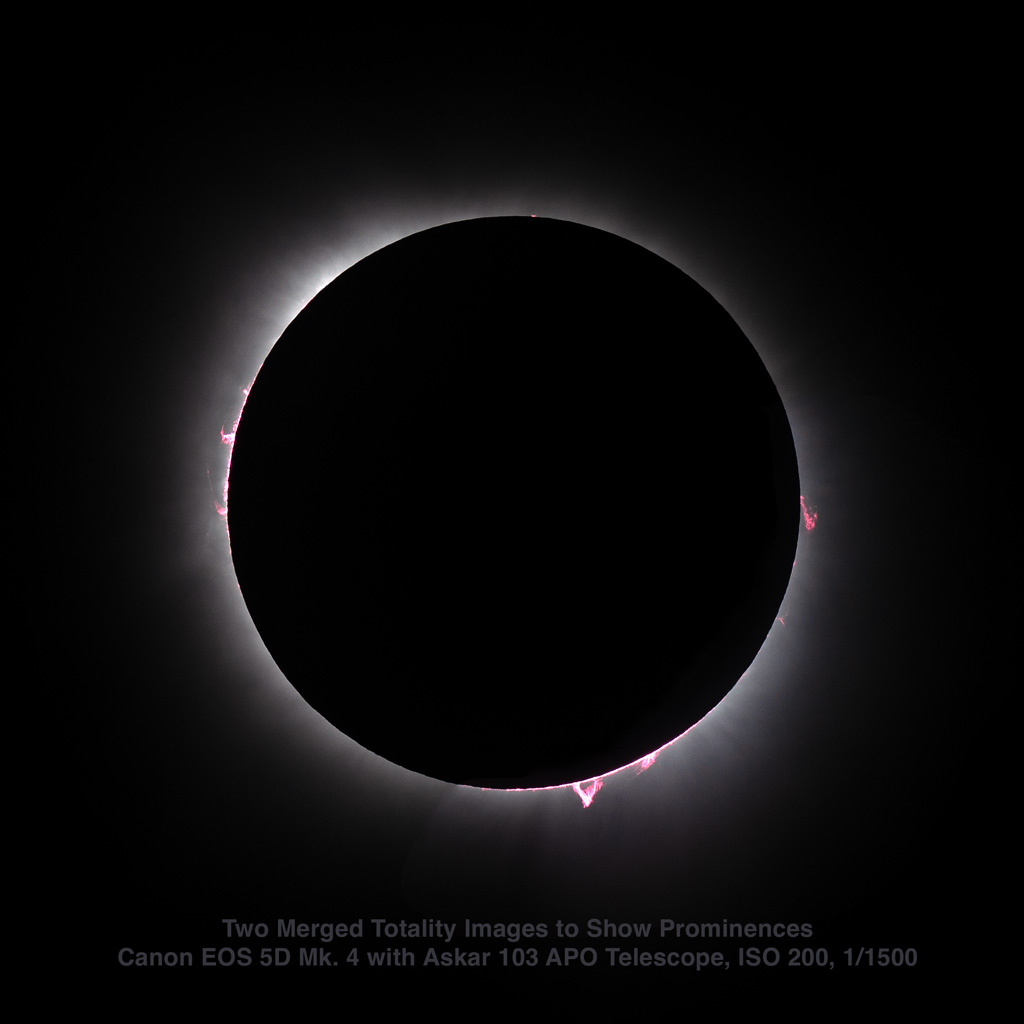
Observers in Northeast Ohio were fortunate. Although the morning began with heavy cloud cover, skies cleared and allowed decent viewing of the eclipse in its entirety. Temperature drops were easily felt as bright daylight transitioned to an eerie twilight. As totality began, cheers of awe could be heard from gathered eclipse watchers at a nearby organized event. Automatic street lights illuminated. A robin was heard singing its evening song. Sunset colors lit the horizon about three-quarters of the way around us. In the southwest, beneath the eclipsed Sun, the horizon appeared dark. And then, as bright sunlight returned, first via a brilliant crescent, then by an expanding and warming solar disk, it was over. Those we spoke with were delightedly awestruck having had the experience of a lifetime.
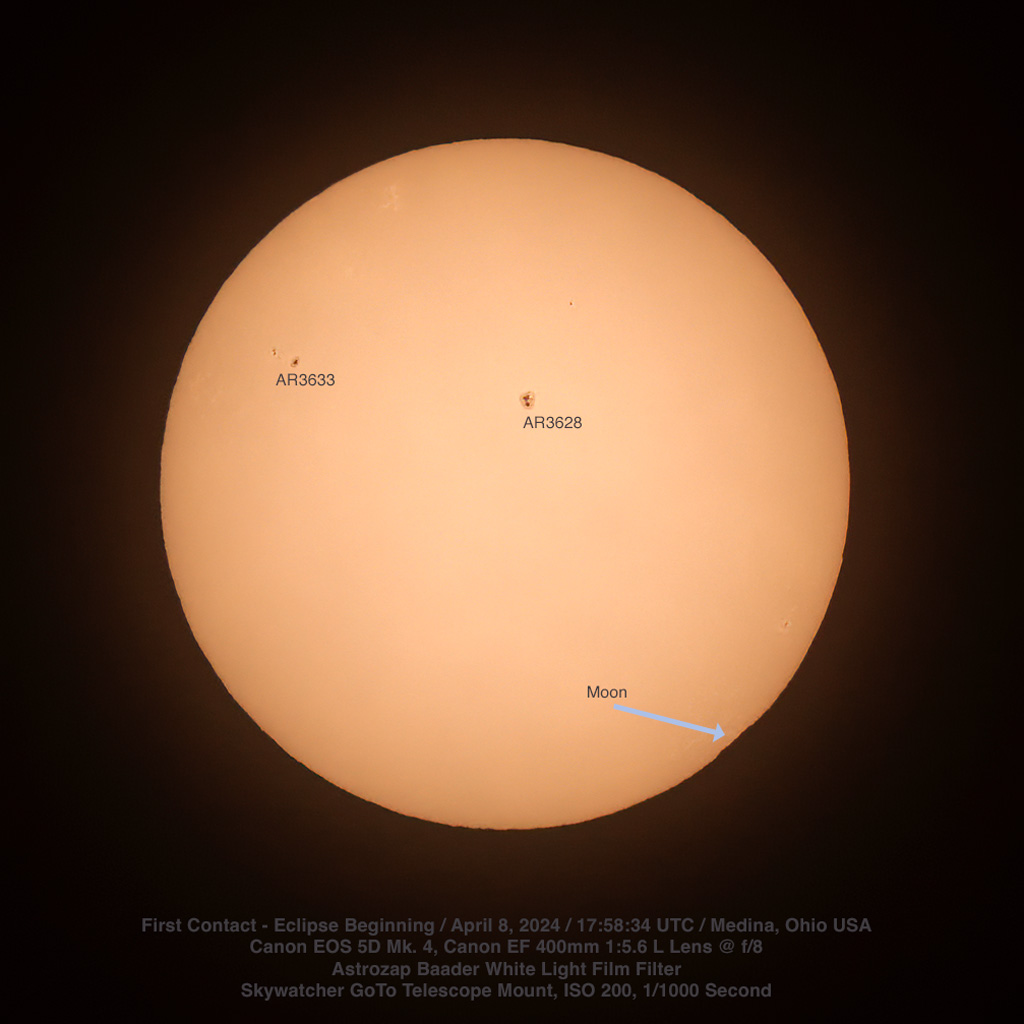
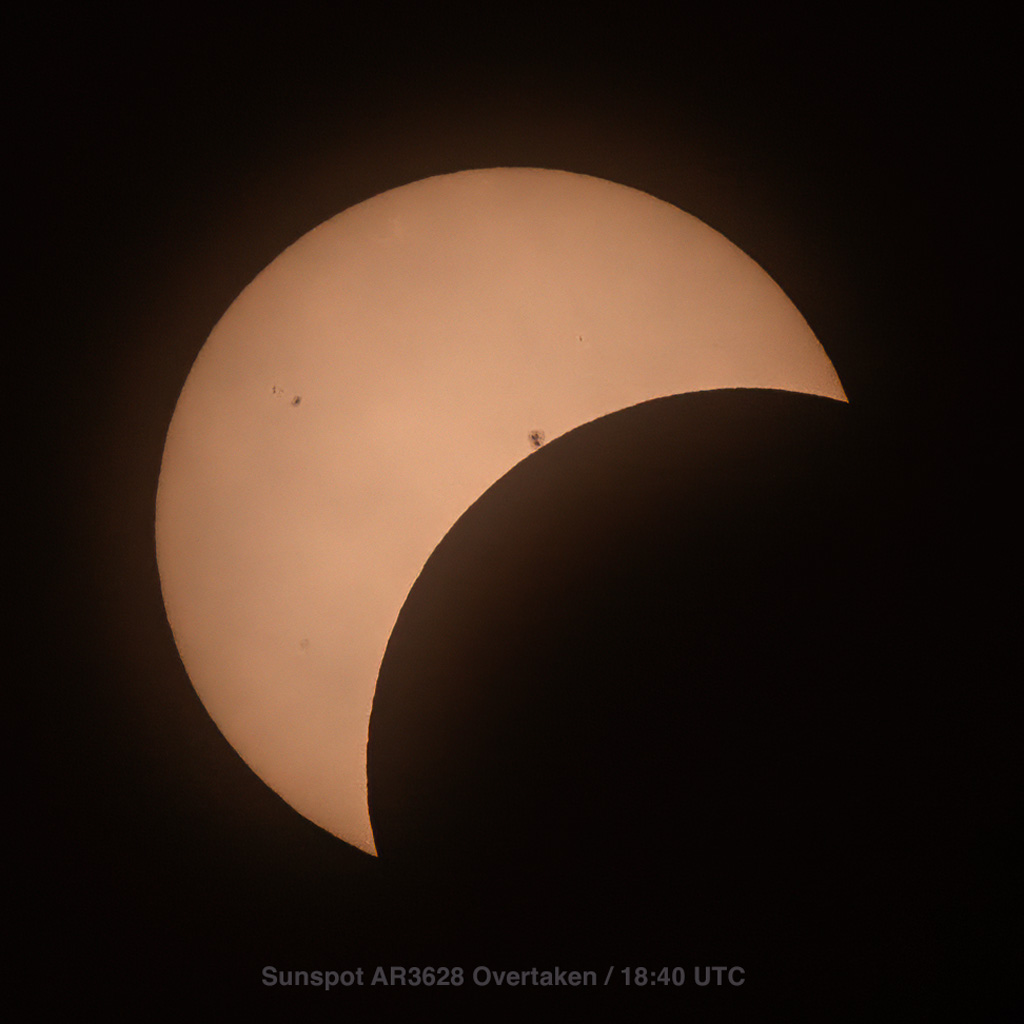
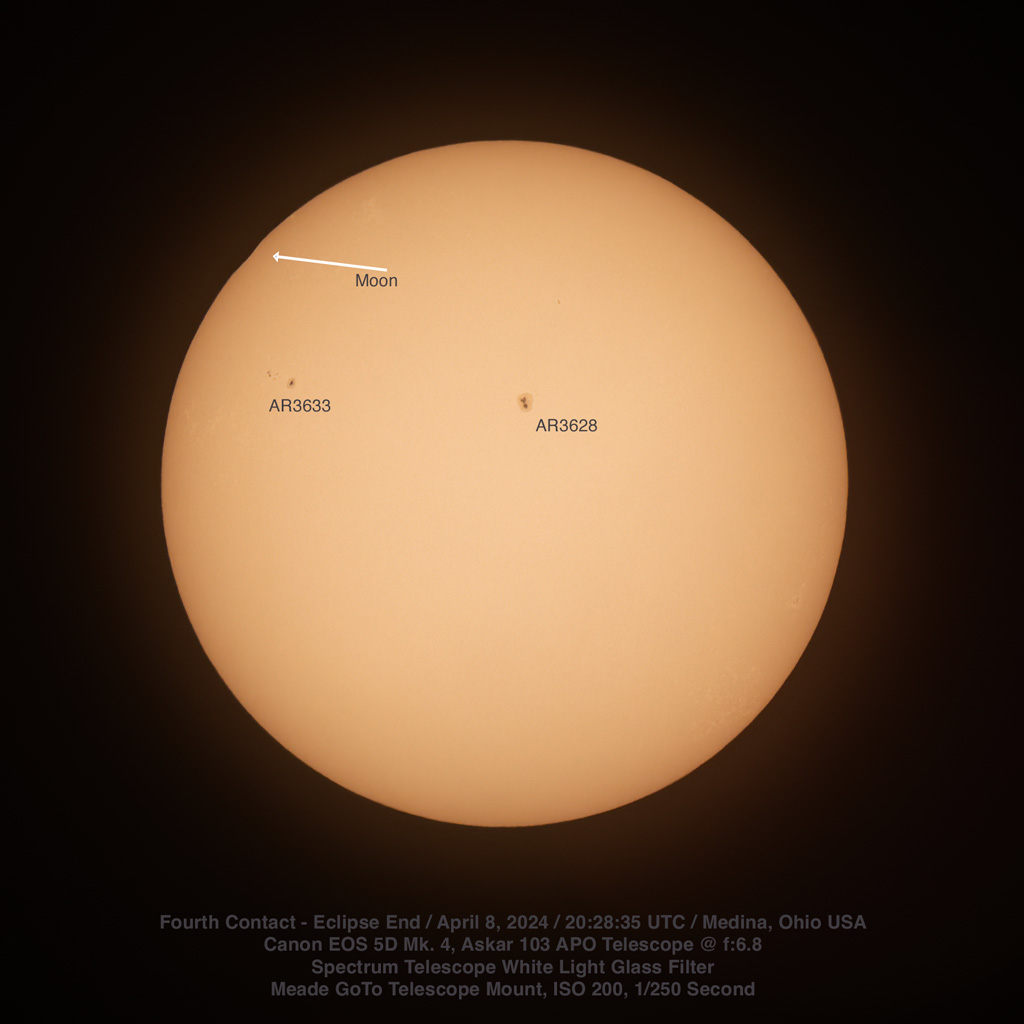
Following are several images of Sun as the eclipse began, during the partial phase, and as it ended. Times are expressed as UTC and were recorded automatically by the camera, set via GPS. Observers in different areas will have seen times that differed from ours and each others due to parallax effects, Moon being much closer to Earth than is Sun.

Taking advantage of a rare day with clear skies, I set up the new-ish Askar 103 APO telescope and got a bit more solar imaging in. The huge sunspot group at the center of the image above is designated AR3615 — it and the isolated sunspot above it (AR3614) exploded in tandem on March 23, directing their CMEs (Coronal Mass Ejections) at Earth. When the CME hit our planet, the result was a severe geomagnetic storm. While not specifically practicing for the upcoming solar eclipse, the experience doesn’t hurt, either! This period of activity makes the sun’s photosphere interesting to observe as features visibly change day-to-day and even more rapidly, if one looks close enough. Sun is nearing the predicted peak of its 11-year cycle of activity which is expected in 2025. That means a couple of more years (at least) of interesting things to see on our nearest star.
 Stella-Luna Observatory