
An encounter with the occult(ation)

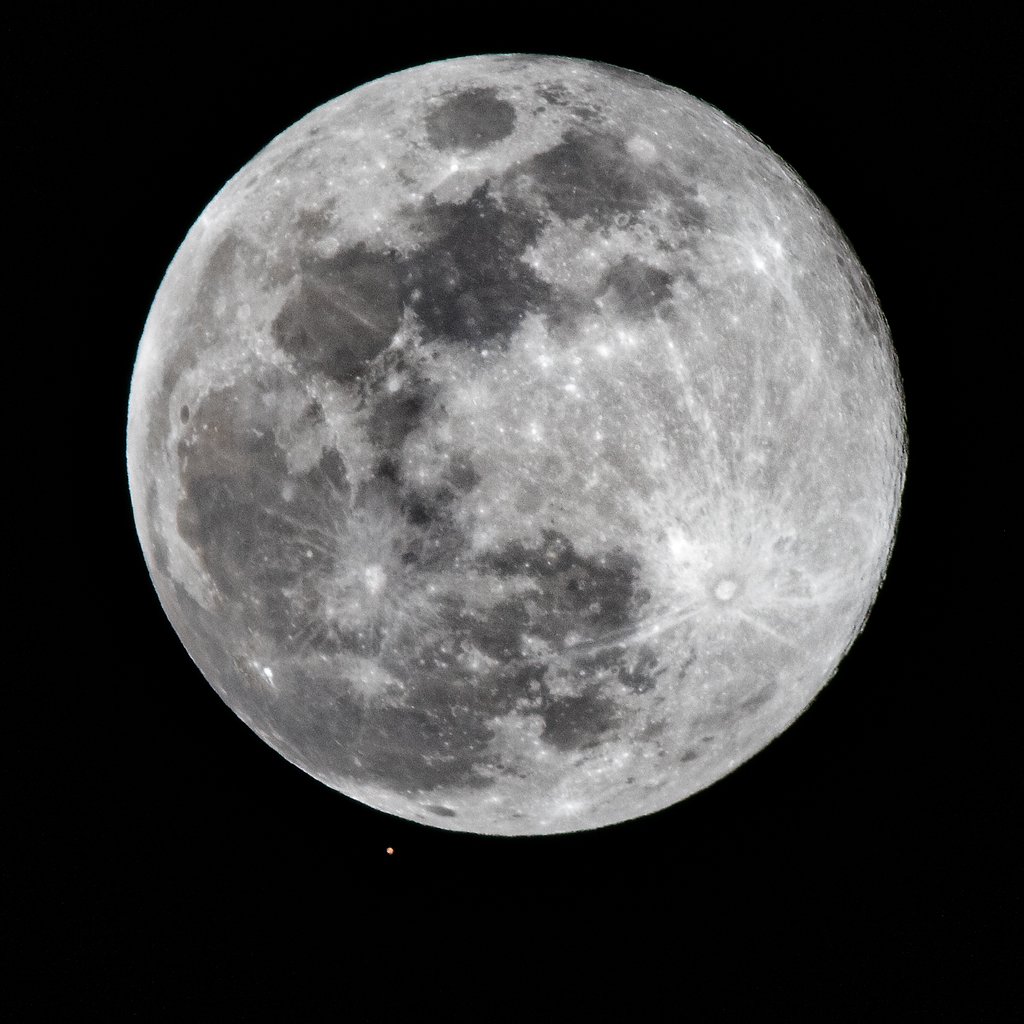
Only a few minutes from occultation, Mars is seen just off the lower edge of the lunar limb in this full-disk image recorded at 9:09 PM EST. The event only occurs with planet Mars about once every 14 years. Photo by James Guilford.

Clouds held off — pretty much — for us to observe the Moon occult* Mars, the reddish dot in the photo above. About once every 14 years or so, everything lines up just right and planet Mars is hidden by Earth’s Moon. Though Mars is about twice as big in diameter as our Moon, it was nearly 60 million miles farther away from Earth during the encounter — to the unaided eye, Mars looked like a tiny bright red star next to the Full Moon.

As predicted by mathematics, Mars and Moon grew nearer and nearer each other until, at 9:12 PM Eastern Standard Time (EST), the Red Planet disappeared behind our brilliant orb.
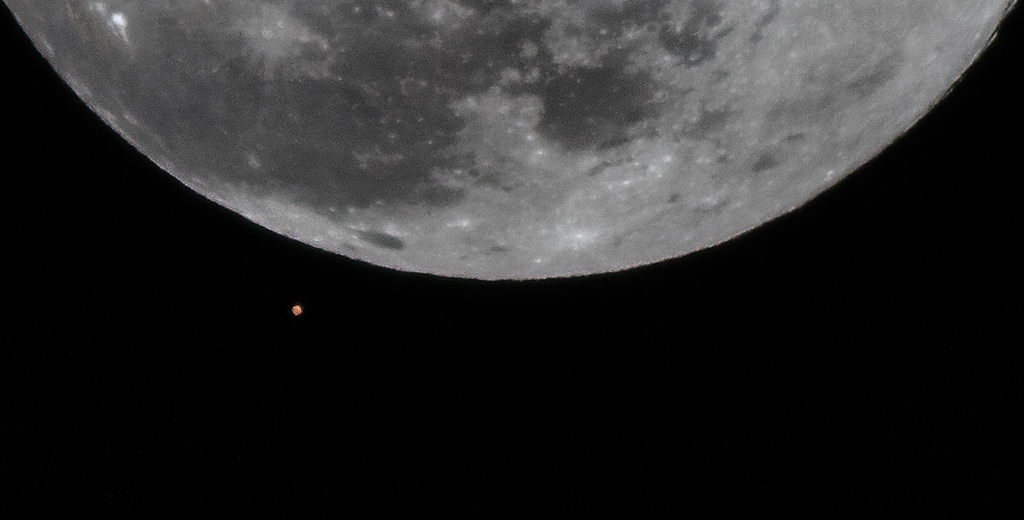
Mars, the small reddish dot in this image, nearing occultation by Earth’s Moon, as seen at 9:07 PM EST, January 13, 2025. Photo by James Guilford.
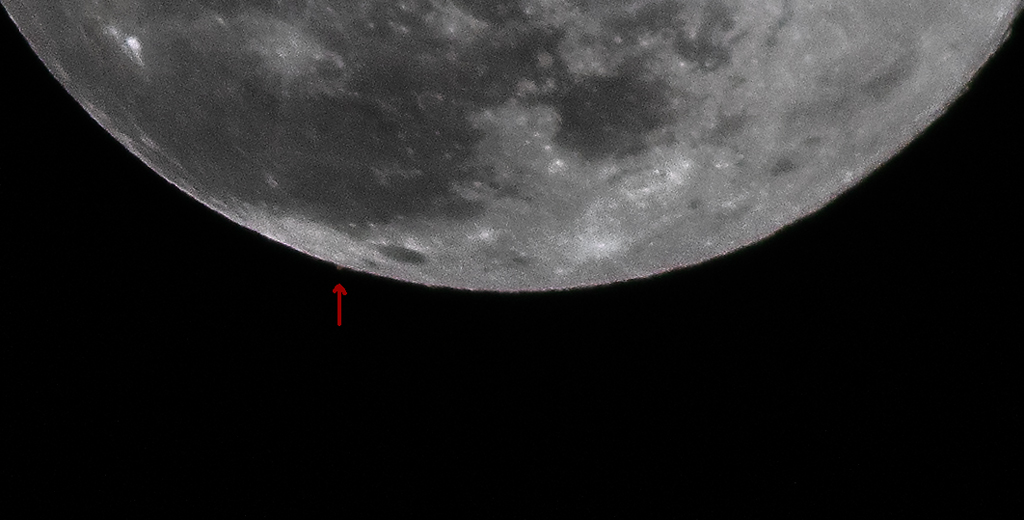
A red arrow indicates a ghostly mound that was Mars as it disappears behind Earth’s Moon at 9:12 PM EST, January 13, 2025. The dark oval to the right of Mars’s vanishing point is the lunar basin Grimaldi. Photo by James Guilford.

Passing clouds threatened to obscure the event but thanks to gaps between those clouds, there was enough clearing for observation. Shortly after Mars vanished, so did those inter-cloud gaps. With Moon now cloud-covered, we did not return to the 13℉ night to watch for Mars to emerge.

Technical: Canon 6D Mk. 2 Camera, Canon 400mm EF 1:5.6 L Lens, Canon 2X telextender, ISO 400, f/11, 1/250 second, photographic tripod.

*Occult: To cut off from view by interposing something. Commonly used as a noun to indicate something supernatural that is hidden from ordinary access.

Two Moons, One Day

Waxing Gibbous Moon, January 10, 2025, at 7:18 PM EST. Note the delicate “C” shape on the upper left-hand edge of the lunar image — rising sun lighting the mountain tops that line Sinus Iridium while lower terrain remains in darkness. Crater Copernicus stands out at center-left, and Crater Tycho stands proudly in the heavily-bombarded lower area of the image. Note the extensive spread of ejecta rays that radiate across Moon’s surface from the relatively recent formation of Tycho. Photo by James Guilford.

It was a clear night so, of course, I had to go outside and take a look. Cold too, at 13℉, so I didn’t stay long! Mars, Jupiter, and Saturn were easy to find, all three shining bright. I was out for a “Moon shot”, though, got a pretty good one. This was made using our Sun shot setup, minus solar filter, of course! Moon was beginning its occultation of the Pleiades which didn’t image well.

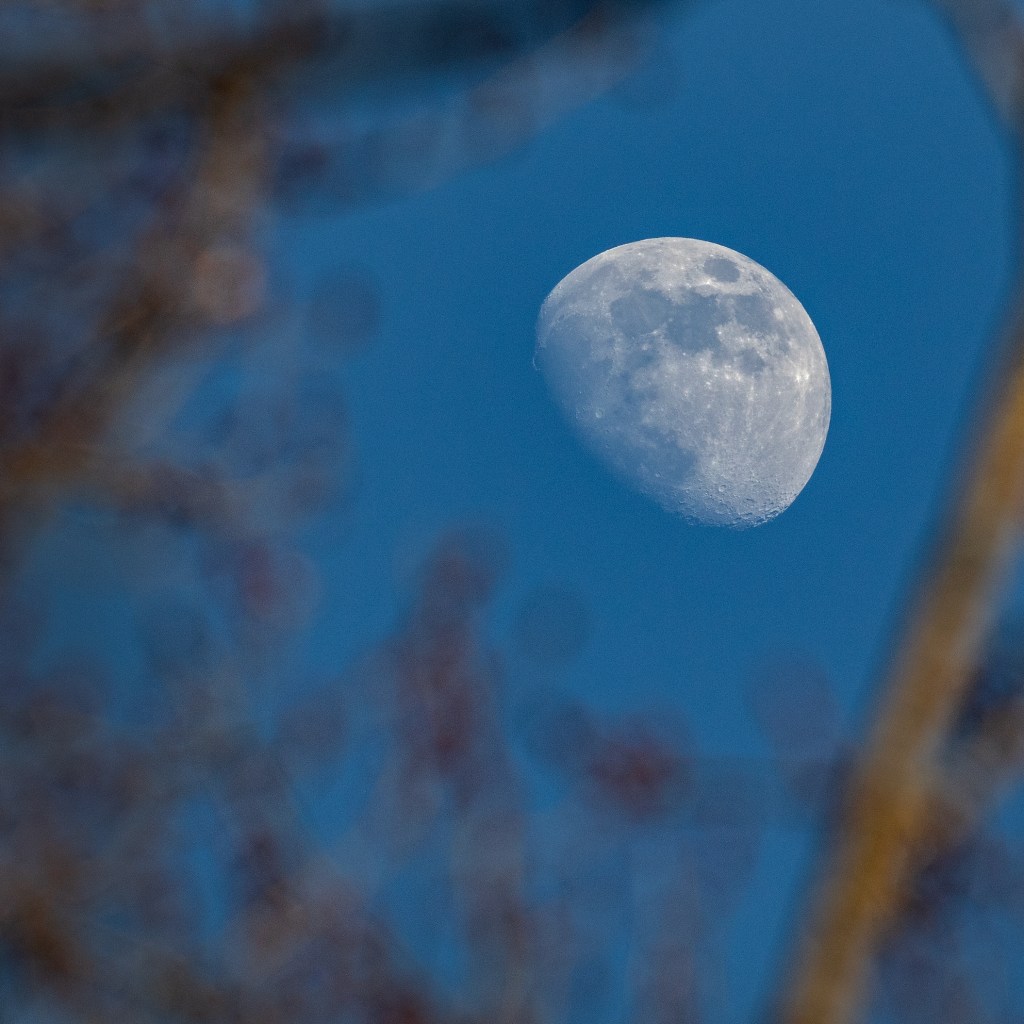
The day was clear, as well, and Moon was clear and bright even against the blue daytime sky. So, here is our neighboring world rising through the trees. This is presented second, instead of at the top, because we prefer the nighttime image.

Waxing Gibbous Moon. January 9, 2025, at 4:08 PM EST. Photo by James Guilford.