Planetary camera first light

Still working without a dome, our setups are outdoors and temporary so we try and keep them fairly simple. Solar observing and imaging generally lend themselves well to brief observations due to the extreme amount of light available and resultant short photographic exposures. With a couple of clear days and nights available, we took advantage and made some experiments and observations with several successive setups on a single Skywatcher EQ6-R Pro mount.

Southern hemisphere of Sun — First Light image from ZWO ASI678MM planetary camera, via Baader Herschel-Prism, and Askar 103 APO telescope. False color applied.

We began with the Askar 103 APO telescope and its 700mm focal length, attaching our Baader Herschel-Prism, and the new ASI678MM monochrome camera. The setup worked well but for one issue: focus was only just achieved with the focuser racked all the way in with no latitude for adjustment. Image quality was very good but probably would have been better if we’d have had a bit more inward travel. Note: It was only later that we realized we might gain the needed travel if we had switched the camera’s nosepiece from the 1.25-inch to the 2-inch, allowing removal of the thick 1.25-inch adapter ring from the Herschel. A well, duh, moment!

By the way, we continue to be impressed by the build quality and optical excellence of the Askar refractor. It’s a solid instrument with great features, delivering superb results.

Askar 103 APO telescope, Baader Herschel-Prism, ASI678MM camera, on the Skywatcher mount makes an excellent combination. A Herschel wedge-style optical device does not require a filter be attached in front of the telescope’s objective lens — deflecting, absorbing, and ejecting the bulk of sunlight energy. Internal filters in the Baader apparatus reduce brightness and increase contrast.
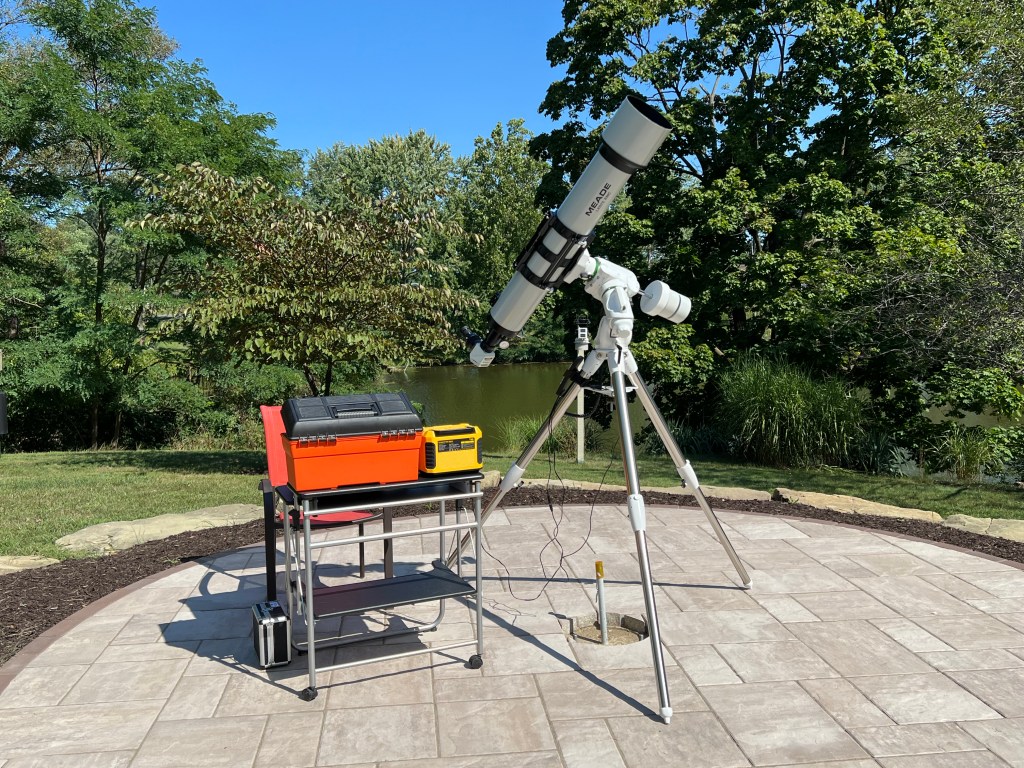
The Meade 6-inch refractor atop the Skywatcher mount and tripod. Visually, very effective, but the setup did not work with the Herschel-Prism and camera. The circular paved area is to form the floor of the observatory structure, the gray conduit to deliver power to a permanent mounting pier. Yes, the sky really was that blue that day!

The second experiment involved installing our massive Meade 6-inch telescope on the mount. The Skywatcher has a retractable rod for holding counterweights and is, therefore, a bit shorter than it might otherwise be, resulting in less leverage. It took nearly all of our available counterweights to balance the big scope. We installed the Herschel-Prism and a nice eyepiece and got beautiful views of the spotted face of our star. Attaching the ASI678MM, however, we could not reach focus — that inward focuser travel limit again — but we don’t believe the switch to the 2-inch nosepiece will help. That’s a shame! The Meade’s 1,250mm focal length would have provided amazing closeups!

The 11-inch Celestron SCT set up for a nighttime trial. This OTA was part of an integrated mount system that had failed so we “deforked” the telescope and attached a mounting rail for use on an equatorial mount.

With the mount set up we decided to try out the 11-inch Celestron SCT at night. Herschel wedge accessories are not to be used on reflecting telescopes as the concentrated unfiltered incoming sunlight can damage the scope’s secondary mirror. To our disappointment the telescope, which has set in storage for months since we attempted collumnation, displayed rather severe image distortions — comma-shaped stars. After a good bit of frustration we dismounted the telescope and planned to come out the next night with the Vixen Cassegrain telescope.

All good things… A series of clear days and nights came to an end with clouds rolling in to cover Saturn as it emerged from behind neighboring trees.

The following evening looked very promising; the sky was actually more transparent than it had been for the Celestron effort. Saturn would rise from behind trees neighboring our site some time after 11 p.m. so, at the appointed hour, we stepped outdoors and looked. Clouds, heralding a day or two of rain showers, were rolling in — broken at first but rapidly obscuring the entire sky. We tore down the setup, stowed the gear, and called it a night.

Tight crop on sunspots from the planetary camera’s First Light image of September 4. Sunspot umbra, penumbra, details are visible as are faculae and the granulated texture of the solar photosphere. Askar telescope, Baader Herschel-Prism, ZWO ASI678MM camera.

Over the period of a couple of days and nights, much was learned and the new planetary camera proved itself to be an excellent performer. We’ll continue to use the camera and telescope for solar and, probably, lunar views. Next we’ll likely try installing the focal reducer to achieve full-disk images.

Saturn and Moon in Conjunction

Moon and Saturn had a close encounter tonight, August 20, 2024. Okay, the two orbs were about 809 million miles apart but they were close in the sky. I shot this image as early as I could, shooting through a narrow gap in the trees, with a telephoto lens and not a big ole telescope (which I’d have preferred). Still, there they were, together in our night sky, and here they are, a glowing pockmarked moon, and a distant and giant ringed world in one picture. Where is Saturn? It’s that tiny amber dot — a few pixels in size — above the lunar disk. Saturn’s ring plane is seen nearly on-edge now making the planet visually even smaller.
— Photo by James Guilford

A break from the sun

I’ve been shooting Sun images so frequently lately that I’ve neglected the night. While a recent aurora was obscured by clouds (and my sleep schedule) here, and no Perseid meteors spotted (clouds and sleep), Moon put in a nice appearance. Our neighbor in space was very low in our southern sky the night of August 14, which was good and bad. It was good because it can be hard to observe objects high overhead. It was bad because lower to the horizon means more air — and turbulence — between the observer and astronomical objects than if they were overhead. A tripod-mounted telephoto lens and DSLR were used for the capture and a bit of post-processing sharpened things up pretty well.

One of the things I enjoy most when observing Moon is looking along the terminator — the divide between dark and lit areas — at features partly illuminated by, in this case, the rising Sun. Especially noticeable is the arc of light near the upper end of the terminator — the sunlit tops of the Jura Mountains, defining the Bay of Rainbows, off of the grand Sea of Showers or Mare Imbrium.

Pretty Pleasing Picture

Sunspot detail taken from whole-disk image.

I meant well but still wound up posting new solar images to Instagram and Threads instead of here. Today’s image was particularly pleasing, however, so I’ve posted it in all three places!

Today was another day featuring a cloudy morning and sunny afternoon. This time, however, we experienced excellent seeing for a while — just long enough to record today’s solar portrait. We’re so pleased with the “inset” image that we’re featuring it first — it’s cropped directly from the whole-disk picture. Obviously sunspots AR3713 and AR3712 are dominant features; they also reportedly possess magnetic fields with the potential for M-Class flares.

Doing this the “old-fashioned” way, this image was a single exposure manually selected as best of a larger group of shots. The chosen image is edited to produce the best available picture from the data gathered. Today’s excellent seeing made for an unusually good photo. We’re pretty pleased.

Whole-disk image of Earth’s Sun as recorded June 14, 2024. Sunspot active regions are labeled.

One for the history books: strong auroras thrilled millions

by James Guilford

The first DSLR image of the night turned out to be the most spectacular.

It turned out to be a stronger impact than forecast, and the strongest thus far of this solar activity cycle; the geomagnetic storm of May 10 – 11, 2024 produced auroras (Northern and Southern Lights) visible at night from locations nearly pole to pole.

The Responsible Spot: The morning of the aurora, we photographed Sun, capturing this close-up of AR3664, the source of coronal materials that caused the Northern Lights or Aurora storm. It was a most impressive feature and remained intact and spewing powerful flares as it disappeared over Sun’s western limb!
NOAA Space Weather Prediction Center’s depiction of the expected extent of aurora May 10, 2024.

Glancing overhead I saw what I found hard believe — aurora ray features directly overhead … at 41º latitude, a rare sight, indeed! Rushing back indoors, I pulled together camera, fisheye lens, and tripod and headed back out.

What most people saw with their unaided eyes resembled thin clouds. Watching those “clouds” as they ebbed and flowed, and subtle coloration betrayed their true nature to those who knew what to look for. The auroral streaks pictured here were directly overhead in Medina, Ohio — 41º latitude.

The aurora still presented itself as cloudy streaks with, perhaps, hints of color. Now also armed with my smartphone, I activated its camera and aimed it at the sky. There on the screen, light amplified by the phone’s electronics, glorious, eye-popping colors filled the sky! I’d never before experienced an aurora like it.

First image of the night came from the iPhone 13 camera, revealing the true extent of the ongoing aurora.

Only occasionally, during the time I was out, did the aurora’s color become visible to me; apparently being just below the limits of my, and others’ visual perception. Another local observer noted color was more visible shortly before I stepped outside to check on things — the actual peak of the display must have happened as twilight was ending and before 10 p.m.

During the hour we watched the show in the sky, the event slowly faded, then returned bringing forth another burst of color. The balance of images here are from a Canon EOS 5D Mk. 4 DSLR camera with a Sigma fisheye lens. The DSLR exposures are ISO 400, f/2.8, and 4 to 8 seconds.

I observed and photographed the aurora from shortly after 10:00 until about 11:30 EDT and in that hour or so, the intensity faded and then re-surged before fading away again which was my signal to shut down. I might have stayed out longer but had a commitment for the next day — sleep was needed — so, satisfied I’d seen the phenomenon at its best, I put away the camera gear.

Looking very nearly straight up, these rays appear to be emanating from a position in the east-northeastern sky. The extent of the aurora was impressive, visible well into the Deep South of the United States. The aurora australis was widely visible in the southern hemisphere.

Knowing it would be all over the news, I submitted my most spectacular shot of the night to the local newspaper — a daily that publishes on Saturday but not Sunday. It was too late for the Saturday edition but the editor gave my photo a three-column, Page 1 spot on Monday.

Colors rain down on a quiet residence, perhaps poured out from the Big Dipper seen here in an inverted position. The north star, Polaris, is a tiny dot near the center of this picture. (Note how two stars of the Dipper’s bowl point toward Polaris.) The short horizontal streak to the right of Polaris is a moving airplane’s navigation lights, captured in the several seconds of the camera’s exposure.

Our Sun is still in its peak activity period, by some accounts it won’t hit solar maximum until some time in 2025, so there may be more auroras in our near future but this was one for the history books!

Page 1 of the Medina County Gazette, Monday, May 13, 2024.

A prominent prominence enhanced an already awe-inspiring eclipse

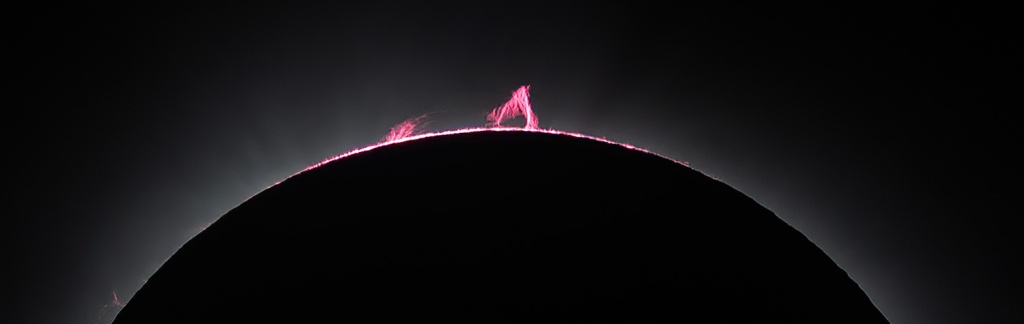
Many eclipse watchers were, with unaided eye, able to see the bright pink or red prominence shown here in our heavily-cropped image of the April 8, 2024 eclipsed sun. The prominences appear red because they are composed primarily of hydrogen which, at high temperatures, emits red light. Image rotated to place the prominence at top for aesthetic reasons. Image Credit: James Guilford / Stella-Luna Observatory.

While we very much wanted to view and photograph Sun’s corona during the April 8 total solar eclipse, a blanket of high, thin cloud covered the area blocking faint details. We were, however, able to observe and image the bright inner corona and prominences (“proms”) along the rim of the eclipsed Sun and what a show it was.

Sun is in the active phase of its 11-year cycle and, during totality, prominences were expected and seen in various sizes and at several sites around the rim. The largest was easily spotted with the unaided eye, causing questions from casual observers as it brightly shined at about the six o’clock position of the eclipse ring as viewed from North America. We were delighted with the images of proms that we were able to acquire!

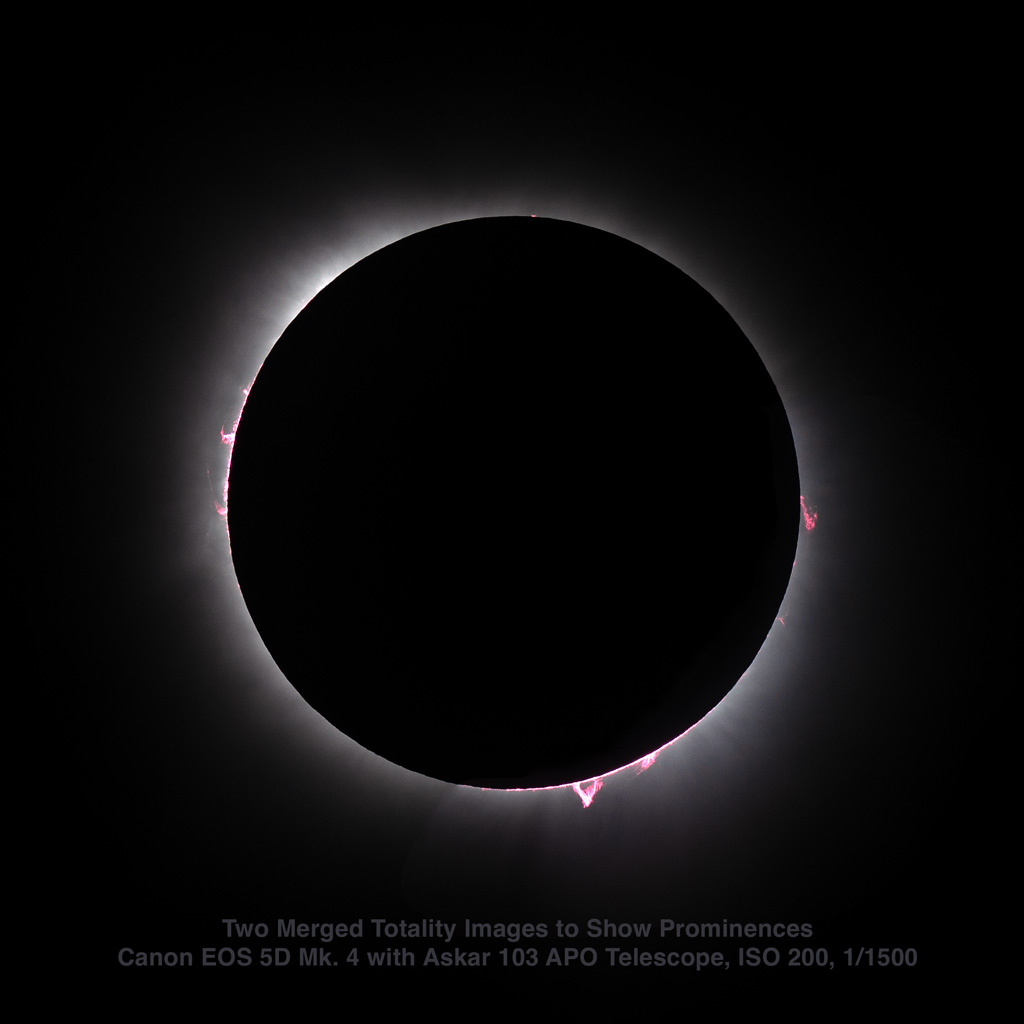
As Moon drifted across Sun during totality it, in turn, covered and exposed different regions of Sun’s limb. To give a fuller impression of prominences seen, we grafted two of our images from totality into one picture; one image was recorded just as totality began, the other as totality was about to end. The resulting picture is not a view one would have had but does correctly illustrate the position and visual size of the proms.

Two images of totality are combined here to illustrate the visual size and placement of promiences exposed during totality of the April 8, 2024 total solar eclipse. The large loop of the prominence near the six o’clock position was easily spotted with the unaided eyes of many, adding to the wonder of their eclipse experience. Image Credit: James Guilford / Stella-Luna Observatory.

Observers in Northeast Ohio were fortunate. Although the morning began with heavy cloud cover, skies cleared and allowed decent viewing of the eclipse in its entirety. Temperature drops were easily felt as bright daylight transitioned to an eerie twilight. As totality began, cheers of awe could be heard from gathered eclipse watchers at a nearby organized event. Automatic street lights illuminated. A robin was heard singing its evening song. Sunset colors lit the horizon about three-quarters of the way around us. In the southwest, beneath the eclipsed Sun, the horizon appeared dark. And then, as bright sunlight returned, first via a brilliant crescent, then by an expanding and warming solar disk, it was over. Those we spoke with were delightedly awestruck having had the experience of a lifetime.

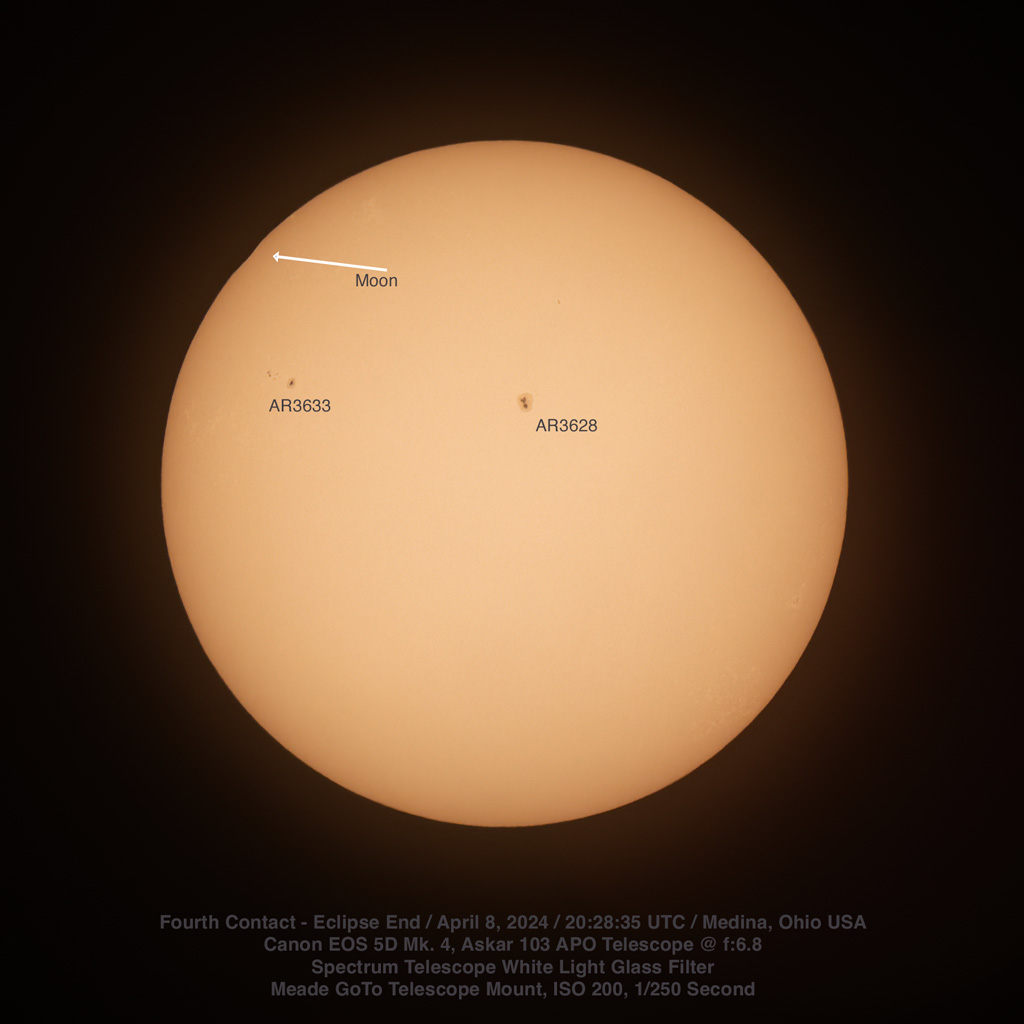
Following are several images of Sun as the eclipse began, during the partial phase, and as it ended. Times are expressed as UTC and were recorded automatically by the camera, set via GPS. Observers in different areas will have seen times that differed from ours and each others due to parallax effects, Moon being much closer to Earth than is Sun.

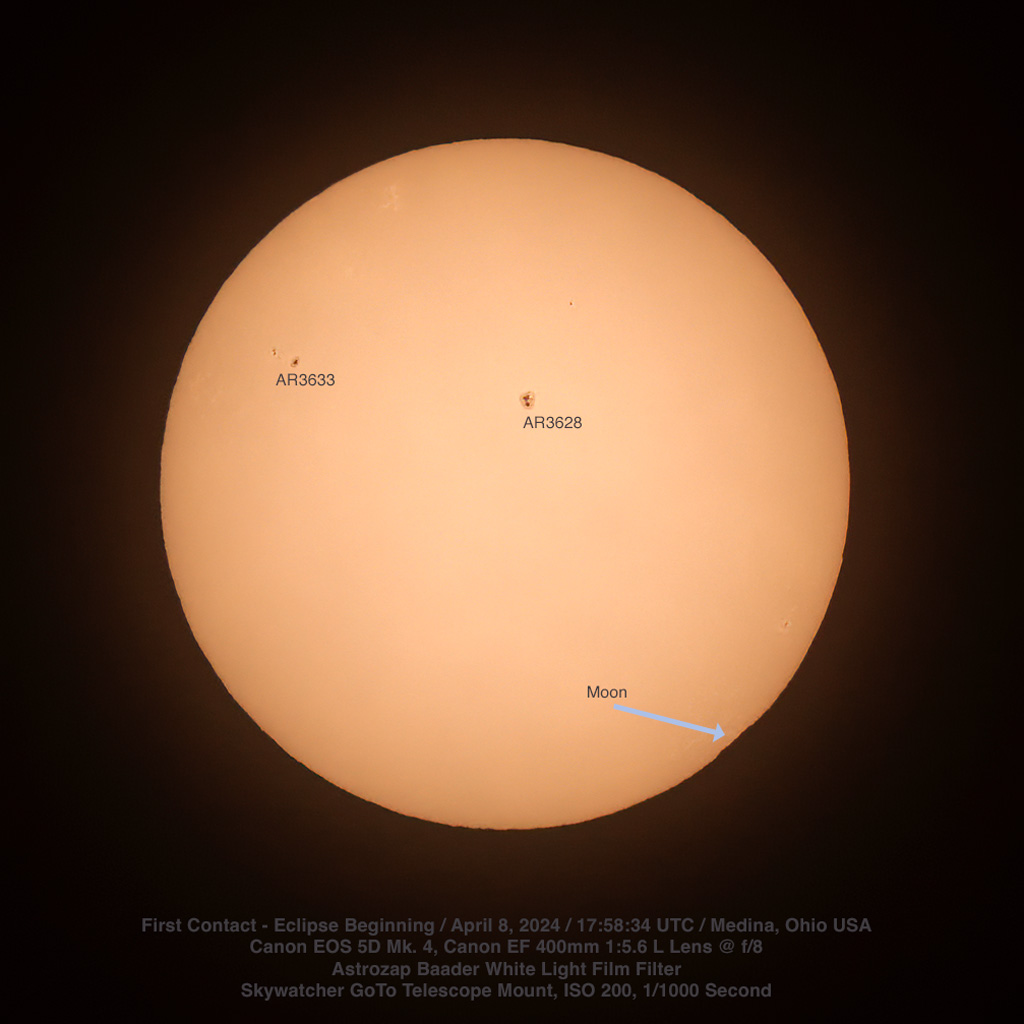
First Contact: The first noticeable encroachment of Moon over the solar disk is shown here. This image was recorded at 17:58:34 and marks the beginning of the eclipse process. Two areas of sunspots are also noted here. Image Credit: James Guilford / Stella-Luna Observatory.
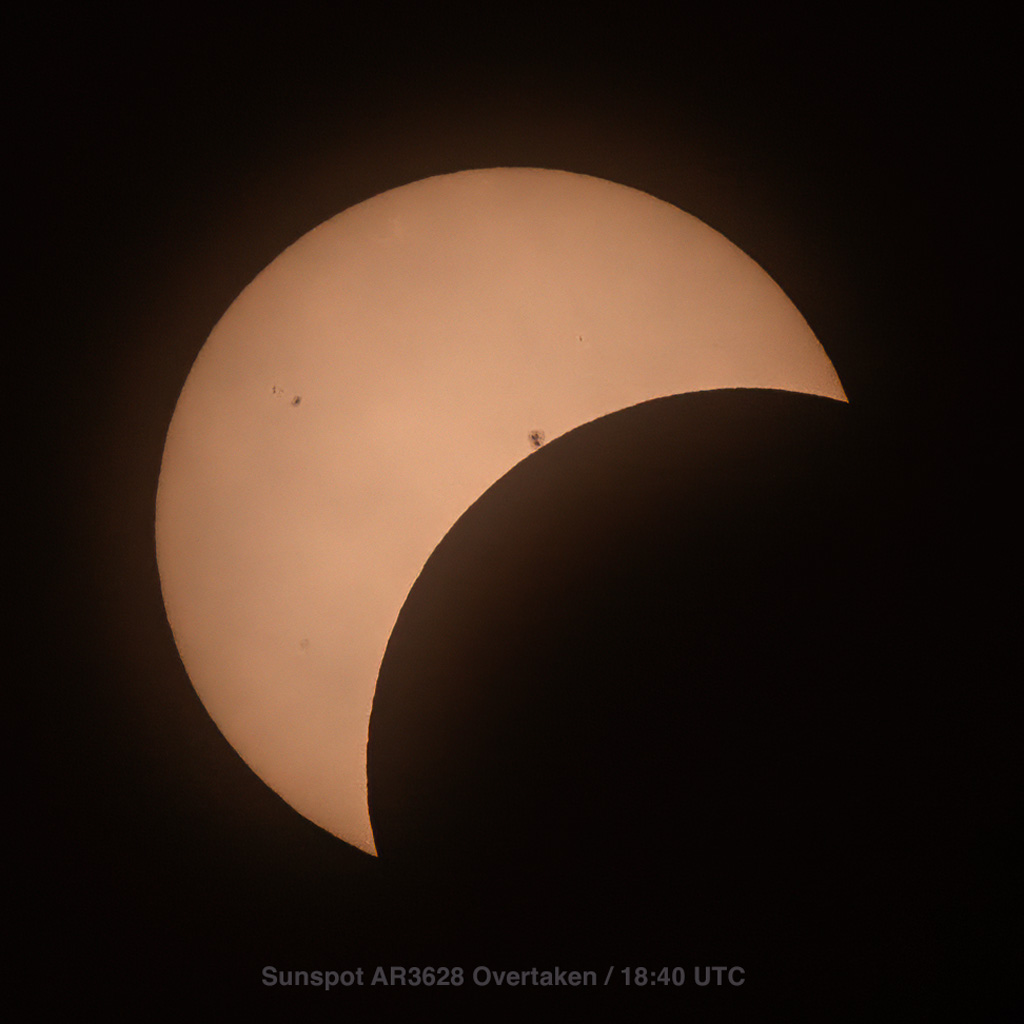
Sunspot AR3628 was about to be covered by the silhouetted Moon as the eclipse progressed from the lower right-hand area of this image toward the upper left. This was imaged at 18:40 UTC. Image Credit: James Guilford / Stella-Luna Observatory.
Fourth Contact: By this point most casual, and many serious observers, had packed up satisfied with a wonderful eclipse experience. We kept the camera running, just so that this instant could be recorded — the moment when Moon completed its passage in front of Sun, in this picture at 20:28:35 UTC. Image Credit: James Guilford / Stella-Luna Observatory.

Another day, another sunspot

The Sun: March 24, 2024, 15:46 UTC, as seen from Medina, Ohio, USA. Canon EOS 6D Mk. 2, Askar 103 APO telescope @ f/6.8, Spectrum Telescope filter, ISO 250, 1/2000 second.

Taking advantage of a rare day with clear skies, I set up the new-ish Askar 103 APO telescope and got a bit more solar imaging in. The huge sunspot group at the center of the image above is designated AR3615 — it and the isolated sunspot above it (AR3614) exploded in tandem on March 23, directing their CMEs (Coronal Mass Ejections) at Earth. When the CME hit our planet, the result was a severe geomagnetic storm. While not specifically practicing for the upcoming solar eclipse, the experience doesn’t hurt, either! This period of activity makes the sun’s photosphere interesting to observe as features visibly change day-to-day and even more rapidly, if one looks close enough. Sun is nearing the predicted peak of its 11-year cycle of activity which is expected in 2025. That means a couple of more years (at least) of interesting things to see on our nearest star.