The total lunar eclipse of March 13 – 14, 2025 did not disappoint! We resolved to capture images from the late partial eclipse to maximum eclipse, mostly to be able to fit in a little sleep! Catching it all, which we could from our North America location, would have required, essentially, an all-night session. Just a bit too much!
Early partial eclipse. The brighter shadow within the penumbra lights the top portion of this image. Note a bit of reddish tone within the dark umbra. 2:08 AM EDT
I sat on a pad over the paved surface where in the cold, where the observatory is to eventually stand. The old telescope mount ticking away as it tracked the moon across the sky. Occasionally geese and ducks on the nearby pond called out against some unseen disturbance. The stars of Great Orion were sinking behind nearby trees.
Moon is deep within the umbra and last penumbra light about to be left behind. 2:19 AM EDT
In the otherwise quiet chill, I watched the lunar transition, from a bright sliver left over from the night’s Full Moon, to glowing copper orb. With a cable release I manually triggered the camera’s shutter: click — pause — click, to record the event.
Maximum eclipse. Moon is fully within the umbra but because it is not traveling through the center of Earth’s deepest shadow, scattered light from the penumbra brightens the upper limb. 2:58 AM EDT
Shortly after maximum eclipse (shown above), at 2:58 AM EDT, I shut down the telescope and, casting a wistful eye at the still-darkened Moon, went indoors. I fed the waiting cat, changed back to pajamas, and returned to bed. In fitful sleep, somehow still cold, happy to have sacrificed rest for the experienced phenomenon.
Tech: Askar 103 ED telescope, Canon EOS 5D Mk 4 camera, Meade Goto Mount, Photoshop. ISO 400, variable exposure times.
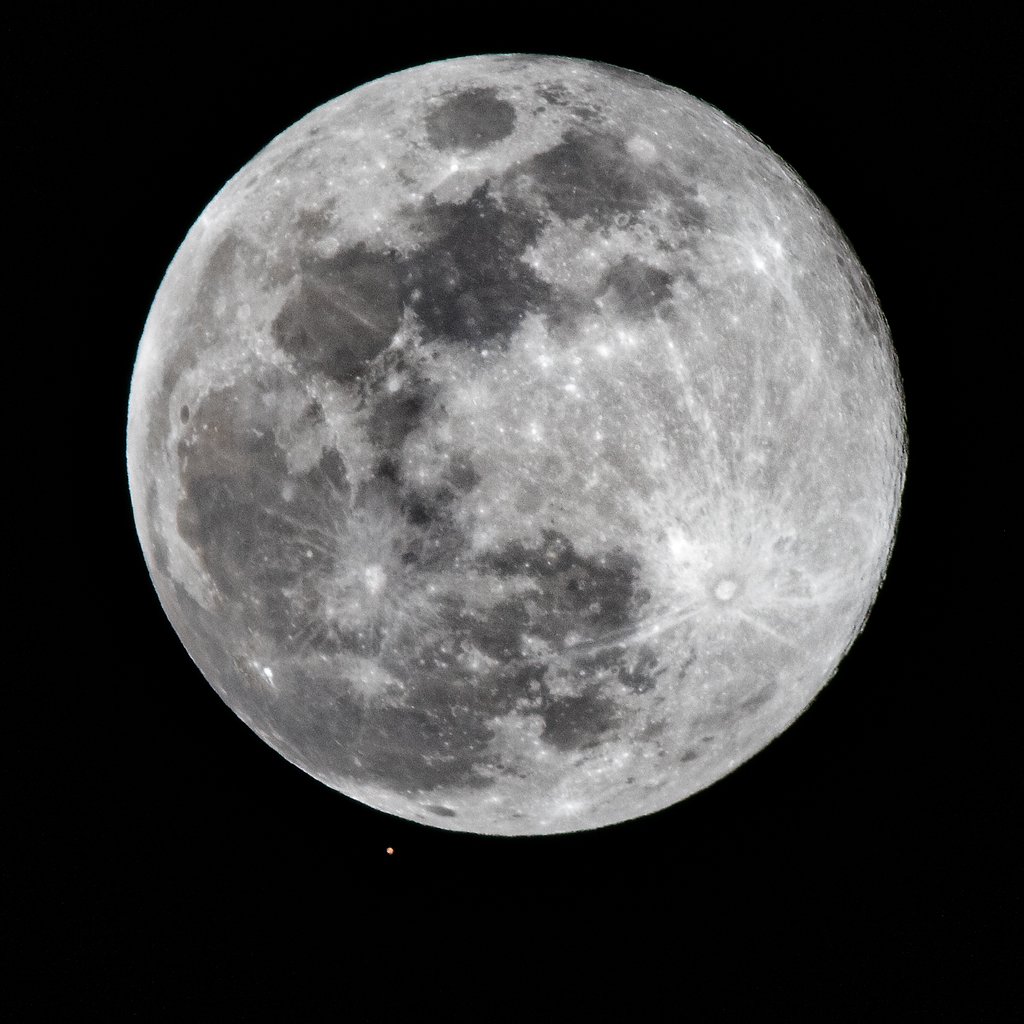
Only a few minutes from occultation, Mars is seen just off the lower edge of the lunar limb in this full-disk image recorded at 9:09 PM EST. The event only occurs with planet Mars about once every 14 years. Photo by James Guilford.
Clouds held off — pretty much — for us to observe the Moon occult* Mars, the reddish dot in the photo above. About once every 14 years or so, everything lines up just right and planet Mars is hidden by Earth’s Moon. Though Mars is about twice as big in diameter as our Moon, it was nearly 60 million miles farther away from Earth during the encounter — to the unaided eye, Mars looked like a tiny bright red star next to the Full Moon.
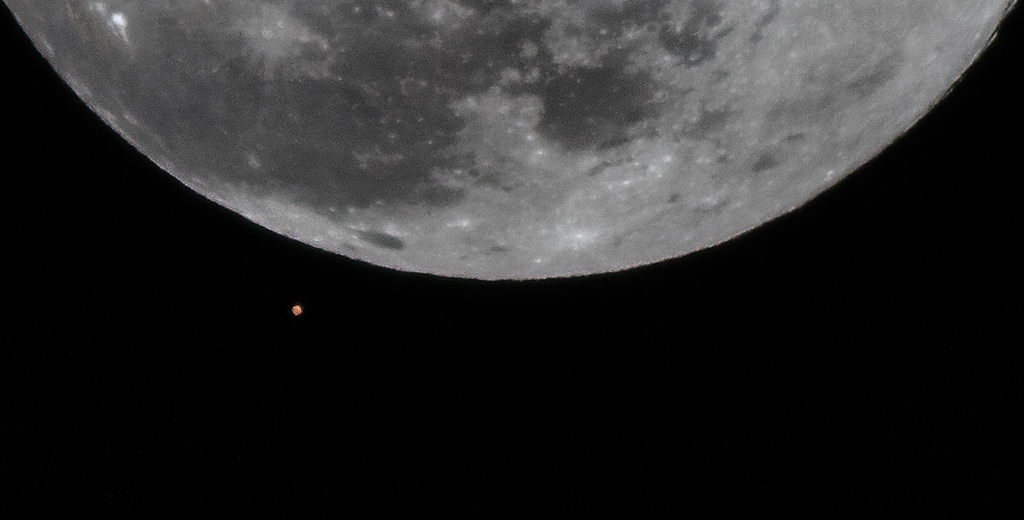
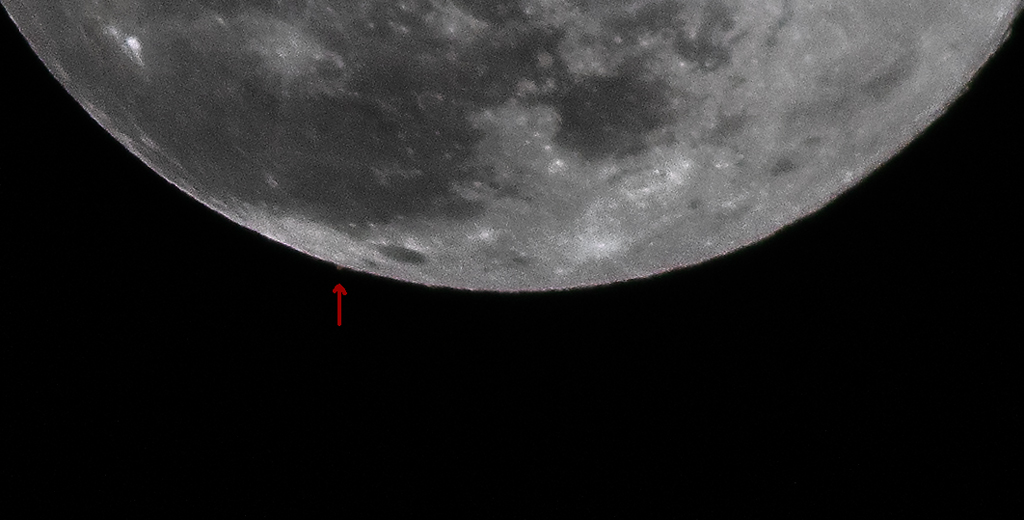
As predicted by mathematics, Mars and Moon grew nearer and nearer each other until, at 9:12 PM Eastern Standard Time (EST), the Red Planet disappeared behind our brilliant orb.
Mars, the small reddish dot in this image, nearing occultation by Earth’s Moon, as seen at 9:07 PM EST, January 13, 2025. Photo by James Guilford.A red arrow indicates a ghostly mound that was Mars as it disappears behind Earth’s Moon at 9:12 PM EST, January 13, 2025. The dark oval to the right of Mars’s vanishing point is the lunar basin Grimaldi. Photo by James Guilford.
Passing clouds threatened to obscure the event but thanks to gaps between those clouds, there was enough clearing for observation. Shortly after Mars vanished, so did those inter-cloud gaps. With Moon now cloud-covered, we did not return to the 13℉ night to watch for Mars to emerge.
Technical: Canon 6D Mk. 2 Camera, Canon 400mm EF 1:5.6 L Lens, Canon 2X telextender, ISO 400, f/11, 1/250 second, photographic tripod.
*Occult: To cut off from view by interposing something. Commonly used as a noun to indicate something supernatural that is hidden from ordinary access.
Waxing Gibbous Moon, January 10, 2025, at 7:18 PM EST. Note the delicate “C” shape on the upper left-hand edge of the lunar image — rising sun lighting the mountain tops that line Sinus Iridium while lower terrain remains in darkness. Crater Copernicus stands out at center-left, and Crater Tycho stands proudly in the heavily-bombarded lower area of the image. Note the extensive spread of ejecta rays that radiate across Moon’s surface from the relatively recent formation of Tycho. Photo by James Guilford.
It was a clear night so, of course, I had to go outside and take a look. Cold too, at 13℉, so I didn’t stay long! Mars, Jupiter, and Saturn were easy to find, all three shining bright. I was out for a “Moon shot”, though, got a pretty good one. This was made using our Sun shot setup, minus solar filter, of course! Moon was beginning its occultation of the Pleiades which didn’t image well.
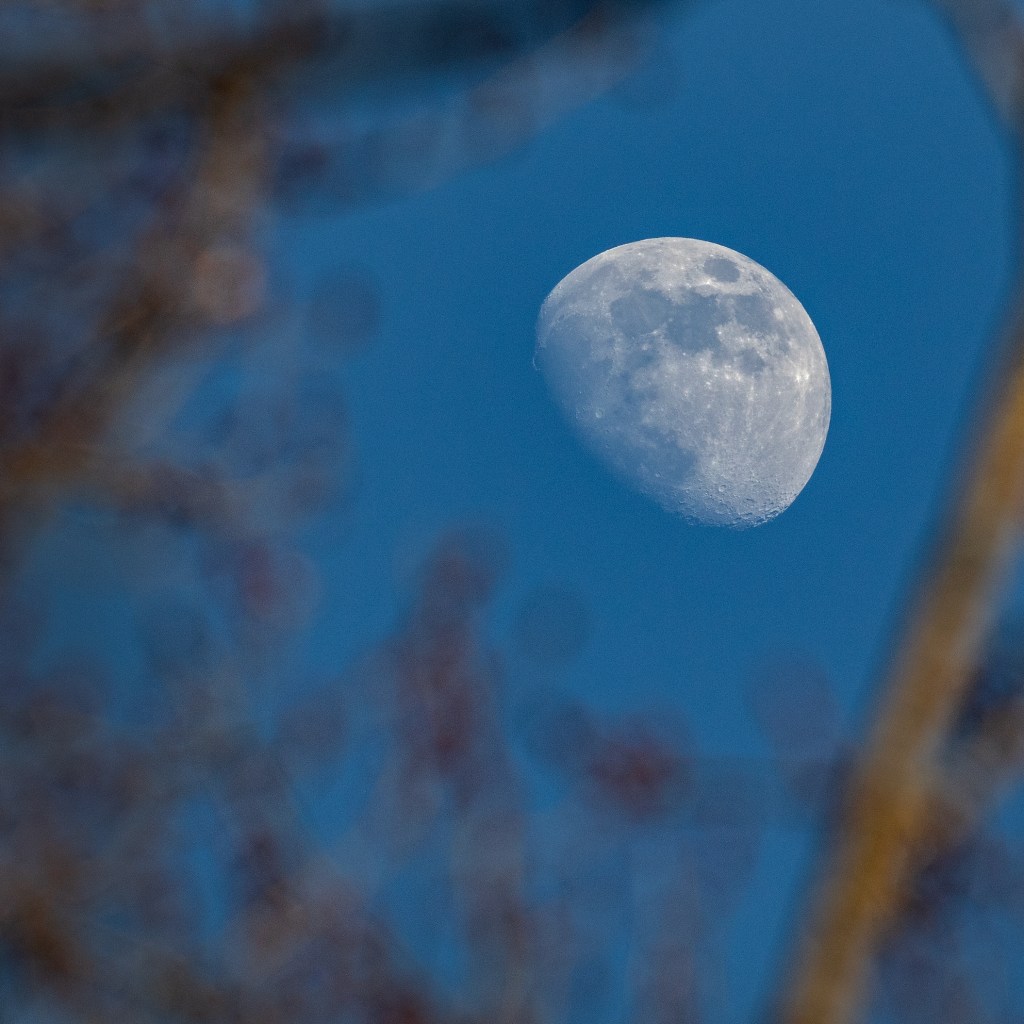
The day was clear, as well, and Moon was clear and bright even against the blue daytime sky. So, here is our neighboring world rising through the trees. This is presented second, instead of at the top, because we prefer the nighttime image.
Waxing Gibbous Moon. January 9, 2025, at 4:08 PM EST. Photo by James Guilford.
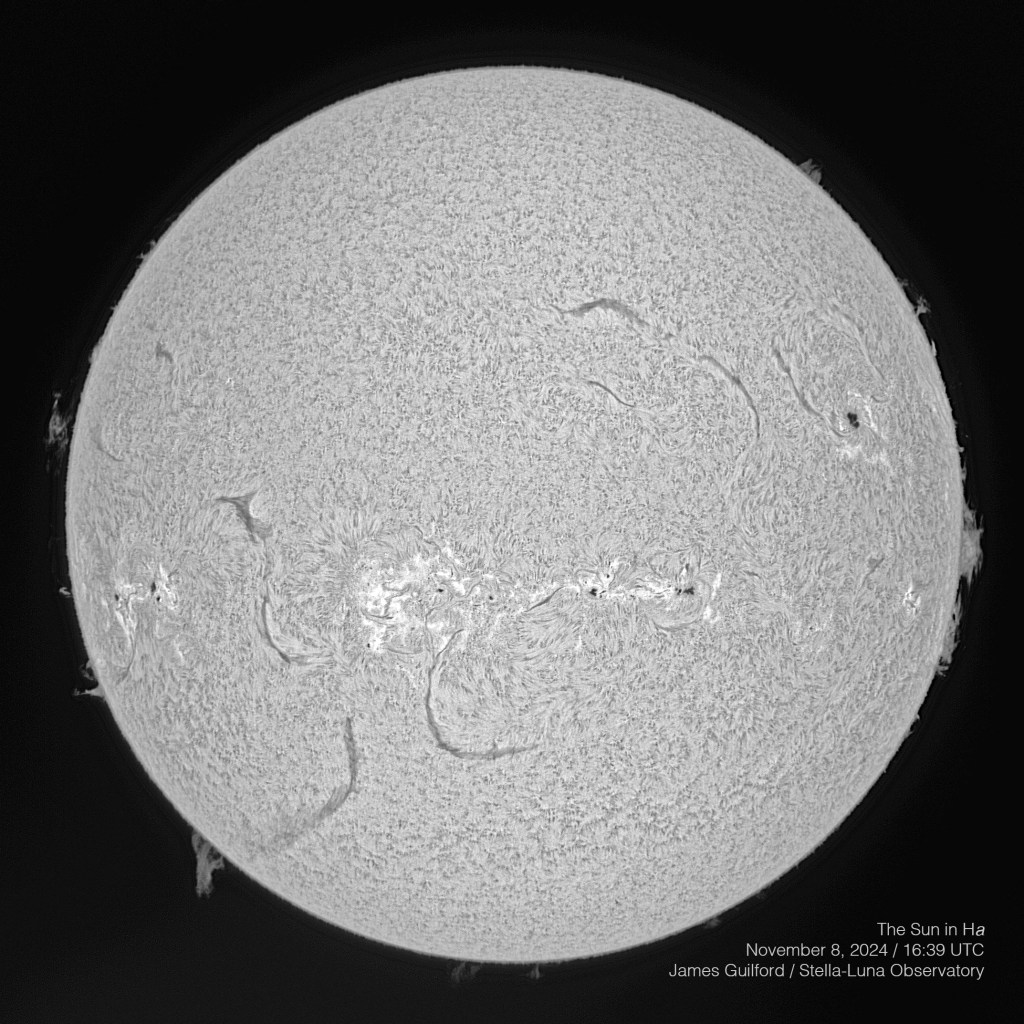
The complete solar disk as recorded in hydrogen-alpha light. The “worm-shaped” shadows seen in several areas are filaments. The dark spots are, yes, sunspots. And around the rim or limb of the solar disk are seen prominences — geysers of solar plasma riding magnetic field lines before crashing back into the sun. False color applied.
In addition to photographing Earth’s Sun in white light nearly every clear day, we occasionally set up the heavy telescope mount and bring out the new hydrogen-alpha (Ha) telescope for a bit of visual observing and unique imaging. It’s a bit of work since, without an observatory building we usually feel we need to take down and store away the mount after each session, so we don’t do that every day.
On November 8 we had clear skies, good atmospheric conditions, and the inclination to do the Ha setup and were rewarded with splendid views plus our best Sun images yet.
Using a Barlow lens to zoom for a closer view, we see large and small prominences and hints of spicules along Sun’s limb, and several large filaments. The dark spots in the upper left-hand corner of this picture is a group of sunspots at active region 3889.
Across the solar disk were visible large and distinct filaments — prominence loops seen from “above” — as well as sunspots and swirling patterns in the solar atmosphere around them. All around the Sun’s limb could be seen prominences glowing against a background of black space. Some of the prominences, which are fountain-like sprays and loops of magnetically-charged plasma, were quite large.
A major part of producing good images is what happens away from the telescope. Our usual practice is to record video of the telescope view and use software, in the office, to sort through thousands of video image frames, then stack the best few hundred to form a single still image. The still image is then edited to bring out as much detail and tonal range as possible. This process, which is common in astrophotography, produces a sharper image than what might be acquired via any single photographic “snapshot” owing largely to atmospheric turbulence.
Using a Barlow lens to zoom for a closer view, we see large and small prominences and spicules along Sun’s limb. The dark spot just above the center of this picture is a large sunspot at active region 3879.
There’s room for improvement, and we’re seeing excellent progress, but the images shown here are our best yet of Sun in hydrogen-alpha light.
Note: H-a light is that which Sun is producing in its chromosphere — the solar atmospheric layer between the outer corona and the lower photosphere — and is invisible even to protected human vision and white light cameras. Specialized optics are required to block other wavelengths found in white light and allow observation of Ha. When we observe or image in white light, we’re actually viewing features such as sunspots while looking through both the corona and the chromosphere!
Safety Note: It is not safe to look directly at the sun without specialized eye protection for solar viewing, and safe solar filters for telescope, binocular, or camera use. Permanent damage to vision can result from improper viewing of the sun.
The complete solar disk as recorded in hydrogen-alpha light. The “worm-shaped” shadows seen in several areas are filaments. The dark spots are, yes, sunspots. And around the rim or limb of the solar disk are seen prominences — geysers of solar plasma riding magnetic field lines before crashing back into the sun. Image was recorded and presented here in monochrome.
C/2023 A3 (Tsuchinshan-ATLAS) seen against a starry night sky on the night of October 17, 2024.
C/2023 A3 (Tsuchinshan-ATLAS) has faded so very much in just a few days! We wish that we could have seen it early in the week — right after it became an evening object here — but rain and clouds ruined the first nights and, as I just said, that comet is fading *fast* as it retreats toward the outer regions of our Solar System. Comet C/2023 A3 had what seemed to be an extraordinarily long tail and, while we were unable to capture its extent, you can see hints of it leading far beyond its bright nucleus. Visual sightings, for us, were binocular-assisted only and when we could finally see it, C/2023 A3 wasn’t exactly “spectacular”but it was another comet to add to our “life list”.
C/2023 A3 (Tsuchinshan-ATLAS) the night of October 18, 2024, seen above moonlit, autumn-colored trees reflected in still lake waters. Photo by James Guilford.C/2023 A3 (Tsuchinshan-ATLAS) the night of October 18, 2024. Photo by James Guilford.
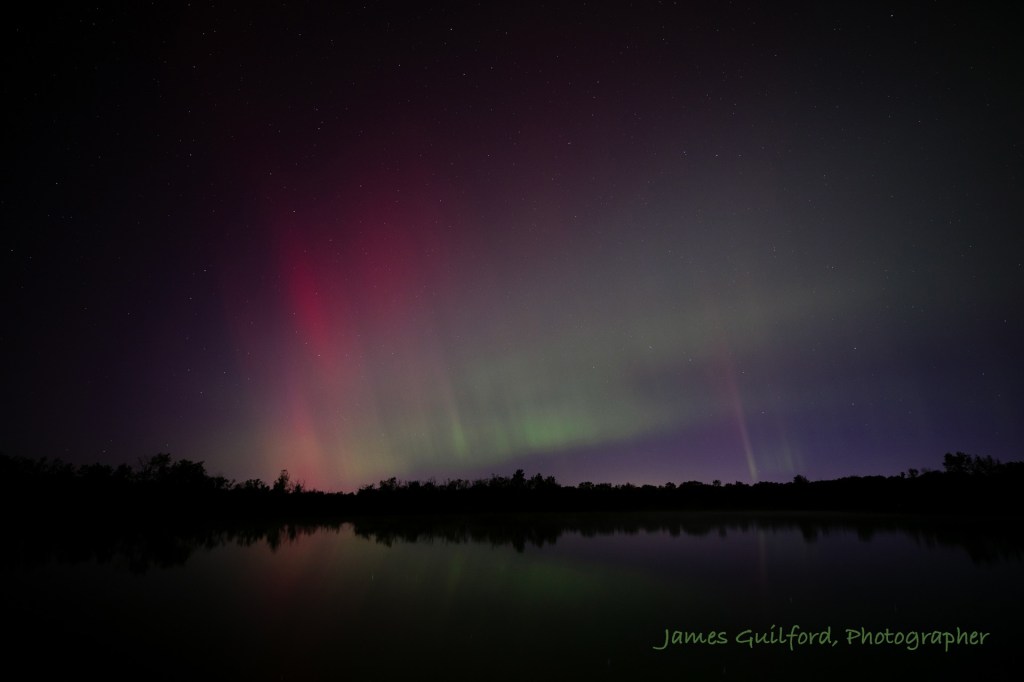
A panoramic view of the aurora borealis as viewed from rural Medina County, Ohio, as a surge in activity occurred. The display is reflected in the still waters of a small lake. The bright light at the right-hand end above the treeline is light pollution from the city of Medina. Photo by James Guilford.
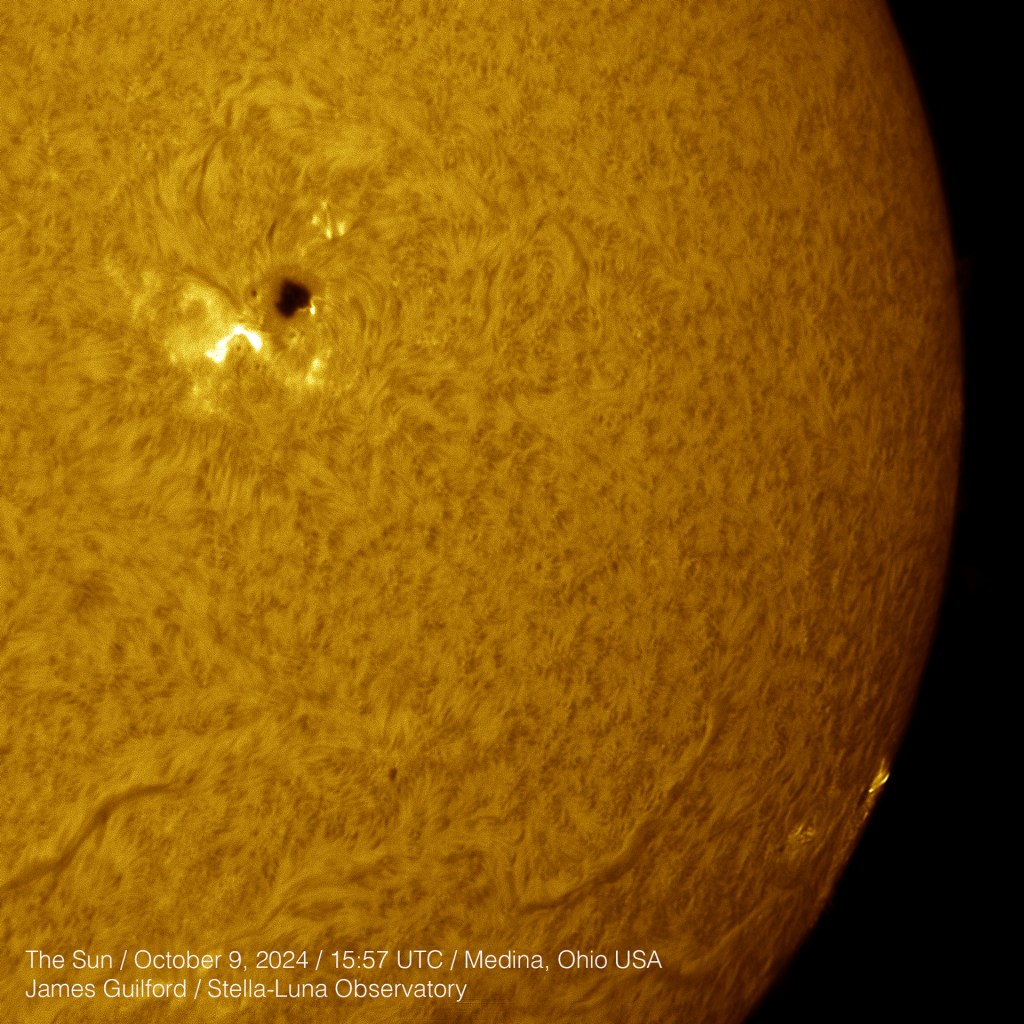
It began on Tuesday, October 8, when a sunspot called AR3848 flared explosively over the course of several hours. The detonation hurled a large and powerful coronal mass ejection (CME) Earthward from Sun. On Thursday, October 10 the magnetically-charged solar plasma hit Earth’s geomagnetic field and fireworks erupted. According to SpaceWeather.com the aurora borealis was seen as far south as Puerto Rico!
The area in the upper left-hand portion of this photograph is AR3848, the “active region” that produced an enormous solar flare on October 8, 2024. This is a view of Sun in hydrogen-alpha light, which shows the solar coronosphere layer. Photo by James Guilford.
I headed out to a remote county park location, where I have permission to be after dark, and was fortunate enough to be ready when a significant surge in activity occurred — around 10 PM EDT. That peak was amazing with colors, shapes, and movement visible across the entire northern horizon. It was particularly cool to see pillars appearing and disappearing in real time. Light from the aurora reflected upon the still waters of the park’s lake. Adding to the quiet, magical mood, were occasional calls in the darkness from perched birds. A wood duck, out on the lake, piped a sound reminding me of common loons.
During peak activity, looking east, we see intense red crowning a curved green ring, the Northern Lights reflected from the surface of still lake water. Photo by James Guilford.
The auroral surge went on for probably a bit more than half an hour, challenging me to select a spot to photograph. First one area would glow, then one at the other end of the bow-shaped display, pillars of light would appear like searchlights, then fade away. A thrill to witness as light, movement, and delicate colors were visible to the unaided eye. The camera picked up more than my poor eyes could see but I say without reservation this was the grandest aurora I’ve witnessed.
The western end of the coronal arc appeared strongest, as viewed from Medina County, through most of the evening. Here, during the surge, we see typical auroral colors, curtain-like waves of shape, and pillars that look like they reach the ground or might be mistaken for searchlights projecting from the ground. Photo by James Guilford.
All evening there seemed to be more intense activity over the western end of the aurora; that was verified by relatives in northwest Ohio whose photos showed a sky full of color directly overhead.
Although some observers were concerned that moonlight might drown out the aurora, that was not a problem during the peak or as it began to subside. This image shows the waxing Moon, low to the western horizon, with colorful patches of glowing sky nearby. Photo by James Guilford.
While I was at the lake I heard others coming and going from the park, pretty much the entire time I was there. A young couple eventually ventured away from the parking lot and encountered me at my spot around 11:30, seeking what I had found — a dark spot near the water. Their arrival had been delayed by a camera gone bad, and they had gone home to pick up another. Things petered out not long after the peak and, checking NOAA resources, it looked like the auroral ring was retreating back north. The couple had missed the best of the night and I, with frozen fingers and toes, I headed home.
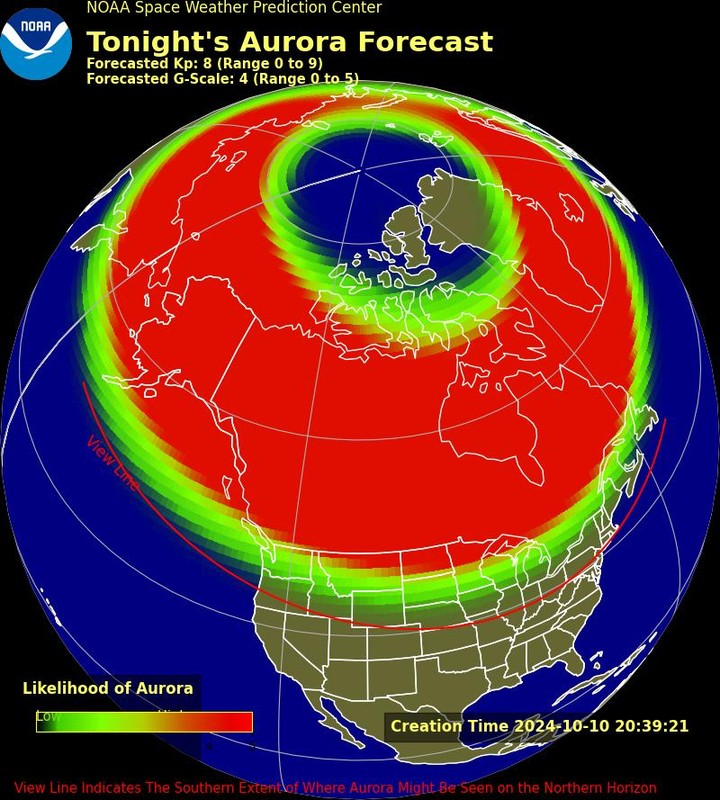
NOAA Space Weather Prediction Center graphic showing the predicted extent of the October 10-11, 2024 aurora borealis. Observers reported seeing portions of the aurora as far south as the Florida Panhandle. According to SpaceWeather.com it was seen as far south as Puerto Rico!
I’ve been shooting Sun images so frequently lately that I’ve neglected the night. While a recent aurora was obscured by clouds (and my sleep schedule) here, and no Perseid meteors spotted (clouds and sleep), Moon put in a nice appearance. Our neighbor in space was very low in our southern sky the night of August 14, which was good and bad. It was good because it can be hard to observe objects high overhead. It was bad because lower to the horizon means more air — and turbulence — between the observer and astronomical objects than if they were overhead. A tripod-mounted telephoto lens and DSLR were used for the capture and a bit of post-processing sharpened things up pretty well.
One of the things I enjoy most when observing Moon is looking along the terminator — the divide between dark and lit areas — at features partly illuminated by, in this case, the rising Sun. Especially noticeable is the arc of light near the upper end of the terminator — the sunlit tops of the Jura Mountains, defining the Bay of Rainbows, off of the grand Sea of Showers or Mare Imbrium.
Sunspots AR3716, AR3713, and AR3712, imaged June 22, 2024, 12:59 UTC, by James Guilford
I continued my practice of daily imaging of the sun for some weeks now. While still deciding precisely how to use and display the images I’m collecting, I’m also trying to standardize how the images are captured and establish a workflow in editing; that is in an effort to give the daily pictures the same overall size and appearance except for details, such as sunspots, where we want to observe changes. It’s not as easy as it may seem, especially when attempting to constantly improve image quality. This ought to become simpler once I have a permanent setup protected day-to-day within an observatory structure.
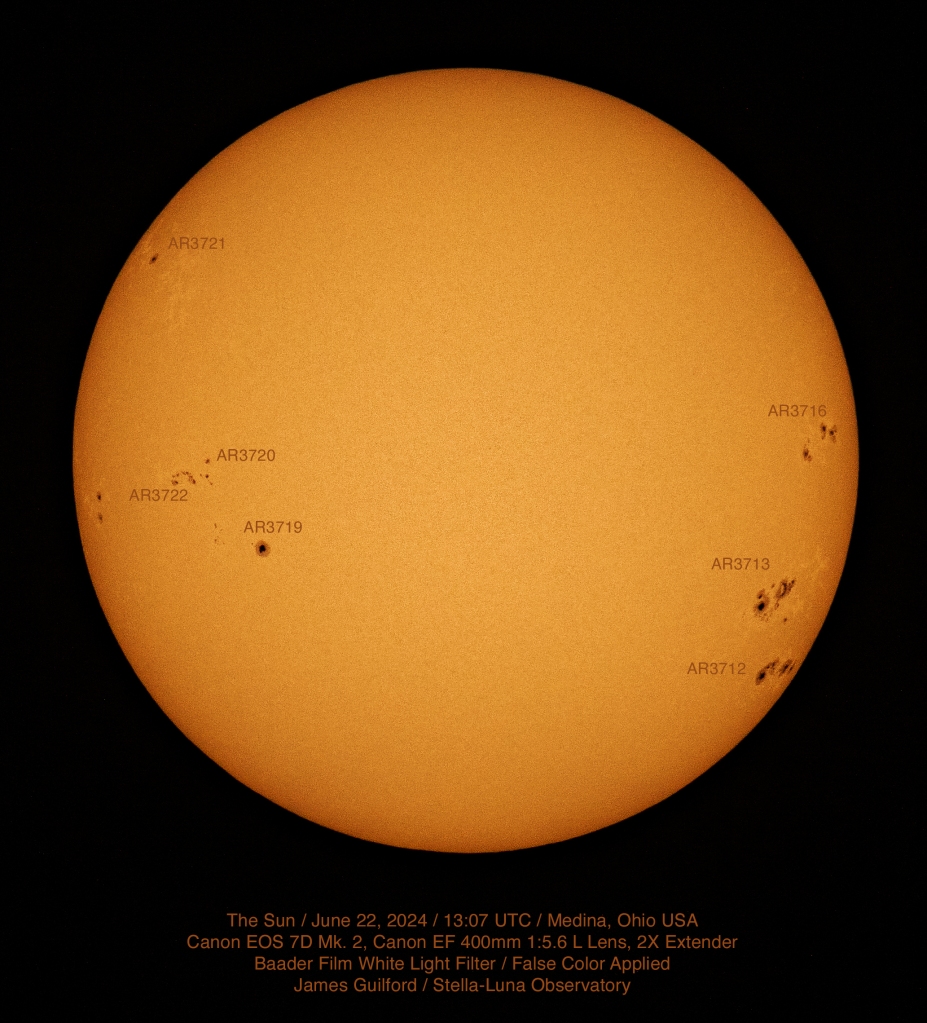
Sunspots AR3713 and AR3712, the more pronounced of the three large groups, have been interesting to watch as they traversed the visible side of Sun. Today (June 22), braving the morning’s already hot and humid conditions, I went to the extra work of setting up the Vixen VC200L Cassegrain telescope in an effort to achieve high quality images of the two — plus AR3716 — big sunspot groups before they disappear over the western solar limb. Both of the active regions reportedly harbor opposing magnetic energies which could, at any time, reconnect and throw off powerful flares but both have been surprisingly quiet. The next few days will be the last when an outburst from AR3713 or AR3712 might affect Earth.
The Sun, June 22, 2024 at 13:07 UTC from Medina, Ohio USA. Equipment: Canon EOS 7D Mk. 2, Canon EF 400mm 1:5.6 L Lens, 2X Extender, and Baader Film White Light Filter. False Color Applied. Image Credit: James Guilford / Stella-Luna Observatory
I meant well but still wound up posting new solar images to Instagram and Threads instead of here. Today’s image was particularly pleasing, however, so I’ve posted it in all three places!
Today was another day featuring a cloudy morning and sunny afternoon. This time, however, we experienced excellent seeing for a while — just long enough to record today’s solar portrait. We’re so pleased with the “inset” image that we’re featuring it first — it’s cropped directly from the whole-disk picture. Obviously sunspots AR3713 and AR3712 are dominant features; they also reportedly possess magnetic fields with the potential for M-Class flares.
Doing this the “old-fashioned” way, this image was a single exposure manually selected as best of a larger group of shots. The chosen image is edited to produce the best available picture from the data gathered. Today’s excellent seeing made for an unusually good photo. We’re pretty pleased.
Whole-disk image of Earth’s Sun as recorded June 14, 2024. Sunspot active regions are labeled.
An example of how I have been posting solar images on Instagram and Threads. This particular image shows giant sunspot complex AR3664 the day its coronal mass ejection from days earlier struck Earth’s magnetosphere setting off widespread and spectacular auroras.
I have been posting solar images on a near-daily basis for some time. I enjoy recording the images and sharing them with the world and Sun is an especially interesting object right now as we near Solar Maximum. Unfortunately, I am not sure the daily postings look all that great on Instagram where, now, our home page looks like a collection of spotted oranges or maybe suspect egg yolks! What to do?
My current thinking is to post only the most interesting images on Instagram and Threads — days when giant sunspots are present, newsworthy, or (eventually, when I get it working) spectacular coronal images — unusually interesting shots. To keep a public repository of the other images — the routine, daily views — a page on this website might be advised. I think I’ll try it.
So a daily posting here, on a solar imaging page, and special stuff also posted on Insta and Threads. Yeah, that sounds about right. Thanks for listening. — JG














 Stella-Luna Observatory