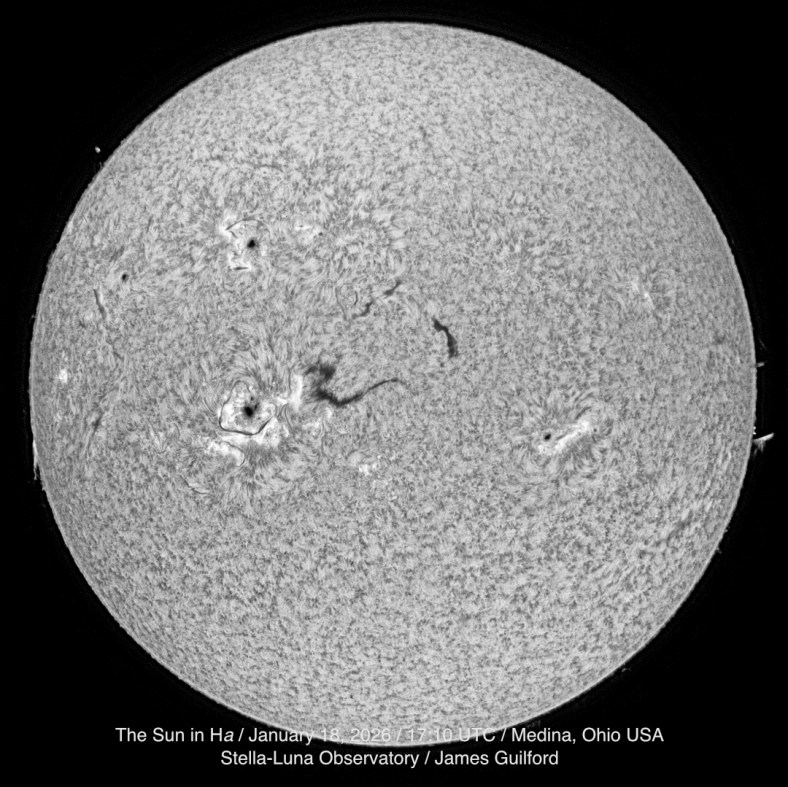
Full disk image of Sun as viewed in hydrogen-alpha light. Snake-like, dark filaments grace the center of the image. Several sunspots are also noted. Dominant in its influence on surrounding plasma features, is Active Region 4341 which exploded with a powerful flare one hour after this image was recorded.
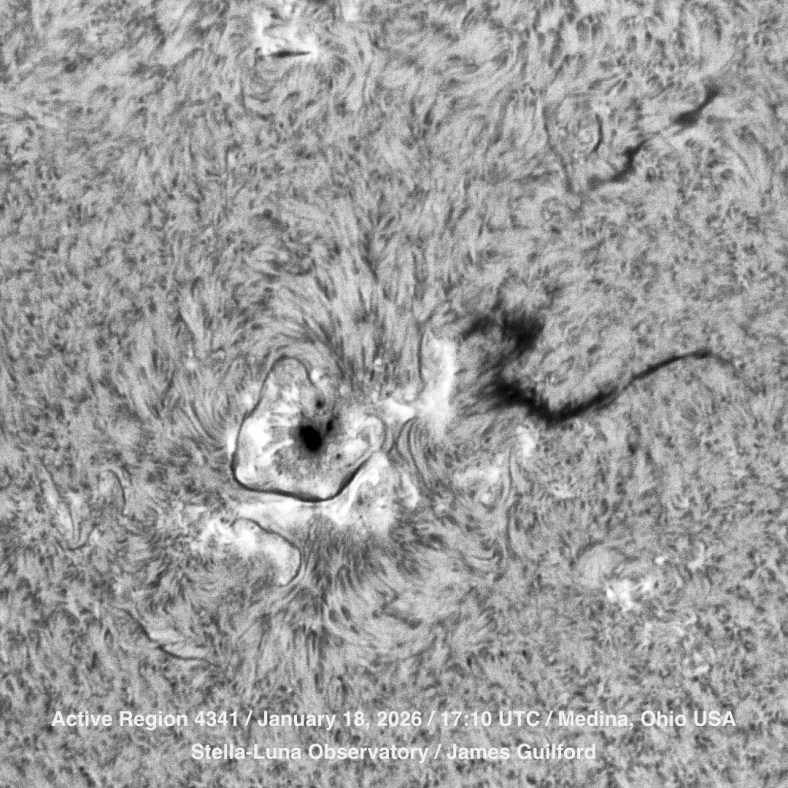
With recent weather, we believed the observatory might be closed until spring. On January18, however, the skies were clear and blue with very little wind. We unsealed the dome, brushed off some of the accumulated snow, and aimed at Sun. The first thing we observed was the presence of large filaments at the center of the disk. One filament, Z-shaped, was in immediate proximity to a large sunspot at Active Region 4341. Also visible were multiple prominences around the disk; Sun is still active! The powerful magnetic forces surrounding AR4341 are made evident by its influence upon Solar plasma — twisting and aligning the visible features like iron filings around a science classroom magnet.
A close-up view of Solar Active Region 4341, in hydrogen-alpha light. Snake-like, dark filaments grace the center of the image. Several sunspots are also noted. Dominant in its influence on surrounding plasma features, AR4341 exploded with a powerful flare one hour after this image was recorded.
While the sky was clear and blue, the temperature was wicked cold for standing around on stone floors. Also, touching metal telescopes, properly allowed to reach the ambient temperature of 19°F, with bare hands is, painful. The laptop computer also found the temperature uncomfortable for, while its battery was charged to about 60% capacity, the system quit complaining of low battery. Attaching the computer’s charger let us finish the session.
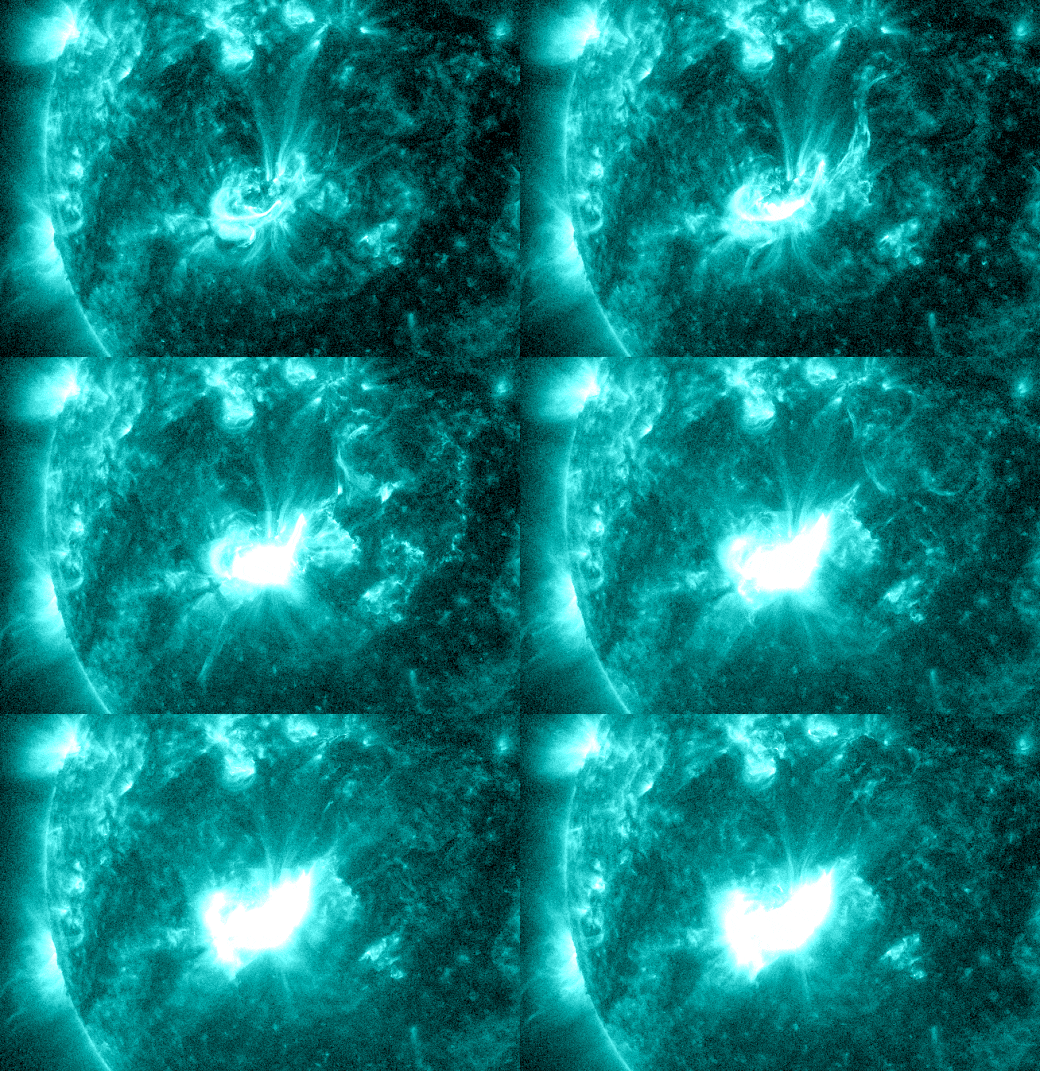
Video from NASA’s Solar Dynamics Observatory spacecraft, showing the X1.9/3b flare at AR4341. — January 18, 2026
One hour after we recorded the images of AR4341, the sunspot exploded with a massive X1.9-class flare. Expansive auroral displays are expected early January 20 though here, in Northeast Ohio, we are expecting cloudy, winter weather.
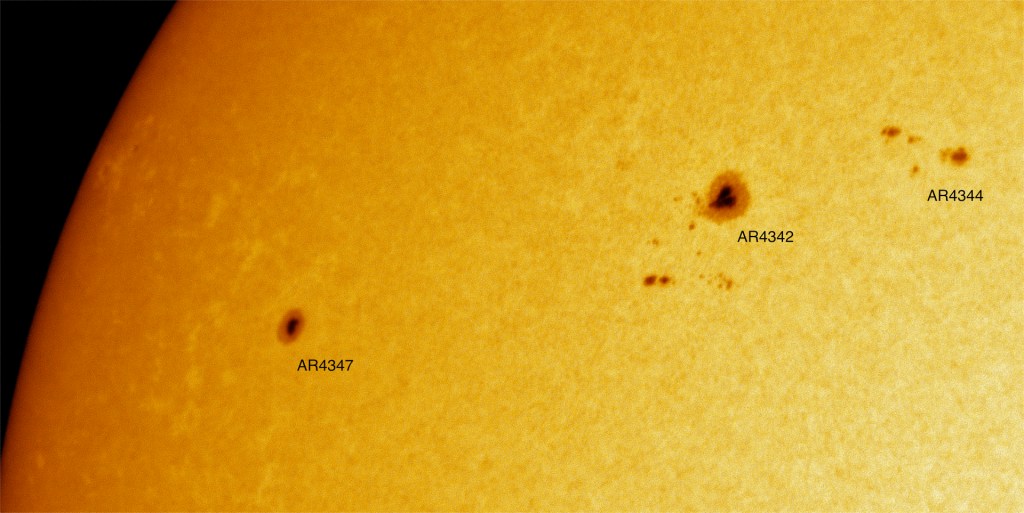
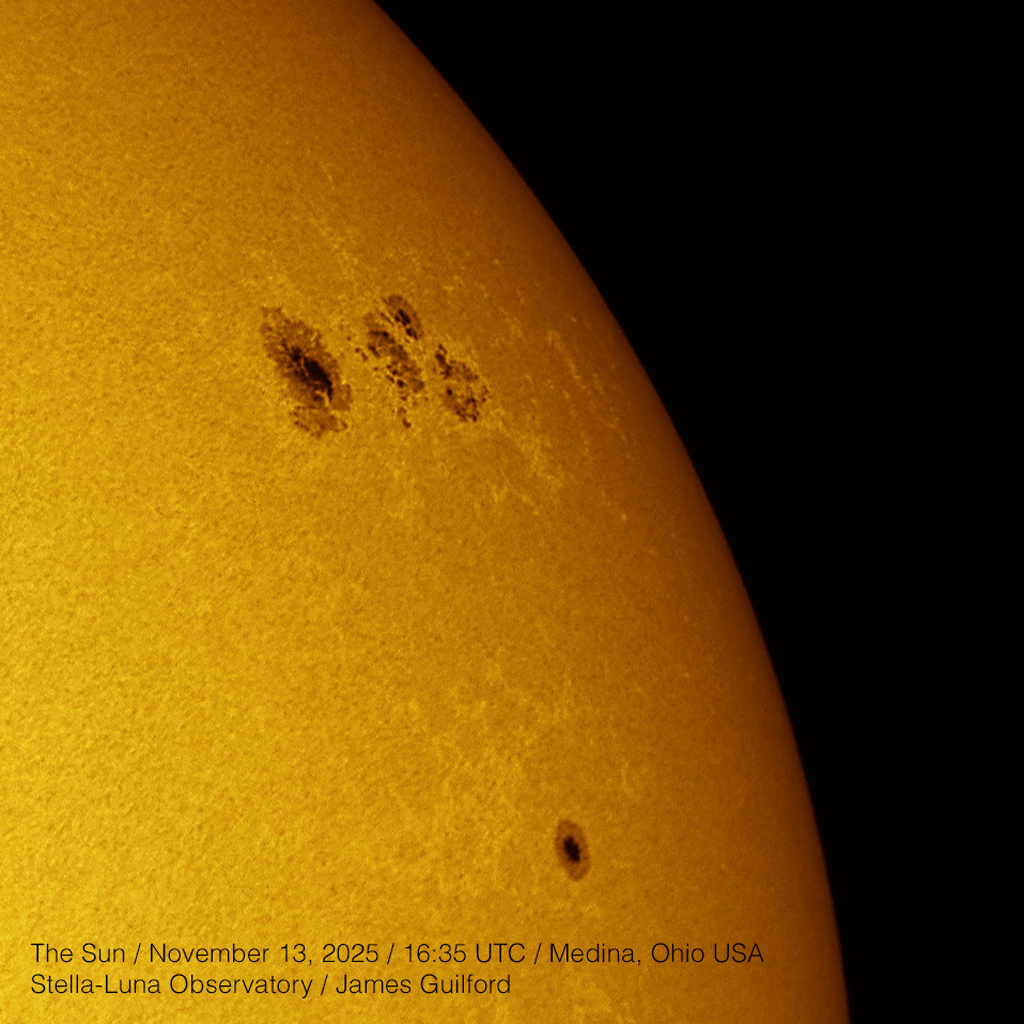
Also appearing on Sun, sunspots at AR4347, 4342, and 4344, shown here in white light (false color applied), in the northern hemisphere. Hydrogen-alpha light reveals features in Sun’s chromosphere, whereas white light imagery shows features, such as sunspots, in Sun’s photosphere — a layer deeper.
Our inland view of the aurora borealis competing with suburban light pollution the night of November 12, 2025. The aurora on the previous night was stronger, raising excitement worldwide; it was cloudy here that night.Just above the treeline in the center of this image may be seen hints of the aurora borealis. Farther north from here, looking out over a dark landscape, the show was probably pretty good!
Here are some views of the sunspot that blew off the CMEs that caused the geomagnetic storms that made the auroras that raised all the hubbub this week.
The sunspot at Active Region 4274 is responsible for all the action. Where we show two sunspots, the smaller one (bottom edge) is AR4275. The first view is in hydrogen-alpha light, the second and third views are in white light; yellow-orange tones are false color applied in processing.
Sunspots and prominences shown via hydrogen-alpha light, false color added.A white light view of AR4274 (top) and much smaller AR4275 (bottom), false color applied.AR4272 close up, with interesting patterns emerging in both the umbra and penumbra areas of the larger spot. Strong winds at the time of imaging reduced resolution somewhat.Here’s a white light image of Sun we made this morning depicting very Active Region 4274 and its less busy neighbors. Rotation is a bit off — rotated southward — but left alone for composition purposes. AR4274 is responsible for a series of coronal mass ejections (CMEs) that resulted in two nights of auroral displays that excited observers worldwide.
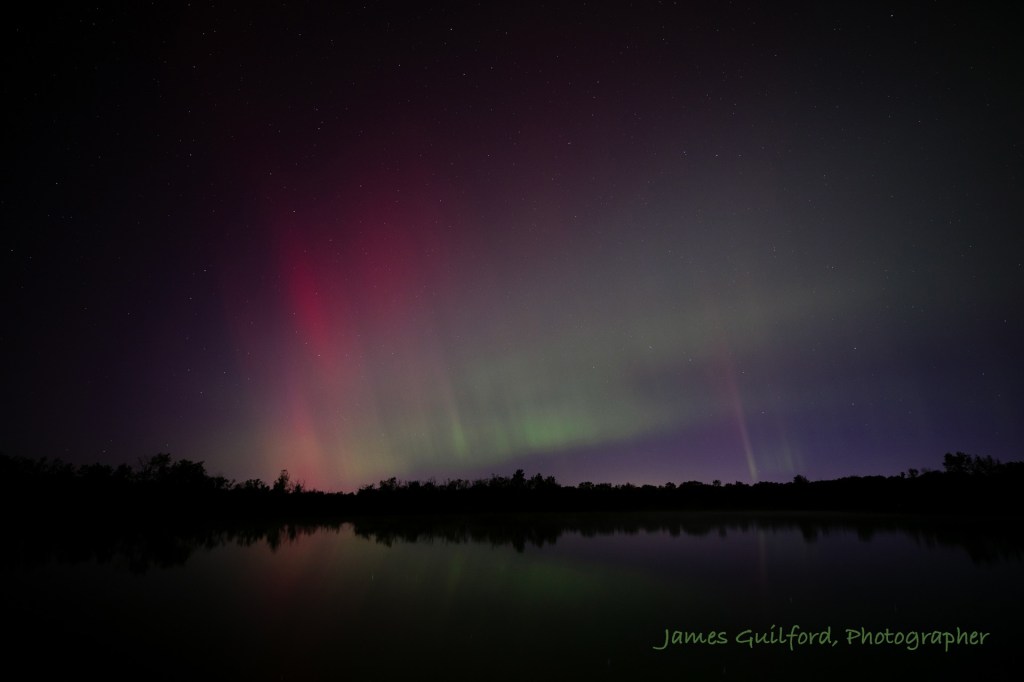
A panoramic view of the aurora borealis as viewed from rural Medina County, Ohio, as a surge in activity occurred. The display is reflected in the still waters of a small lake. The bright light at the right-hand end above the treeline is light pollution from the city of Medina. Photo by James Guilford.
It began on Tuesday, October 8, when a sunspot called AR3848 flared explosively over the course of several hours. The detonation hurled a large and powerful coronal mass ejection (CME) Earthward from Sun. On Thursday, October 10 the magnetically-charged solar plasma hit Earth’s geomagnetic field and fireworks erupted. According to SpaceWeather.com the aurora borealis was seen as far south as Puerto Rico!
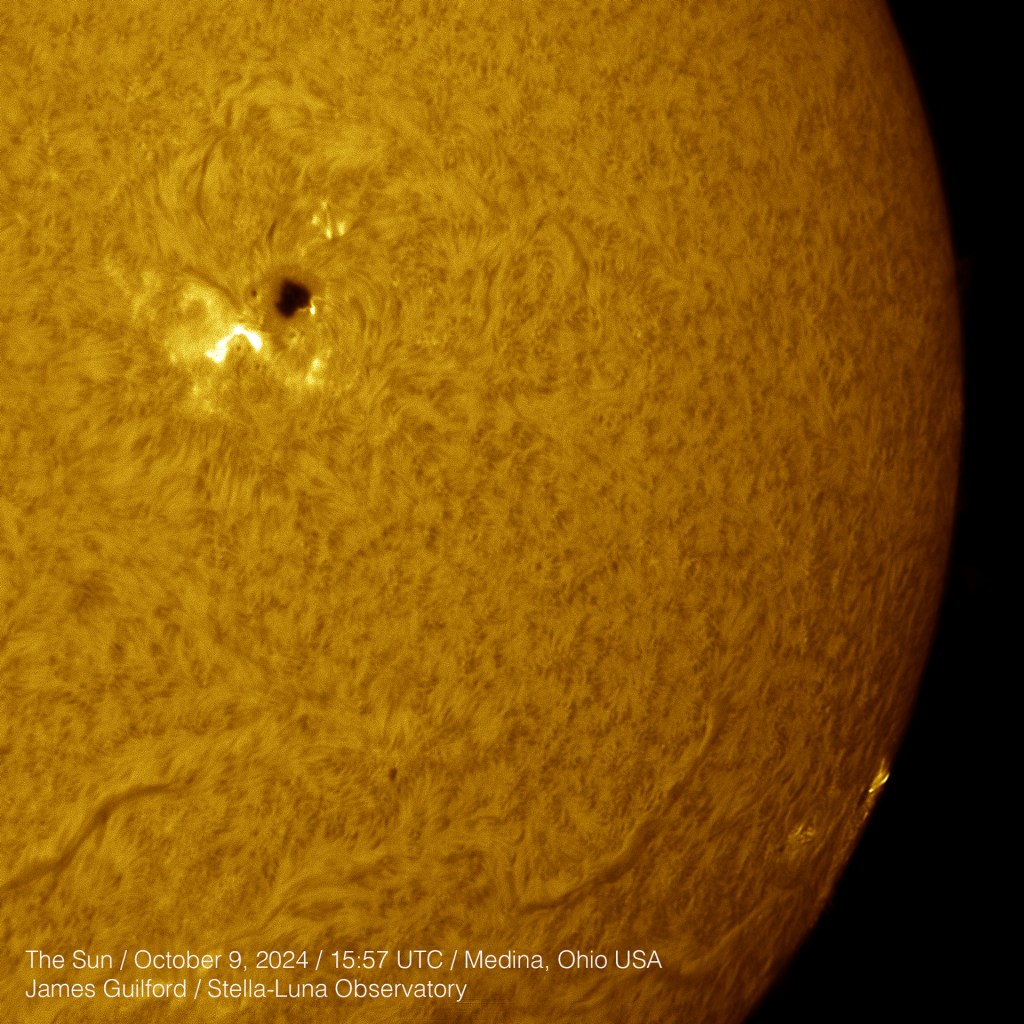
The area in the upper left-hand portion of this photograph is AR3848, the “active region” that produced an enormous solar flare on October 8, 2024. This is a view of Sun in hydrogen-alpha light, which shows the solar coronosphere layer. Photo by James Guilford.
I headed out to a remote county park location, where I have permission to be after dark, and was fortunate enough to be ready when a significant surge in activity occurred — around 10 PM EDT. That peak was amazing with colors, shapes, and movement visible across the entire northern horizon. It was particularly cool to see pillars appearing and disappearing in real time. Light from the aurora reflected upon the still waters of the park’s lake. Adding to the quiet, magical mood, were occasional calls in the darkness from perched birds. A wood duck, out on the lake, piped a sound reminding me of common loons.
During peak activity, looking east, we see intense red crowning a curved green ring, the Northern Lights reflected from the surface of still lake water. Photo by James Guilford.
The auroral surge went on for probably a bit more than half an hour, challenging me to select a spot to photograph. First one area would glow, then one at the other end of the bow-shaped display, pillars of light would appear like searchlights, then fade away. A thrill to witness as light, movement, and delicate colors were visible to the unaided eye. The camera picked up more than my poor eyes could see but I say without reservation this was the grandest aurora I’ve witnessed.
The western end of the coronal arc appeared strongest, as viewed from Medina County, through most of the evening. Here, during the surge, we see typical auroral colors, curtain-like waves of shape, and pillars that look like they reach the ground or might be mistaken for searchlights projecting from the ground. Photo by James Guilford.
All evening there seemed to be more intense activity over the western end of the aurora; that was verified by relatives in northwest Ohio whose photos showed a sky full of color directly overhead.
Although some observers were concerned that moonlight might drown out the aurora, that was not a problem during the peak or as it began to subside. This image shows the waxing Moon, low to the western horizon, with colorful patches of glowing sky nearby. Photo by James Guilford.
While I was at the lake I heard others coming and going from the park, pretty much the entire time I was there. A young couple eventually ventured away from the parking lot and encountered me at my spot around 11:30, seeking what I had found — a dark spot near the water. Their arrival had been delayed by a camera gone bad, and they had gone home to pick up another. Things petered out not long after the peak and, checking NOAA resources, it looked like the auroral ring was retreating back north. The couple had missed the best of the night and I, with frozen fingers and toes, I headed home.
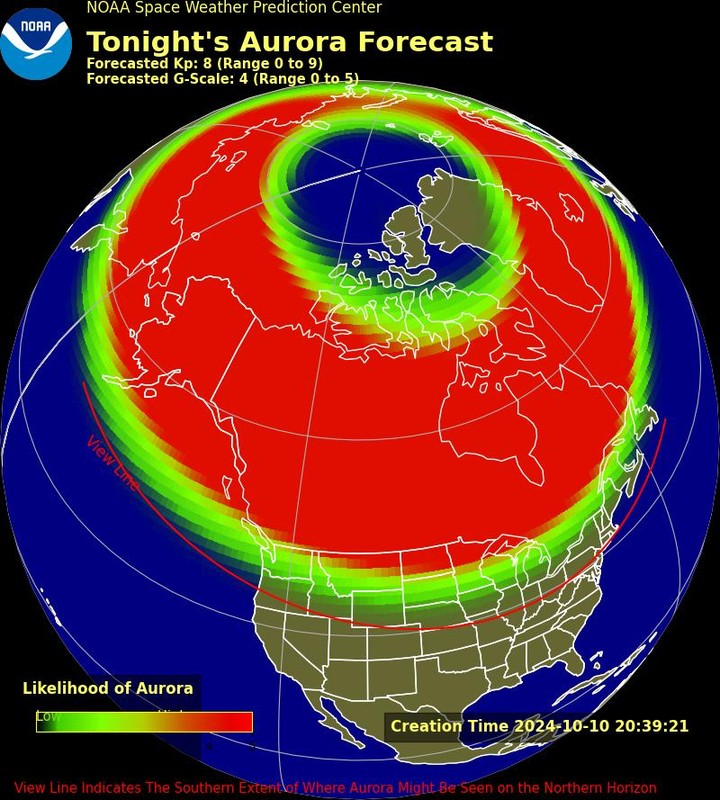
NOAA Space Weather Prediction Center graphic showing the predicted extent of the October 10-11, 2024 aurora borealis. Observers reported seeing portions of the aurora as far south as the Florida Panhandle. According to SpaceWeather.com it was seen as far south as Puerto Rico!
The first DSLR image of the night turned out to be the most spectacular.
It turned out to be a stronger impact than forecast, and the strongest thus far of this solar activity cycle; the geomagnetic storm of May 10 – 11, 2024 produced auroras (Northern and Southern Lights) visible at night from locations nearly pole to pole.
The Responsible Spot: The morning of the aurora, we photographed Sun, capturing this close-up of AR3664, the source of coronal materials that caused the Northern Lights or Aurora storm. It was a most impressive feature and remained intact and spewing powerful flares as it disappeared over Sun’s western limb!
The forecast of possible aurora prompted me to step outside at about 10 PM (EDT), when twilight had faded, to check the skies. At first I saw what I thought might be clouds but knowing auroras can be feeble, I watched. Sure enough, there was movement in those “clouds”.
NOAA Space Weather Prediction Center’s depiction of the expected extent of aurora May 10, 2024.
Glancing overhead I saw what I found hard believe — aurora ray features directly overhead … at 41º latitude, a rare sight, indeed! Rushing back indoors, I pulled together camera, fisheye lens, and tripod and headed back out.
What most people saw with their unaided eyes resembled thin clouds. Watching those “clouds” as they ebbed and flowed, and subtle coloration betrayed their true nature to those who knew what to look for. The auroral streaks pictured here were directly overhead in Medina, Ohio — 41º latitude.
The aurora still presented itself as cloudy streaks with, perhaps, hints of color. Now also armed with my smartphone, I activated its camera and aimed it at the sky. There on the screen, light amplified by the phone’s electronics, glorious, eye-popping colors filled the sky! I’d never before experienced an aurora like it.
First image of the night came from the iPhone 13 camera, revealing the true extent of the ongoing aurora.
Only occasionally, during the time I was out, did the aurora’s color become visible to me; apparently being just below the limits of my, and others’ visual perception. Another local observer noted color was more visible shortly before I stepped outside to check on things — the actual peak of the display must have happened as twilight was ending and before 10 p.m.
During the hour we watched the show in the sky, the event slowly faded, then returned bringing forth another burst of color. The balance of images here are from a Canon EOS 5D Mk. 4 DSLR camera with a Sigma fisheye lens. The DSLR exposures are ISO 400, f/2.8, and 4 to 8 seconds.
I observed and photographed the aurora from shortly after 10:00 until about 11:30 EDT and in that hour or so, the intensity faded and then re-surged before fading away again which was my signal to shut down. I might have stayed out longer but had a commitment for the next day — sleep was needed — so, satisfied I’d seen the phenomenon at its best, I put away the camera gear.
Looking very nearly straight up, these rays appear to be emanating from a position in the east-northeastern sky. The extent of the aurora was impressive, visible well into the Deep South of the United States. The aurora australis was widely visible in the southern hemisphere.
Knowing it would be all over the news, I submitted my most spectacular shot of the night to the local newspaper — a daily that publishes on Saturday but not Sunday. It was too late for the Saturday edition but the editor gave my photo a three-column, Page 1 spot on Monday.
Colors rain down on a quiet residence, perhaps poured out from the Big Dipper seen here in an inverted position. The north star, Polaris, is a tiny dot near the center of this picture. (Note how two stars of the Dipper’s bowl point toward Polaris.) The short horizontal streak to the right of Polaris is a moving airplane’s navigation lights, captured in the several seconds of the camera’s exposure.
Our Sun is still in its peak activity period, by some accounts it won’t hit solar maximum until some time in 2025, so there may be more auroras in our near future but this was one for the history books!
Page 1 of the Medina County Gazette, Monday, May 13, 2024.









 Stella-Luna Observatory