Waiting for dry weather

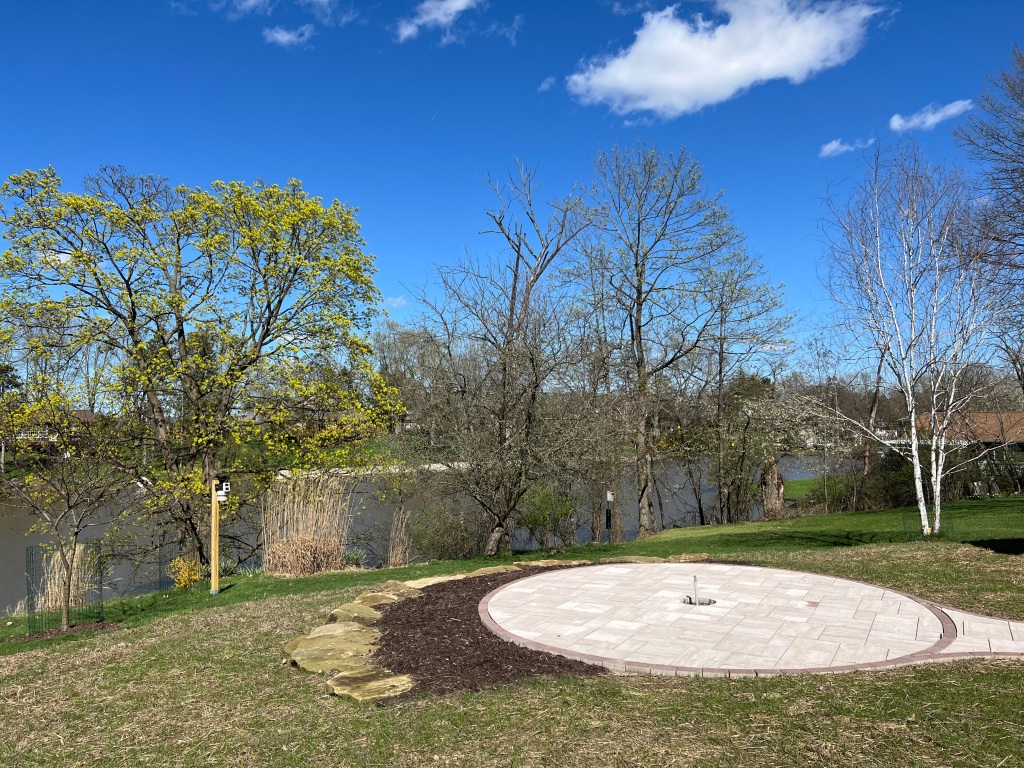
An intense blue sky with a few puffy white clouds over an early spring landscape. Trees line the middle distance while in the foreground, a round, empty patio.
The round patio seen here will form the base and floor of the observatory.

The landscape contractor promised, at the end of last season, that they would return to finish work on our observatory patio. Remaining to be done is installation of polymeric sand in the “grout” lines of the patio pavers. The material will be swept in to fill the gaps between the paver stones with enough getting beneath them to make them stable — the stones rock a bit now when walked upon. We’re told the weather must remain above freezing and the concrete surface beneath the stones must be dry in order for the polymeric sand to properly fill the spaces and cure properly.

One manufacturer wrote this about the benefits of their product: “Polymeric sand is appreciated by paver installers because joints you get from it are durable and even. This eliminates any risk of weed growth and ant infestation that could affect the overall aesthetics and durability of paver projects.” — Techniseal.com

We are likely now beyond freezing temperatures until this fall. Now we await a stretch of dry weather and it may be a while — it has been a very rainy spring!

And now we wait, we’re running late…

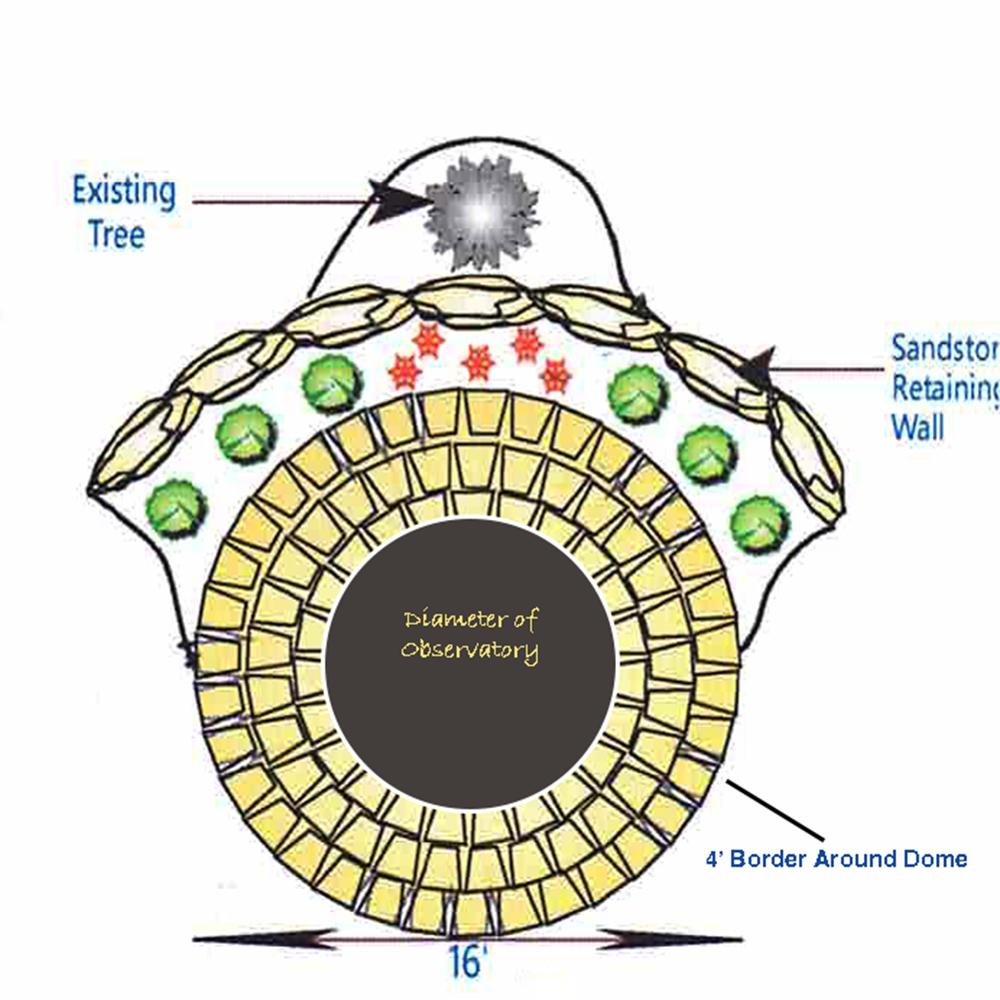
Drawn plan of a patio structure that is to form the base of our observatory. The observatory will be built at the center of the circular paved area while a tapered pathway provides access. An 18-inch Sonotube will form the foundation for a steel pier supporting the telescope.
Drawn plan of a patio structure that is to form the base of our observatory. The observatory will be built at the center of the circular paved area while a tapered pathway provides access. An 18-inch Sonotube will form the concrete foundation for a steel pier supporting the telescope.

Today we approved the final design of the patio that will serve as the base of the observatory. With the observatory structure already on-order, it’s now a waiting game. Dates for delivery/construction of these two main components are uncertain, though the landscape work is expected to start in early November. Depending upon how things unfold we may be in a situation where either the observatory arrives before the base construction begins and we rush to assemble before winter, or the base is built and we wait for the observatory. Either way, depending upon timing and weather conditions, the crated components of the structure may wind up overwintering in our garage! We’re running late.

Landscape base design

A local landscaping company was contacted to design and quote on a “hardscape” base for the Sirius observatory dome structure. The thinking here is that, since the site is a residential lot, a potential future buyer may or may not want an observatory. Some day, when the property is put up for sale, the observatory structure could be optionally sold and removed, leaving a nice patio feature with a center spot for a table or fire feature for the new owner. In the mean time, the landscaping will make the observatory even more attractive and provide a solid base. We’ll be meeting with the designer soon for some Q&A and tweaks to the design

Observatory Ordered

A Sirius 7.5-foot observatory configured in the same way as our on-order structure. The base, however, is expected to be much larger. Photo via the manufactuerer

We started the month of August out by {finally} placing our order for a Sirius 7.5-foot observatory. The fiberglass structure will arrive in kit form, to be assembled on-site. We should be able to do most of the work ourselves but may need to hire muscle to lift the dome into place! In the meantime, I’m looking to contract with a landscaper to prepare the build site. We’ve something unique in mind — a hardscape patio, of sorts, that will form a base for the observatory. If and when the observatory eventually needs to be removed, the remaining base will be a paver-style patio with the telescope’s pier foundation serving as mounting point for a fire feature or table! We think it’s pretty clever. We also think it will be expensive. We’ll see what we can actually do!

Work has begun

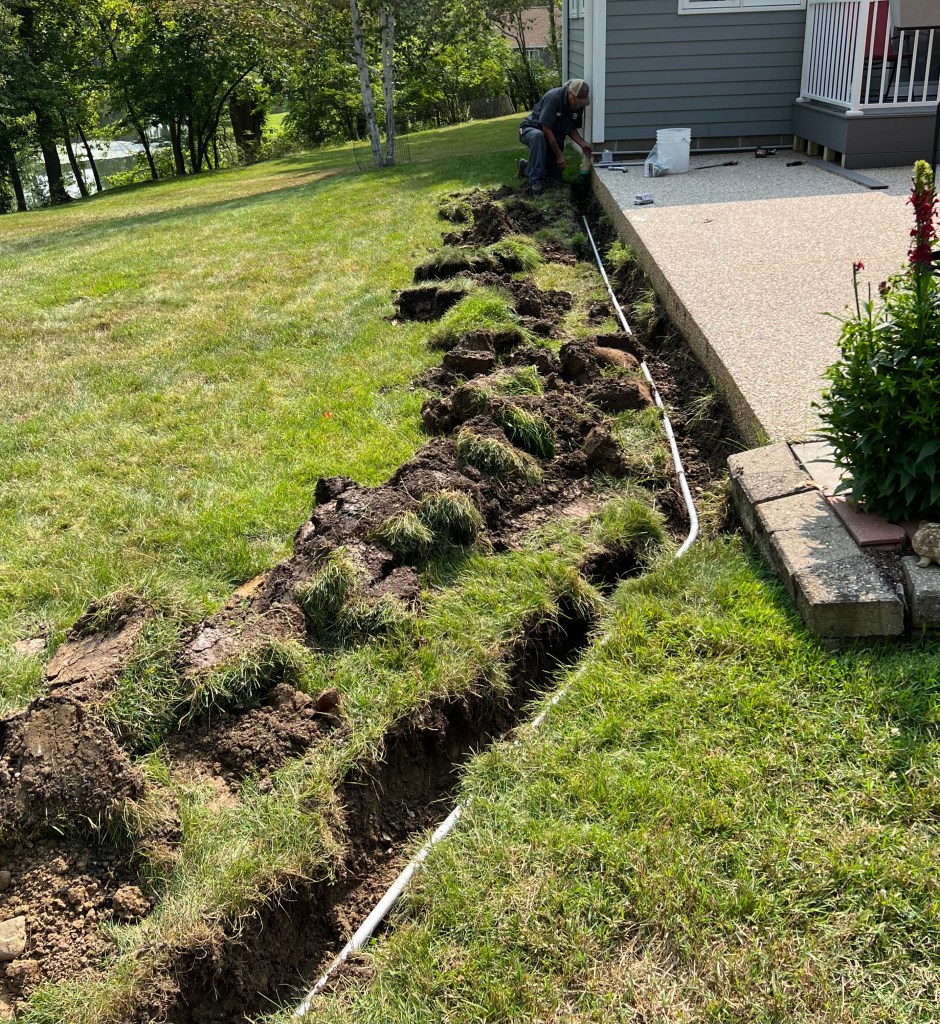
An electrician works on the conduit run from the house to the shed. The metal conduit runs through a trench dug for that purpose.

UPDATE: On July 31 we received the approved Building Permit which gives us the go-ahead on the project. The observatory kit — it’s delivered as a ready-to-assemble set of parts — will be ordered ASAP. The purchase had to wait until the permit was issued since the purchase price is not refundable and what would have happened if the city said no???

Last week we had professional electricians run power to the shed where a warm room / control room will be set up for the observatory. For burial of the metal conduit, they dug a much wider trench than I expected and I’ll be cleaning up the earthen scar this coming week. I’ll be framing out a space within the shed for the actual control room which will be wired for electrical service.

The Building Permit Application was filed with the city last Friday — surely unique in the history of this town — so we’ll see how it goes! If the permit is approved, we’ll launch into acquisition of the observatory and preparation of the site for the structure. If the permit is denied, I’ll probably set up an open-air pier for the telescopes and run them from the control room. I expect they’ll approve it — you ought to see what people put in their back yards!

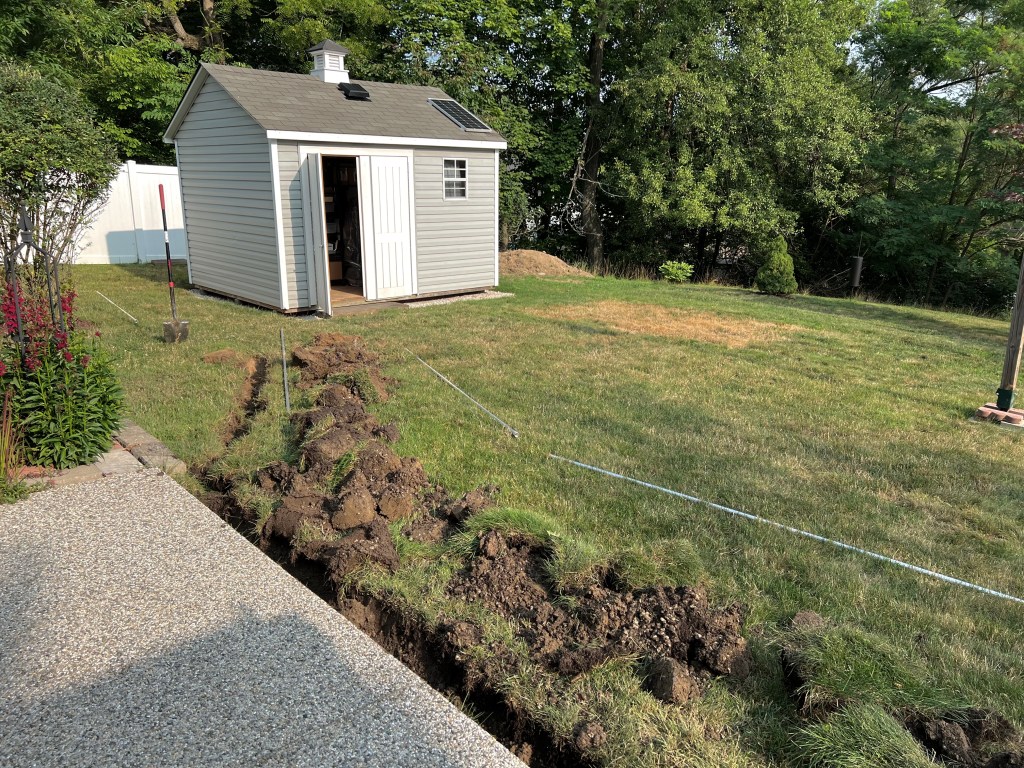
The conduit, before burial, and the shed. The end of the building with the window will be partitioned for use as the warm room / control room. The solar panel on the rooftop currently supplies weather station equipment and is, surprisingly, barely adequate to the task.