
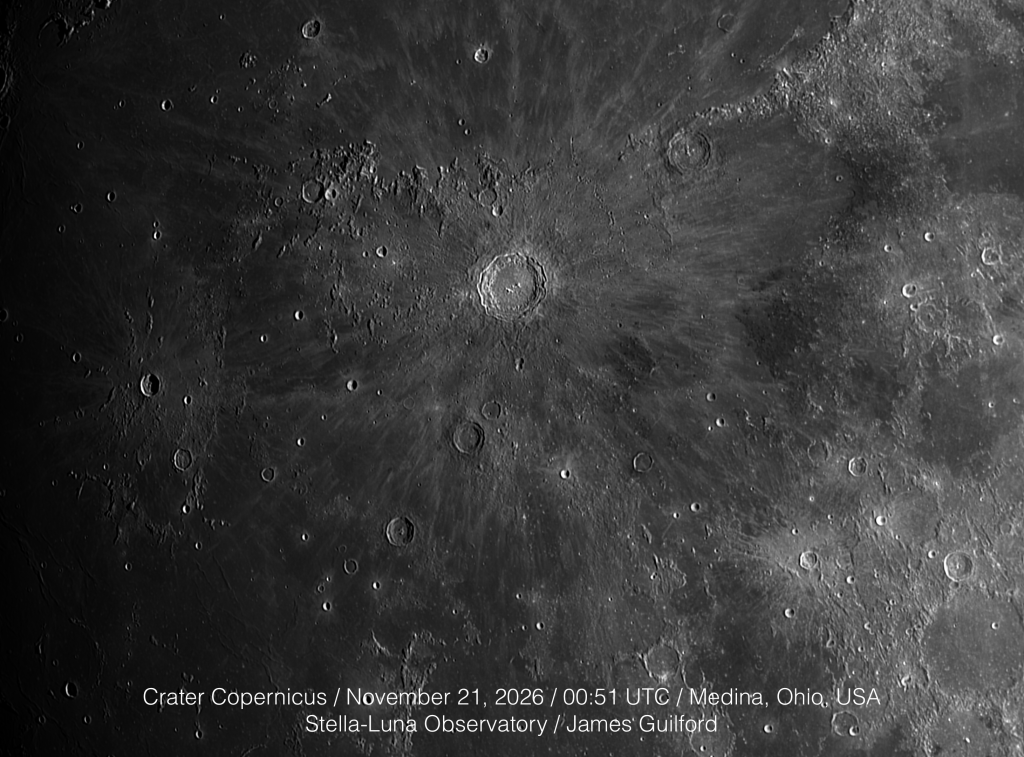
When a comet or asteroid strikes Earth’s Moon, it excavates an area of the Lunar surface, pushing some of the material – regolith – aside, and splashing much of it out and across the surrounding area. The scattered material, ejected from beneath the darker, weathered surface, is lighter in color forming “rays” radiating from the site of the impact. All that said to explain the fascinating and sometimes subtle and beautiful markings we observe when we look at our Moon.
A wonderful example of ejecta rays is the spray surrounding Copernicus crater. About 800 million years ago, an asteroid impact formed the feature in the dark, open lava surface of Mare Insularum, just south of where it meets Mare Imbrium. At about 93 km (58 miles) in diameter, isolated Copernicus is easily seen via small telescopes and binoculars. The ejecta rays of this crater are softer, cloudier than the more typical radial streaks formed by impacts; they are well displayed across the dark material surrounding the crater. Tycho, south of Copernicus, provides an excellent example of typical ejecta ray appearance.
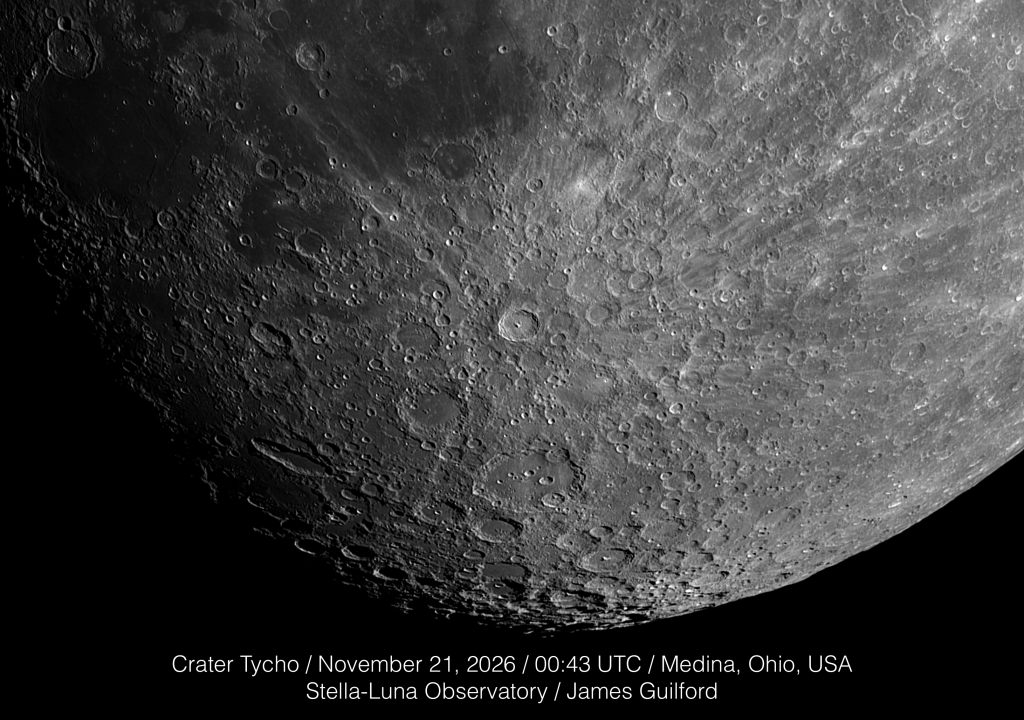
Tycho lies in Moon’s heavily-cratered southern highlands, standing out due to its relative youth (about 108 million years) and expansive net of ejecta rays that extend as far as about 1,500 kilometers, or about 930 miles. The crater has a diameter of around 85 km (53 mi), is about 4.7 km (2.9 mi) deep, and features a central peak 2,500 meters (8,200 ft) in height. Tycho is prominent enough to easily be seen using a small telescope or good binoculars.
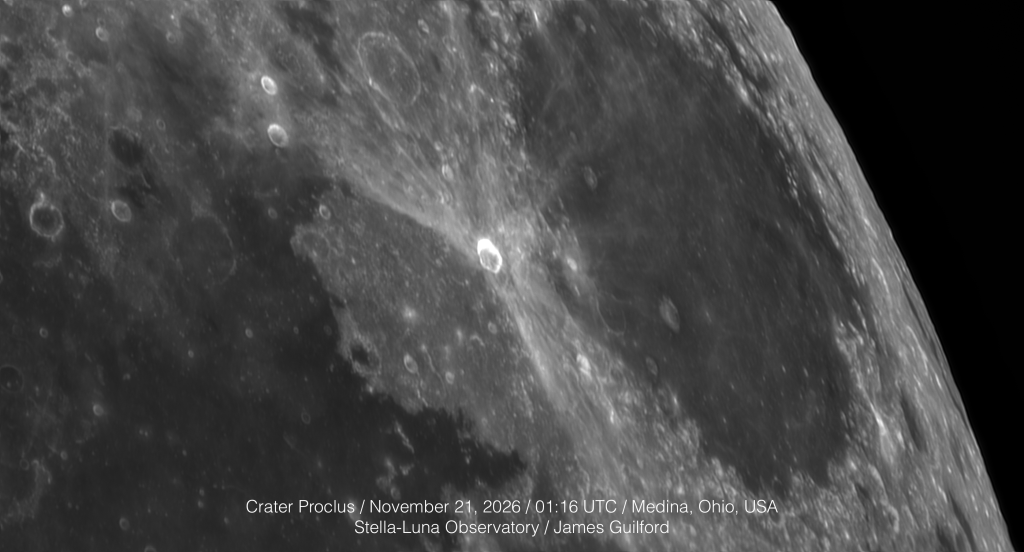
Our third featured crater is one of the Lunar areas that holds fascination for me: Proclus crater and its spray of bright ejecta. I mean, it looks like an asteroid hit just now and those are clouds of regolith flying out over the surrounding terrain! More recent in Lunar history, an impact took place less than 1.1 billion years ago, forming a crater that is pentagonal in shape, and 27 km (about 17 miles) across. The dark area to the left is Mare Tranquillitatis, the Sea of Tranquility, while on the right is Mare Crisium, the “Sea of Crises”. Flat lighting, during this waxing gibbous Lunar phase, causes craters in the vicinity to appear as circles rather than depressed areas with raised walls.

