Our temporary observing setups are assembled on the base/floor of the planned observatory. The light orange bucket, at center, protects an empty electrical conduit that will provide utility power to a permanent pier that will be installed there. In the foreground is a table supporting a light shield for the laptop computer. The large tripod next to the table supports the white light imaging scope. In the background is the Sky-Watcher SolarQuest mount with our Coronado hydrogen-alpha solar scope attached.
We’re still doing open-air astronomy though we have a nice, solid, clean, and level space to set up our gear! This is the setup we were using today to record the sunspot at active region 4079 as it is about to roll over the solar limb/horizon. Fortunately, though it’s a very temporary setup, the portable gear we use for casual solar imaging is fairly easy to set up.
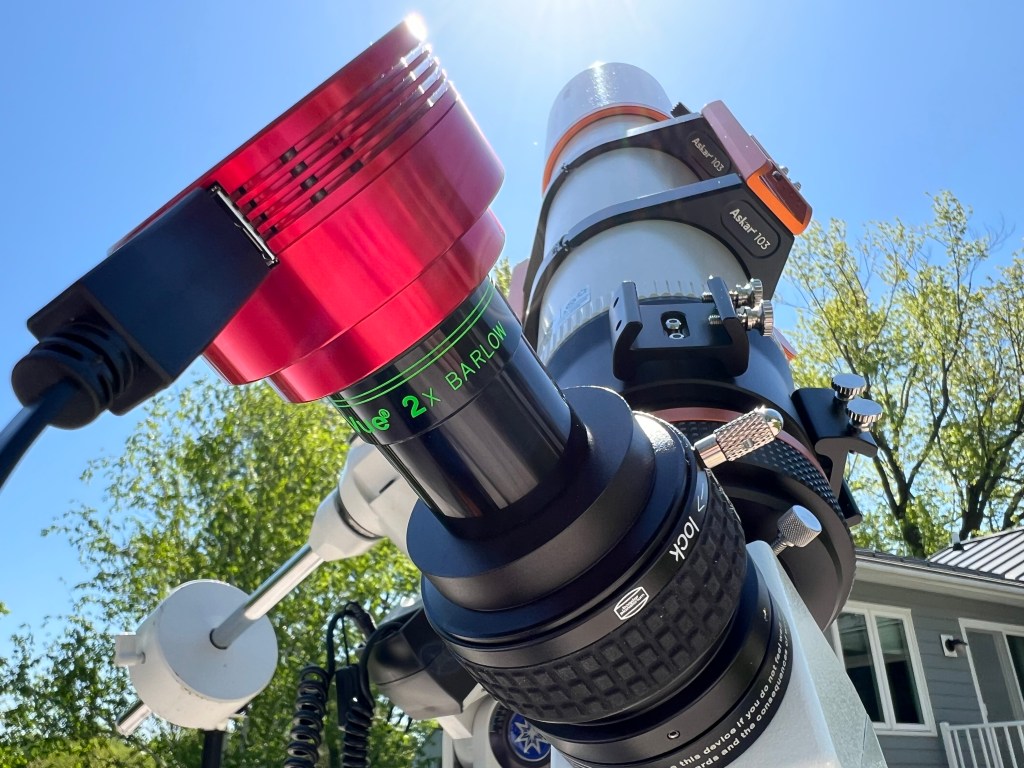
From an unusual vantage point, a picture of the solar setup used today to record the passage of active region 4079 toward Sun’s horizon. The red object is the planetary camera.
We continued experiments to determine what gear will work together for imaging. There were a few surprises and there’s need for more experimentation. What we settled on for today’s solar efforts is pictured above and includes: Askar 103 APO telescope, Meade LXD75 Goto Mount, TeleVue 2X Barlow, Baader Planetarium Safety Herschel Wedge, and ZWO ASI678MM monochrome planetary camera.
The sun as it appeared at 11:32 AM EDT on May 10, 2025. Sunspot/Active Region numbers are labeled in this image with AR4079 very near the solar western limb or edge.
Although the sky was clear, seeing was a bit shaky so once again, sharpness wasn’t what we’d like. Still, in all, we got the shot we wanted and learned a few things about our astronomy equipment. Also, the sky was blue, the air was pleasant, and birds were singing, so not a bad way to spend a couple of hours.
A closeup view of the sunspot at AR4079. There is a bright line splitting the dark central umbra of the sunspot, the gray penumbra radiating in filaments around it. White cloud-like areas surround the sunspot, especially to its north; called plage, they are associated with areas of concentrated magnetic field.
The total lunar eclipse of March 13 – 14, 2025 did not disappoint! We resolved to capture images from the late partial eclipse to maximum eclipse, mostly to be able to fit in a little sleep! Catching it all, which we could from our North America location, would have required, essentially, an all-night session. Just a bit too much!
Early partial eclipse. The brighter shadow within the penumbra lights the top portion of this image. Note a bit of reddish tone within the dark umbra. 2:08 AM EDT
I sat on a pad over the paved surface where in the cold, where the observatory is to eventually stand. The old telescope mount ticking away as it tracked the moon across the sky. Occasionally geese and ducks on the nearby pond called out against some unseen disturbance. The stars of Great Orion were sinking behind nearby trees.
Moon is deep within the umbra and last penumbra light about to be left behind. 2:19 AM EDT
In the otherwise quiet chill, I watched the lunar transition, from a bright sliver left over from the night’s Full Moon, to glowing copper orb. With a cable release I manually triggered the camera’s shutter: click — pause — click, to record the event.
Maximum eclipse. Moon is fully within the umbra but because it is not traveling through the center of Earth’s deepest shadow, scattered light from the penumbra brightens the upper limb. 2:58 AM EDT
Shortly after maximum eclipse (shown above), at 2:58 AM EDT, I shut down the telescope and, casting a wistful eye at the still-darkened Moon, went indoors. I fed the waiting cat, changed back to pajamas, and returned to bed. In fitful sleep, somehow still cold, happy to have sacrificed rest for the experienced phenomenon.
Tech: Askar 103 ED telescope, Canon EOS 5D Mk 4 camera, Meade Goto Mount, Photoshop. ISO 400, variable exposure times.
The total lunar eclipse of November 8, 2022, as viewed from Medina County. Photo by James Guilford.
In the wee hours of Friday, March 14, the Full Moon will pass through Earth’s shadow in space resulting in the coppery-red colors of a total lunar eclipse. While skies are expected to be clear for the event and temperatures tolerable, the show won’t be in “prime time” — maximum eclipse and color will be on display at about 2:58 AM (EDT) Friday. This will be the only total lunar eclipse of 2025.
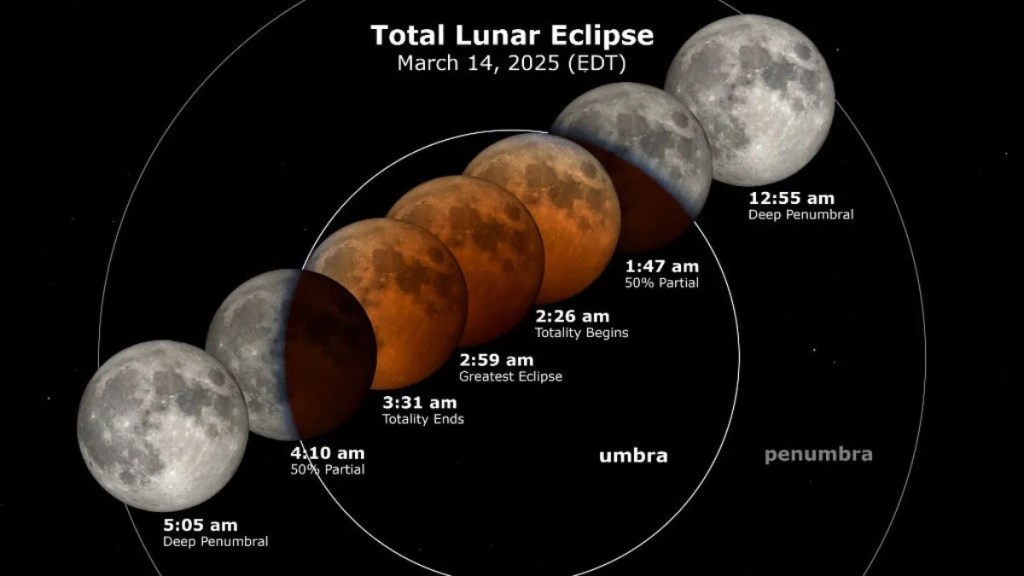
While the timing of this year’s eclipse may be brutal, it also means the entirety of the process will be visible. By 12:55 AM (an hour after midnight, to be clear) Moon will have a strangely soft, faded appearance, then lit by the diffuse light of Earth’s outer shadow or penumbra.
The partial eclipse begins at 1:09 AM and by 1:47 AM, half of the lunar disk will be dark, hidden in Earth’s deep inner shadow called the umbra. Darkness will progress across Moon and as the last light fades from the lunar surface, color will begin to appear with the onset of totality.
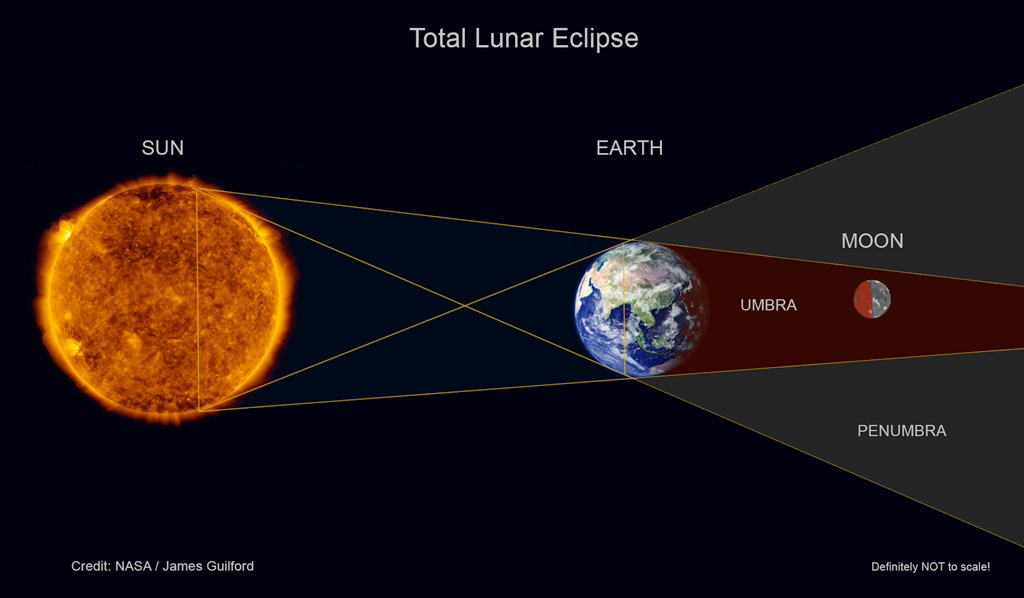
A total lunar eclipse occurs when Moon passes through the central portion of Earth’s shadow, known as the umbra, where all direct light from Sun is blocked and Moon is illuminated only by scattered light passing through Earth’s atmosphere.
At 2:26 AM, with Moon totally inside the umbra, the spooky beauty will be on full display. Earth’s inner shadow is full of colored light — sunlight scattered through the planet’s atmosphere bearing the scattered colors of the globe’s sunrises and sunsets — the source of a total lunar eclipse’s hues.
Maximum eclipse is reached at 2:58 – 2:59 AM and Moon will be as dark and colorful as it can be during the process. The eclipse sequence begins to reverse after the maximum as Moon continues its passage through Earth’s shadow. Observers will note the darker and lighter portions of Moon’s face subtly rotating as the event unfolds because Moon is not passing directly through the center of the umbra — the upper portion of the disk will be near the edge of the shadow area, the lower portion closest to the center and darkest region.
The timing and appearance of the March 14, 2025 total lunar eclipse is illustrated here. Note the penumbra and umbra shadow areas and the rotating shadow distribution on the lunar surface. Movement is right to left. Illustration Credit: NASA Scientific Visualization Studio
By 6:00 AM Moon will have returned to its Full illumination as if nothing had happened. Those who potentially lost sleep watching, however, will perhaps yawn but be will gratified to have seen one of the most impressive and beautiful astronomical events available to us.
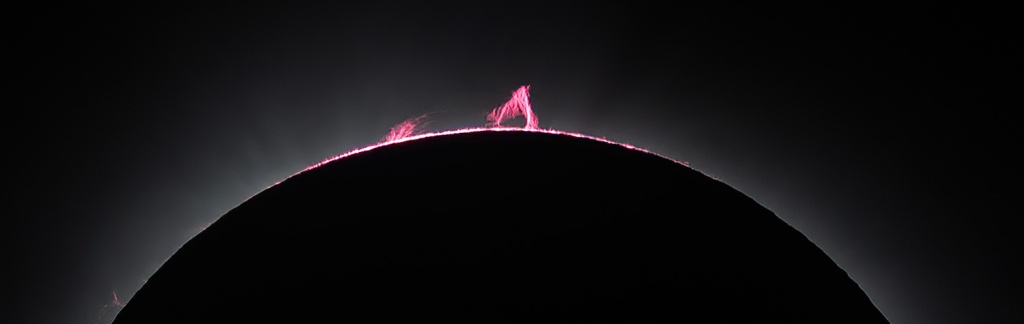
Many eclipse watchers were, with unaided eye, able to see the bright pink or red prominence shown here in our heavily-cropped image of the April 8, 2024 eclipsed sun. The prominences appear red because they are composed primarily of hydrogen which, at high temperatures, emits red light. Image rotated to place the prominence at top for aesthetic reasons. Image Credit: James Guilford / Stella-Luna Observatory.
While we very much wanted to view and photograph Sun’s corona during the April 8 total solar eclipse, a blanket of high, thin cloud covered the area blocking faint details. We were, however, able to observe and image the bright inner corona and prominences (“proms”) along the rim of the eclipsed Sun and what a show it was.
Sun is in the active phase of its 11-year cycle and, during totality, prominences were expected and seen in various sizes and at several sites around the rim. The largest was easily spotted with the unaided eye, causing questions from casual observers as it brightly shined at about the six o’clock position of the eclipse ring as viewed from North America. We were delighted with the images of proms that we were able to acquire!
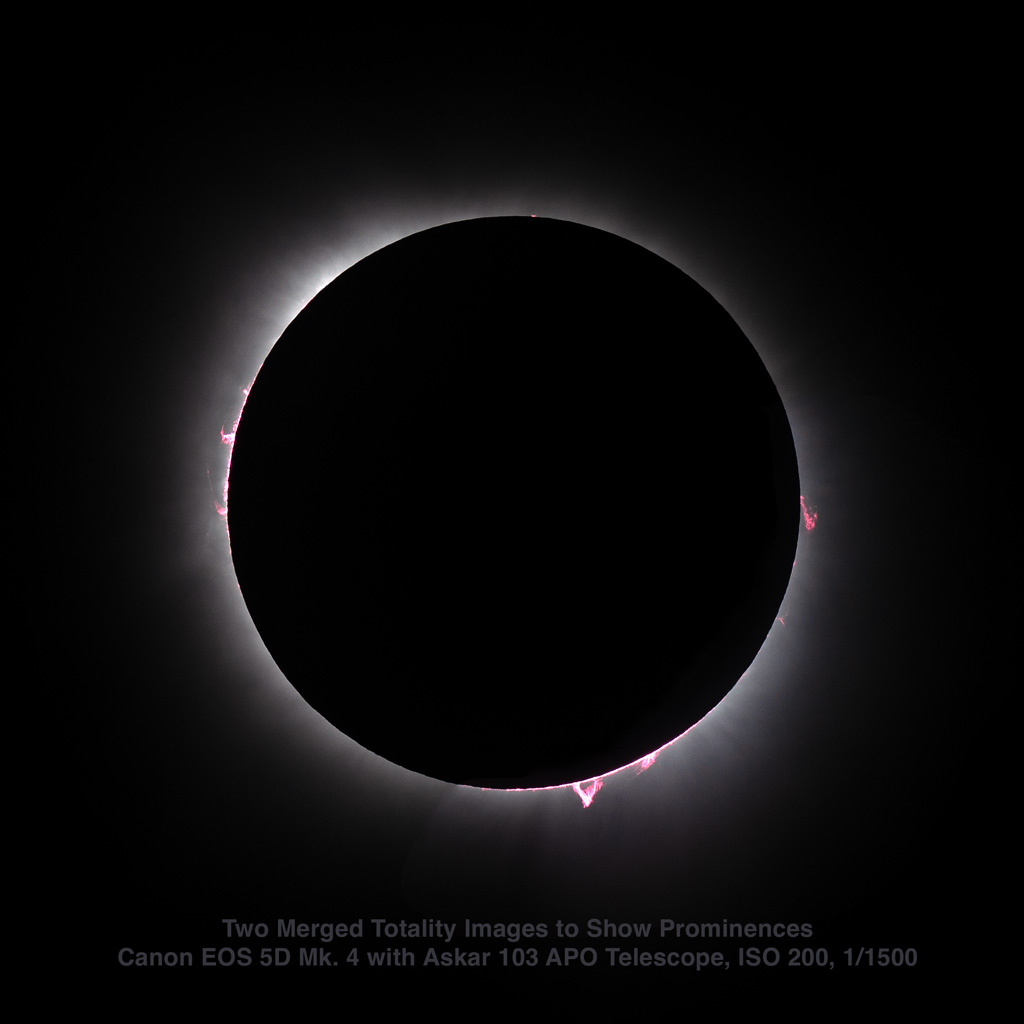
As Moon drifted across Sun during totality it, in turn, covered and exposed different regions of Sun’s limb. To give a fuller impression of prominences seen, we grafted two of our images from totality into one picture; one image was recorded just as totality began, the other as totality was about to end. The resulting picture is not a view one would have had but does correctly illustrate the position and visual size of the proms.
Two images of totality are combined here to illustrate the visual size and placement of promiences exposed during totality of the April 8, 2024 total solar eclipse. The large loop of the prominence near the six o’clock position was easily spotted with the unaided eyes of many, adding to the wonder of their eclipse experience. Image Credit: James Guilford / Stella-Luna Observatory.
Observers in Northeast Ohio were fortunate. Although the morning began with heavy cloud cover, skies cleared and allowed decent viewing of the eclipse in its entirety. Temperature drops were easily felt as bright daylight transitioned to an eerie twilight. As totality began, cheers of awe could be heard from gathered eclipse watchers at a nearby organized event. Automatic street lights illuminated. A robin was heard singing its evening song. Sunset colors lit the horizon about three-quarters of the way around us. In the southwest, beneath the eclipsed Sun, the horizon appeared dark. And then, as bright sunlight returned, first via a brilliant crescent, then by an expanding and warming solar disk, it was over. Those we spoke with were delightedly awestruck having had the experience of a lifetime.
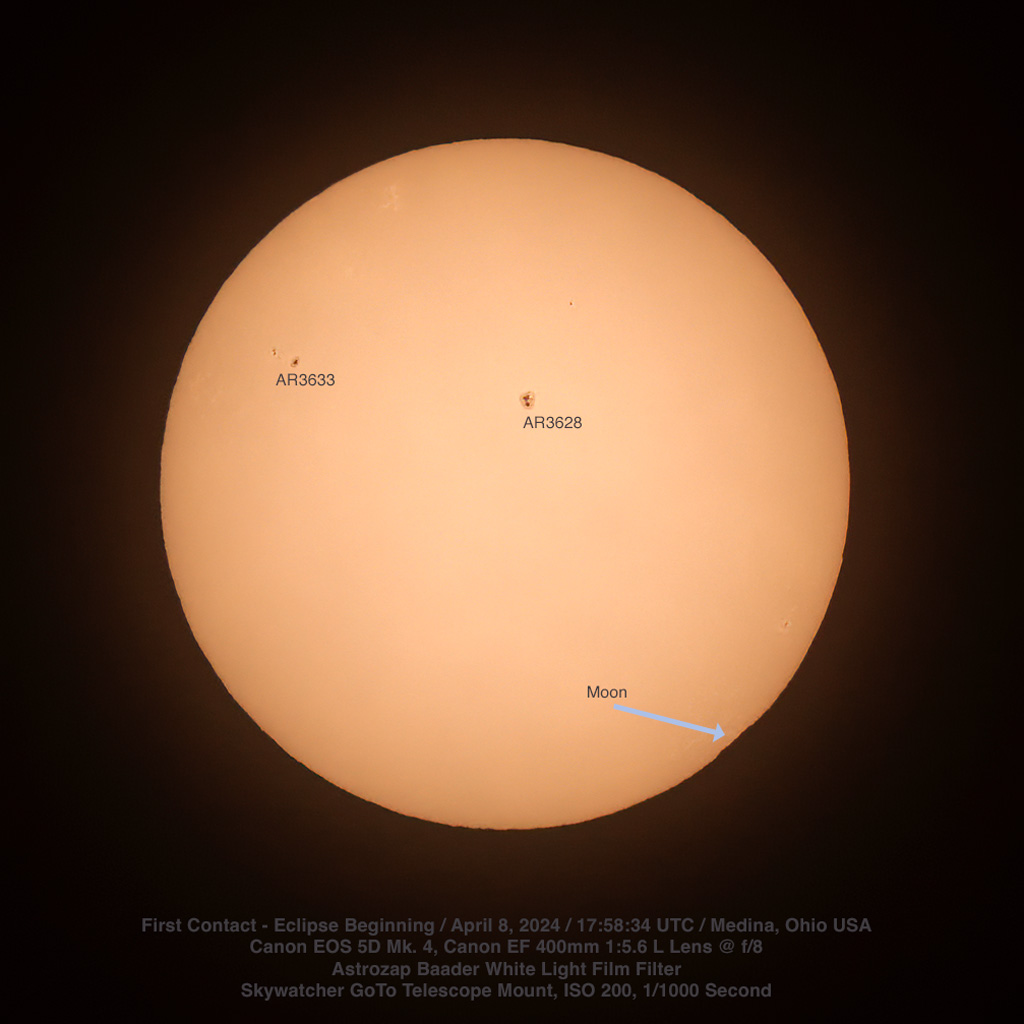
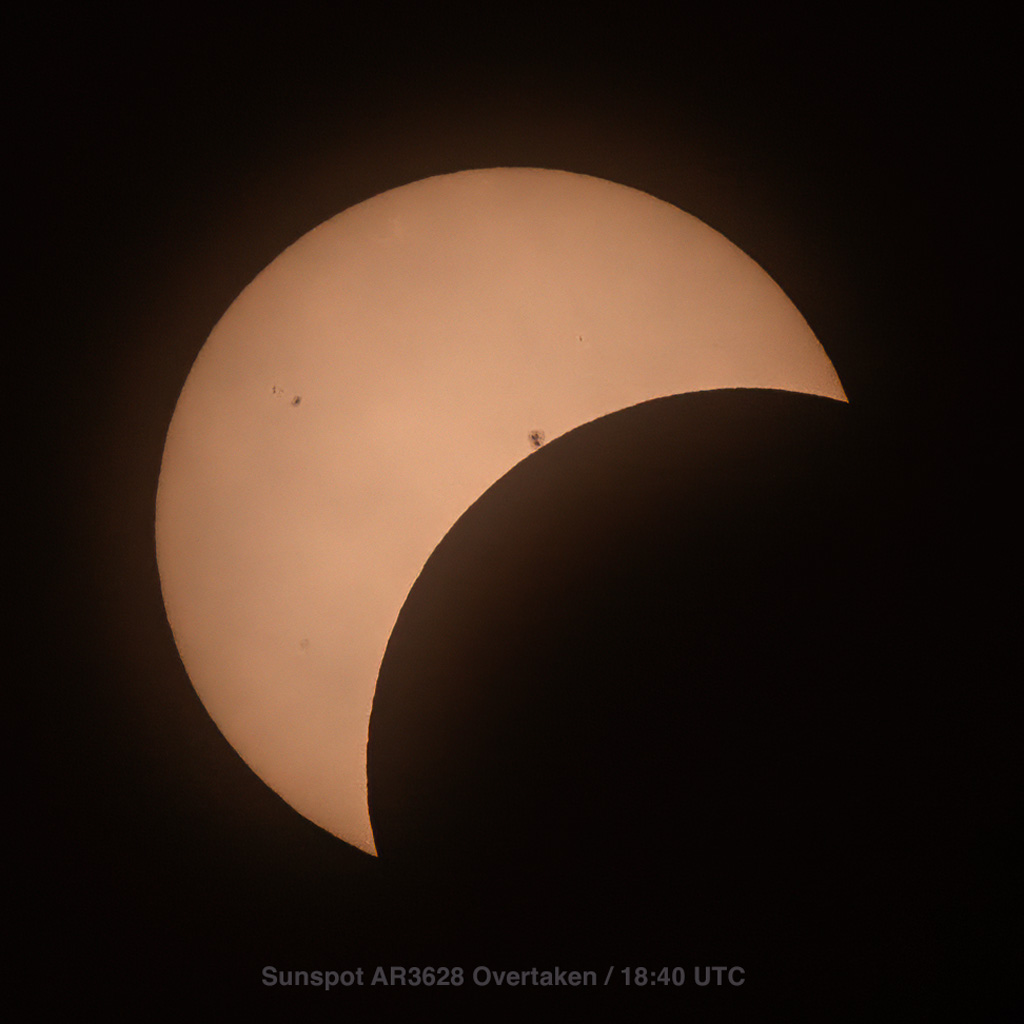
Following are several images of Sun as the eclipse began, during the partial phase, and as it ended. Times are expressed as UTC and were recorded automatically by the camera, set via GPS. Observers in different areas will have seen times that differed from ours and each others due to parallax effects, Moon being much closer to Earth than is Sun.
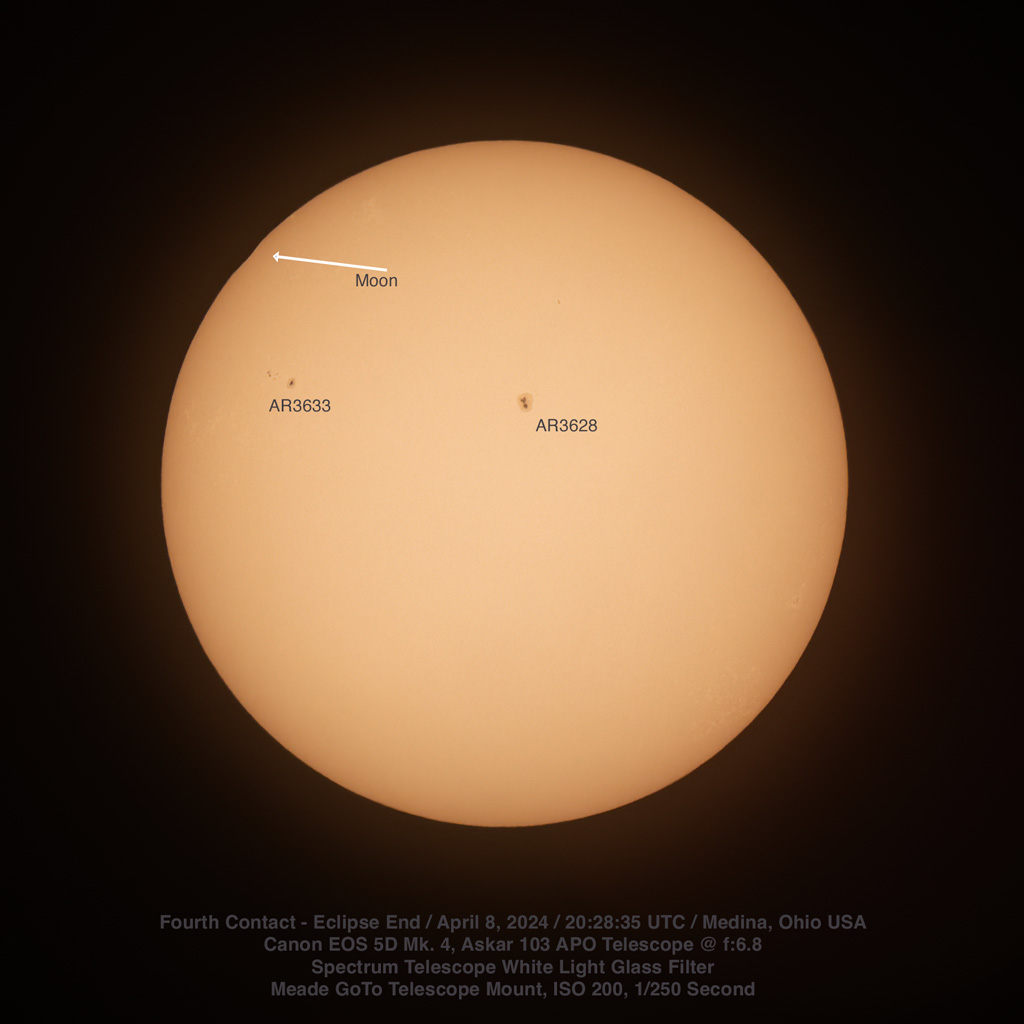
First Contact: The first noticeable encroachment of Moon over the solar disk is shown here. This image was recorded at 17:58:34 and marks the beginning of the eclipse process. Two areas of sunspots are also noted here. Image Credit: James Guilford / Stella-Luna Observatory.Sunspot AR3628 was about to be covered by the silhouetted Moon as the eclipse progressed from the lower right-hand area of this image toward the upper left. This was imaged at 18:40 UTC. Image Credit: James Guilford / Stella-Luna Observatory.Fourth Contact: By this point most casual, and many serious observers, had packed up satisfied with a wonderful eclipse experience. We kept the camera running, just so that this instant could be recorded — the moment when Moon completed its passage in front of Sun, in this picture at 20:28:35 UTC. Image Credit: James Guilford / Stella-Luna Observatory.
On Saturday, October 14, 2023, there will be plenty of buzz about the annular solar eclipse taking place. The eclipse will happen, blue sky or cloudy, dimming the day’s midday light. Here in Medina, Ohio we won’t, however, be seeing the real attraction, the so-called “Ring of Fire”. We will, however, experience a partial eclipse of the sun; about 35 percent of the sun will be obscured by Moon, making Sun a crescent.
Eclipse timings for Medina, Ohio as provided by TimeAndDate.com
What’s an annular eclipse, then? Well, “annular” means ring-shaped, not “annual” as in once a year. The ring, or annulus, we’re talking about here is created by our Moon passing between we Earthbound viewers and Sun covering most, but not all of the solar disk. At its peak, an annular eclipse leaves brilliant ring of sunlight visible, shining around the edges of Moon — the ring of fire. The better-known total solar eclipse occurs when Moon covers all of the solar disk, allowing viewers to see the beautiful haze of Sun’s corona streaming around the dark circle where Moon superimposes Sun.
Solar eclipses take place in three basic varieties: partial, annular, and total and what happens on each occasion is dependent upon the positions of Sun, Moon, and viewer. Why won’t anyone see a total solar eclipse this Saturday? In short, it’s because Moon’s orbit is elliptical, not circular. On an elliptical path Moon will appear larger or smaller from Earth, depending upon Moon’s position on its orbit. We’re fortunate that Moon can so perfectly cover Sun when it’s a bit nearer us, producing glorious total eclipses. But when Moon is a bit farther out for an eclipse and appears smaller, it can’t quite cover all of Sun and that’s when annular eclipses happen.
Moon is near enough to Earth that parallax influences what viewers experience. At the center line of an annular or total eclipse, the full effect of the event may be enjoyed. Stray off that center line (path of annularity, or path of totality) and a partial eclipse is seen. It’s like someone hiding a few steps behind a tree. If the tree is directly in the line of sight of the viewer, the person is hidden. Take a step to one side, however, and the hidden person begins to be revealed. Parallax.
Viewing: Neither those out west nor we here in Ohio can safely view the annular or partial eclipse phases safely without proper gear. ISO-Certified viewers are the gold standard so long as they are undamaged. Eclipse viewing glasses are available from many sources though it’s probably too late to order them in before this weekend’s event. Maybe think about buying some soon for next year’s total eclipse! There is a mix of opinion regarding #14 welder’s glass — they’re probably alright to use if you have them but be careful — welder’s glass comes in different shades and lighter shades may not provide adequate protection!
Do Not Use: Sunglasses of any sort, photographic negatives, Compact Discs, shiny plastic wrapping, etc. for viewing the sun. If you view the brilliant solar disk improperly, damage to your eyes can result and be instantaneous and permanent. If you happen to have solar eclipse glasses from previous events, those would be great to use but examine them first! Hold the glasses close to a bright light source and look for pinholes, scratches, or other damage; if you can see light spots coming through the lenses throw the glasses away!
We Saw It! The skies, recovered to blue and sunshine from overnight rain and clouds giving us hope and a spring in our step. As the hour of eclipse approached, so did a generally thin milky layer of clouds. The eclipse was not spoiled, however, and we enjoyed a wonderful view. We sincerely hope you were able to experience the “2024 Great American Eclipse” as well.
The Sun during totality, exposed to show prominences looping from the solar surface. Prominences were seen in several locations along the limb but the one seen here, near the bottom of the disk, was easily seen with the unaided eye. Photo by James Guilford.
————————————————————————–
Eclipse Watching in Medina, Ohio
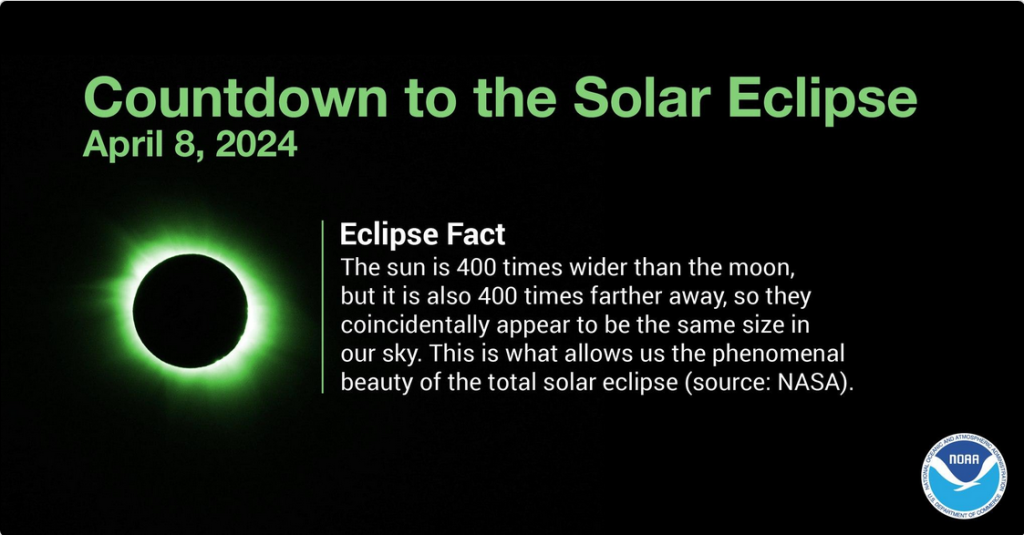
April skies are notoriously changeable here in Northeast Ohio where we are otherwise in an excellent location for viewing the April 8, 2024 total solar eclipse. In fact, the chances of a clear sky here are only about 37 percent. Ugh! Dedicated eclipse chasers will mostly head to the southwestern U.S. for better chances at clear skies. For those of us not traveling, let’s hope for clear skies here on the Big Day because a total solar eclipse is more than just an awesome sight, it’s an experience! Let’s be prepared.
An Updated List of Resources Appears Near The End of This Article
Time and Eclipses Wait for No One
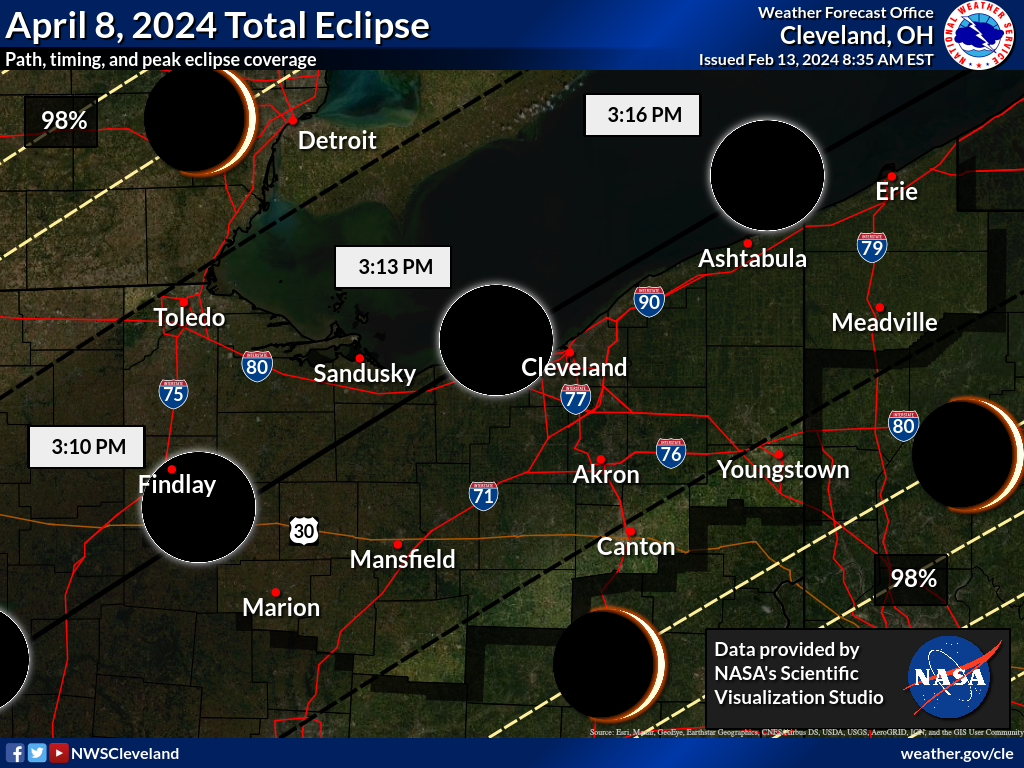
Moon’s shadow will be clipping across Ohio at about 2,100 miles per hour, so the peak period of the eclipse — totality — is fleeting. Medina will experience about 3 minutes and 28 seconds of totality, which is pretty good. If we were in the central line of the path of totality, which passes right through Lorain, we would have 3 minutes and 53 seconds of glorious viewing. Here, courtesy of the U.S. Naval Observatory, are local times for critical points of the eclipse:
Timing in Medina, Ohio (Eastern Daylight Time)
Partial Eclipse Begins — 1:58:38
Totality Begins — 3:13:23
Maximum Eclipse — 3:15:06
Totality Ends — 3:15:51
Partial Eclipse Ends — 4:28:38
☀️ 🌑 ☀️
Sights and Experiences
The eclipse will begin when Moon starts its passage across the solar disk. When viewed through protective filters, a tiny nick will be missing from Sun’s limb. That nick will gradually grow as the partial eclipse phase progresses. Viewed through “eclipse glasses” or other specialty solar filters, Sun will transition from a full disk to, eventually, a slim crescent. Our surroundings will not become dark as night but the light will take on an eerie softness as Sun fades. If, heaven forbid, skies are cloudy, it will be very dark in the path of totality … very dark indeed.
Sunspots may be visible. Dark markings of various sizes and shapes may be seen on the solar disk during the partial phases of the eclipse. Sun is in the most active phase of its regular cycle during which sunspots are common. If they are large enough, sunspots can be seen using eclipse glasses but are best observed through telescopes equipped with solar filters.
The air may feel cooler, birds and other animals may begin evening behaviors. Street lights and other automatic lighting may activate.
Just before totality begins, two interesting effects will be seen, caused by Moon: Baily’s beads are dots of sunlight that will dance along the edge of the blackened moon. The diamond ring effect is a singular burst of sunlight that, combined with the light ring of the now-eclipsed sun, is reminiscent of a shining diamond. Both effects are caused by sunlight shining through the mountainous terrain on Moon’s horizon as it moves into position in front of Sun.
Look around as these things are happening, and watch for shadow bands — dim waves of dark and light that will ripple across the ground immediately before and after totality. The bands are a memorable experience but often missed because most attention will be on the sky above!
During totality — and only during totality — eclipse glasses and solar filters are not needed. In fact, the eclipse will be too dim to be seen through the protective devices. Looking around where they are standing, watchers will notice that it is not as dark as night but something odd is to be seen. Overhead, where the brilliant afternoon sun should be shining, it’s dark but for the glorious total eclipse. Along the distant horizon, there is sunlight — it’s coming from areas outside of Moon’s shadow, away from the path of totality.
Marvel at Sun’s corona as it radiates from the dark circle of moon-covered-sun. It’s a sight not soon forgotten! During totality look for a star-like light to the southwest of the eclipse — it’s planet Venus! To the upper left of Sun’s position is planet Jupiter.
The interesting effects and partial eclipse phases will take place in reverse order as totality ends. Put those eclipse glasses and filters back on immediately — even the crescent Sun is powerful enough to damage unprotected eyes — and don’t forget to turn unprotected cameras away from Sun!
So What’s Happening?
A total solar eclipse occurs when Moon passes between Sun and Earth, causing Moon’s shadow to be cast on Earth’s surface. Moon is at the right distance from Earth that, when it does pass in front of Sun, the fit is nearly perfect, blocking direct sunlight from reaching the surface within its shadow. An annular eclipse happens when Moon’s orbit carries it a bit too far from Earth to cover the solar disk, producing a “ring of fire” — sunlight in a halo around the dark Moon. Most of the time, Moon’s orbit carries it into positions where its shadow “misses” Earth, so there’s no eclipse.
When the moon passes directly between the sun and Earth, a solar eclipse takes place. (NEVER look at the sun during any type of solar eclipse! Looking at the sun is dangerous. It can damage your eyes.) Image Credit: NASA
As mentioned earlier, when totality is reached, Sun’s brilliant light is completely blocked as viewed from within Moon’s shadow. That shielding from brilliant sunlight allows the solar corona to be seen. The corona is a hazy glow surrounding the darkened Sun and is the outermost region of the Sun’s atmosphere, consisting of plasma (hot ionized gas). The corona continually varies in size and shape as it is affected by the Sun’s magnetic field so its appearance differs eclipse-to-eclipse and is of great interest to those who study our nearest star — it also makes totality a unique and awe-inspiring sight.
Eclipse Viewing Safety
Don’t risk your vision! Even when Sun is “mostly” covered by Moon before and after the total eclipse, sunlight will be strong enough to cause permanent eye damage. Sunglasses and other makeshift items are not enough. To look at the sun, use only certified “eclipse glasses” — filters — so you can safely view Sun before and after totality. Here’s a link to sources: https://eclipse.aas.org/eye-safety/viewers-filters — More Information Below
Medina, Ohio Area Resources
Branches of Medina County (Ohio) District Library were distributing eclipse glasses free of charge, one per family, as supplies allow, at the time of this writing. Glasses are easy to share amongst family members, looking one at a time at the partly-eclipsed sun. In fact, it is best for adults to watch children who are using eclipse glasses to make certain they’re wearing them correctly and that can’t be done if the adult is wearing eclipse glasses at the same time — they’re too dark!Library Eclipse Programs
The Medina County Fair Board will be renting out Solar Eclipse Camping sites for campers and motorhomes beginning Friday April 5 thru Tuesday April 9. There will be electric hook-up and restrooms and showers on site. Call (330) 723-9633 or email medinafair@gmail.com to reserve a space. Looking for a place to just park your vehicle to watch the eclipse? You can rent a parking spot for $20 (cash only) at the Community Center parking lot.
Useful Mobile Apps via the AAS
Here you’ll find some of the best eclipse-related apps and software available, as judged by members of the American Astronomical Society (AAS) Solar Eclipse Task Force: https://eclipse.aas.org/resources/apps-software
Solar Eclipse Timer App
Want more precision and audio/voice prompts at critical points of the event? Then this app’s for you! (Included in the AAS list) There are versions for iOS and Android and a small charge to update to the 2024 version ($1.99 for iOS) but it’s worth it if you want a sophisticated digital assistant — be sure and install and update in advance for your observing location! https://www.solareclipsetimer.com/
A Word About “Eclipse Glasses“
Purchase and use only ISO filters and eclipse glasses certified for direct viewing of the sun. This is your vision, and that of your loved ones, we’re talking about here! Sunglasses, smoked glass, Compact Discs, photographic negatives, and other items are not safe for looking directly at Sun! Safe, inexpensive eclipse glasses and filter cards are widely available for this eclipse so should be bought in advance and stored safely away. Read and follow instructions that should be printed on eclipse glass frames. Check the “lenses” for damage such as tears or pinholes and throw the glasses away if any defects are found. The glasses can be kept and used after the event but should be examined before use every time. Remember, too, these often colorfully-framed eclipse glasses may be appealing to children BUT THEY ARE NOT TOYS — they are all that stand between the user and permanent eye damage so do not allow kids to play with them. For more on this subject, see:https://eclipse.aas.org/eye-safety/iso-certification
If you’re using old eclipse glasses, make sure the lenses aren’t scratched or damaged. Check out this video from NASA on how to make sure your glasses are good to go: youtube.com/









 Stella-Luna Observatory