A total lunar eclipse, not in “prime time”

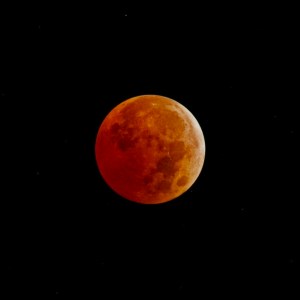
The coppery totality of the November 8, 2022 total lunar eclipse. The disk is darkest around the lower left, and lightest in the upper right-hand areas. Photo by James Guilford.
The total lunar eclipse of November 8, 2022, as viewed from Medina County. Photo by James Guilford.

In the wee hours of Friday, March 14, the Full Moon will pass through Earth’s shadow in space resulting in the coppery-red colors of a total lunar eclipse. While skies are expected to be clear for the event and temperatures tolerable, the show won’t be in “prime time” — maximum eclipse and color will be on display at about 2:58 AM (EDT) Friday. This will be the only total lunar eclipse of 2025.

While the timing of this year’s eclipse may be brutal, it also means the entirety of the process will be visible. By 12:55 AM (an hour after midnight, to be clear) Moon will have a strangely soft, faded appearance, then lit by the diffuse light of Earth’s outer shadow or penumbra.

The partial eclipse begins at 1:09 AM and by 1:47 AM, half of the lunar disk will be dark, hidden in Earth’s deep inner shadow called the umbra. Darkness will progress across Moon and as the last light fades from the lunar surface, color will begin to appear with the onset of totality.
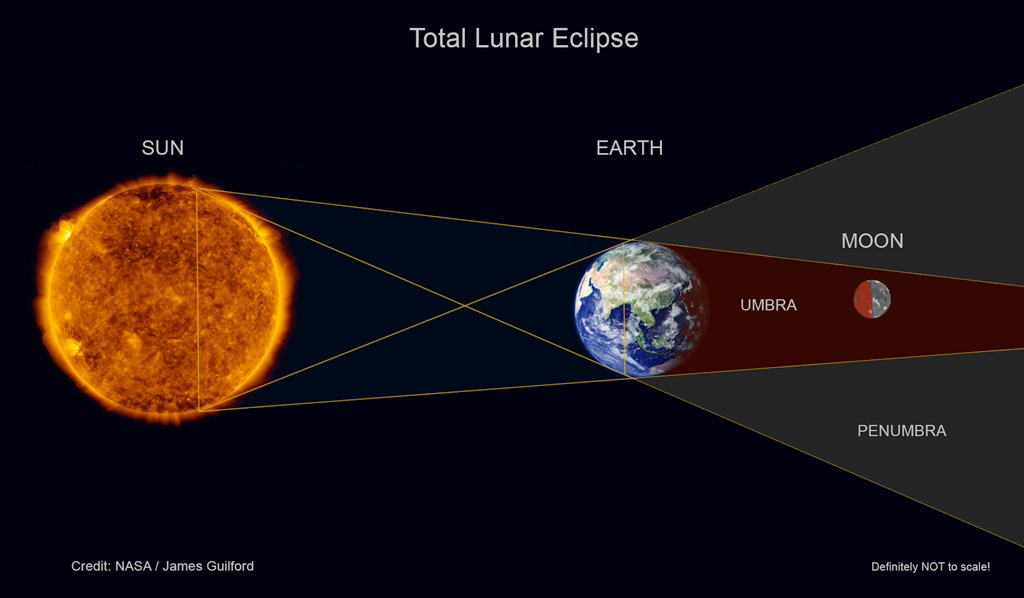
A total lunar eclipse occurs when Moon passes through the central portion of Earth’s shadow, known as the umbra, where all direct light from Sun is blocked and Moon is illuminated only by scattered light passing through Earth’s atmosphere.

At 2:26 AM, with Moon totally inside the umbra, the spooky beauty will be on full display. Earth’s inner shadow is full of colored light — sunlight scattered through the planet’s atmosphere bearing the scattered colors of the globe’s sunrises and sunsets — the source of a total lunar eclipse’s hues.

Maximum eclipse is reached at 2:58 – 2:59 AM and Moon will be as dark and colorful as it can be during the process. The eclipse sequence begins to reverse after the maximum as Moon continues its passage through Earth’s shadow. Observers will note the darker and lighter portions of Moon’s face subtly rotating as the event unfolds because Moon is not passing directly through the center of the umbra — the upper portion of the disk will be near the edge of the shadow area, the lower portion closest to the center and darkest region.
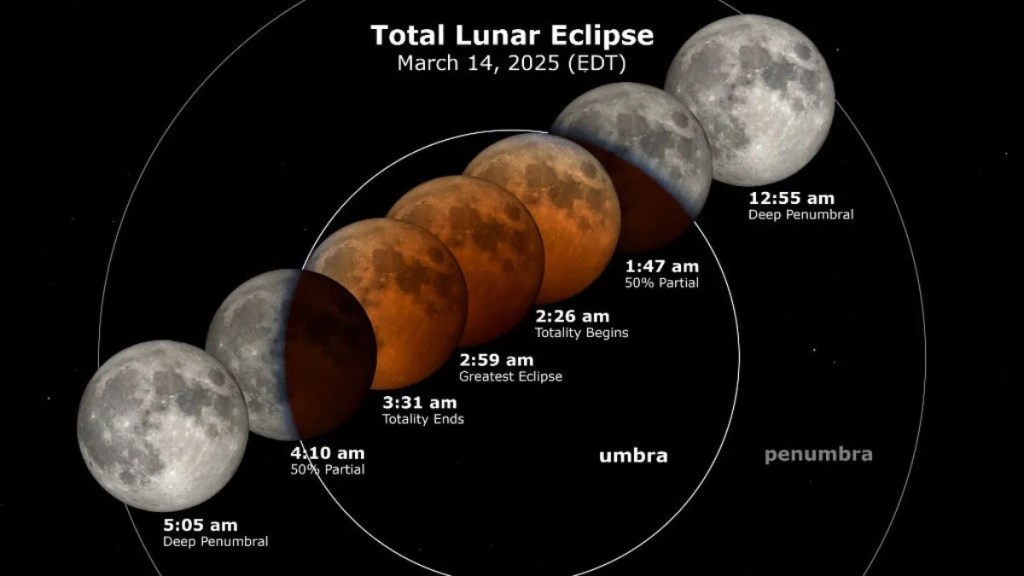
The timing and appearance of the March 14, 2025 total lunar eclipse is illustrated here. Note the penumbra and umbra shadow areas and the rotating shadow distribution on the lunar surface. Movement is right to left. Illustration Credit: NASA Scientific Visualization Studio

By 6:00 AM Moon will have returned to its Full illumination as if nothing had happened. Those who potentially lost sleep watching, however, will perhaps yawn but be will gratified to have seen one of the most impressive and beautiful astronomical events available to us.
An encounter with the occult(ation)

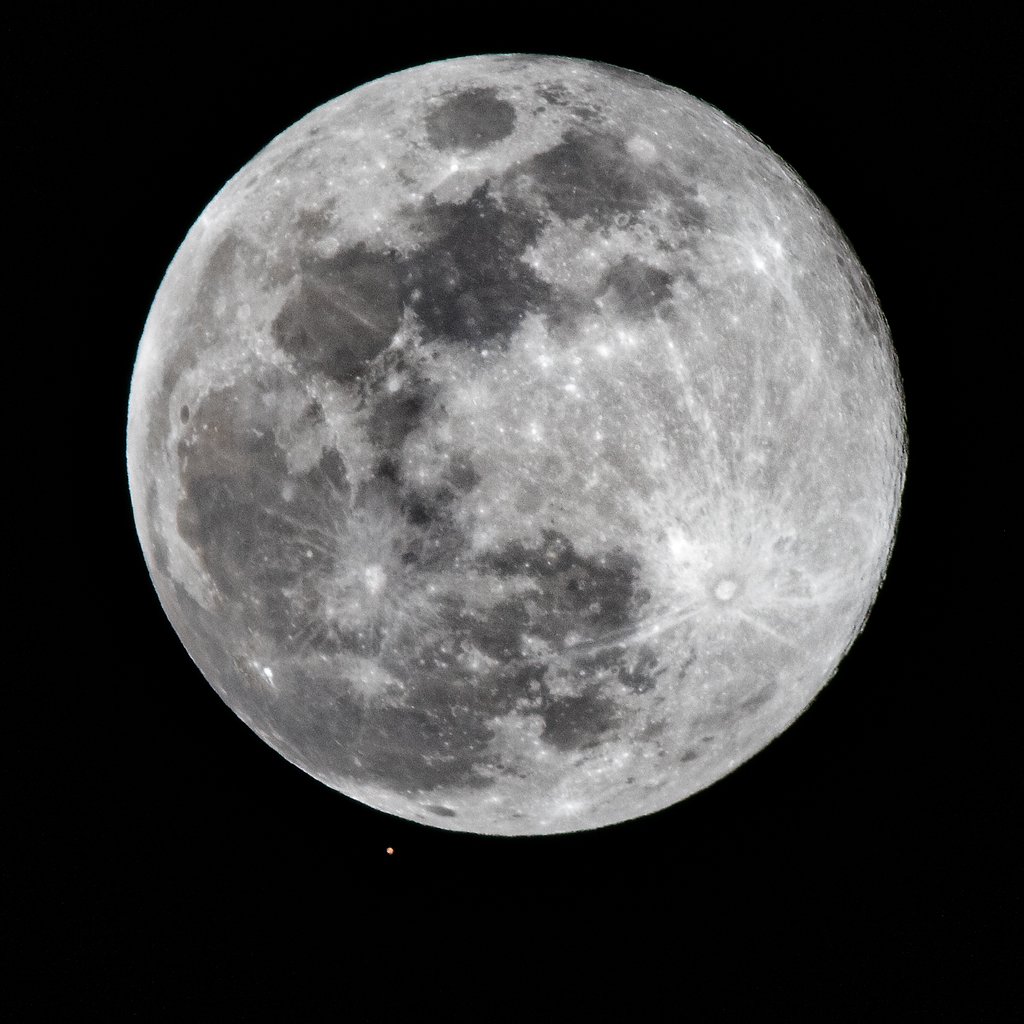
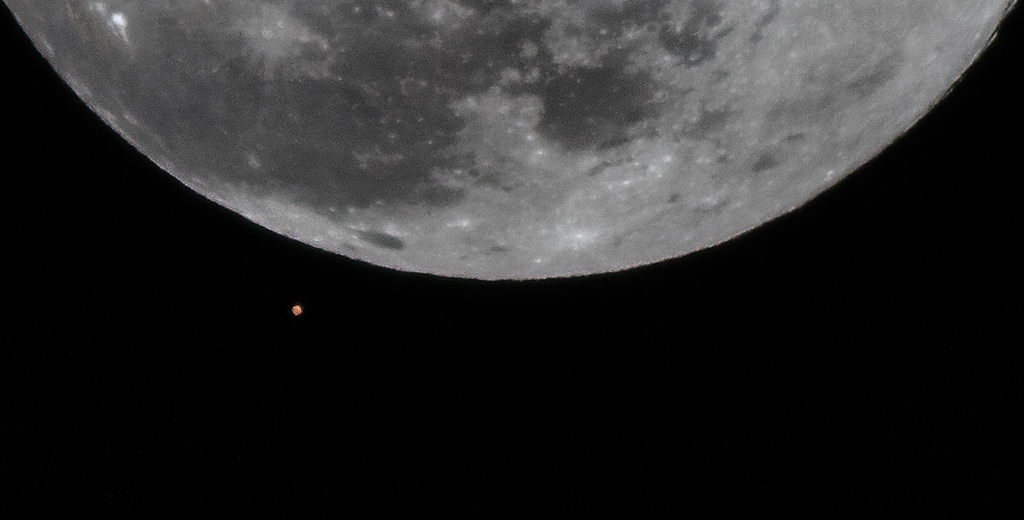
Only a few minutes from occultation, Mars is seen just off the lower edge of the lunar limb in this full-disk image recorded at 9:09 PM EST. The event only occurs with planet Mars about once every 14 years. Photo by James Guilford.

Clouds held off — pretty much — for us to observe the Moon occult* Mars, the reddish dot in the photo above. About once every 14 years or so, everything lines up just right and planet Mars is hidden by Earth’s Moon. Though Mars is about twice as big in diameter as our Moon, it was nearly 60 million miles farther away from Earth during the encounter — to the unaided eye, Mars looked like a tiny bright red star next to the Full Moon.

As predicted by mathematics, Mars and Moon grew nearer and nearer each other until, at 9:12 PM Eastern Standard Time (EST), the Red Planet disappeared behind our brilliant orb.

Mars, the small reddish dot in this image, nearing occultation by Earth’s Moon, as seen at 9:07 PM EST, January 13, 2025. Photo by James Guilford.
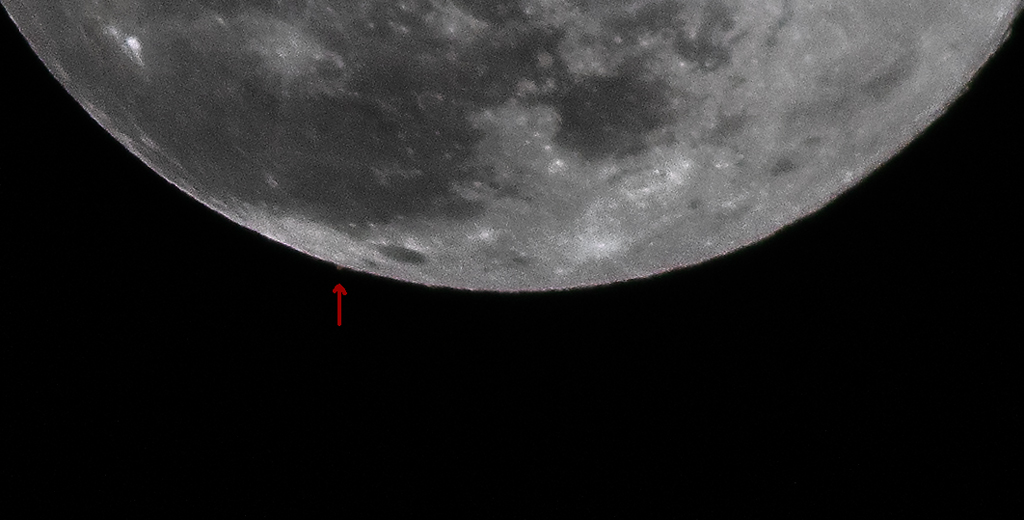
A red arrow indicates a ghostly mound that was Mars as it disappears behind Earth’s Moon at 9:12 PM EST, January 13, 2025. The dark oval to the right of Mars’s vanishing point is the lunar basin Grimaldi. Photo by James Guilford.

Passing clouds threatened to obscure the event but thanks to gaps between those clouds, there was enough clearing for observation. Shortly after Mars vanished, so did those inter-cloud gaps. With Moon now cloud-covered, we did not return to the 13℉ night to watch for Mars to emerge.

Technical: Canon 6D Mk. 2 Camera, Canon 400mm EF 1:5.6 L Lens, Canon 2X telextender, ISO 400, f/11, 1/250 second, photographic tripod.

*Occult: To cut off from view by interposing something. Commonly used as a noun to indicate something supernatural that is hidden from ordinary access.