
Two Moons, One Day

Waxing Gibbous Moon, January 10, 2025, at 7:18 PM EST. Note the delicate “C” shape on the upper left-hand edge of the lunar image — rising sun lighting the mountain tops that line Sinus Iridium while lower terrain remains in darkness. Crater Copernicus stands out at center-left, and Crater Tycho stands proudly in the heavily-bombarded lower area of the image. Note the extensive spread of ejecta rays that radiate across Moon’s surface from the relatively recent formation of Tycho. Photo by James Guilford.

It was a clear night so, of course, I had to go outside and take a look. Cold too, at 13℉, so I didn’t stay long! Mars, Jupiter, and Saturn were easy to find, all three shining bright. I was out for a “Moon shot”, though, got a pretty good one. This was made using our Sun shot setup, minus solar filter, of course! Moon was beginning its occultation of the Pleiades which didn’t image well.

The day was clear, as well, and Moon was clear and bright even against the blue daytime sky. So, here is our neighboring world rising through the trees. This is presented second, instead of at the top, because we prefer the nighttime image.
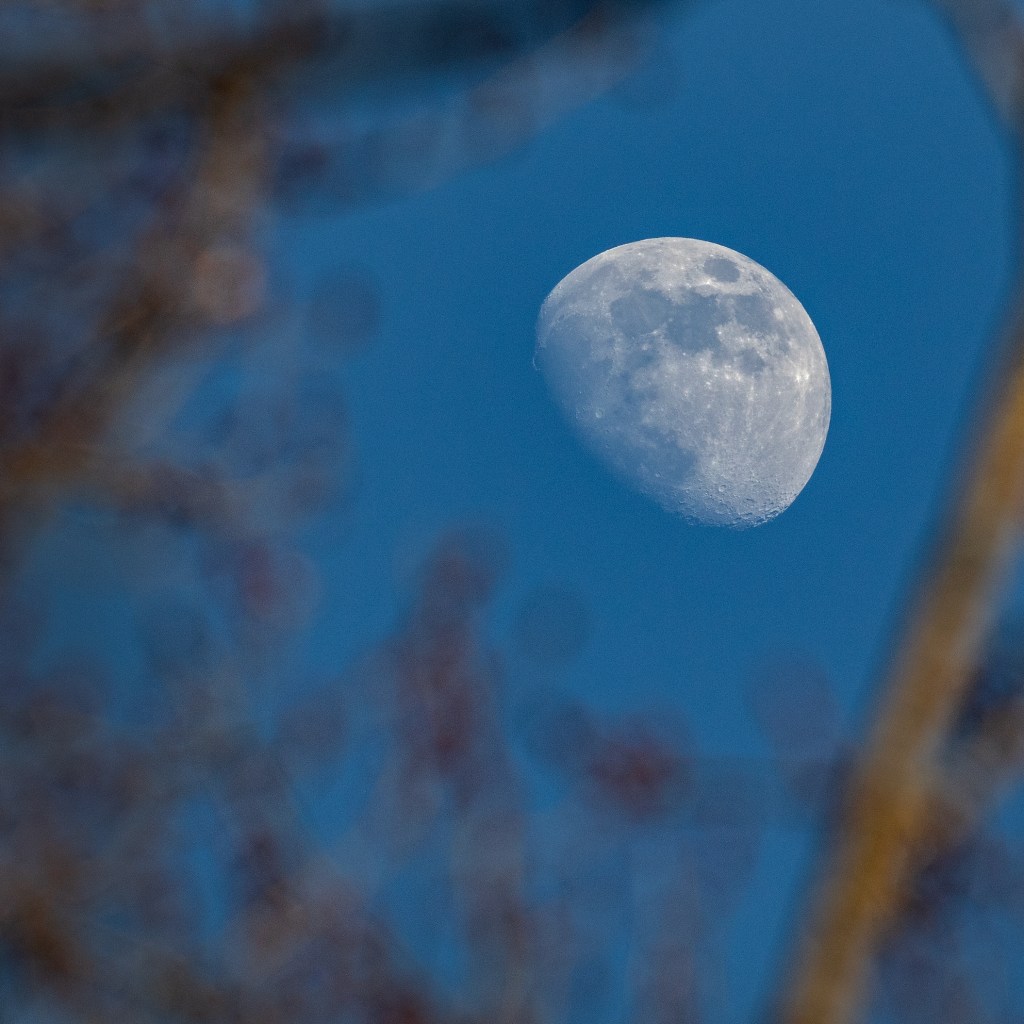
Waxing Gibbous Moon. January 9, 2025, at 4:08 PM EST. Photo by James Guilford.

A break from the sun

I’ve been shooting Sun images so frequently lately that I’ve neglected the night. While a recent aurora was obscured by clouds (and my sleep schedule) here, and no Perseid meteors spotted (clouds and sleep), Moon put in a nice appearance. Our neighbor in space was very low in our southern sky the night of August 14, which was good and bad. It was good because it can be hard to observe objects high overhead. It was bad because lower to the horizon means more air — and turbulence — between the observer and astronomical objects than if they were overhead. A tripod-mounted telephoto lens and DSLR were used for the capture and a bit of post-processing sharpened things up pretty well.

One of the things I enjoy most when observing Moon is looking along the terminator — the divide between dark and lit areas — at features partly illuminated by, in this case, the rising Sun. Especially noticeable is the arc of light near the upper end of the terminator — the sunlit tops of the Jura Mountains, defining the Bay of Rainbows, off of the grand Sea of Showers or Mare Imbrium.