November 3, 2025 — The air was still and the moon so bright and clear tonight, we had to open up the observatory long enough to take a peek and a pic! Moon was 92% illuminated in its waxing gibbous phase, lighting the landscape around us, no flashlight required. Technical: Askar 103 APO telescope, TeleVue Powermate 2X Barlow, Canon EOS 5D Mk. 4 DSLR, single exposure.
An International Observe the Moon Night promotional graphic. Credit: NASA
Note: The observatory construction is essentially complete with only a few “touch up” items and further outfitting remaining. We’ll eventually get around to writing and illustrating the story of the project. First, though, the 2025 International Observe the Moon Night….
October 4 marked International Observe the Moon Night (IOMN), an event billed as an opportunity to “unite people across the globe in a celebration of lunar observation, science, and exploration.” Coordinated and promoted by NASA, IOMN boasted 1,045 registered events worldwide. That count does not include informal events and individuals who, on their own, observed Earth’s Moon, encouraged by the promotion. Unfortunately, due to a U.S. government shutdown, NASA staff are unable to update the IOMN website and we may never know how it went this year.
While we did not host an outreach event, we did post fresh, new telescopic images depicting lunar details, along with descriptions of those events as our participation. This year, we concentrated our efforts on the Threads social media platform. What follows is what we posted.
Here’s a nice full-disk view of Earth’s Moon, one we made a few months ago with a phase very close to what we see tonight. The phase is called the “waxing gibbous” and is seen between the First Quarter and Full Moon. Moon will reach its full phase the night of October 6, this year.Mare Humorum, aka Sea of Moisture, is the dark circle at the center of this image. It was formed in an impact by an asteroid or comet, the crater filled with basalt. The “sea” is about 264 miles across and is seen here near the terminator — the dividing line between night and day — not long after local lunar sunrise. Crater Gassendi is the circular ring that intersects with Humorum. The crater is about 69 miles in diameter; a smaller crater at its northern edge is called Gassed A.
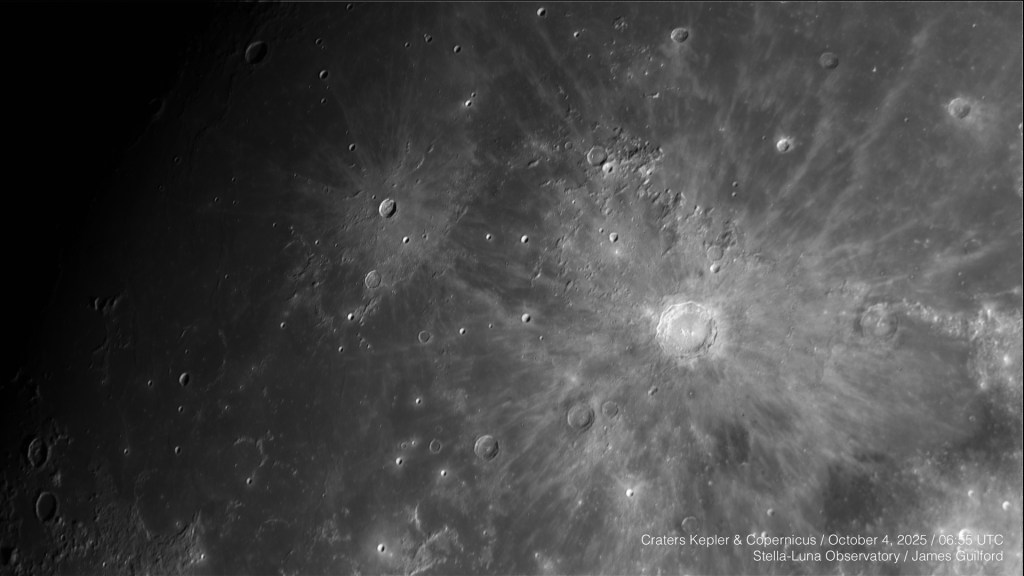
Followup Edit: Spellcheck was convinced we meant to type “Gassed” when what we really wanted was Gassendi A. Maybe it was the chili we had for dinner. Here’s crater Tycho, prominent even in the heavily-bombarded southern lunar highlands. Estimated to be 108 million years old, Tycho is about 53 miles in diameter but easily spotted using binoculars or a small telescope. The crater’s vast field of ejecta rays — the spray of material “splashed” out when an object hit Moon — is bright and forms lines that lead back to their origin. The feature was named after Danish astronomer Tycho Brahe.Also near the terminator, in Moon’s northwest, is this beautiful pair of craters: Kepler (left) and Copernicus. Like Tycho, Copernicus is marked by the prominent lines of ejecta radiating from the impact site, a crater about 58 miles in diameter. Crater Kepler, about 20 miles wide, lies to the west of Copernicus with its western rim shining brightly in the light of the lunar sunrise. For our final image of the night, we’re posting our image of a complex area of Moon at the northern end of the terminator. In the upper right we see crater Anaxagoras and surroundings glowing brightly, contrasted against the stark blackness of space. The smooth band spanning the image is Mare Frigoris. “C” shaped arch marks Sinus Iridum, opening to Mare Imbrium. Crater Plato is the circle with a smooth, dark floor in the lower right. Notice the chain of smaller, satellite craters next to Plato.
Crater Plato is about 63 miles in diameter and about 3.84 billion years old. Once again, see how the western rims of the craters along the terminator shine in the low-angle light from the rising Sun.
We hope you have enjoyed what you have seen and will see online tonight, or were fortunate to attend an International Observe the Moon Night event in person. Outdoors, at home, online, or wherever you may be, we’re glad to have had you with us. We hope IOMN has united people across the globe in a celebration of lunar observation, science, and exploration, under one sky, appreciating one Moon. Goodnight, and keep looking up!
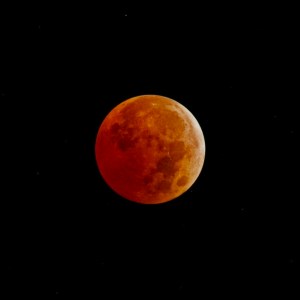
The total lunar eclipse of March 13 – 14, 2025 did not disappoint! We resolved to capture images from the late partial eclipse to maximum eclipse, mostly to be able to fit in a little sleep! Catching it all, which we could from our North America location, would have required, essentially, an all-night session. Just a bit too much!
Early partial eclipse. The brighter shadow within the penumbra lights the top portion of this image. Note a bit of reddish tone within the dark umbra. 2:08 AM EDT
I sat on a pad over the paved surface where in the cold, where the observatory is to eventually stand. The old telescope mount ticking away as it tracked the moon across the sky. Occasionally geese and ducks on the nearby pond called out against some unseen disturbance. The stars of Great Orion were sinking behind nearby trees.
Moon is deep within the umbra and last penumbra light about to be left behind. 2:19 AM EDT
In the otherwise quiet chill, I watched the lunar transition, from a bright sliver left over from the night’s Full Moon, to glowing copper orb. With a cable release I manually triggered the camera’s shutter: click — pause — click, to record the event.
Maximum eclipse. Moon is fully within the umbra but because it is not traveling through the center of Earth’s deepest shadow, scattered light from the penumbra brightens the upper limb. 2:58 AM EDT
Shortly after maximum eclipse (shown above), at 2:58 AM EDT, I shut down the telescope and, casting a wistful eye at the still-darkened Moon, went indoors. I fed the waiting cat, changed back to pajamas, and returned to bed. In fitful sleep, somehow still cold, happy to have sacrificed rest for the experienced phenomenon.
Tech: Askar 103 ED telescope, Canon EOS 5D Mk 4 camera, Meade Goto Mount, Photoshop. ISO 400, variable exposure times.
The total lunar eclipse of November 8, 2022, as viewed from Medina County. Photo by James Guilford.
In the wee hours of Friday, March 14, the Full Moon will pass through Earth’s shadow in space resulting in the coppery-red colors of a total lunar eclipse. While skies are expected to be clear for the event and temperatures tolerable, the show won’t be in “prime time” — maximum eclipse and color will be on display at about 2:58 AM (EDT) Friday. This will be the only total lunar eclipse of 2025.
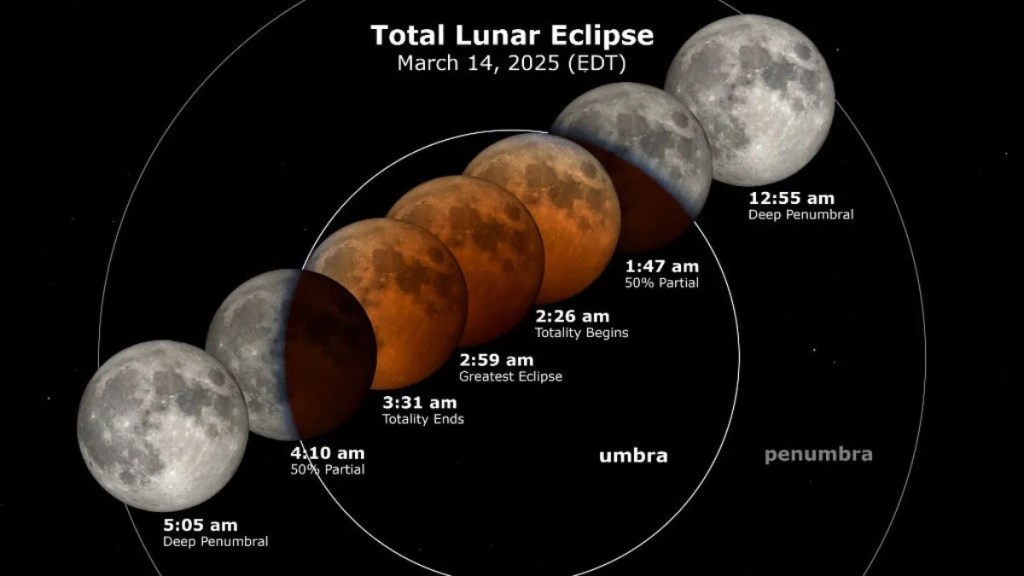
While the timing of this year’s eclipse may be brutal, it also means the entirety of the process will be visible. By 12:55 AM (an hour after midnight, to be clear) Moon will have a strangely soft, faded appearance, then lit by the diffuse light of Earth’s outer shadow or penumbra.
The partial eclipse begins at 1:09 AM and by 1:47 AM, half of the lunar disk will be dark, hidden in Earth’s deep inner shadow called the umbra. Darkness will progress across Moon and as the last light fades from the lunar surface, color will begin to appear with the onset of totality.
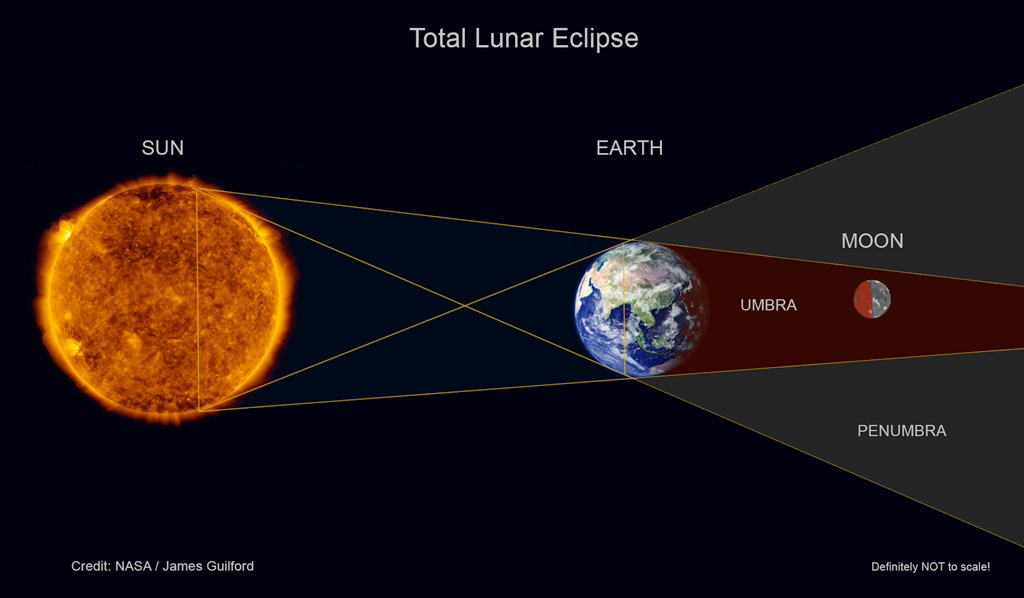
A total lunar eclipse occurs when Moon passes through the central portion of Earth’s shadow, known as the umbra, where all direct light from Sun is blocked and Moon is illuminated only by scattered light passing through Earth’s atmosphere.
At 2:26 AM, with Moon totally inside the umbra, the spooky beauty will be on full display. Earth’s inner shadow is full of colored light — sunlight scattered through the planet’s atmosphere bearing the scattered colors of the globe’s sunrises and sunsets — the source of a total lunar eclipse’s hues.
Maximum eclipse is reached at 2:58 – 2:59 AM and Moon will be as dark and colorful as it can be during the process. The eclipse sequence begins to reverse after the maximum as Moon continues its passage through Earth’s shadow. Observers will note the darker and lighter portions of Moon’s face subtly rotating as the event unfolds because Moon is not passing directly through the center of the umbra — the upper portion of the disk will be near the edge of the shadow area, the lower portion closest to the center and darkest region.
The timing and appearance of the March 14, 2025 total lunar eclipse is illustrated here. Note the penumbra and umbra shadow areas and the rotating shadow distribution on the lunar surface. Movement is right to left. Illustration Credit: NASA Scientific Visualization Studio
By 6:00 AM Moon will have returned to its Full illumination as if nothing had happened. Those who potentially lost sleep watching, however, will perhaps yawn but be will gratified to have seen one of the most impressive and beautiful astronomical events available to us.
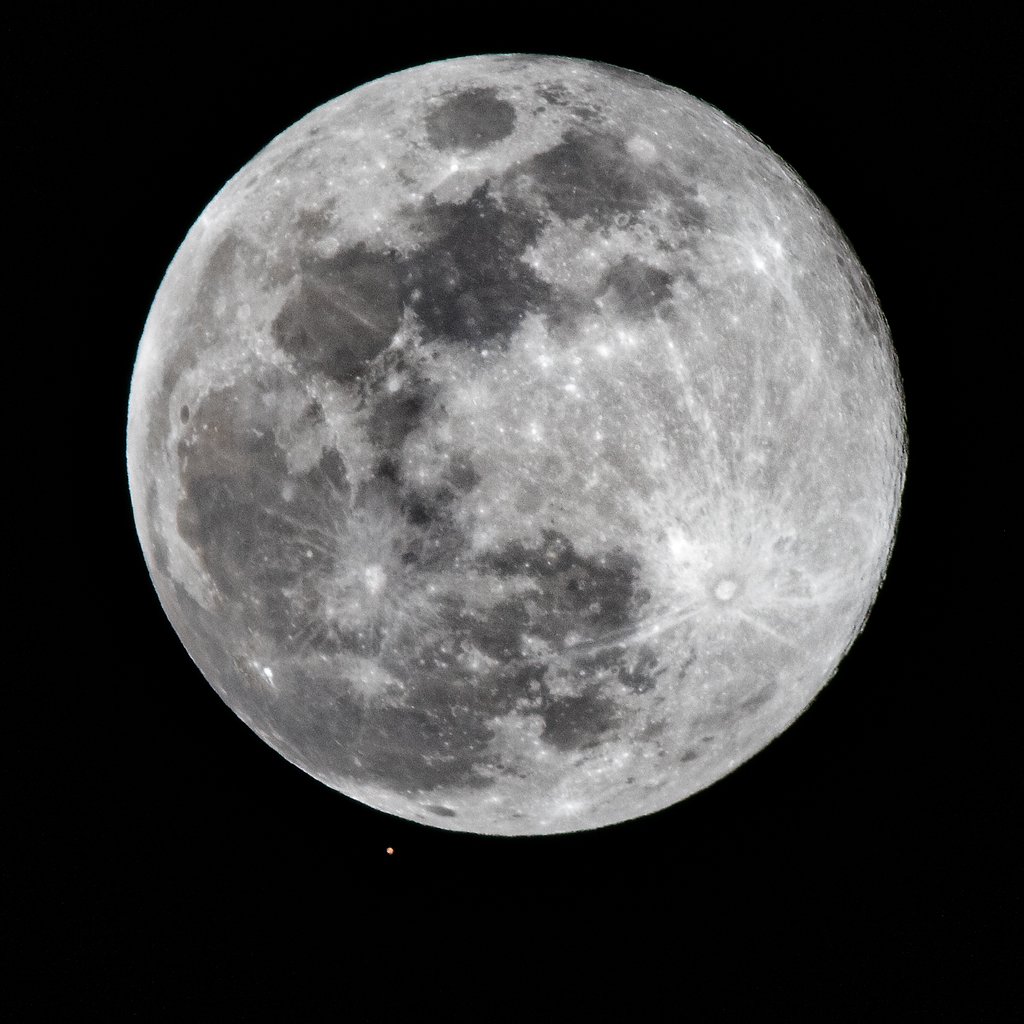
Only a few minutes from occultation, Mars is seen just off the lower edge of the lunar limb in this full-disk image recorded at 9:09 PM EST. The event only occurs with planet Mars about once every 14 years. Photo by James Guilford.
Clouds held off — pretty much — for us to observe the Moon occult* Mars, the reddish dot in the photo above. About once every 14 years or so, everything lines up just right and planet Mars is hidden by Earth’s Moon. Though Mars is about twice as big in diameter as our Moon, it was nearly 60 million miles farther away from Earth during the encounter — to the unaided eye, Mars looked like a tiny bright red star next to the Full Moon.
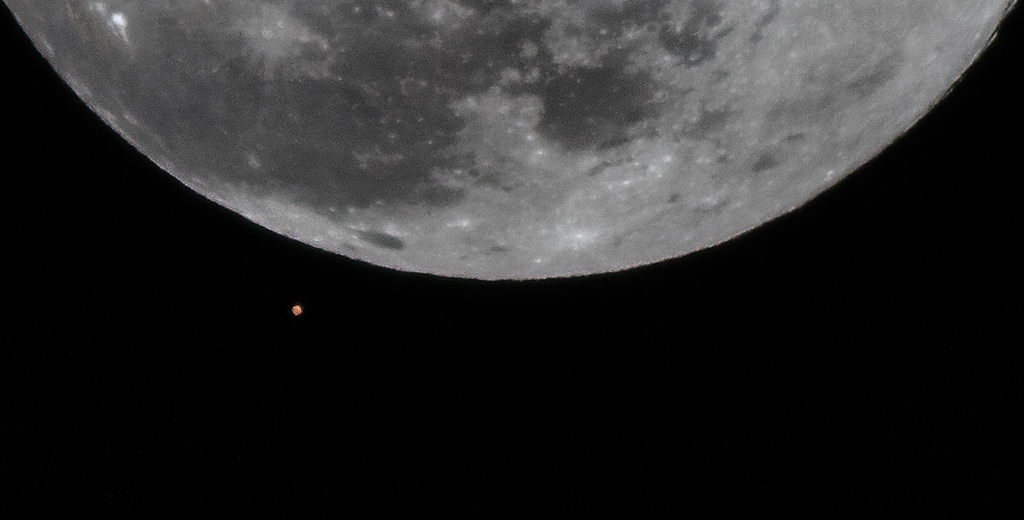
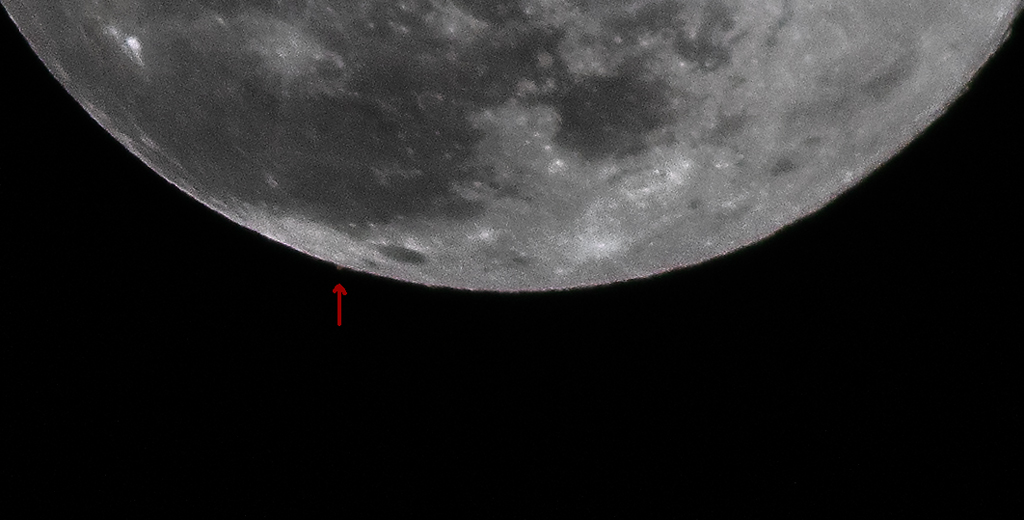
As predicted by mathematics, Mars and Moon grew nearer and nearer each other until, at 9:12 PM Eastern Standard Time (EST), the Red Planet disappeared behind our brilliant orb.
Mars, the small reddish dot in this image, nearing occultation by Earth’s Moon, as seen at 9:07 PM EST, January 13, 2025. Photo by James Guilford.A red arrow indicates a ghostly mound that was Mars as it disappears behind Earth’s Moon at 9:12 PM EST, January 13, 2025. The dark oval to the right of Mars’s vanishing point is the lunar basin Grimaldi. Photo by James Guilford.
Passing clouds threatened to obscure the event but thanks to gaps between those clouds, there was enough clearing for observation. Shortly after Mars vanished, so did those inter-cloud gaps. With Moon now cloud-covered, we did not return to the 13℉ night to watch for Mars to emerge.
Technical: Canon 6D Mk. 2 Camera, Canon 400mm EF 1:5.6 L Lens, Canon 2X telextender, ISO 400, f/11, 1/250 second, photographic tripod.
*Occult: To cut off from view by interposing something. Commonly used as a noun to indicate something supernatural that is hidden from ordinary access.
Waxing Gibbous Moon, January 10, 2025, at 7:18 PM EST. Note the delicate “C” shape on the upper left-hand edge of the lunar image — rising sun lighting the mountain tops that line Sinus Iridium while lower terrain remains in darkness. Crater Copernicus stands out at center-left, and Crater Tycho stands proudly in the heavily-bombarded lower area of the image. Note the extensive spread of ejecta rays that radiate across Moon’s surface from the relatively recent formation of Tycho. Photo by James Guilford.
It was a clear night so, of course, I had to go outside and take a look. Cold too, at 13℉, so I didn’t stay long! Mars, Jupiter, and Saturn were easy to find, all three shining bright. I was out for a “Moon shot”, though, got a pretty good one. This was made using our Sun shot setup, minus solar filter, of course! Moon was beginning its occultation of the Pleiades which didn’t image well.
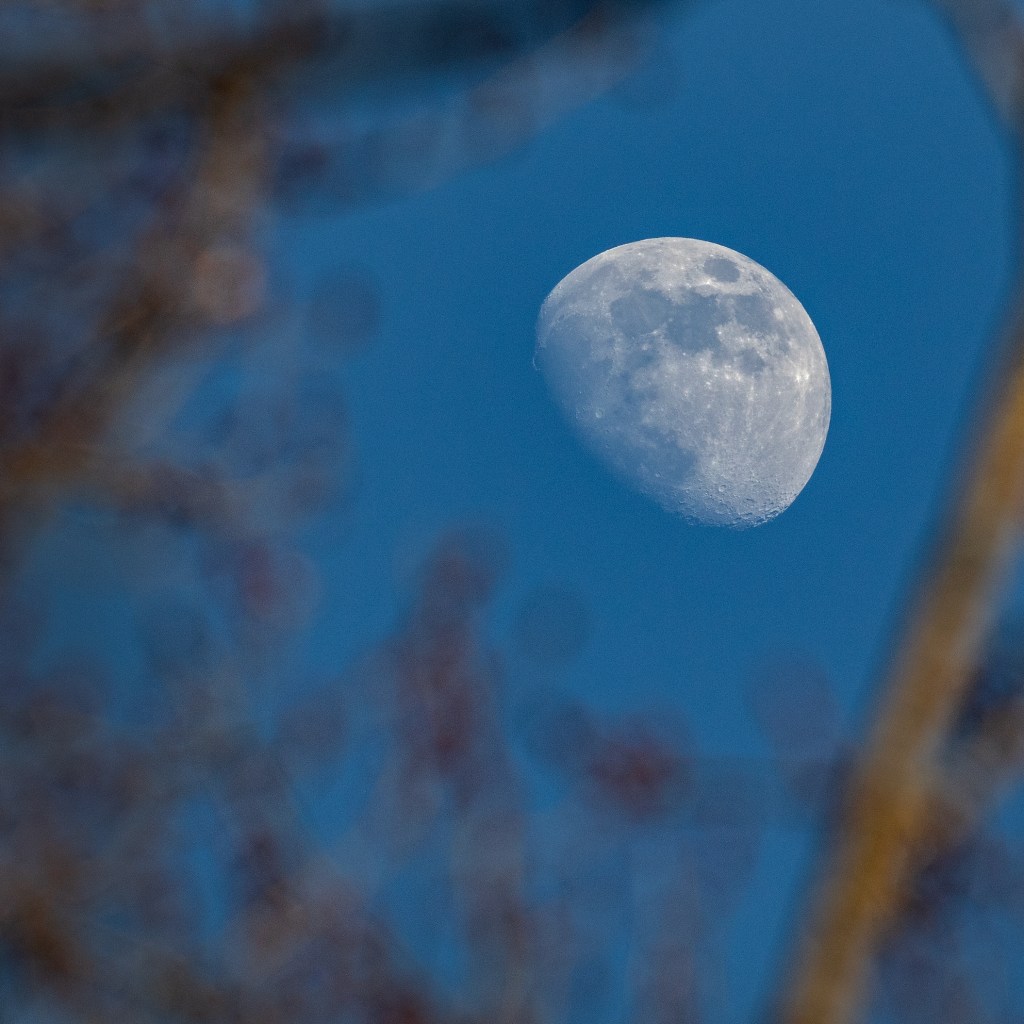
The day was clear, as well, and Moon was clear and bright even against the blue daytime sky. So, here is our neighboring world rising through the trees. This is presented second, instead of at the top, because we prefer the nighttime image.
Waxing Gibbous Moon. January 9, 2025, at 4:08 PM EST. Photo by James Guilford.
Moon and Saturn had a close encounter tonight, August 20, 2024. Okay, the two orbs were about 809 million miles apart but they were close in the sky. I shot this image as early as I could, shooting through a narrow gap in the trees, with a telephoto lens and not a big ole telescope (which I’d have preferred). Still, there they were, together in our night sky, and here they are, a glowing pockmarked moon, and a distant and giant ringed world in one picture. Where is Saturn? It’s that tiny amber dot — a few pixels in size — above the lunar disk. Saturn’s ring plane is seen nearly on-edge now making the planet visually even smaller. — Photo by James Guilford
I’ve been shooting Sun images so frequently lately that I’ve neglected the night. While a recent aurora was obscured by clouds (and my sleep schedule) here, and no Perseid meteors spotted (clouds and sleep), Moon put in a nice appearance. Our neighbor in space was very low in our southern sky the night of August 14, which was good and bad. It was good because it can be hard to observe objects high overhead. It was bad because lower to the horizon means more air — and turbulence — between the observer and astronomical objects than if they were overhead. A tripod-mounted telephoto lens and DSLR were used for the capture and a bit of post-processing sharpened things up pretty well.
One of the things I enjoy most when observing Moon is looking along the terminator — the divide between dark and lit areas — at features partly illuminated by, in this case, the rising Sun. Especially noticeable is the arc of light near the upper end of the terminator — the sunlit tops of the Jura Mountains, defining the Bay of Rainbows, off of the grand Sea of Showers or Mare Imbrium.
On Saturday, October 14, 2023, there will be plenty of buzz about the annular solar eclipse taking place. The eclipse will happen, blue sky or cloudy, dimming the day’s midday light. Here in Medina, Ohio we won’t, however, be seeing the real attraction, the so-called “Ring of Fire”. We will, however, experience a partial eclipse of the sun; about 35 percent of the sun will be obscured by Moon, making Sun a crescent.
Eclipse timings for Medina, Ohio as provided by TimeAndDate.com
What’s an annular eclipse, then? Well, “annular” means ring-shaped, not “annual” as in once a year. The ring, or annulus, we’re talking about here is created by our Moon passing between we Earthbound viewers and Sun covering most, but not all of the solar disk. At its peak, an annular eclipse leaves brilliant ring of sunlight visible, shining around the edges of Moon — the ring of fire. The better-known total solar eclipse occurs when Moon covers all of the solar disk, allowing viewers to see the beautiful haze of Sun’s corona streaming around the dark circle where Moon superimposes Sun.
Solar eclipses take place in three basic varieties: partial, annular, and total and what happens on each occasion is dependent upon the positions of Sun, Moon, and viewer. Why won’t anyone see a total solar eclipse this Saturday? In short, it’s because Moon’s orbit is elliptical, not circular. On an elliptical path Moon will appear larger or smaller from Earth, depending upon Moon’s position on its orbit. We’re fortunate that Moon can so perfectly cover Sun when it’s a bit nearer us, producing glorious total eclipses. But when Moon is a bit farther out for an eclipse and appears smaller, it can’t quite cover all of Sun and that’s when annular eclipses happen.
Moon is near enough to Earth that parallax influences what viewers experience. At the center line of an annular or total eclipse, the full effect of the event may be enjoyed. Stray off that center line (path of annularity, or path of totality) and a partial eclipse is seen. It’s like someone hiding a few steps behind a tree. If the tree is directly in the line of sight of the viewer, the person is hidden. Take a step to one side, however, and the hidden person begins to be revealed. Parallax.
Viewing: Neither those out west nor we here in Ohio can safely view the annular or partial eclipse phases safely without proper gear. ISO-Certified viewers are the gold standard so long as they are undamaged. Eclipse viewing glasses are available from many sources though it’s probably too late to order them in before this weekend’s event. Maybe think about buying some soon for next year’s total eclipse! There is a mix of opinion regarding #14 welder’s glass — they’re probably alright to use if you have them but be careful — welder’s glass comes in different shades and lighter shades may not provide adequate protection!
Do Not Use: Sunglasses of any sort, photographic negatives, Compact Discs, shiny plastic wrapping, etc. for viewing the sun. If you view the brilliant solar disk improperly, damage to your eyes can result and be instantaneous and permanent. If you happen to have solar eclipse glasses from previous events, those would be great to use but examine them first! Hold the glasses close to a bright light source and look for pinholes, scratches, or other damage; if you can see light spots coming through the lenses throw the glasses away!
Crater Tycho is featured here, its web of light-colored ejecta radiating in all directions. Celestron C11 telescope with ZWO ASI 294MC Pro camera.
Taking advantage of what seem to be rare clear skies, last night (September 1, 2023) I ran first light trials on the Celestron C11 I was given, in combination with my ZWO ASI color astronomy camera. The telescope, with its decent aperture and long focal length, may become the primary observatory instrument. The results were largely disappointing with no good deep sky results, terrible results from Saturn, and not-so-good images of Jupiter. Even Earth’s Moon, usually an easy target, was barely in focus. It didn’t occur to me to use my Bahtinov mask focus aid — my gear is spread across two buildings and three or four locations! Once built, the observatory should help with organization. I hope to try again this coming week when mild, clear nights are forecast and I hope it is only a matter of technique and not an optical issue.
On the positive side, polar alignment was excellent as was goto control alignment so telescope sky tracking was very good during my efforts — until something caused an unexpected reboot of the telescope controller. I don’t know if dew short circuited a connector or if the connector pulled loose from the handbox but it was disconcerting!
The images shown here are simply interesting to look at, though not the quality I’d normally want to show. The first is youngish Crater Tycho showing off its extensive web of ejecta rays. The second picture includes several lunar “seas” including the “C” shaped Sea of Crisis. Two craters are seen near the left edge of the circle; the lower of those craters is named Picard. No, Star Trekkers, not THAT Picard. Still, a fun fact.
Several lunar seas are shown in this image with the Sea of Crisis, the C-shaped feature, on the right. Within the Sea of Crisis are seen two small dots and the lower of the two is Crater Picard. Celestron C11 telecope with ZWO ASI 294MC Pro camera.








 Stella-Luna Observatory