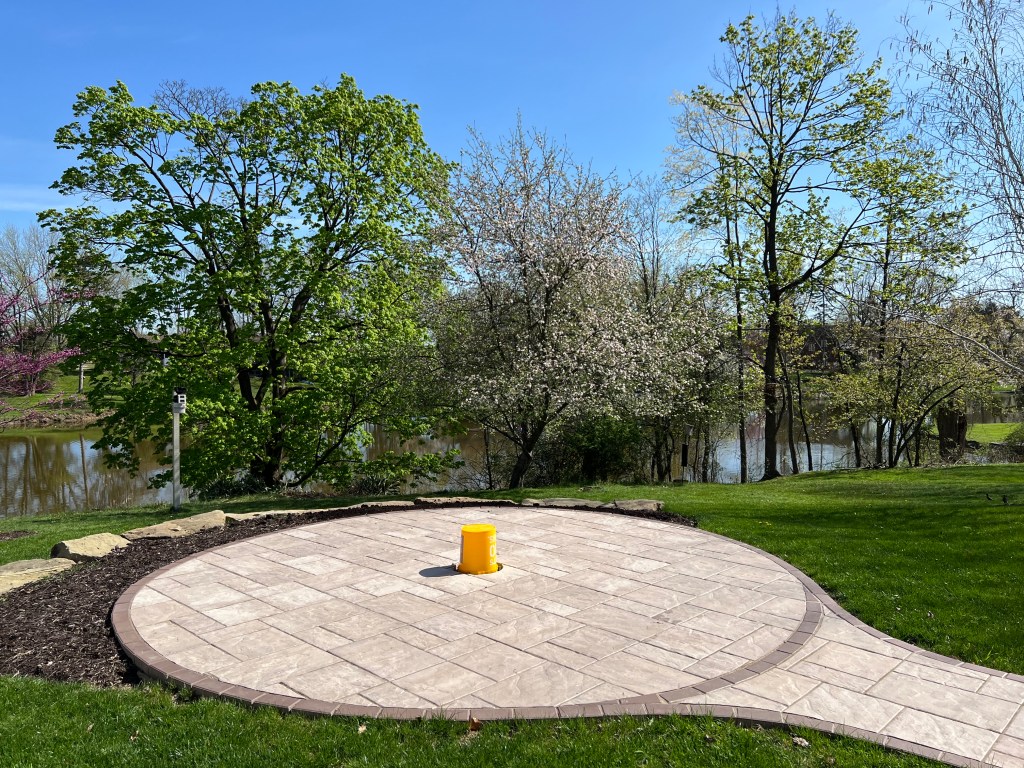
The patio floor of the observatory awaits its observatory.
Frustration continues as we await word that the observatory has been shipped. We’ll be firing off another query of the manufacturer tonight reminding them, yet again, that we’re still waiting. Not that our questions or complaints have helped move things along. We’ll likely soon go ahead with pulling wiring through the buried conduit — utility power could be helpful even without the building. We hope to install landscape plants next week in the curved area along the north (left) edge of the patio. Our plant of choice is “Creeping Juniper”. Will we need to make some sort of temporary telescope shelter while we await our observatory (telescope shelter) in order to make better use of what we have? Maybe.
The latest from the manufacturer of our observatory structure: “The [shipping] broker advised me to wait until the 2nd of April USA time to see what extra paperwork there might be under Trump’s tariffs.” It appears to us that our tariff-loving President’s “Liberation Day” will mean more money “liberated” from our bank account.
And so, another delay in shipping, for yet another reason — they recently had to remake the shipping crate due to wood content — costing more money in the end. If the manufacturer had shipped earlier, and from our viewpoint, it appears they could have, this latest mess and expense would have been avoided — it’s not like it was a secret widespread tariffs were coming!
We can only hope all will be resolved and shipping will actually begin early this month. Will we be able to build the thing this summer, a year-plus from our original expectation?
The experience has, thus far, been frustrating, and disheartening. We have little faith the path ahead will be smoother.
Note: We know of no U.S. manufacturer of small observatories made of fiberglass or non-metal materials. These unique products are imported and subject to shipping charges and import costs such as tariffs.
Just when we thought the manufacturer of our observatory was actually about to ship, they report new problems causing yet another delay. This time it has something to do with a tropical cyclone hitting their port, and port officials later demanding certification that the wood pieces of the crate are safe (presumably from insect infestation) for international shipping. Now a replacement crate is being built from plastic and metal parts. This, by the way, was previously promised over the Christmas/New Year’s holiday. Still hoping we can maybe get the thing here and built sometime this summer. Another week, another delay, another sad disappointment.
The dome has been mated to the curved base walls of the observatory, on the factory floor. Photo courtesy Sirius Observatories.
Another update from its maker informs us our observatory has reached another milestone with the dome now mated to the curved base walls. While construction is not yet finished, we’re told arrangements are being made for shipping. We’re trying to not get too excited — by the time the observatory arrives here, winter will have arrived and we’ll probably have to store our precious purchase until spring!
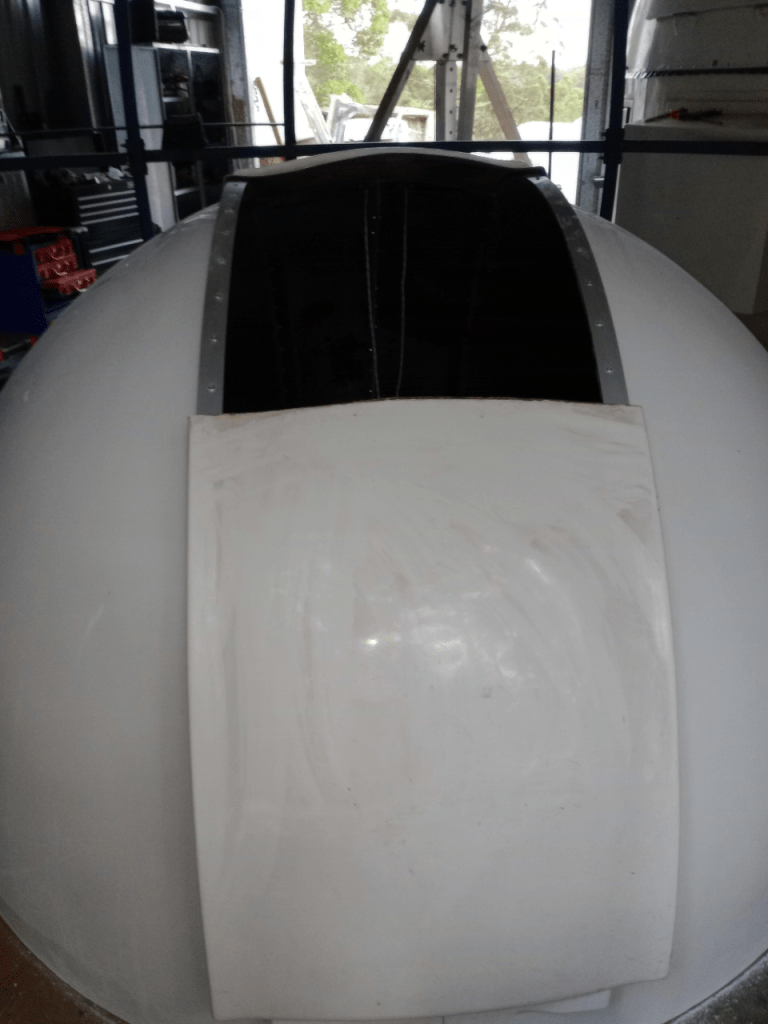
Our observatory dome at the manufacturer’s shop. It will be cleaned and waxed prior to shipping. November 10, 2024
After a worrisome extended period without updates, we at last heard from the maker of our observatory; the dome is nearly complete! As we understand it, the dome will be lifted on to the round wall base for fitting and quality control testing — including installation and operation of its electrical rotation system. Once assured everything fits and works properly, the observatory will be disassembled and crated for shipping. No shipping date has been provided as yet but we’re happy to hear progress has been made.
Still working without a dome, our setups are outdoors and temporary so we try and keep them fairly simple. Solar observing and imaging generally lend themselves well to brief observations due to the extreme amount of light available and resultant short photographic exposures. With a couple of clear days and nights available, we took advantage and made some experiments and observations with several successive setups on a single Skywatcher EQ6-R Pro mount.
Southern hemisphere of Sun — First Light image from ZWO ASI678MM planetary camera, via Baader Herschel-Prism, and Askar 103 APO telescope. False color applied.
We began with the Askar 103 APO telescope and its 700mm focal length, attaching our Baader Herschel-Prism, and the new ASI678MM monochrome camera. The setup worked well but for one issue: focus was only just achieved with the focuser racked all the way in with no latitude for adjustment. Image quality was very good but probably would have been better if we’d have had a bit more inward travel. Note: It was only later that we realized we might gain the needed travel if we had switched the camera’s nosepiece from the 1.25-inch to the 2-inch, allowing removal of the thick 1.25-inch adapter ring from the Herschel. A well, duh, moment!
By the way, we continue to be impressed by the build quality and optical excellence of the Askar refractor. It’s a solid instrument with great features, delivering superb results.
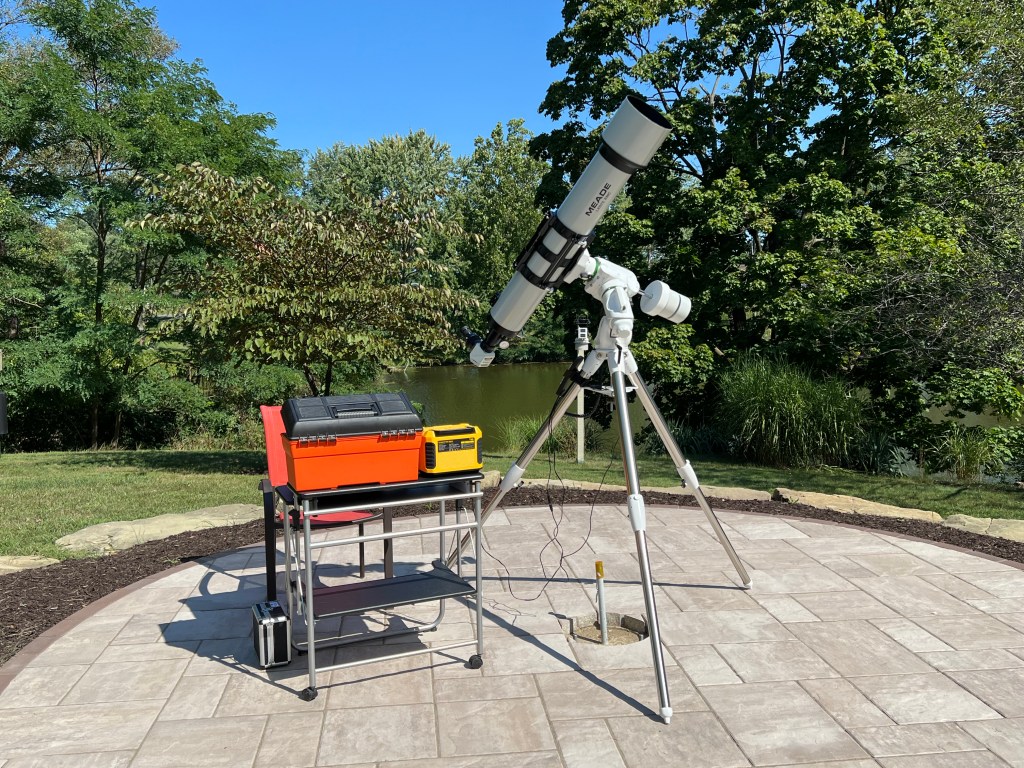
Askar 103 APO telescope, Baader Herschel-Prism, ASI678MM camera, on the Skywatcher mount makes an excellent combination. A Herschel wedge-style optical device does not require a filter be attached in front of the telescope’s objective lens — deflecting, absorbing, and ejecting the bulk of sunlight energy. Internal filters in the Baader apparatus reduce brightness and increase contrast.The Meade 6-inch refractor atop the Skywatcher mount and tripod. Visually, very effective, but the setup did not work with the Herschel-Prism and camera. The circular paved area is to form the floor of the observatory structure, the gray conduit to deliver power to a permanent mounting pier. Yes, the sky really was that blue that day!
The second experiment involved installing our massive Meade 6-inch telescope on the mount. The Skywatcher has a retractable rod for holding counterweights and is, therefore, a bit shorter than it might otherwise be, resulting in less leverage. It took nearly all of our available counterweights to balance the big scope. We installed the Herschel-Prism and a nice eyepiece and got beautiful views of the spotted face of our star. Attaching the ASI678MM, however, we could not reach focus — that inward focuser travel limit again — but we don’t believe the switch to the 2-inch nosepiece will help. That’s a shame! The Meade’s 1,250mm focal length would have provided amazing closeups!
The 11-inch Celestron SCT set up for a nighttime trial. This OTA was part of an integrated mount system that had failed so we “deforked” the telescope and attached a mounting rail for use on an equatorial mount.
With the mount set up we decided to try out the 11-inch Celestron SCT at night. Herschel wedge accessories are not to be used on reflecting telescopes as the concentrated unfiltered incoming sunlight can damage the scope’s secondary mirror. To our disappointment the telescope, which has set in storage for months since we attempted collumnation, displayed rather severe image distortions — comma-shaped stars. After a good bit of frustration we dismounted the telescope and planned to come out the next night with the Vixen Cassegrain telescope.
All good things… A series of clear days and nights came to an end with clouds rolling in to cover Saturn as it emerged from behind neighboring trees.
The following evening looked very promising; the sky was actually more transparent than it had been for the Celestron effort. Saturn would rise from behind trees neighboring our site some time after 11 p.m. so, at the appointed hour, we stepped outdoors and looked. Clouds, heralding a day or two of rain showers, were rolling in — broken at first but rapidly obscuring the entire sky. We tore down the setup, stowed the gear, and called it a night.
Tight crop on sunspots from the planetary camera’s First Light image of September 4. Sunspot umbra, penumbra, details are visible as are faculae and the granulated texture of the solar photosphere. Askar telescope, Baader Herschel-Prism, ZWO ASI678MM camera.
Over the period of a couple of days and nights, much was learned and the new planetary camera proved itself to be an excellent performer. We’ll continue to use the camera and telescope for solar and, probably, lunar views. Next we’ll likely try installing the focal reducer to achieve full-disk images.
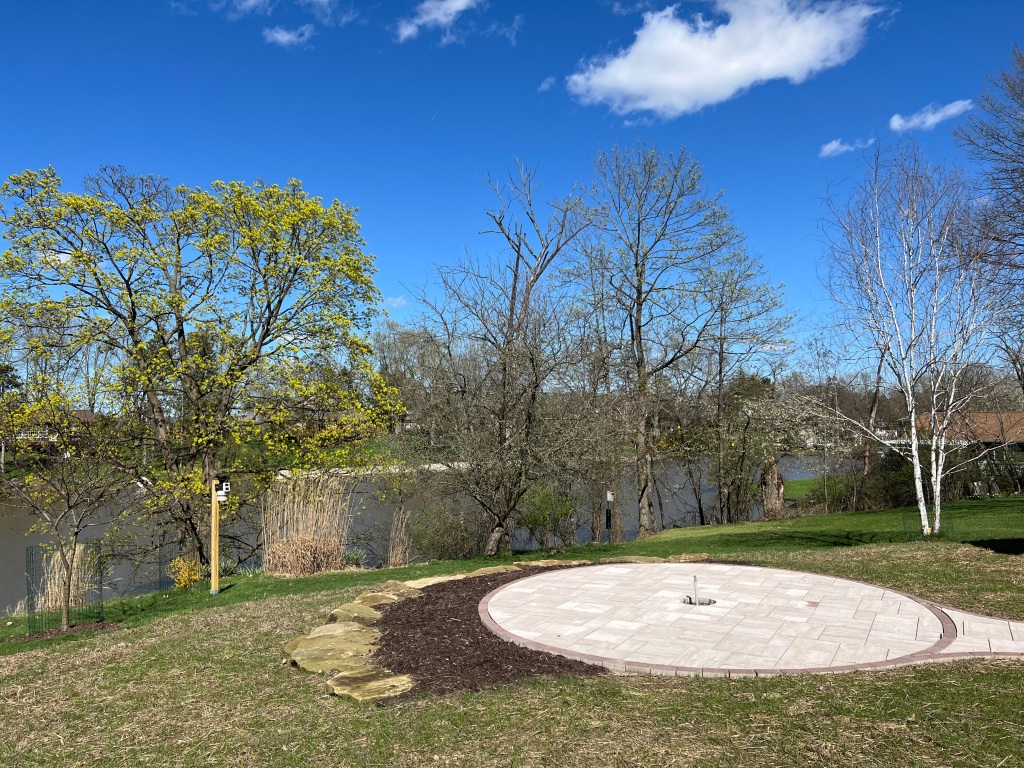
The completed observatory base is of patio construction with a concrete pad beneath decorative concrete pavers. The color of the pavers here is more intense in this picture because they were freshly wetted. We are considering sealing the pavers to enhance the color for a longer term.
Our contractor, taking advantage of a break in the weather, applied Polybind-brand polymeric sand to the observatory’s patio base completing that phase of the project. The space beneath the patio paver stones needed to be dry to allow the sand material to freely flow into all available gaps. Once wetted, the Polybind rapidly cures, sealing out insects and seeds.
Checking with the manufacturer of our Sirius Observatory we learned that production delays will push back our project well into the summer months. Disappointing, to say the least, but good things are worth waiting for. We’re considering now whether to install the steel pier at the center of the base while we wait — with or without a telescope attached, the pier could be covered between uses. With the pier in place, we wouldn’t need to carry out a tripod and mount every time we wish to use the observing pad.
The round patio seen here will form the base and floor of the observatory.
The landscape contractor promised, at the end of last season, that they would return to finish work on our observatory patio. Remaining to be done is installation of polymeric sand in the “grout” lines of the patio pavers. The material will be swept in to fill the gaps between the paver stones with enough getting beneath them to make them stable — the stones rock a bit now when walked upon. We’re told the weather must remain above freezing and the concrete surface beneath the stones must be dry in order for the polymeric sand to properly fill the spaces and cure properly.
One manufacturer wrote this about the benefits of their product: “Polymeric sand is appreciated by paver installers because joints you get from it are durable and even. This eliminates any risk of weed growth and ant infestation that could affect the overall aesthetics and durability of paver projects.” — Techniseal.com
We are likely now beyond freezing temperatures until this fall. Now we await a stretch of dry weather and it may be a while — it has been a very rainy spring!
Drawn plan of a patio structure that is to form the base of our observatory. The observatory will be built at the center of the circular paved area while a tapered pathway provides access. An 18-inch Sonotube will form the concrete foundation for a steel pier supporting the telescope.
Today we approved the final design of the patio that will serve as the base of the observatory. With the observatory structure already on-order, it’s now a waiting game. Dates for delivery/construction of these two main components are uncertain, though the landscape work is expected to start in early November. Depending upon how things unfold we may be in a situation where either the observatory arrives before the base construction begins and we rush to assemble before winter, or the base is built and we wait for the observatory. Either way, depending upon timing and weather conditions, the crated components of the structure may wind up overwintering in our garage! We’re running late.
Crater Tycho is featured here, its web of light-colored ejecta radiating in all directions. Celestron C11 telescope with ZWO ASI 294MC Pro camera.
Taking advantage of what seem to be rare clear skies, last night (September 1, 2023) I ran first light trials on the Celestron C11 I was given, in combination with my ZWO ASI color astronomy camera. The telescope, with its decent aperture and long focal length, may become the primary observatory instrument. The results were largely disappointing with no good deep sky results, terrible results from Saturn, and not-so-good images of Jupiter. Even Earth’s Moon, usually an easy target, was barely in focus. It didn’t occur to me to use my Bahtinov mask focus aid — my gear is spread across two buildings and three or four locations! Once built, the observatory should help with organization. I hope to try again this coming week when mild, clear nights are forecast and I hope it is only a matter of technique and not an optical issue.
On the positive side, polar alignment was excellent as was goto control alignment so telescope sky tracking was very good during my efforts — until something caused an unexpected reboot of the telescope controller. I don’t know if dew short circuited a connector or if the connector pulled loose from the handbox but it was disconcerting!
The images shown here are simply interesting to look at, though not the quality I’d normally want to show. The first is youngish Crater Tycho showing off its extensive web of ejecta rays. The second picture includes several lunar “seas” including the “C” shaped Sea of Crisis. Two craters are seen near the left edge of the circle; the lower of those craters is named Picard. No, Star Trekkers, not THAT Picard. Still, a fun fact.
Several lunar seas are shown in this image with the Sea of Crisis, the C-shaped feature, on the right. Within the Sea of Crisis are seen two small dots and the lower of the two is Crater Picard. Celestron C11 telecope with ZWO ASI 294MC Pro camera.








 Stella-Luna Observatory