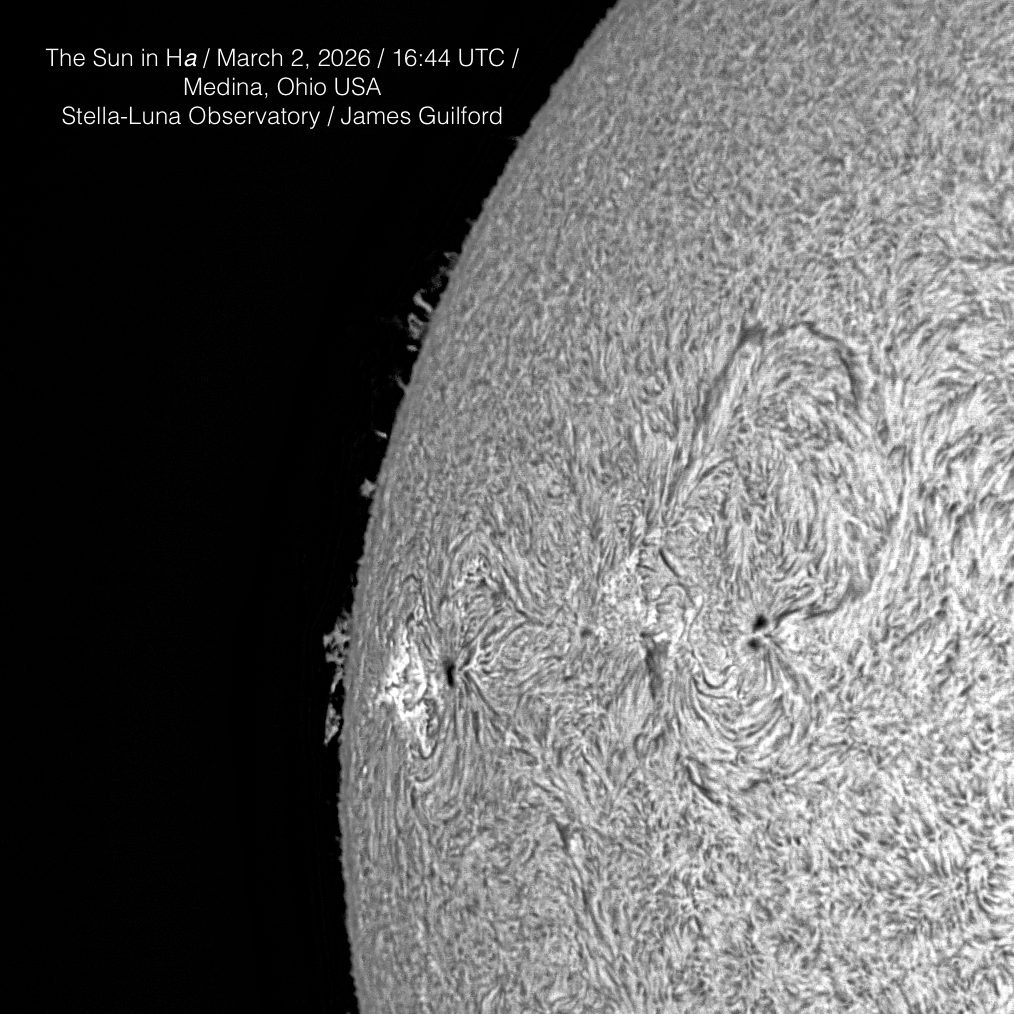
This image depicts the northeast quadrant of our Sun, as recorded the morning of March 2, 2026. The data collected were in hydrogen-alpha light and depict well the turbulent curves in the chromosphere resulting from Solar plasma interacting with strong magnetic fields surrounding two sunspots shown here, left to right: Active Regions 4384 and 4381. Several tenuous prominences are found along the rim of the circle. This is a non-colored monochrome image. // James Guilford, Stella-Luna Observatory
It was the last sunny day expected for, likely, a week so we had to get out and image our Sun. Well, we would have done it anyway! Seeing conditions were forecast to be better than average but at midday, when we have our first clear shot at Sun, the atmosphere was stirred up and shaking our view. Still, the miracle of “lucky imaging” came through and we were able to make passable pictures from the image data. Interestingly, the sunspots at Active Regions 4384 and 4381 are the remnants of the giant sunspot formerly known as AR4366 surviving a trip around the far side of our star! Sunspots, by the way, receive new designations when they are first observed appearing over the eastern horizon even if they were previously observed as they disappeared over the western edge.
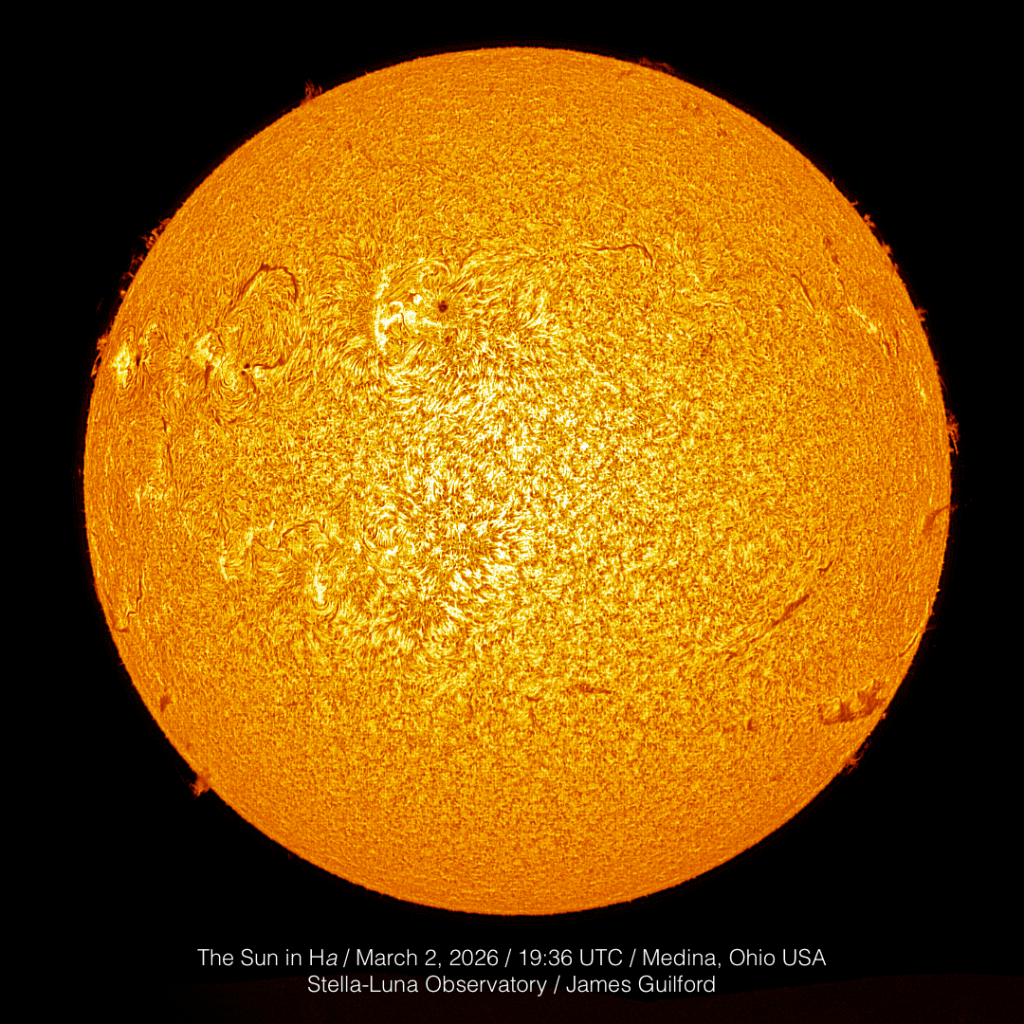
Both of these images were the result of data stacked in ASI’s VideoStack application. The image above was then processed only in Pixelmator Pro. The image below was processed in PixInsight/Solar Toolbox, and Pixelmator Pro.
An image of our Sun taken in hydrogen-alpha light reveals a turbulent chromosphere, marked with a few dark filaments. Three sunspots are found in the left-hand portion of the disk though difficult to see via hydrogen-alpha. False color has been added to this image. // James Guilford, Stella-Luna Observatory
Our neighborhood star: The Sun. Photographed in hydrogen-alpha light, this image shows the roiling chromosphere of our star with a large filament parallel with the left-hand edge of the picture, sunspots strung vertically across the center, and a good number of prominences along the rim, glowing against the dark background of space. Image has been rotated — east is up, north is right. Imaged 2024-10-26. 18:43 UTC. Credit: James Guilford, Stella-Luna Observatory
White light allows viewing Sun as if we could stare directly at it without the resulting blindness. The Herschel wedge does much the same thing but with, perhaps, a bit more contrast and detail. Both of those white light views allow us to see a layer of the solar atmosphere called the photosphere. In the photosphere the most apparent details are sunspots, standing black against a white background. With enough resolution we can also see granulation — enormous convective bubbles of searing solar plasma.
One layer above the photosphere — yes, above — is the chromosphere. Shining in the wavelength of hydrogen-alpha (Ha), the chromosphere is not visible to us without light filters that exclude all light but Ha. A wholly different view of our Sun is available in that wavelength. Swirling seas of plasma form curves and hash as they are moved by magnetic fields, long filaments float over those seas, as fountains of glowing gas arc from the solar disk contrasted against the blackness of space. On closer examination, the solar limb appears rough, a bit like a fine-toothed saw blade, as innumerable spicules, jets of glowing gas, are seen in contrast. Yes, sunspots are visible but are no longer the primary interest.
After many tries and failures at processing images to best show the chromosphere complete with prominences, I finally learned what some other imagers were using to process their images: Solar Toolbox — a package of programming scripts used with the PixInsight imaging application. I still have much to learn about Toolbox but it has already been enormously helpful to me in the challenging world of solar imaging! Thus, the image above is from very good data recorded about seven months ago, now reprocessed using Toolbox.


 Stella-Luna Observatory