First Light: A new telescope means a new beginning

First light image of Messier 57: The Ring Nebula. For the occasion, only 60 light frames and 30 dark frames, 15 seconds each frame, were captured and stacked. Affinity Photo 2 was used to create the stack and Pixelmator Pro for editing. M57 is a planetary nebula in constellation Lyra and was formed during the death throes of a Sun-like star.

We had been considering what our next step might be in outfitting the observatory with a more-or-less permanently mounted telescope. Would a very long focal length Cassegrain suit our needs? Both the C11 SCT and the Vixen Modified Cassegrain were available, already on hand but both had issues. After struggling with collimation on both telescopes, we were leaning toward a high-quality refractor as the solution. Long focal length on a refractor, though, means a long tube and we have limited space. The incident that damaged the Vixen pretty much forced our hand. Frustrated with collimation issues, and telescope repairs we doubt we could perform, we made the decision to go with a new refractor.

What ultimately steered us toward Askar and helped ease some (not all) doubt concerning focal lengths was the wonderfully high quality image of the “daytime Moon” we had captured with the smaller Askar 103APO — images with that level of quality can be cropped to make up for some lack of focal length. Watching YouTube reviews of some Askar’s bigger telescopes offered further assurance we were headed in the right direction.

The new Askar 151PHQ telescope installed on the observatory’s pier. At the eyepiece end is a ZWO ASIAir Plus computer and ZWO Automatic Electronic Focuser. We anticipate moving the computer to a different location on the telescope as cable management becomes a priority.

Inside doubled shipping boxes, the telescope was delivered in a solid transport case, packed in form-fit dense foam padding. The case is very high quality, very heavy, and bears multiple hand grips; it will now be set aside, stored some place against the day the telescope is taken out of service for some reason. If the case was an optional item, in our case we aren’t sure we would want it.

The Askar 151PHQ is doubtless the highest-quality telescope we have ever owned or used. It is a quadruplet astrograph, featuring a 151mm (six inch) aperture and a 1057mm focal length for an f/7 focal ratio, and designed to produce flat field images without add-on optics.

Taking advantage of a rare, relatively clear night, we went for first light using the big instrument with minimal configuration: no finder scope, no automatic tracking, no camera cooling, etc. While we had installed the ZWO AEF purchased years ago, and the ASI AirPlus, we used them only for manual electric focusing which, by the way, was a big improvement in itself! The optional hand controller was a wonderful thing to have, allowing us to watch through the eyepiece or on the computer screen and make smooth, minute adjustments to focus without telescope vibration. Yes, wonderful!

Under Bortle 6/7 skies pinpoint stars shown brightly through the eyepiece as we focused on Arcturus, then searched for M57. Our hazy skies, made worse by light pollution (maybe a Bortle 8 night), didn’t make things easy but with a little patience, a tiny, ghostly ring appeared in the field of view. We swapped out the eyepiece for the one-shot color camera, refocused, and began the imaging run. While we have much to learn about processing deep sky objects, we were happy to see the quality of the resulting stacked image: round stars and lots of them (many more stars than we’re used to seeing there), good detail in the ring, and decent color — all in 60 light, and 30 dark 15-second frames. The Moon eluded us that night, still down in the trees at midnight, but we tried solar first light the next morning.

First images of our Sun via the Askar 151PHQ were recorded under poor seeing conditions but, with some work, produced some pretty impressive results. A TeleVue Powermate 2.5X Barlow was employed here. We hope to refine our setup for the new telescope for better edge-to-edge focus. The telescope was equipped with a Baader white light solar film filter and monochrome camera; false color applied during processing.

Placing a Baader Solar film filter over the Askar’s objective and aiming the scope at Sun, we quickly saw beautiful detail in the sunspots that marked the surface on July 31. Imaging was routine and easy, though seeing was poor. The telescope’s 1,057mm focal length did not allow a full disk image of our star on the ASI astronomical camera’s sensor but installing a Barlow lens we achieved some dramatic detail views. We can hardly wait to try again under better skies!

Long focal length produces a Solar image too large to entirely fit on the astronomy camera’s sensor. With quality like this, however, we won’t complain. This is Sun on July 31, 2026, imaged via white light solar filter and monochrome camera, false color applied during processing.

Nearly too large! When observing low elevation targets, the telescope fits snugly within the observatory walls. Fortunately, the tall pier and large mount elevate the assembly enough that normal observing is at a comfortable height and (M57 was at the zenith during First Light!) high elevation targets do not cause us to lay on the floor or scrape the camera there! We suspect this scope on a tripod might present some problems for high elevation object observing.

Thus far the only negative, something unanticipated, is that because of the Petzval design, an optical element is located deep within the OTA making use of our beloved Herschel Wedge a risk to the telescope; that optical element is at a point in the light path where focused and unfiltered sunlight could overheat and damage the lens! We’re working around it and will assign the Herschel to the Askar 103 when desired. As we anticipated, we’d love to have much more focal length but without collimation to worry about and high quality images to work with, we’ll hope to get by … maybe with the help of a really good Barlow lens?
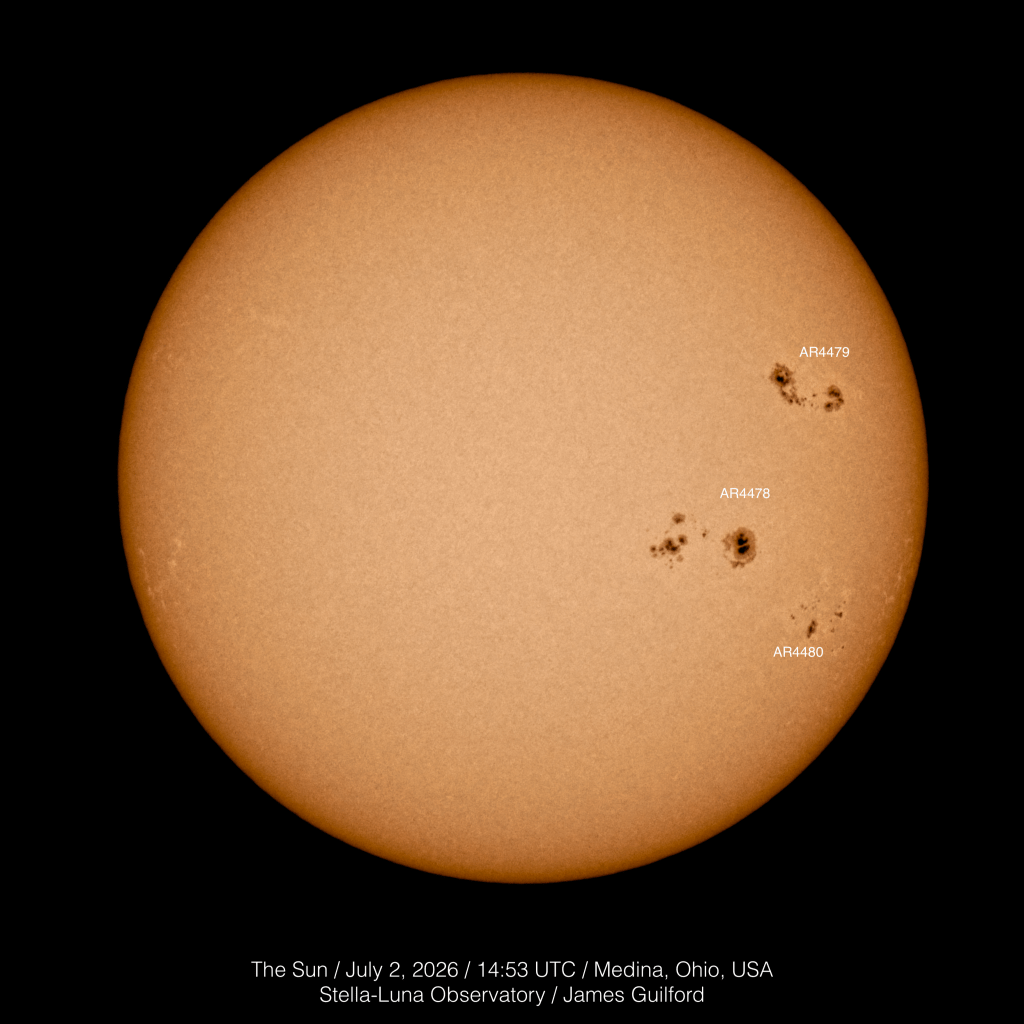
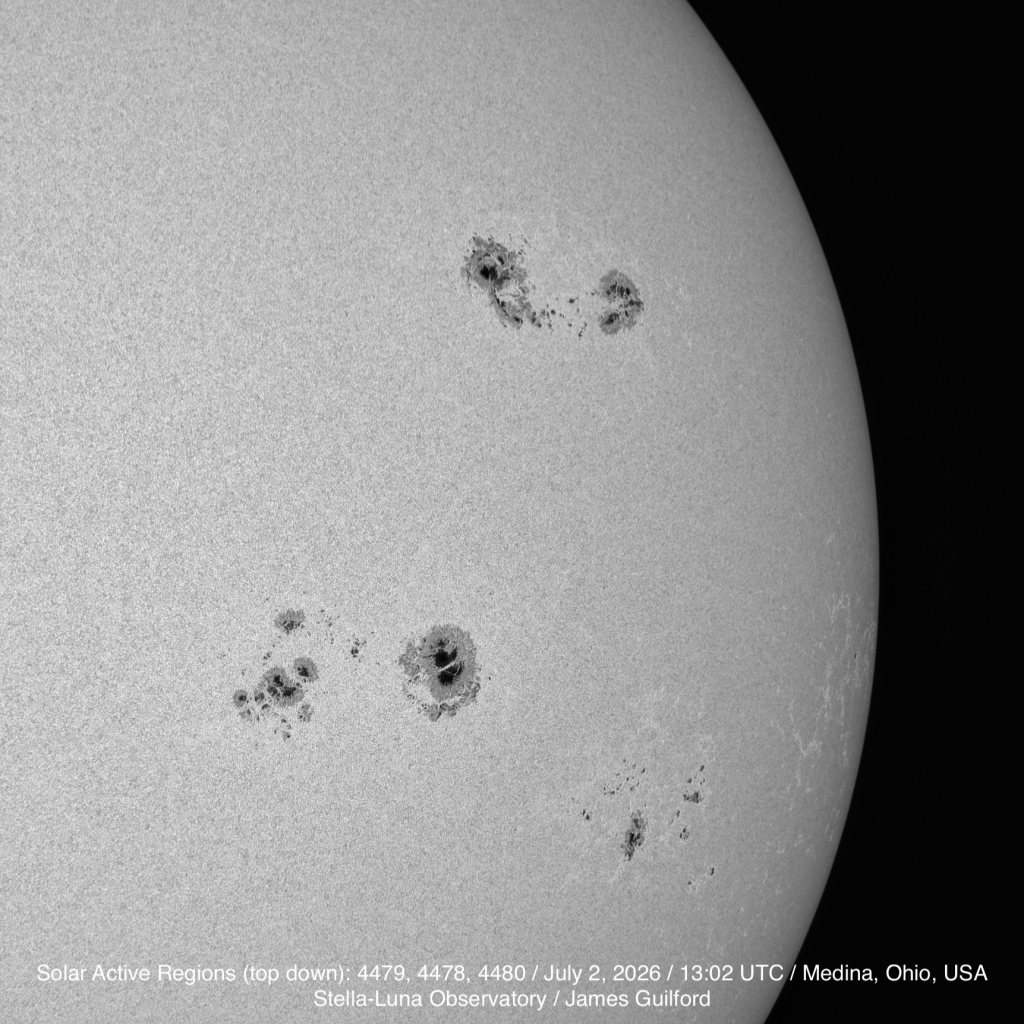
Three (very) active regions mark the sun’s surface

Whole-disk view of Sun as it appeared late morning July 2, 2026. The sunspots are nearing Sun’s western horizon (right) but still pose a threat of geomagnetic storms from their flares. This image was captured using our Canon EOS 5D Mk. 4 DSLR, 400mm telephoto lens with 2X extender, and white light Baader film solar filter. False color added.

Three active regions nearing the western solar horizon have been busy, exploding with multiple flares and coronal mass ejections (CMEs). That solar material is expected to reach Earth beginning July 3 and continuing into the U.S. Independence Day weekend. The CMEs impacting Earth’s magnetosphere could produce auroras. Those blessed with clear night skies should be alert for a possible *quiet* fireworks display! Respect.

A closeup view of the three active regions mentioned in this post was recorded using our Askar 103APO telescope, and Baader Planetarium Herschel safety wedge. The image was recorded the morning of July 2, 2026 in monochrome and is reproduced here in that state. Photosphere granulation, faculae, and sunspot details are visible here.

Impressive sunspot commands attention in midday heat

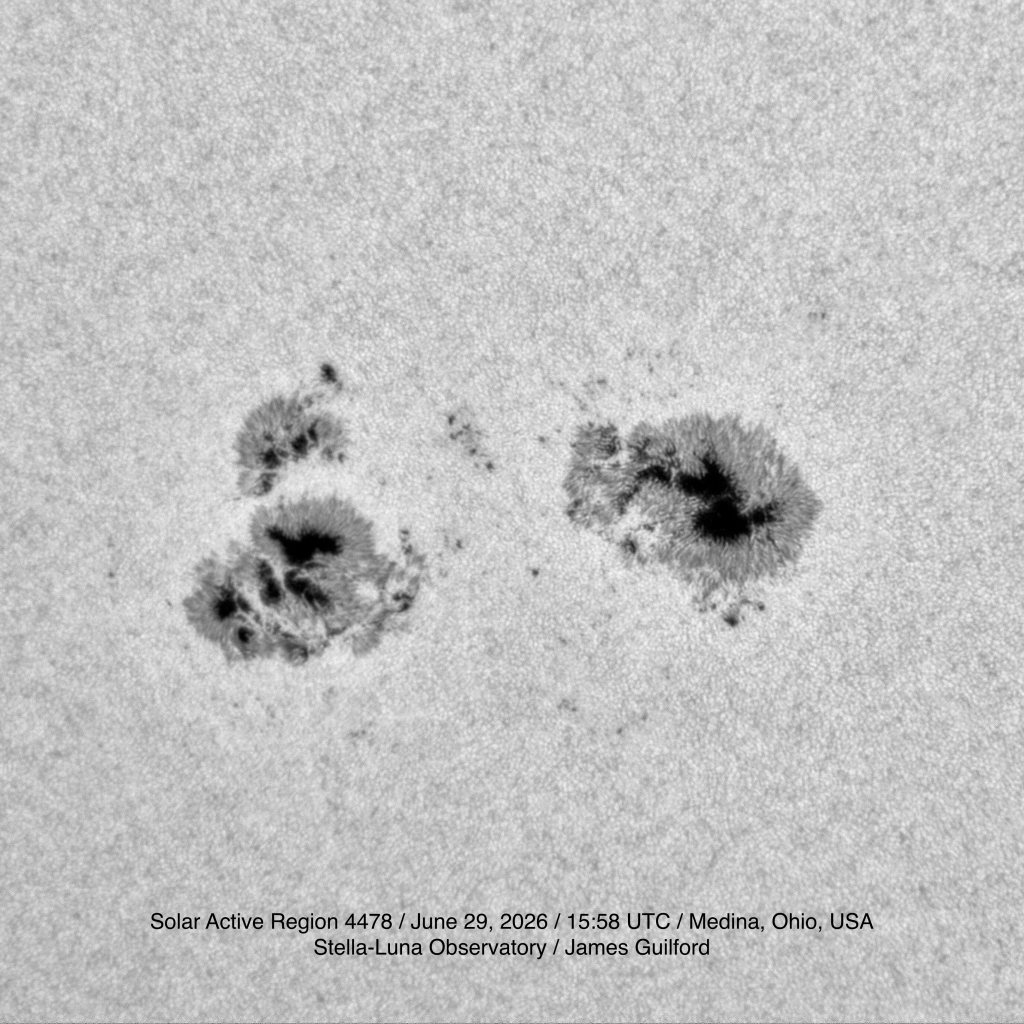
Sunspots at Solar Active Region 4478 imaged with an Askar 103APO telescope, Herschel wedge, and Tele Vue Powermate 5X under poor seeing conditions. Credit: James Guilford

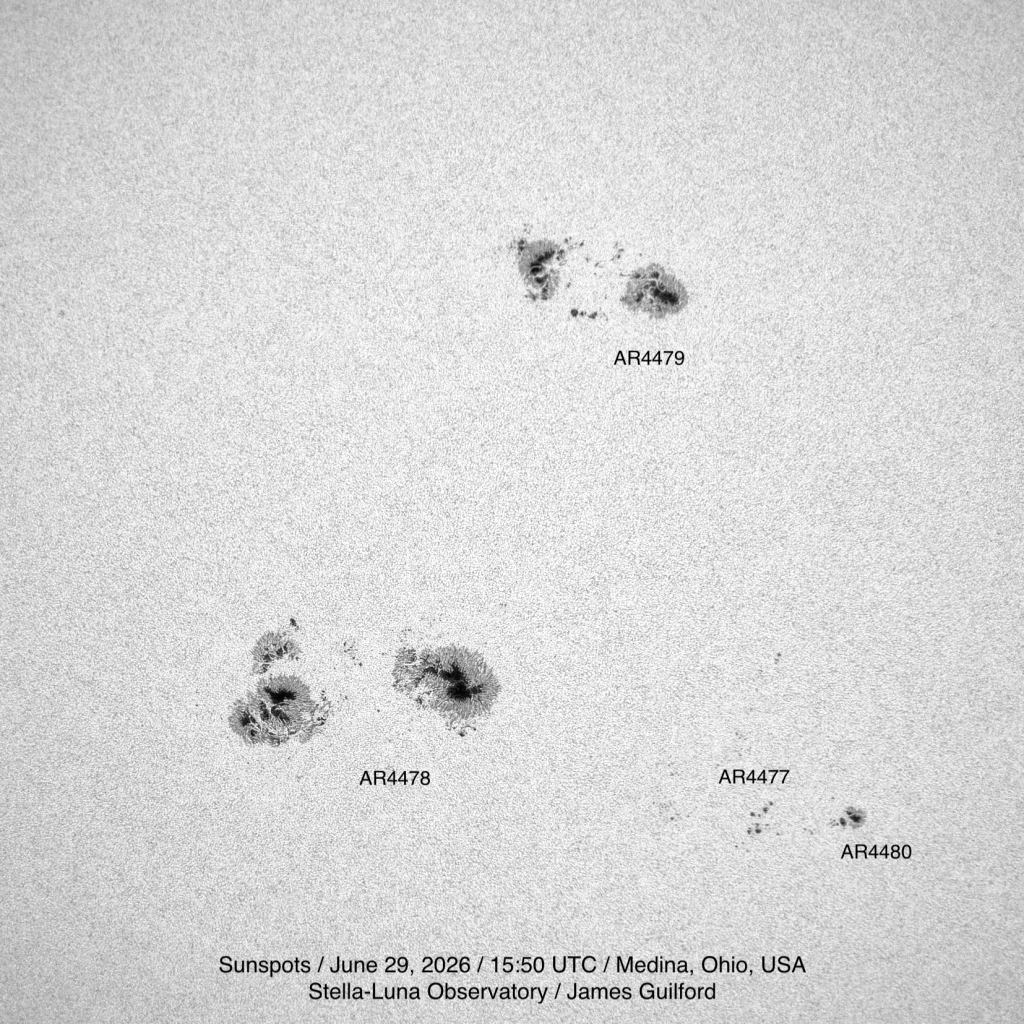
June 29, 2026 — Morning clouds and the usual trees kept us from working in the cooler, quieter air today so, nearing local (EDT) noon in heat and roiling atmosphere, we took our first shot at Solar Active Region 4478. The region featured a pair of massive sunspots that have been exciting observers lately. Using the Askar 103APO telescope with Baader Planetarium Herschel wedge in white light, we caught the impressive sight. Now aimed squarely at Earth, both AR4478 and 4479 pose a threat of powerful X-Class flares.

Several of the sunspots in Solar active regions as imaged via Askar 103APO telescope, Herschel wedge, and Tele Vue Powermate 2X under poor seeing conditions. Credit: James Guilford

Afternoon sunshine enjoyed side-by-side

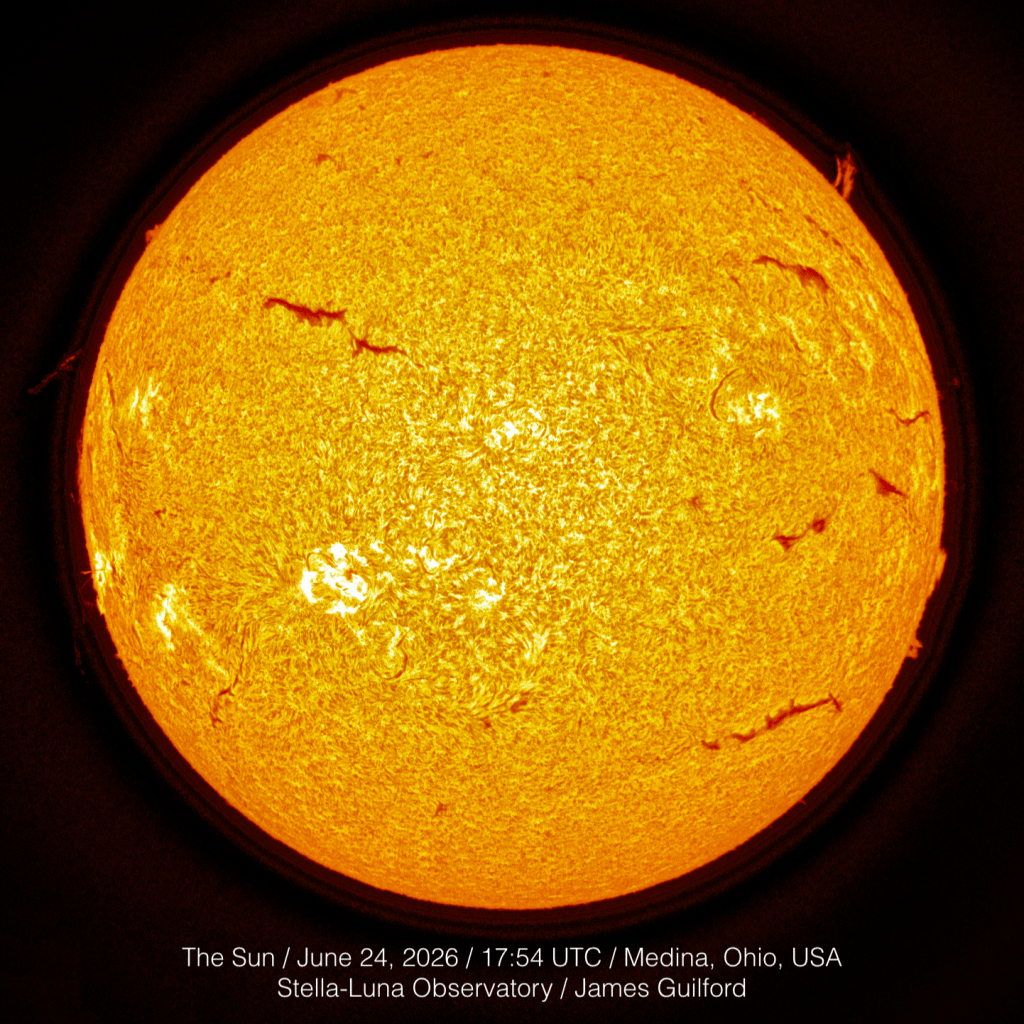
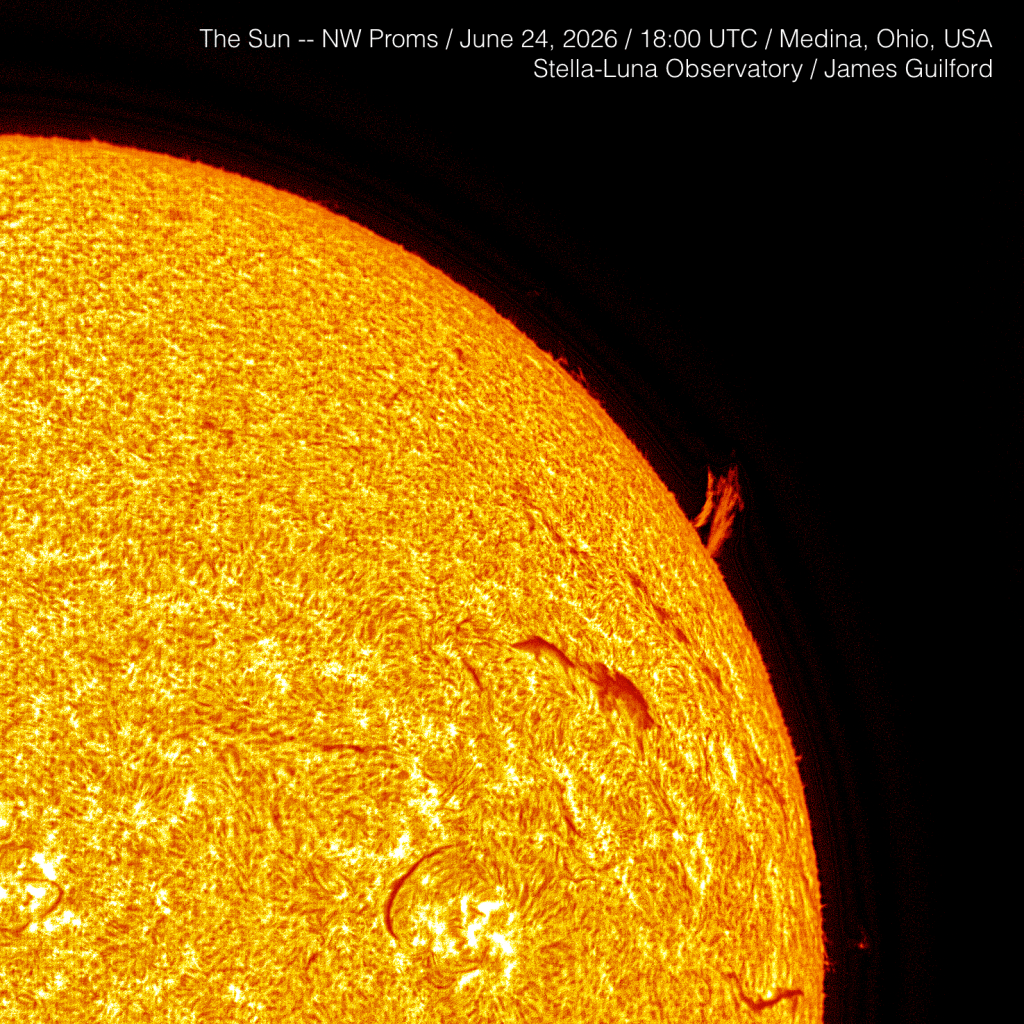
The morning was filled and, though it is best to observe Sun before the heat of the day sets in, the skies were still clear this afternoon so we opened the dome. Happily, there were points of interest, particularly the two plumes of prominences on the northwest rim!

Just emerging over the eastern limb (left edge, above) is a large sunspot which should prove interesting to observe, the next time we enjoy clear skies here!

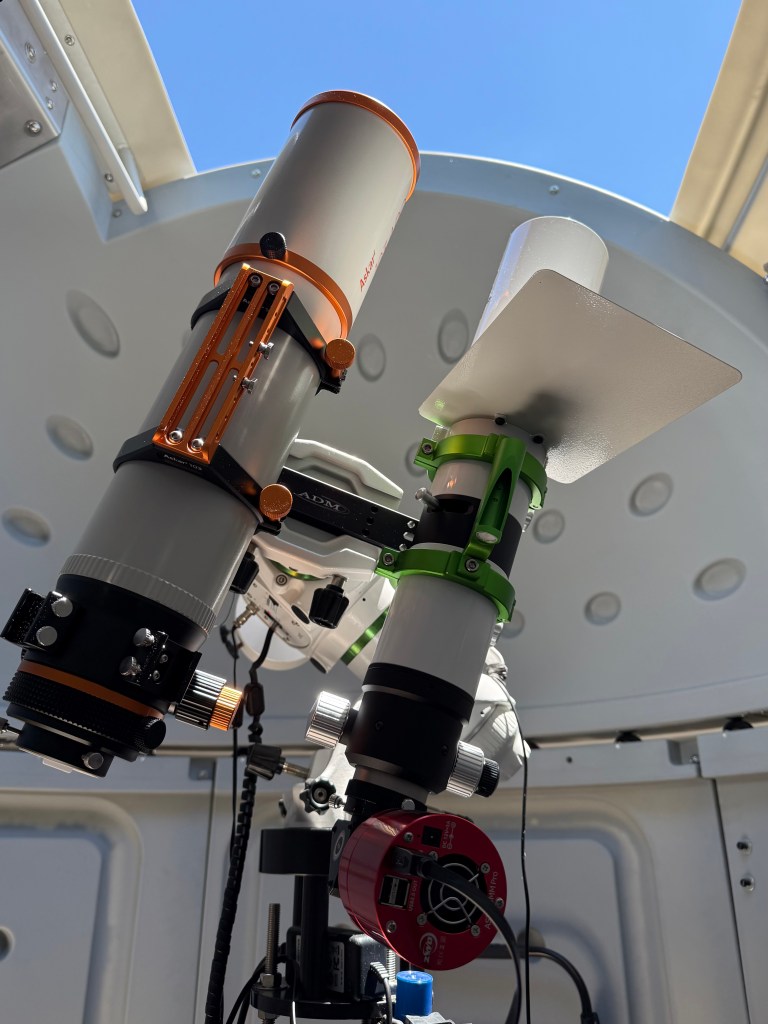
This was also our first use of a new bracket that allows side-by-side mounting and simultaneous use of two telescopes on the pier. The apparatus, made by ADM Accessories, and purchased from High Point Scientific, is sturdily-built and not excessive in weight. Presently we have the Askar 103APO and the Sky-Watcher 76Ha scopes up but will likely experiment with other configurations.

Two telescopes are installed side-by-side on the observatory mount and pier employing an ADM Accessories mounting system purchase from High Point Scientific. The arrangement allows use of two telescopes simultaneously or separately without the need for rebalancing or alignment when switching between them.

Our Sun has a flare, or two, for drama

Active Region 4455 as it appeared at 13:55 UTC on June 2, 2026. Viewed via hydrogen-alpha light, the chromosphere has a mottled appearance due to magnetic field lines affecting the distribution of Solar plasma. Image by James Guilford

June 3, 2026 — Multiple flares with associated coronal mass ejections (CMEs) have been observed over the past 24 hours, originating from Solar Active Region 4455, shown here. “Closely-spaced impacts on June 5th could produce strong G3-class geomagnetic storms,” reports SpaceWeather .com, “with auroras in Europe and the USA at mid-latitudes.” Of course, we are expecting cloudy skies, here in Northeast Ohio, when the aurora may occur. #spaceweather #aurora #sun #sunspot #solarastronomy #astronomy

A little scare, a quick fix

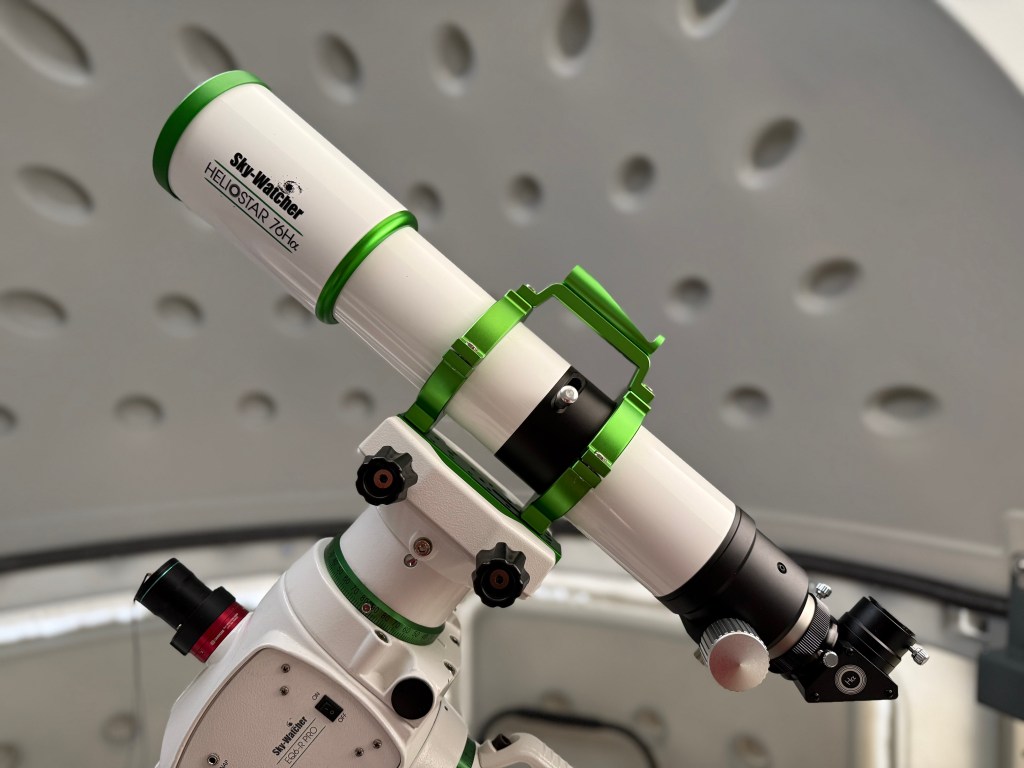
Our Sky-Watcher HelioStar 76Ha Solar telescope mounted on the observatory’s permanent mount. The focuser, for those new to these things, is operated via the silver knob seen at the lower end of the telescope. Photo by James Guilford.

A couple of days ago, during a rather ambitious solar imaging session, the focuser on our Sky-Watcher HelioStar 76Ha telescope failed. And by failure, we mean the specialized diagonal that holds an eyepiece or camera would not stay put! The focuser would barely move the assembly and, once released, the diagonal plus camera would … zzzzzzip! … slide outward as far as it could. As one might expect, that sort of thing makes the telescope worthless. Disappointment? Disaster?

Contacting Agena Astro, the telescope’s seller, their rep. reminded us that the unit was still under warranty and supplied contact information for Sky-Watcher USA’s Support. Sending off an email describing the issue we waited a reply. “Sounds like the focuser might need to be adjusted,” came the reply a short time later. “Don’t worry we have a lot of adjustment with this focuser.” Adjusting three screws on the telescope, as instructed, and within five minutes the system was working good as new!

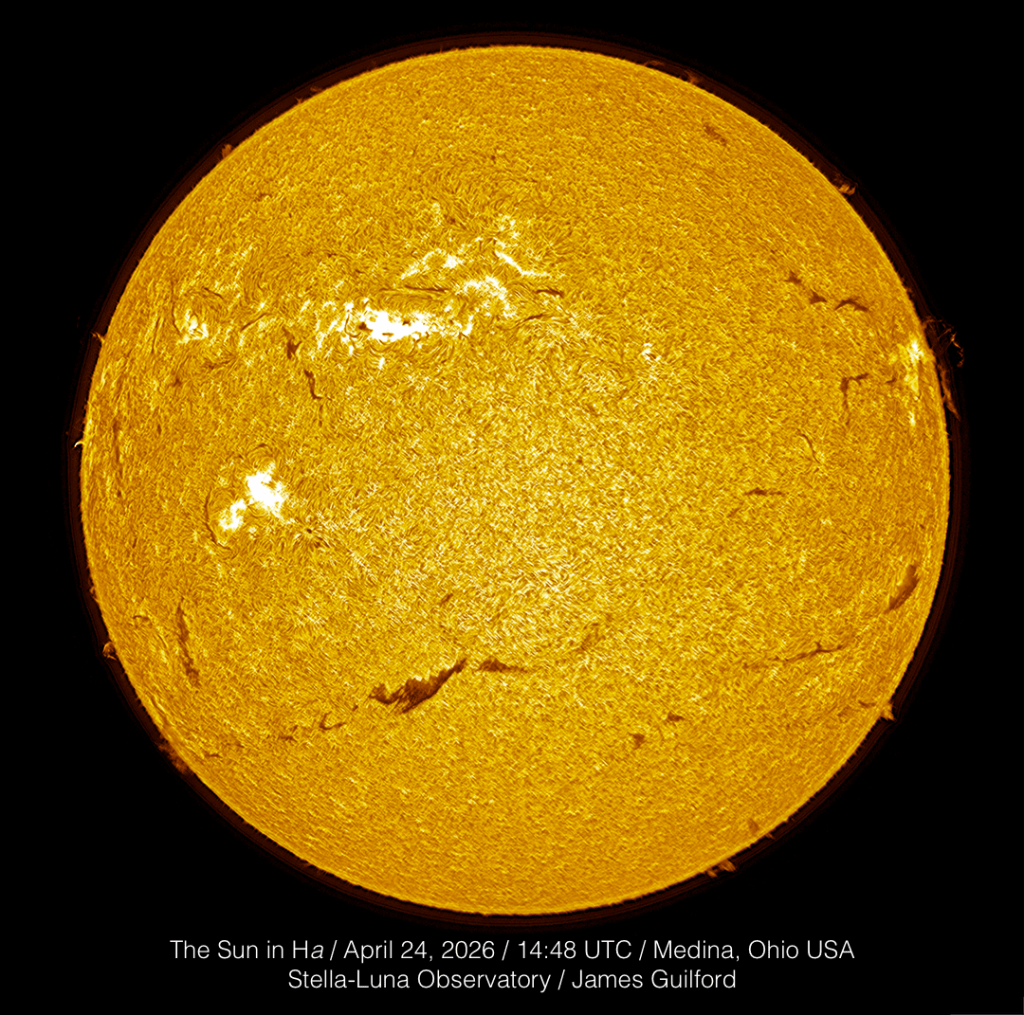
The Sun as it appeared via hydrogen-alpha light on April 24, 2026; as imaged using the Sky-Watcher HelioStar 76Ha Solar telescope, and a ZWO ASI monochrome camera. False color applied. Image by James Guilford.

So there was a little scare. Excellent support provided by the retailer and the manufacturer. A quick fix. And we were able to take advantage of excellent conditions today, making images of our local star! Thanks go out to Agena Astro and Sky-Watcher USA!

Last imaging for a while

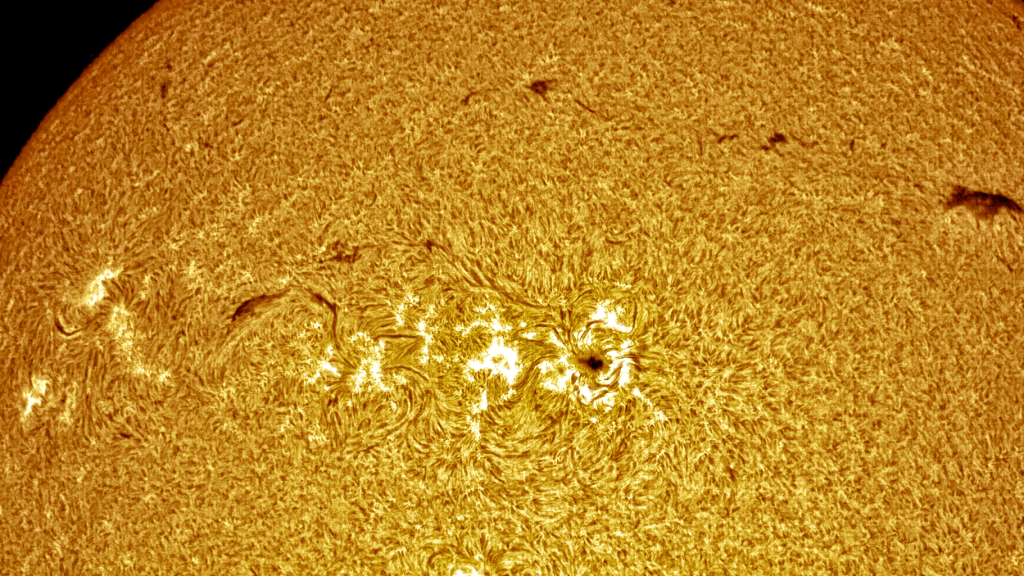
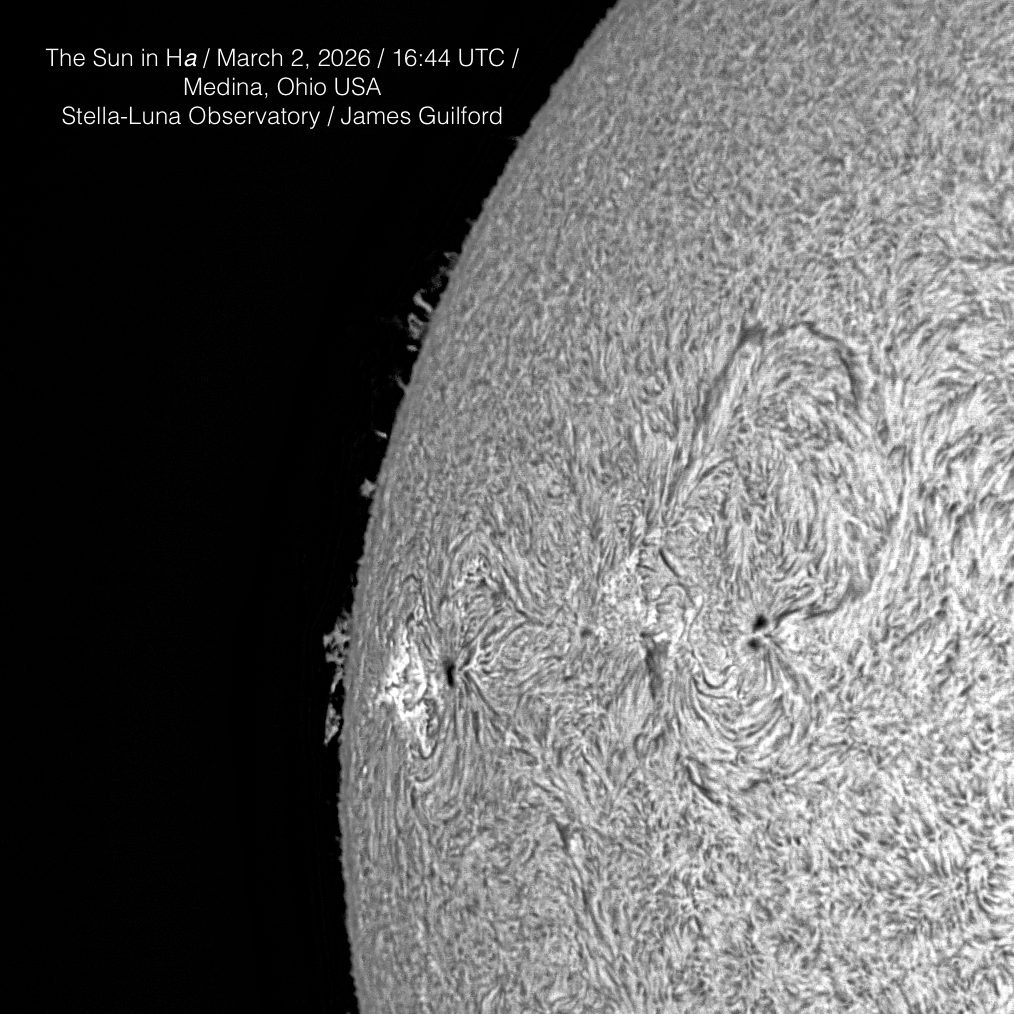
This image depicts the northeast quadrant of our Sun, as recorded the morning of March 2, 2026. The data collected were in hydrogen-alpha light and depict well the turbulent curves in the chromosphere resulting from Solar plasma interacting with strong magnetic fields surrounding two sunspots shown here, left to right: Active Regions 4384 and 4381. Several tenuous prominences are found along the rim of the circle. This is a non-colored monochrome image. // James Guilford, Stella-Luna Observatory

It was the last sunny day expected for, likely, a week so we had to get out and image our Sun. Well, we would have done it anyway! Seeing conditions were forecast to be better than average but at midday, when we have our first clear shot at Sun, the atmosphere was stirred up and shaking our view. Still, the miracle of “lucky imaging” came through and we were able to make passable pictures from the image data. Interestingly, the sunspots at Active Regions 4384 and 4381 are the remnants of the giant sunspot formerly known as AR4366 surviving a trip around the far side of our star! Sunspots, by the way, receive new designations when they are first observed appearing over the eastern horizon even if they were previously observed as they disappeared over the western edge.

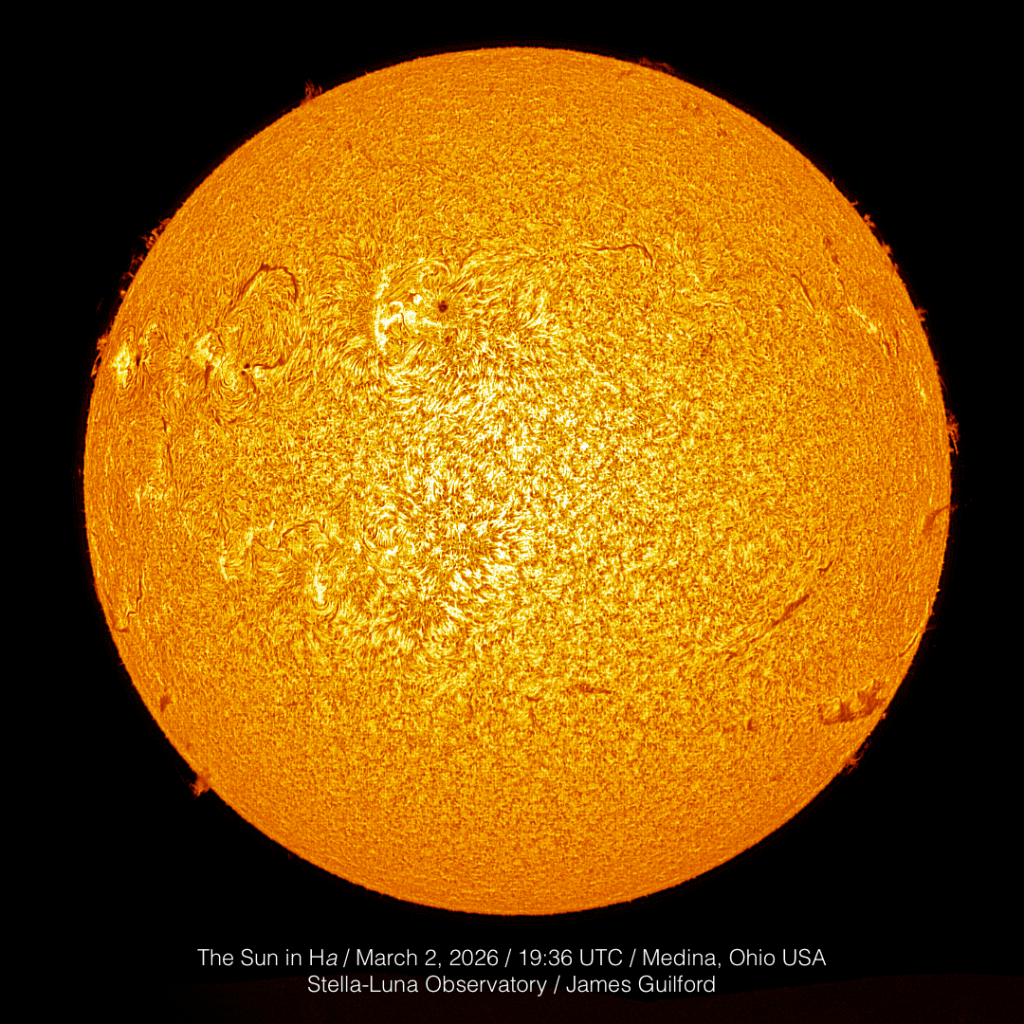
Both of these images were the result of data stacked in ASI’s VideoStack application. The image above was then processed only in Pixelmator Pro. The image below was processed in PixInsight/Solar Toolbox, and Pixelmator Pro.

An image of our Sun taken in hydrogen-alpha light reveals a turbulent chromosphere, marked with a few dark filaments. Three sunspots are found in the left-hand portion of the disk though difficult to see via hydrogen-alpha. False color has been added to this image. // James Guilford, Stella-Luna Observatory

We captured a filaprom!

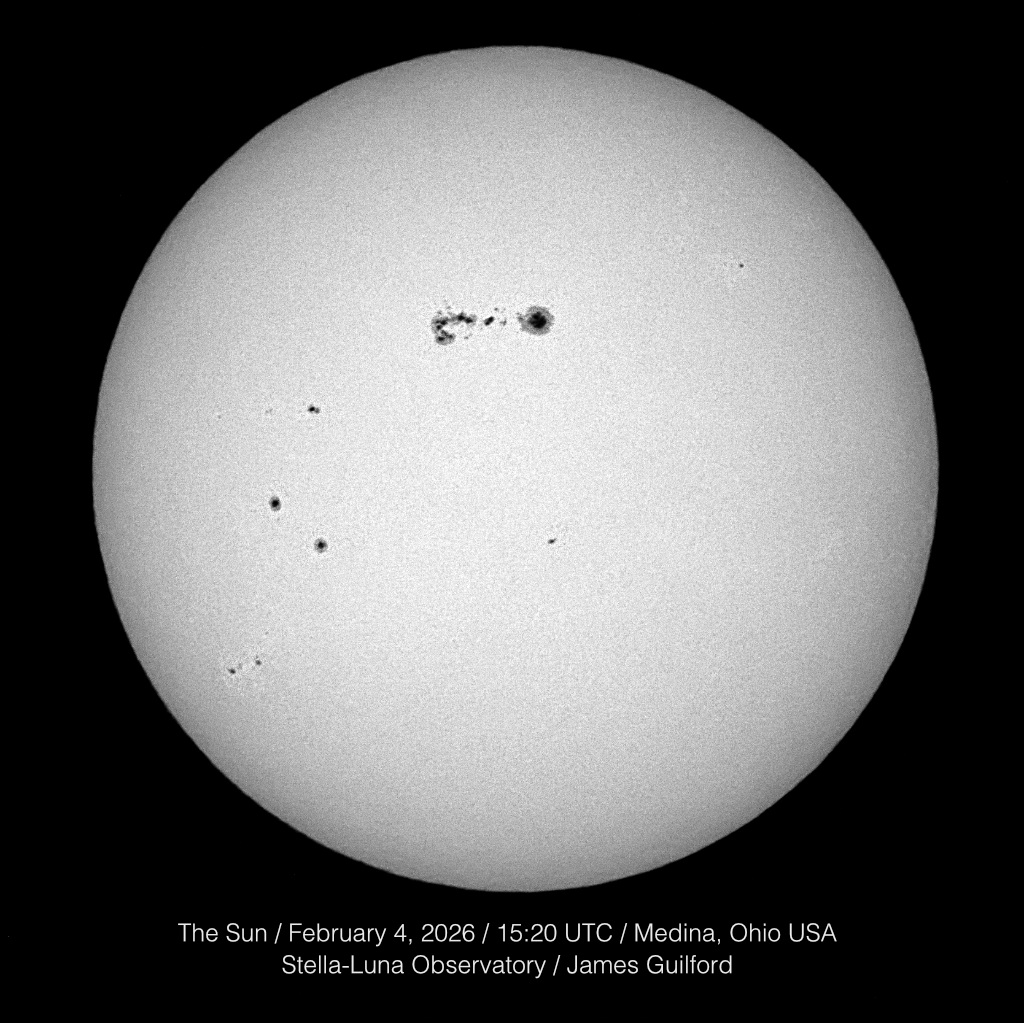
Shown in white light is our Sun as it appeared on February 4, 2026. A large sunspot, designated Active Region 4366, drew much attention as it transited the surface, issuing flares along the way.

On sunny days, this winter, when it’s not bone-shatteringly cold, we’ve been imaging Sun. In white light, we’ve tracked the progress of a couple of impressively-large sunspots as they traversed the Solar photosphere, including one designated Active Region 4366 that drew global attention in late January and early February 2026. We’ve also been observing in hydrogen-alpha (Ha) light.

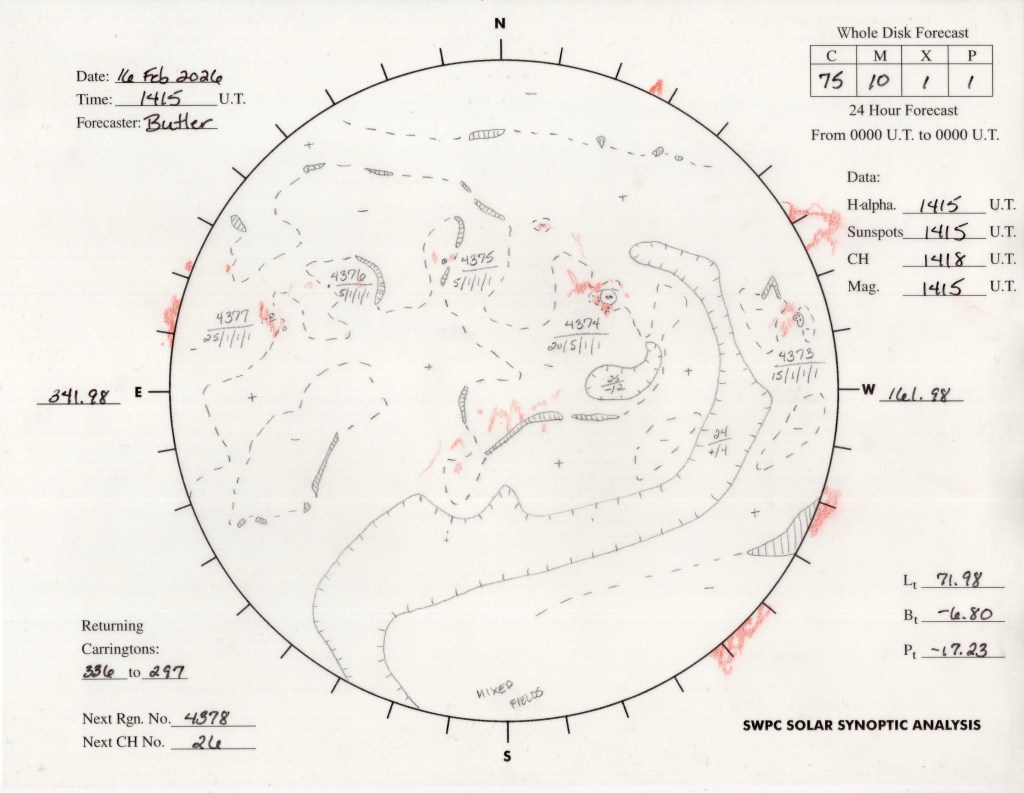
The NOAA SWPC Solar Synoptic Analysis map showing Sun on February 16, 2026.

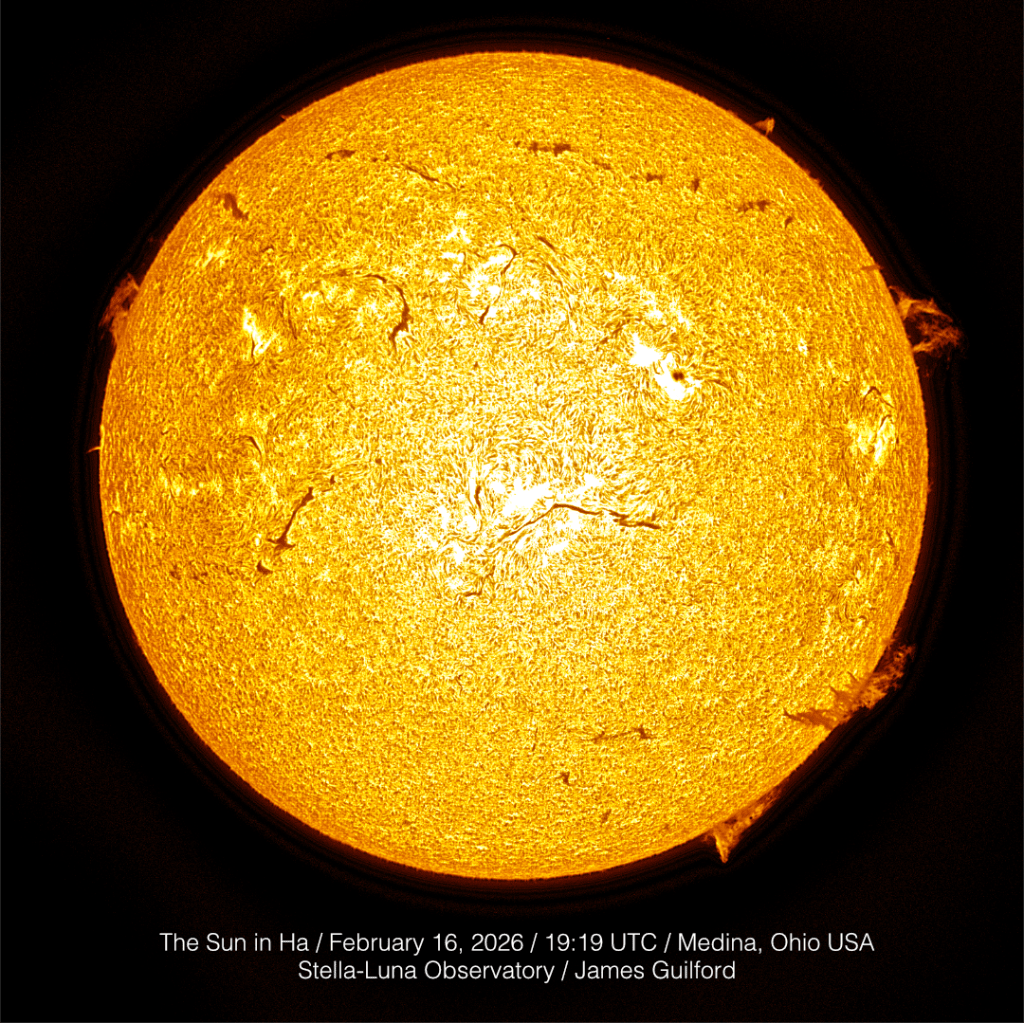
On sunny February 16, we checked the NOAA Space Weather Prediction Center’s daily Synoptic Analysis map for targets of interest. Yes! The map indicated several prominences around Sun’s rim so, a great day to see what was out there.

The full-disk image of Sun as it appeared in hydrogen-alpha light. This is a monochrome image original with false color applied. The “filaprom” is located at about the four o’clock position on the disk.

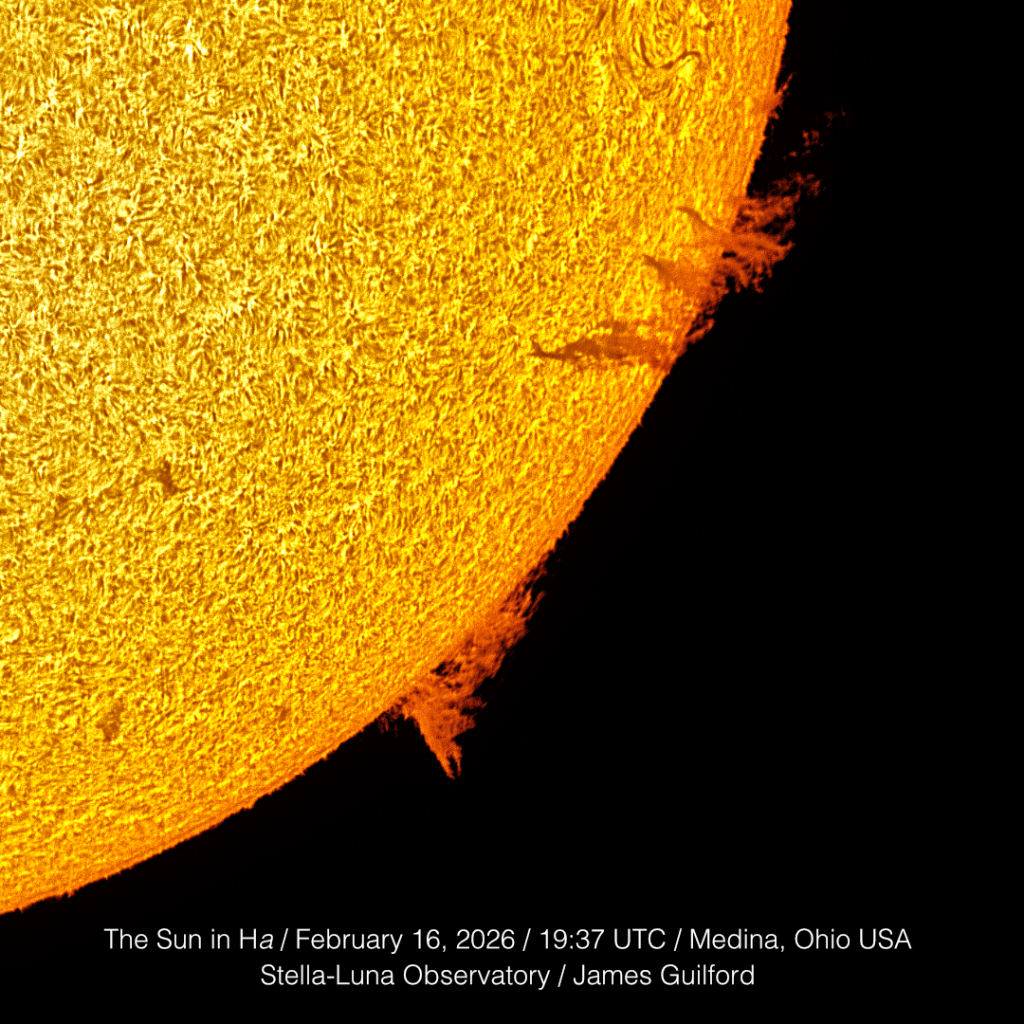
While an arch-shaped prominence at about the two o’clock position was our original target, as soon as we looked through the telescope’s eyepiece we saw it — a filaprom! What’s that? The snake-like features that appear in Ha are called filaments. If a filament bridges the Solar limb, its true nature is revealed: it’s a prominence, appearing as a dark filament when viewed against the bright chromosphere, and as a bright prominence when contrasted against the blackness of space — a filaprom! It was a first for us and delightful to observe!

Close-up view of the filaprom, near the top of the arc. Lower on the curve is a prominence issued from a position just over the Solar limb. Near the left-hand portion of the frame is a filament feature — a prominence viewed against the bright Solar chromosphere.

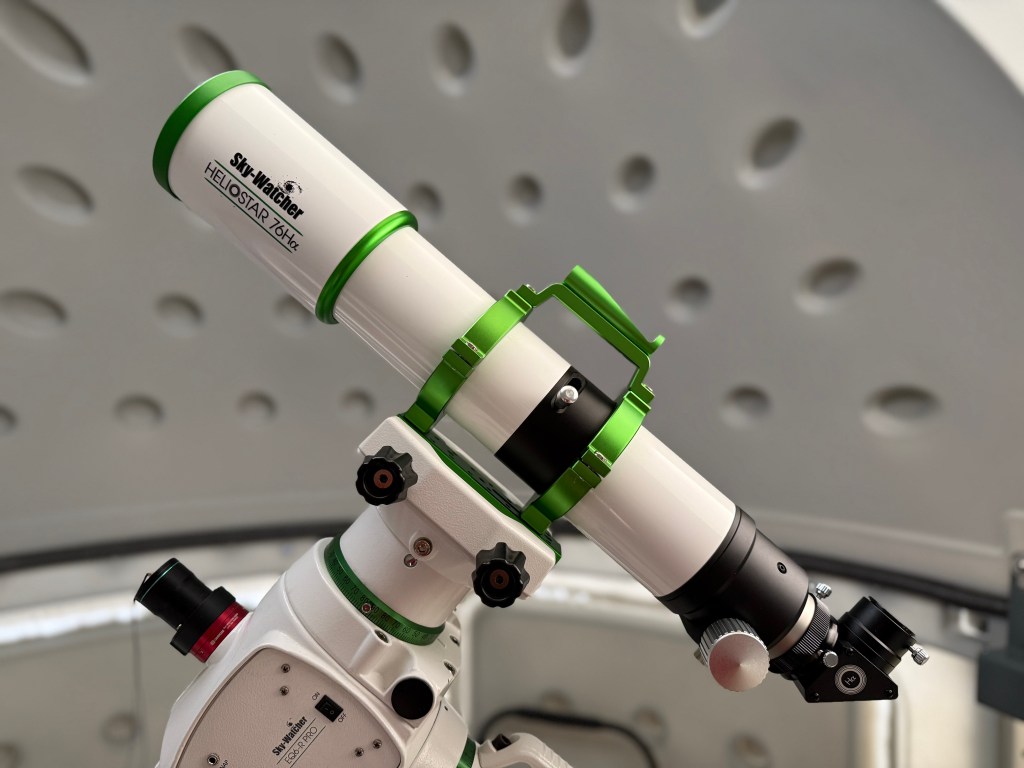
Improvements in instrumentation and processing skills helped with both the capture and depiction of our nearest star’s activities. We recently upgraded to the relatively-new Sky-Watcher Heliostar 76Ha telescope and that has made a huge difference in visualizing the chromosphere. The telescope’s filtering system, with a “single-stack” arrangement, is capable of 0.5 Angstrom or better which really brings out detail — stronger image “signal” produces image data that are easier to process and edit. More about the telescope another time.

The Sky-Watcher Heliostar 76Ha telescope in its parked position beneath the observatory dome.

A break in the weather allows view of an active Sun

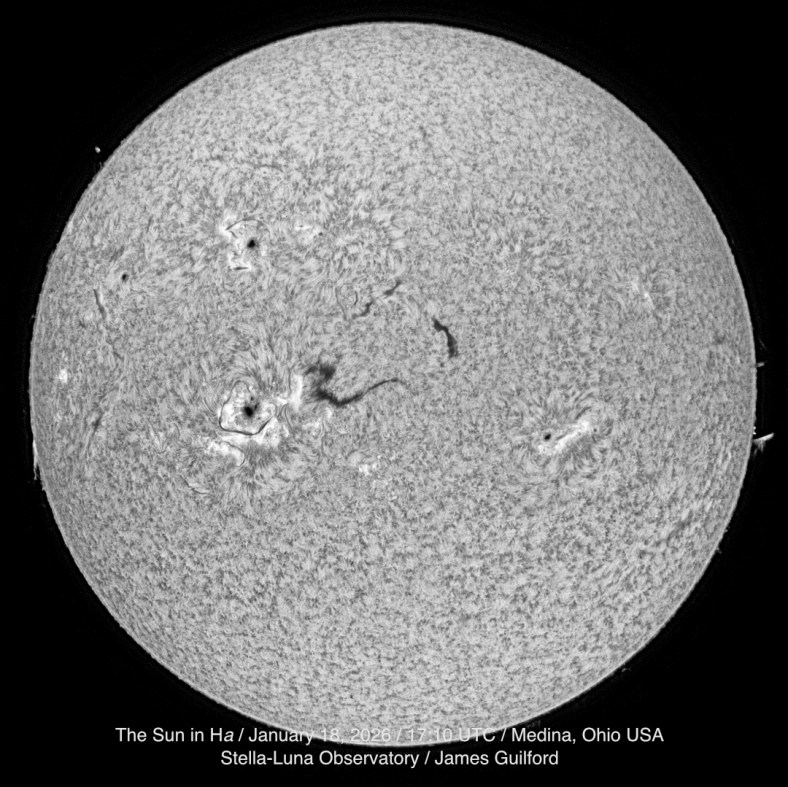
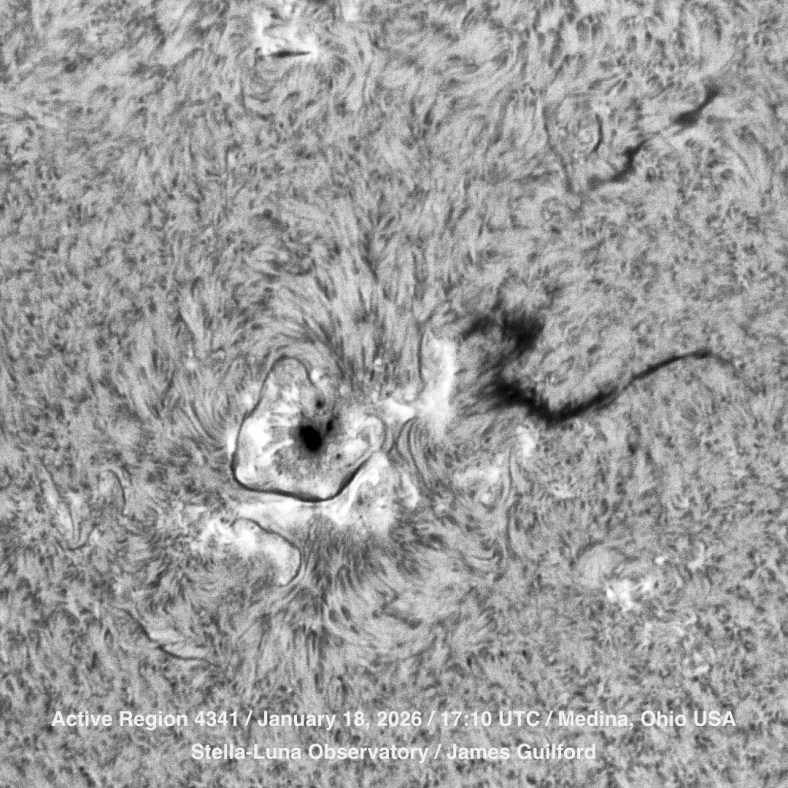
Full disk image of Sun as viewed in hydrogen-alpha light. Snake-like, dark filaments grace the center of the image. Several sunspots are also noted. Dominant in its influence on surrounding plasma features, is Active Region 4341 which exploded with a powerful flare one hour after this image was recorded.

With recent weather, we believed the observatory might be closed until spring. On January18, however, the skies were clear and blue with very little wind. We unsealed the dome, brushed off some of the accumulated snow, and aimed at Sun. The first thing we observed was the presence of large filaments at the center of the disk. One filament, Z-shaped, was in immediate proximity to a large sunspot at Active Region 4341. Also visible were multiple prominences around the disk; Sun is still active! The powerful magnetic forces surrounding AR4341 are made evident by its influence upon Solar plasma — twisting and aligning the visible features like iron filings around a science classroom magnet.

A close-up view of Solar Active Region 4341, in hydrogen-alpha light. Snake-like, dark filaments grace the center of the image. Several sunspots are also noted. Dominant in its influence on surrounding plasma features, AR4341 exploded with a powerful flare one hour after this image was recorded.

While the sky was clear and blue, the temperature was wicked cold for standing around on stone floors. Also, touching metal telescopes, properly allowed to reach the ambient temperature of 19°F, with bare hands is, painful. The laptop computer also found the temperature uncomfortable for, while its battery was charged to about 60% capacity, the system quit complaining of low battery. Attaching the computer’s charger let us finish the session.

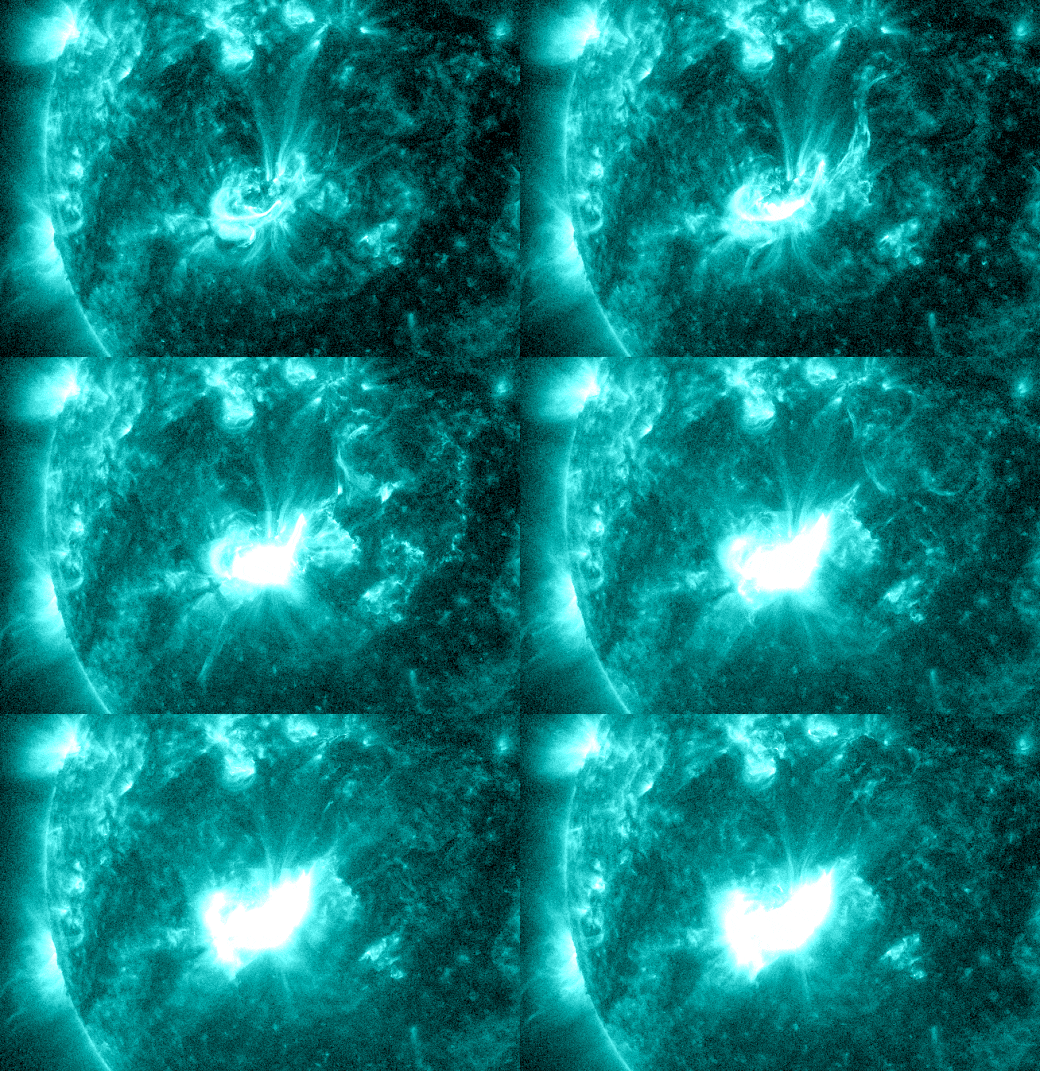
Video from NASA's Solar Dynamics Observatory spacecraft, showing the X1.9/3b flare at AR4341. -- January 18, 2026. The Solar image appears in shades of green with black background. The flare is at the center, in white, as it expands during the explosion.
Video from NASA’s Solar Dynamics Observatory spacecraft, showing the X1.9/3b flare at AR4341. — January 18, 2026

One hour after we recorded the images of AR4341, the sunspot exploded with a massive X1.9-class flare. Expansive auroral displays are expected early January 20 though here, in Northeast Ohio, we are expecting cloudy, winter weather.

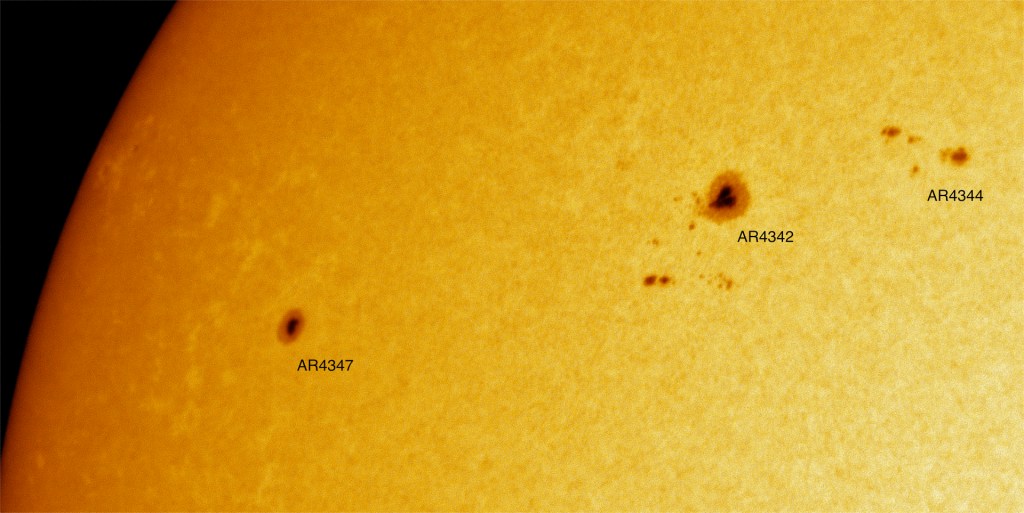
Also appearing on Sun, sunspots at AR4347, 4342, and 4344, shown here in white light (false color applied), in the northern hemisphere. Hydrogen-alpha light reveals features in Sun’s chromosphere, whereas white light imagery shows features, such as sunspots, in Sun’s photosphere — a layer deeper.

The sunspot that made the auroras

Our inland view of the aurora borealis competing with suburban light pollution the night of November 12, 2025. The aurora on the previous night was stronger, raising excitement worldwide; it was cloudy here that night.
Just above the treeline in the center of this image may be seen hints of the aurora borealis. Farther north from here, looking out over a dark landscape, the show was probably pretty good!

Here are some views of the sunspot

that blew off the CMEs

that caused the geomagnetic storms

that made the auroras

that raised all the hubbub this week.

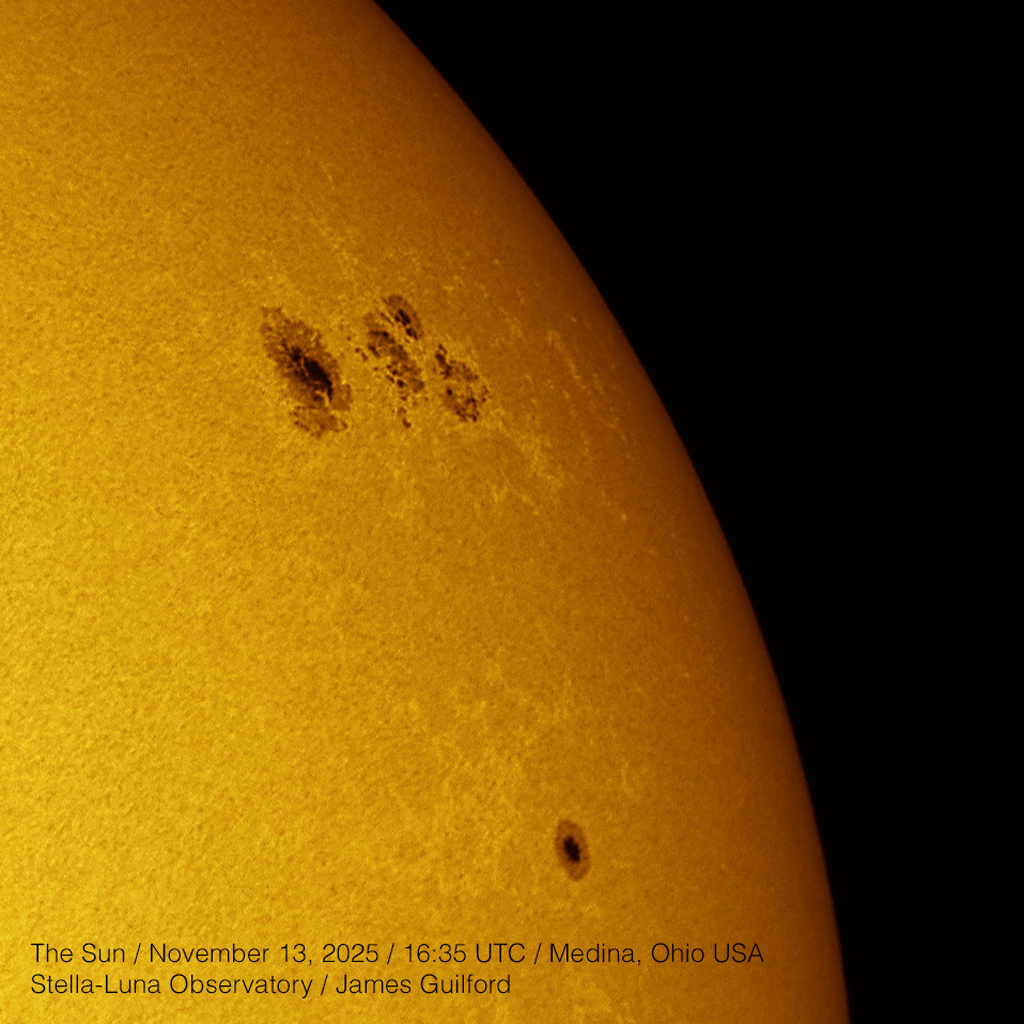
The sunspot at Active Region 4274 is responsible for all the action. Where we show two sunspots, the smaller one (bottom edge) is AR4275.

The first view is in hydrogen-alpha light, the second and third views are in white light; yellow-orange tones are false color applied in processing.

Sunspots and prominences shown via hydrogen-alpha light, false color added.
A white light view of AR4274 (top) and much smaller AR4275 (bottom), false color applied.
AR4272 close up, with interesting patterns emerging in both the umbra and penumbra areas of the larger spot. Strong winds at the time of imaging reduced resolution somewhat.
Here’s a white light image of Sun we made this morning depicting very Active Region 4274 and its less busy neighbors. Rotation is a bit off — rotated southward — but left alone for composition purposes. AR4274 is responsible for a series of coronal mass ejections (CMEs) that resulted in two nights of auroral displays that excited observers worldwide.