An example of how I have been posting solar images on Instagram and Threads. This particular image shows giant sunspot complex AR3664 the day its coronal mass ejection from days earlier struck Earth’s magnetosphere setting off widespread and spectacular auroras.
I have been posting solar images on a near-daily basis for some time. I enjoy recording the images and sharing them with the world and Sun is an especially interesting object right now as we near Solar Maximum. Unfortunately, I am not sure the daily postings look all that great on Instagram where, now, our home page looks like a collection of spotted oranges or maybe suspect egg yolks! What to do?
My current thinking is to post only the most interesting images on Instagram and Threads — days when giant sunspots are present, newsworthy, or (eventually, when I get it working) spectacular coronal images — unusually interesting shots. To keep a public repository of the other images — the routine, daily views — a page on this website might be advised. I think I’ll try it.
So a daily posting here, on a solar imaging page, and special stuff also posted on Insta and Threads. Yeah, that sounds about right. Thanks for listening. — JG
The first DSLR image of the night turned out to be the most spectacular.
It turned out to be a stronger impact than forecast, and the strongest thus far of this solar activity cycle; the geomagnetic storm of May 10 – 11, 2024 produced auroras (Northern and Southern Lights) visible at night from locations nearly pole to pole.
The Responsible Spot: The morning of the aurora, we photographed Sun, capturing this close-up of AR3664, the source of coronal materials that caused the Northern Lights or Aurora storm. It was a most impressive feature and remained intact and spewing powerful flares as it disappeared over Sun’s western limb!
The forecast of possible aurora prompted me to step outside at about 10 PM (EDT), when twilight had faded, to check the skies. At first I saw what I thought might be clouds but knowing auroras can be feeble, I watched. Sure enough, there was movement in those “clouds”.
NOAA Space Weather Prediction Center’s depiction of the expected extent of aurora May 10, 2024.
Glancing overhead I saw what I found hard believe — aurora ray features directly overhead … at 41º latitude, a rare sight, indeed! Rushing back indoors, I pulled together camera, fisheye lens, and tripod and headed back out.
What most people saw with their unaided eyes resembled thin clouds. Watching those “clouds” as they ebbed and flowed, and subtle coloration betrayed their true nature to those who knew what to look for. The auroral streaks pictured here were directly overhead in Medina, Ohio — 41º latitude.
The aurora still presented itself as cloudy streaks with, perhaps, hints of color. Now also armed with my smartphone, I activated its camera and aimed it at the sky. There on the screen, light amplified by the phone’s electronics, glorious, eye-popping colors filled the sky! I’d never before experienced an aurora like it.
First image of the night came from the iPhone 13 camera, revealing the true extent of the ongoing aurora.
Only occasionally, during the time I was out, did the aurora’s color become visible to me; apparently being just below the limits of my, and others’ visual perception. Another local observer noted color was more visible shortly before I stepped outside to check on things — the actual peak of the display must have happened as twilight was ending and before 10 p.m.
During the hour we watched the show in the sky, the event slowly faded, then returned bringing forth another burst of color. The balance of images here are from a Canon EOS 5D Mk. 4 DSLR camera with a Sigma fisheye lens. The DSLR exposures are ISO 400, f/2.8, and 4 to 8 seconds.
I observed and photographed the aurora from shortly after 10:00 until about 11:30 EDT and in that hour or so, the intensity faded and then re-surged before fading away again which was my signal to shut down. I might have stayed out longer but had a commitment for the next day — sleep was needed — so, satisfied I’d seen the phenomenon at its best, I put away the camera gear.
Looking very nearly straight up, these rays appear to be emanating from a position in the east-northeastern sky. The extent of the aurora was impressive, visible well into the Deep South of the United States. The aurora australis was widely visible in the southern hemisphere.
Knowing it would be all over the news, I submitted my most spectacular shot of the night to the local newspaper — a daily that publishes on Saturday but not Sunday. It was too late for the Saturday edition but the editor gave my photo a three-column, Page 1 spot on Monday.
Colors rain down on a quiet residence, perhaps poured out from the Big Dipper seen here in an inverted position. The north star, Polaris, is a tiny dot near the center of this picture. (Note how two stars of the Dipper’s bowl point toward Polaris.) The short horizontal streak to the right of Polaris is a moving airplane’s navigation lights, captured in the several seconds of the camera’s exposure.
Our Sun is still in its peak activity period, by some accounts it won’t hit solar maximum until some time in 2025, so there may be more auroras in our near future but this was one for the history books!
Page 1 of the Medina County Gazette, Monday, May 13, 2024.
The Sun: March 24, 2024, 15:46 UTC, as seen from Medina, Ohio, USA. Canon EOS 6D Mk. 2, Askar 103 APO telescope @ f/6.8, Spectrum Telescope filter, ISO 250, 1/2000 second.
Taking advantage of a rare day with clear skies, I set up the new-ish Askar 103 APO telescope and got a bit more solar imaging in. The huge sunspot group at the center of the image above is designated AR3615 — it and the isolated sunspot above it (AR3614) exploded in tandem on March 23, directing their CMEs (Coronal Mass Ejections) at Earth. When the CME hit our planet, the result was a severe geomagnetic storm. While not specifically practicing for the upcoming solar eclipse, the experience doesn’t hurt, either! This period of activity makes the sun’s photosphere interesting to observe as features visibly change day-to-day and even more rapidly, if one looks close enough. Sun is nearing the predicted peak of its 11-year cycle of activity which is expected in 2025. That means a couple of more years (at least) of interesting things to see on our nearest star.
We Saw It! The skies, recovered to blue and sunshine from overnight rain and clouds giving us hope and a spring in our step. As the hour of eclipse approached, so did a generally thin milky layer of clouds. The eclipse was not spoiled, however, and we enjoyed a wonderful view. We sincerely hope you were able to experience the “2024 Great American Eclipse” as well.
The Sun during totality, exposed to show prominences looping from the solar surface. Prominences were seen in several locations along the limb but the one seen here, near the bottom of the disk, was easily seen with the unaided eye. Photo by James Guilford.
————————————————————————–
Eclipse Watching in Medina, Ohio
April skies are notoriously changeable here in Northeast Ohio where we are otherwise in an excellent location for viewing the April 8, 2024 total solar eclipse. In fact, the chances of a clear sky here are only about 37 percent. Ugh! Dedicated eclipse chasers will mostly head to the southwestern U.S. for better chances at clear skies. For those of us not traveling, let’s hope for clear skies here on the Big Day because a total solar eclipse is more than just an awesome sight, it’s an experience! Let’s be prepared.
An Updated List of Resources Appears Near The End of This Article
Time and Eclipses Wait for No One
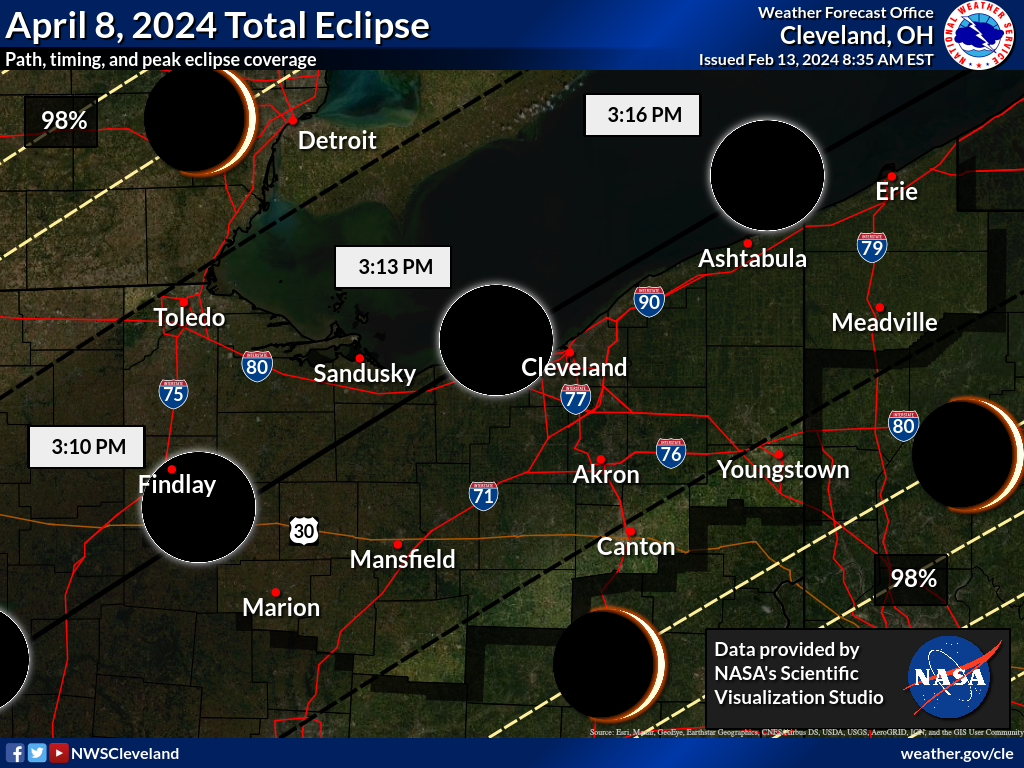
Moon’s shadow will be clipping across Ohio at about 2,100 miles per hour, so the peak period of the eclipse — totality — is fleeting. Medina will experience about 3 minutes and 28 seconds of totality, which is pretty good. If we were in the central line of the path of totality, which passes right through Lorain, we would have 3 minutes and 53 seconds of glorious viewing. Here, courtesy of the U.S. Naval Observatory, are local times for critical points of the eclipse:
Timing in Medina, Ohio (Eastern Daylight Time)
Partial Eclipse Begins — 1:58:38
Totality Begins — 3:13:23
Maximum Eclipse — 3:15:06
Totality Ends — 3:15:51
Partial Eclipse Ends — 4:28:38
☀️ 🌑 ☀️
Sights and Experiences
The eclipse will begin when Moon starts its passage across the solar disk. When viewed through protective filters, a tiny nick will be missing from Sun’s limb. That nick will gradually grow as the partial eclipse phase progresses. Viewed through “eclipse glasses” or other specialty solar filters, Sun will transition from a full disk to, eventually, a slim crescent. Our surroundings will not become dark as night but the light will take on an eerie softness as Sun fades. If, heaven forbid, skies are cloudy, it will be very dark in the path of totality … very dark indeed.
Sunspots may be visible. Dark markings of various sizes and shapes may be seen on the solar disk during the partial phases of the eclipse. Sun is in the most active phase of its regular cycle during which sunspots are common. If they are large enough, sunspots can be seen using eclipse glasses but are best observed through telescopes equipped with solar filters.
The air may feel cooler, birds and other animals may begin evening behaviors. Street lights and other automatic lighting may activate.
Just before totality begins, two interesting effects will be seen, caused by Moon: Baily’s beads are dots of sunlight that will dance along the edge of the blackened moon. The diamond ring effect is a singular burst of sunlight that, combined with the light ring of the now-eclipsed sun, is reminiscent of a shining diamond. Both effects are caused by sunlight shining through the mountainous terrain on Moon’s horizon as it moves into position in front of Sun.
Look around as these things are happening, and watch for shadow bands — dim waves of dark and light that will ripple across the ground immediately before and after totality. The bands are a memorable experience but often missed because most attention will be on the sky above!
During totality — and only during totality — eclipse glasses and solar filters are not needed. In fact, the eclipse will be too dim to be seen through the protective devices. Looking around where they are standing, watchers will notice that it is not as dark as night but something odd is to be seen. Overhead, where the brilliant afternoon sun should be shining, it’s dark but for the glorious total eclipse. Along the distant horizon, there is sunlight — it’s coming from areas outside of Moon’s shadow, away from the path of totality.
Marvel at Sun’s corona as it radiates from the dark circle of moon-covered-sun. It’s a sight not soon forgotten! During totality look for a star-like light to the southwest of the eclipse — it’s planet Venus! To the upper left of Sun’s position is planet Jupiter.
The interesting effects and partial eclipse phases will take place in reverse order as totality ends. Put those eclipse glasses and filters back on immediately — even the crescent Sun is powerful enough to damage unprotected eyes — and don’t forget to turn unprotected cameras away from Sun!
So What’s Happening?
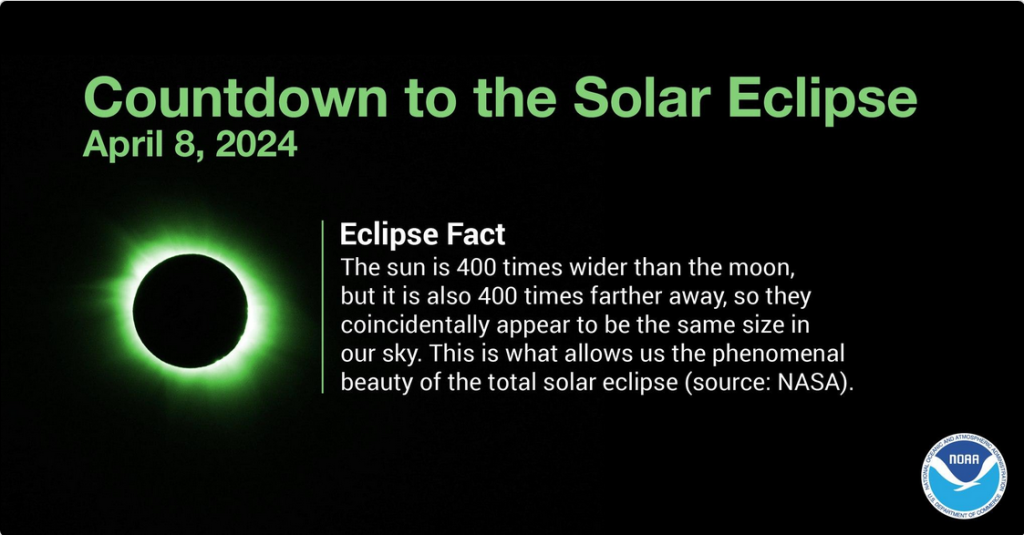
A total solar eclipse occurs when Moon passes between Sun and Earth, causing Moon’s shadow to be cast on Earth’s surface. Moon is at the right distance from Earth that, when it does pass in front of Sun, the fit is nearly perfect, blocking direct sunlight from reaching the surface within its shadow. An annular eclipse happens when Moon’s orbit carries it a bit too far from Earth to cover the solar disk, producing a “ring of fire” — sunlight in a halo around the dark Moon. Most of the time, Moon’s orbit carries it into positions where its shadow “misses” Earth, so there’s no eclipse.
When the moon passes directly between the sun and Earth, a solar eclipse takes place. (NEVER look at the sun during any type of solar eclipse! Looking at the sun is dangerous. It can damage your eyes.) Image Credit: NASA
As mentioned earlier, when totality is reached, Sun’s brilliant light is completely blocked as viewed from within Moon’s shadow. That shielding from brilliant sunlight allows the solar corona to be seen. The corona is a hazy glow surrounding the darkened Sun and is the outermost region of the Sun’s atmosphere, consisting of plasma (hot ionized gas). The corona continually varies in size and shape as it is affected by the Sun’s magnetic field so its appearance differs eclipse-to-eclipse and is of great interest to those who study our nearest star — it also makes totality a unique and awe-inspiring sight.
Eclipse Viewing Safety
Don’t risk your vision! Even when Sun is “mostly” covered by Moon before and after the total eclipse, sunlight will be strong enough to cause permanent eye damage. Sunglasses and other makeshift items are not enough. To look at the sun, use only certified “eclipse glasses” — filters — so you can safely view Sun before and after totality. Here’s a link to sources: https://eclipse.aas.org/eye-safety/viewers-filters — More Information Below
Medina, Ohio Area Resources
Branches of Medina County (Ohio) District Library were distributing eclipse glasses free of charge, one per family, as supplies allow, at the time of this writing. Glasses are easy to share amongst family members, looking one at a time at the partly-eclipsed sun. In fact, it is best for adults to watch children who are using eclipse glasses to make certain they’re wearing them correctly and that can’t be done if the adult is wearing eclipse glasses at the same time — they’re too dark!Library Eclipse Programs
The Medina County Fair Board will be renting out Solar Eclipse Camping sites for campers and motorhomes beginning Friday April 5 thru Tuesday April 9. There will be electric hook-up and restrooms and showers on site. Call (330) 723-9633 or email medinafair@gmail.com to reserve a space. Looking for a place to just park your vehicle to watch the eclipse? You can rent a parking spot for $20 (cash only) at the Community Center parking lot.
Useful Mobile Apps via the AAS
Here you’ll find some of the best eclipse-related apps and software available, as judged by members of the American Astronomical Society (AAS) Solar Eclipse Task Force: https://eclipse.aas.org/resources/apps-software
Solar Eclipse Timer App
Want more precision and audio/voice prompts at critical points of the event? Then this app’s for you! (Included in the AAS list) There are versions for iOS and Android and a small charge to update to the 2024 version ($1.99 for iOS) but it’s worth it if you want a sophisticated digital assistant — be sure and install and update in advance for your observing location! https://www.solareclipsetimer.com/
A Word About “Eclipse Glasses“
Purchase and use only ISO filters and eclipse glasses certified for direct viewing of the sun. This is your vision, and that of your loved ones, we’re talking about here! Sunglasses, smoked glass, Compact Discs, photographic negatives, and other items are not safe for looking directly at Sun! Safe, inexpensive eclipse glasses and filter cards are widely available for this eclipse so should be bought in advance and stored safely away. Read and follow instructions that should be printed on eclipse glass frames. Check the “lenses” for damage such as tears or pinholes and throw the glasses away if any defects are found. The glasses can be kept and used after the event but should be examined before use every time. Remember, too, these often colorfully-framed eclipse glasses may be appealing to children BUT THEY ARE NOT TOYS — they are all that stand between the user and permanent eye damage so do not allow kids to play with them. For more on this subject, see:https://eclipse.aas.org/eye-safety/iso-certification
If you’re using old eclipse glasses, make sure the lenses aren’t scratched or damaged. Check out this video from NASA on how to make sure your glasses are good to go: youtube.com/
I hauled out the 1970s vintage Celestron C90 telephoto lens this morning, attached my AstroZap Baader film solar filter, and my Canon EOS 7D to quickly image Sun. I’m hoping to be able to use the compact mirror lens for quick shots such as this and for images of the Moon; trials have thus far met with mixed results. It’s a cool old lens but not as good as other gear in my current collection. The setup was mounted on a simple photographic tripod and, astro-folk will note, Sun’s orientation here is cockeyed. Once the observatory is set up and a mounted telescope put into use, we expect to see improved resolution/magnification, and won’t have to struggle with gear too heavy for the tripod! There’s a smattering of sunspots to be seen in this image along with a few other, more subtle features in the solar photosphere. Clouds rolled in soon after this image was made.






 Stella-Luna Observatory