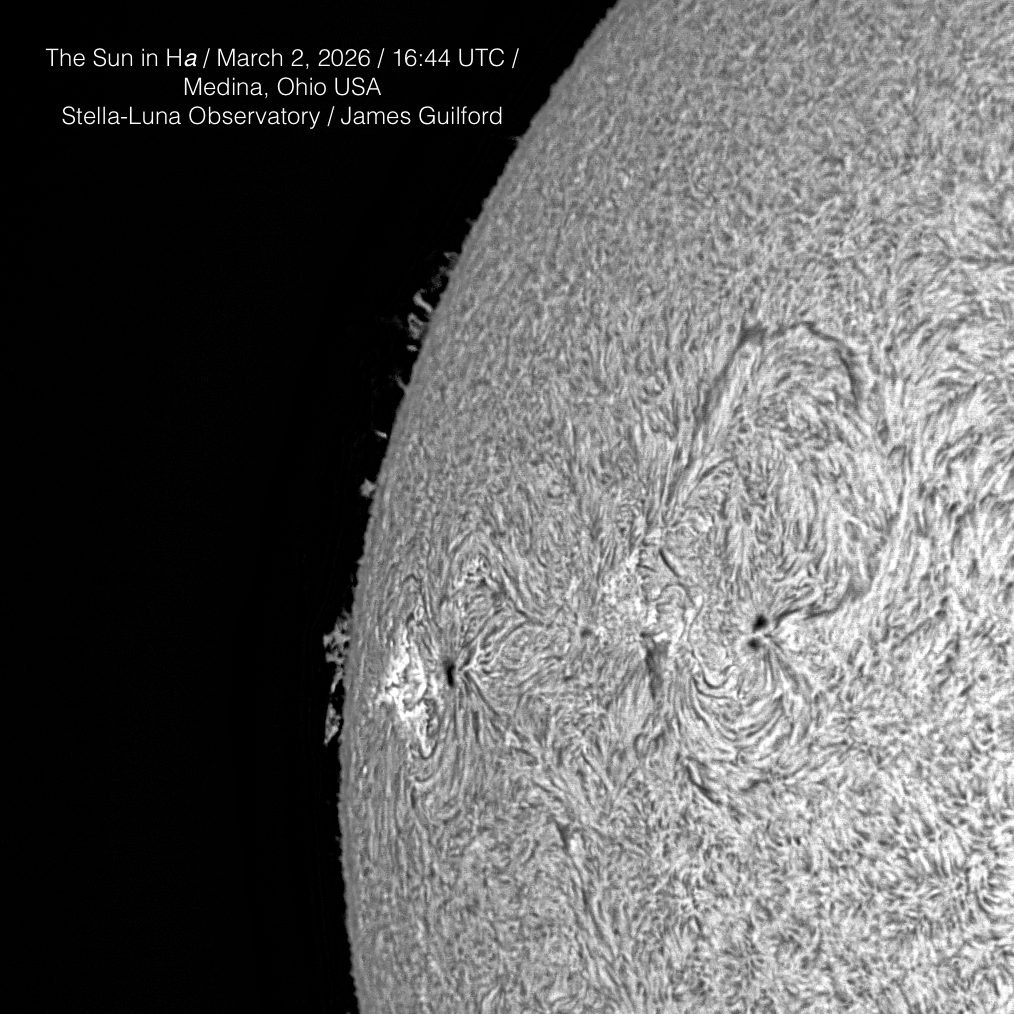
This image depicts the northeast quadrant of our Sun, as recorded the morning of March 2, 2026. The data collected were in hydrogen-alpha light and depict well the turbulent curves in the chromosphere resulting from Solar plasma interacting with strong magnetic fields surrounding two sunspots shown here, left to right: Active Regions 4384 and 4381. Several tenuous prominences are found along the rim of the circle. This is a non-colored monochrome image. // James Guilford, Stella-Luna Observatory
It was the last sunny day expected for, likely, a week so we had to get out and image our Sun. Well, we would have done it anyway! Seeing conditions were forecast to be better than average but at midday, when we have our first clear shot at Sun, the atmosphere was stirred up and shaking our view. Still, the miracle of “lucky imaging” came through and we were able to make passable pictures from the image data. Interestingly, the sunspots at Active Regions 4384 and 4381 are the remnants of the giant sunspot formerly known as AR4366 surviving a trip around the far side of our star! Sunspots, by the way, receive new designations when they are first observed appearing over the eastern horizon even if they were previously observed as they disappeared over the western edge.
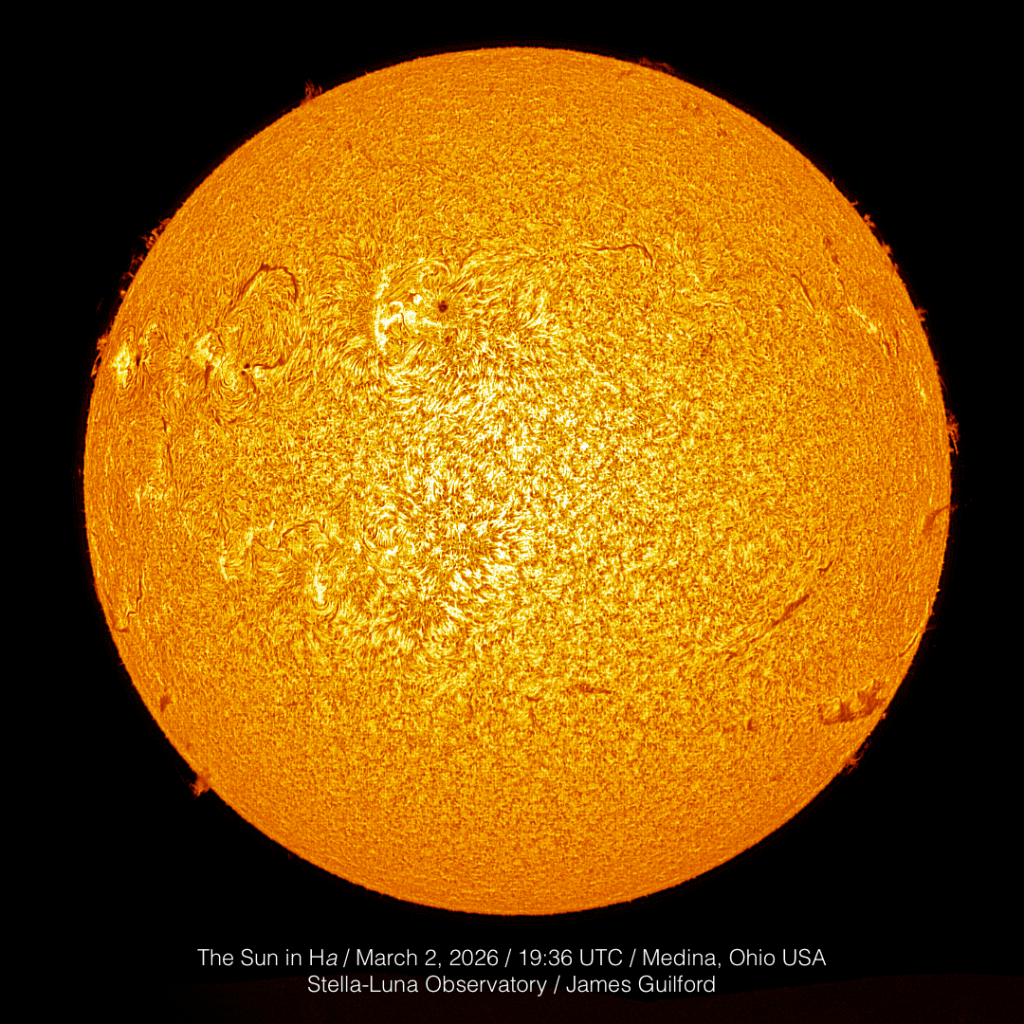
Both of these images were the result of data stacked in ASI’s VideoStack application. The image above was then processed only in Pixelmator Pro. The image below was processed in PixInsight/Solar Toolbox, and Pixelmator Pro.
An image of our Sun taken in hydrogen-alpha light reveals a turbulent chromosphere, marked with a few dark filaments. Three sunspots are found in the left-hand portion of the disk though difficult to see via hydrogen-alpha. False color has been added to this image. // James Guilford, Stella-Luna Observatory
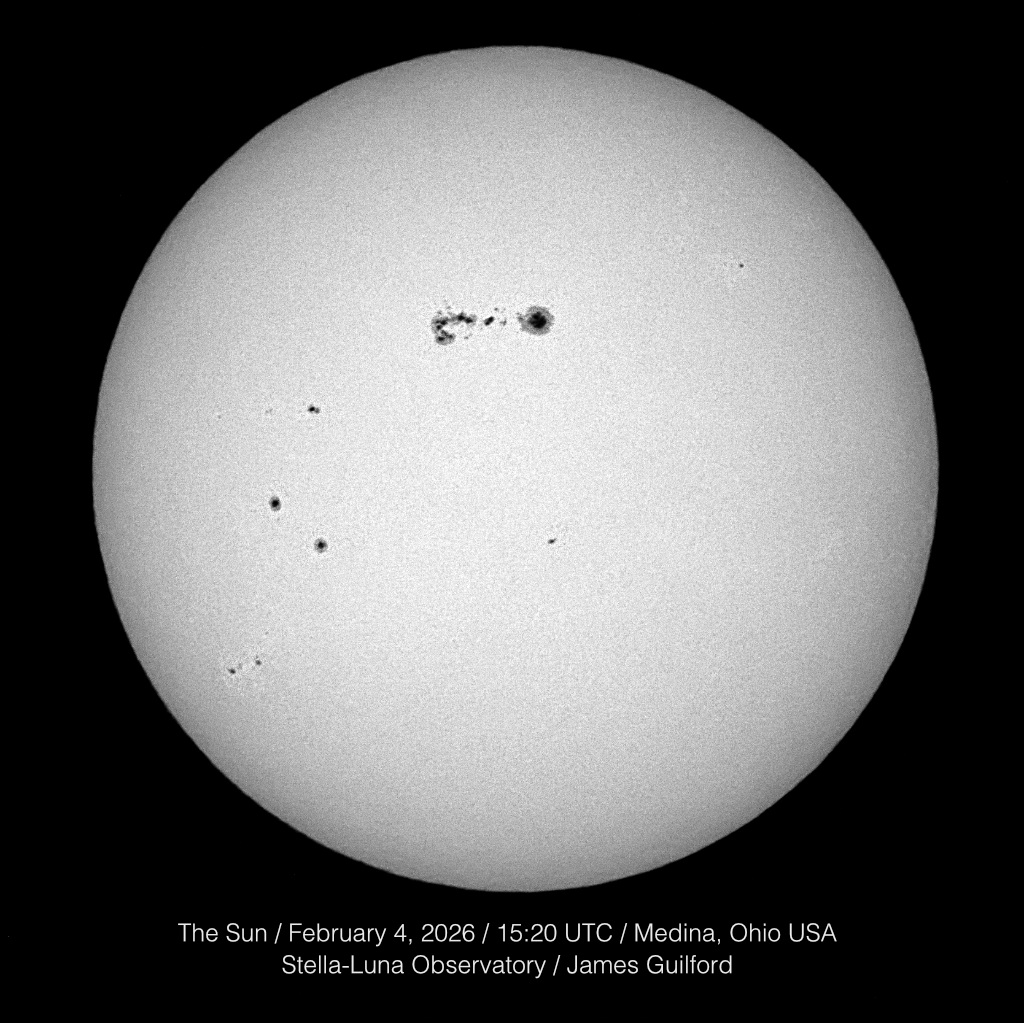
Shown in white light is our Sun as it appeared on February 4, 2026. A large sunspot, designated Active Region 4366, drew much attention as it transited the surface, issuing flares along the way.
On sunny days, this winter, when it’s not bone-shatteringly cold, we’ve been imaging Sun. In white light, we’ve tracked the progress of a couple of impressively-large sunspots as they traversed the Solar photosphere, including one designated Active Region 4366 that drew global attention in late January and early February 2026. We’ve also been observing in hydrogen-alpha (Ha) light.
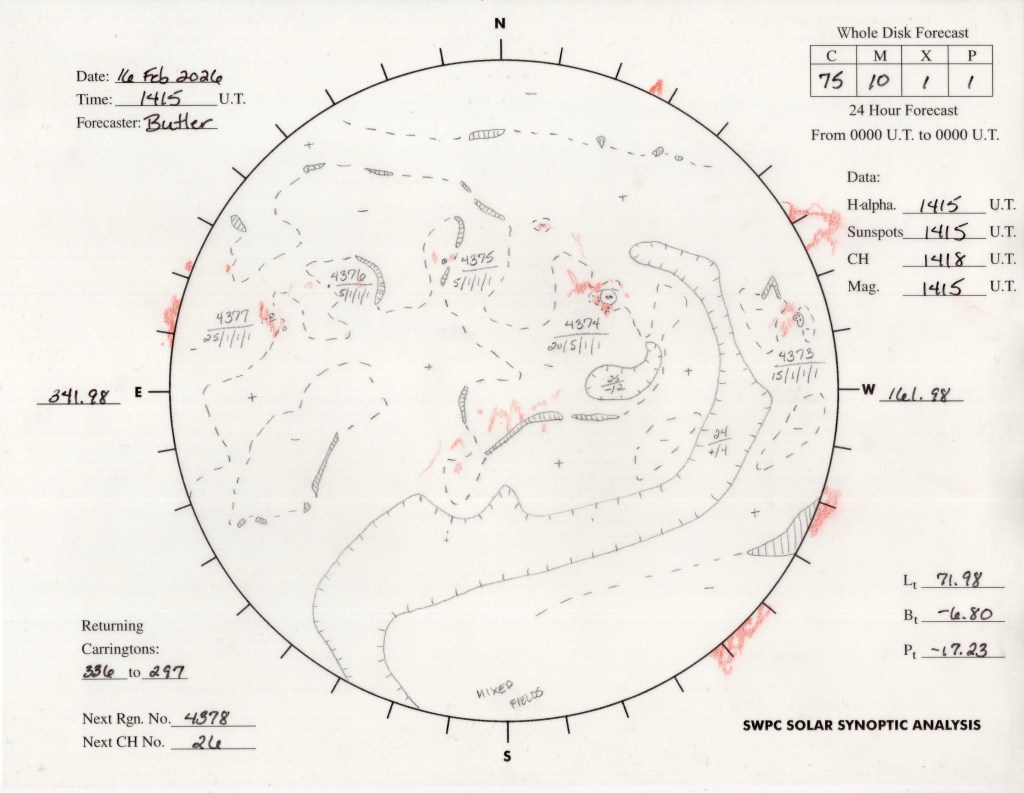
The NOAA SWPC Solar Synoptic Analysis map showing Sun on February 16, 2026.
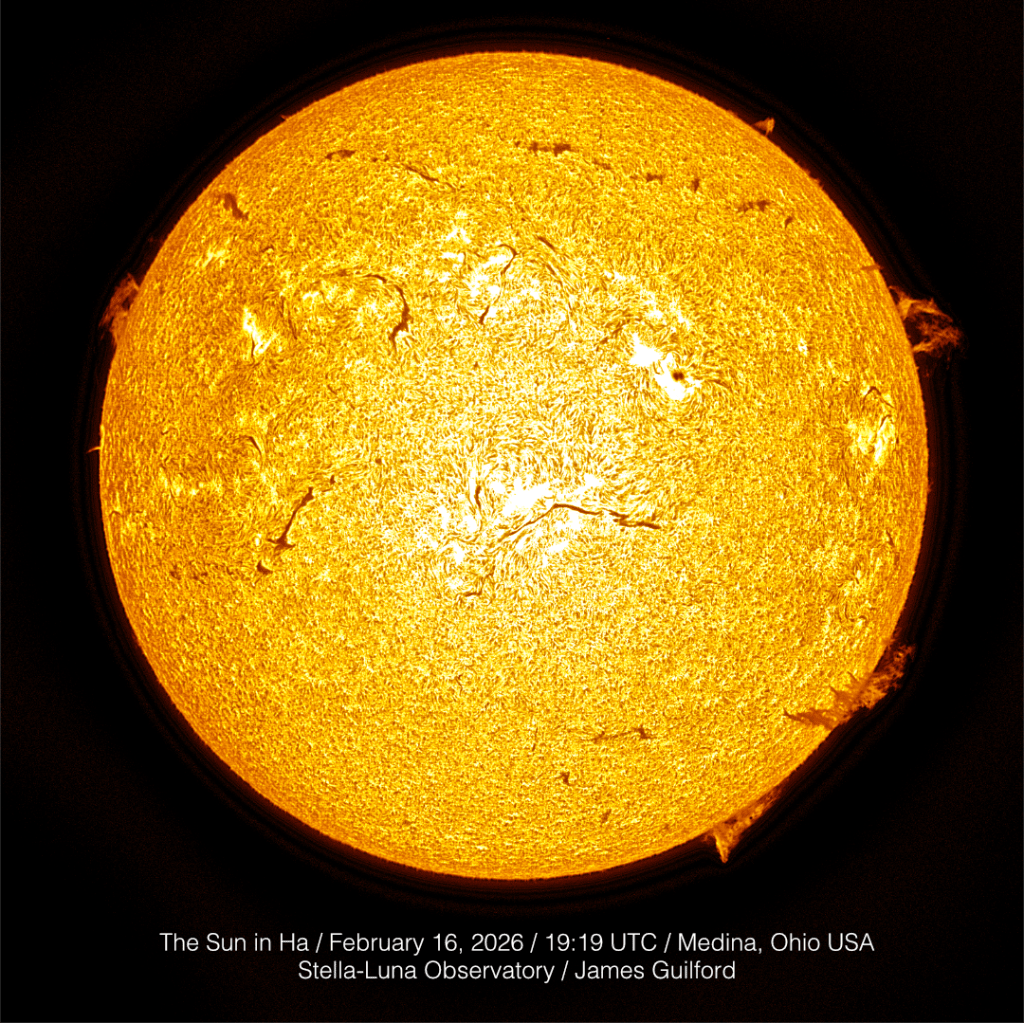
On sunny February 16, we checked the NOAA Space Weather Prediction Center’s daily Synoptic Analysis map for targets of interest. Yes! The map indicated several prominences around Sun’s rim so, a great day to see what was out there.
The full-disk image of Sun as it appeared in hydrogen-alpha light. This is a monochrome image original with false color applied. The “filaprom” is located at about the four o’clock position on the disk.
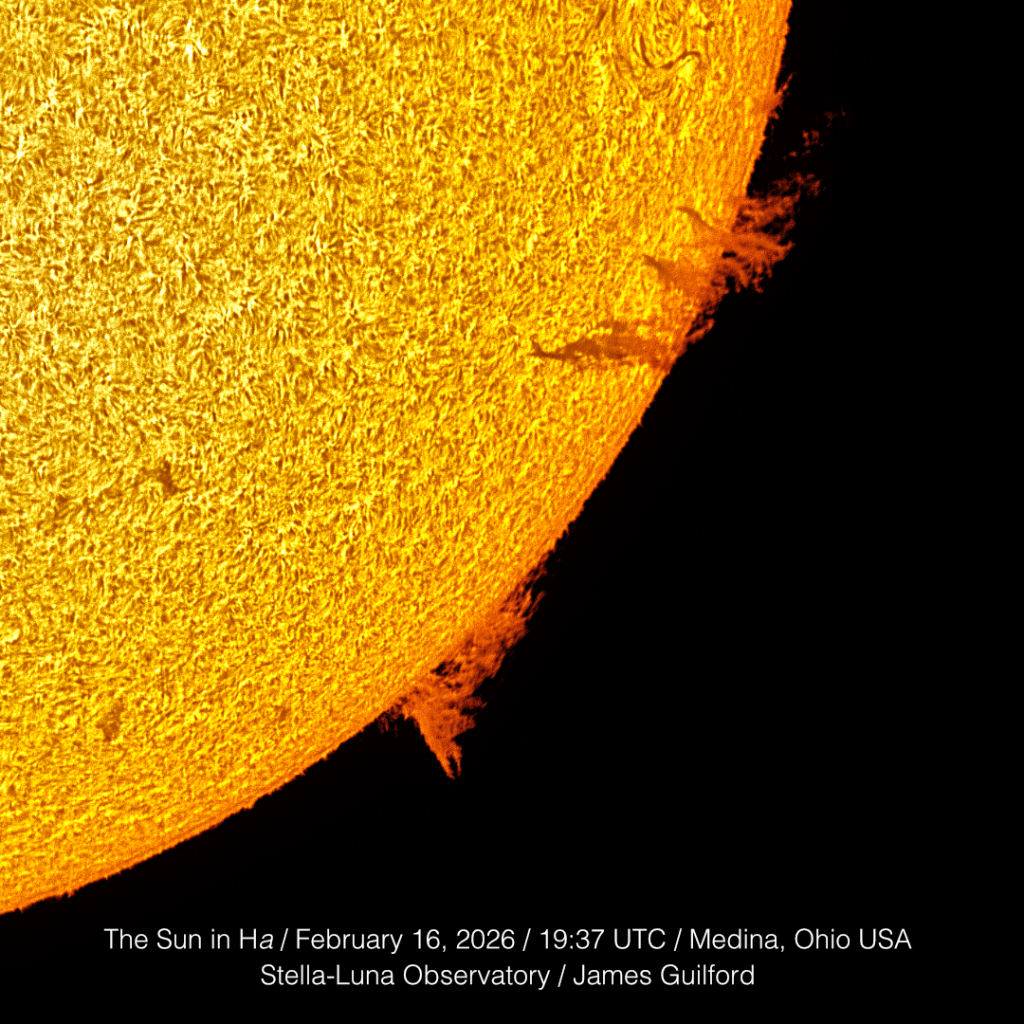
While an arch-shaped prominence at about the two o’clock position was our original target, as soon as we looked through the telescope’s eyepiece we saw it — a filaprom! What’s that? The snake-like features that appear in Ha are called filaments. If a filament bridges the Solar limb, its true nature is revealed: it’s a prominence, appearing as a dark filament when viewed against the bright chromosphere, and as a bright prominence when contrasted against the blackness of space — a filaprom! It was a first for us and delightful to observe!
Close-up view of the filaprom, near the top of the arc. Lower on the curve is a prominence issued from a position just over the Solar limb. Near the left-hand portion of the frame is a filament feature — a prominence viewed against the bright Solar chromosphere.
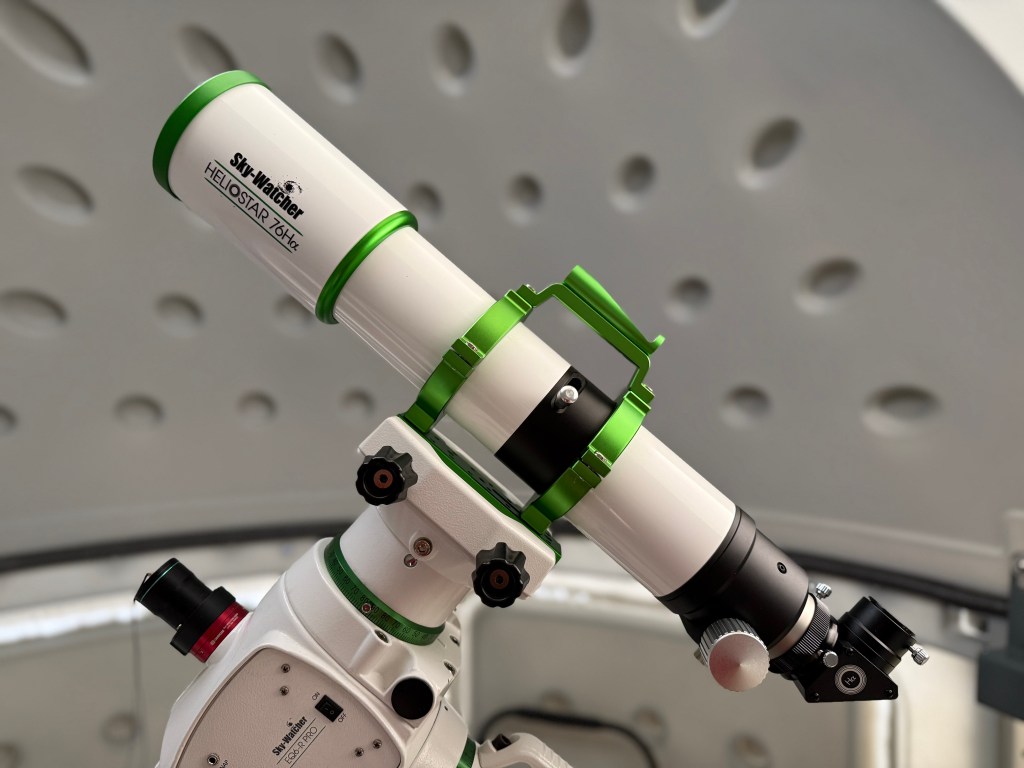
Improvements in instrumentation and processing skills helped with both the capture and depiction of our nearest star’s activities. We recently upgraded to the relatively-new Sky-Watcher Heliostar 76Ha telescope and that has made a huge difference in visualizing the chromosphere. The telescope’s filtering system, with a “single-stack” arrangement, is capable of 0.5 Angstrom or better which really brings out detail — stronger image “signal” produces image data that are easier to process and edit. More about the telescope another time.
The Sky-Watcher Heliostar 76Ha telescope in its parked position beneath the observatory dome.
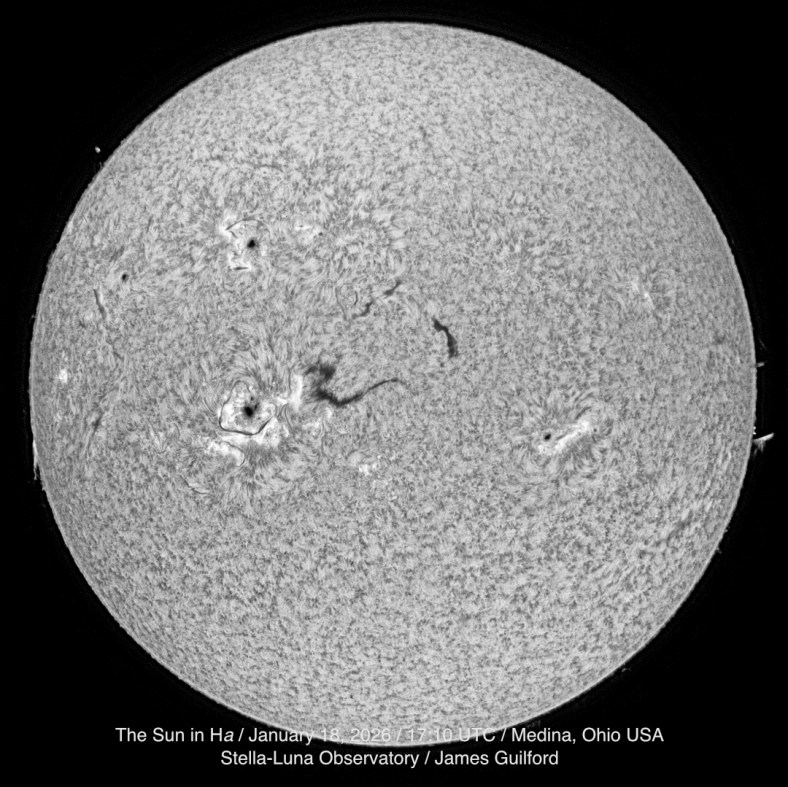
Full disk image of Sun as viewed in hydrogen-alpha light. Snake-like, dark filaments grace the center of the image. Several sunspots are also noted. Dominant in its influence on surrounding plasma features, is Active Region 4341 which exploded with a powerful flare one hour after this image was recorded.
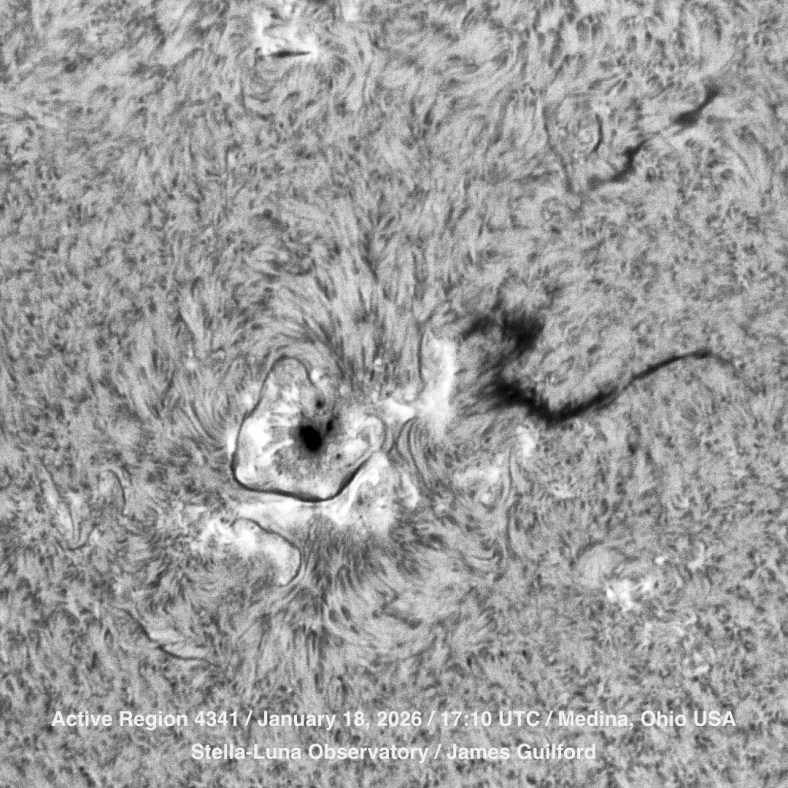
With recent weather, we believed the observatory might be closed until spring. On January18, however, the skies were clear and blue with very little wind. We unsealed the dome, brushed off some of the accumulated snow, and aimed at Sun. The first thing we observed was the presence of large filaments at the center of the disk. One filament, Z-shaped, was in immediate proximity to a large sunspot at Active Region 4341. Also visible were multiple prominences around the disk; Sun is still active! The powerful magnetic forces surrounding AR4341 are made evident by its influence upon Solar plasma — twisting and aligning the visible features like iron filings around a science classroom magnet.
A close-up view of Solar Active Region 4341, in hydrogen-alpha light. Snake-like, dark filaments grace the center of the image. Several sunspots are also noted. Dominant in its influence on surrounding plasma features, AR4341 exploded with a powerful flare one hour after this image was recorded.
While the sky was clear and blue, the temperature was wicked cold for standing around on stone floors. Also, touching metal telescopes, properly allowed to reach the ambient temperature of 19°F, with bare hands is, painful. The laptop computer also found the temperature uncomfortable for, while its battery was charged to about 60% capacity, the system quit complaining of low battery. Attaching the computer’s charger let us finish the session.
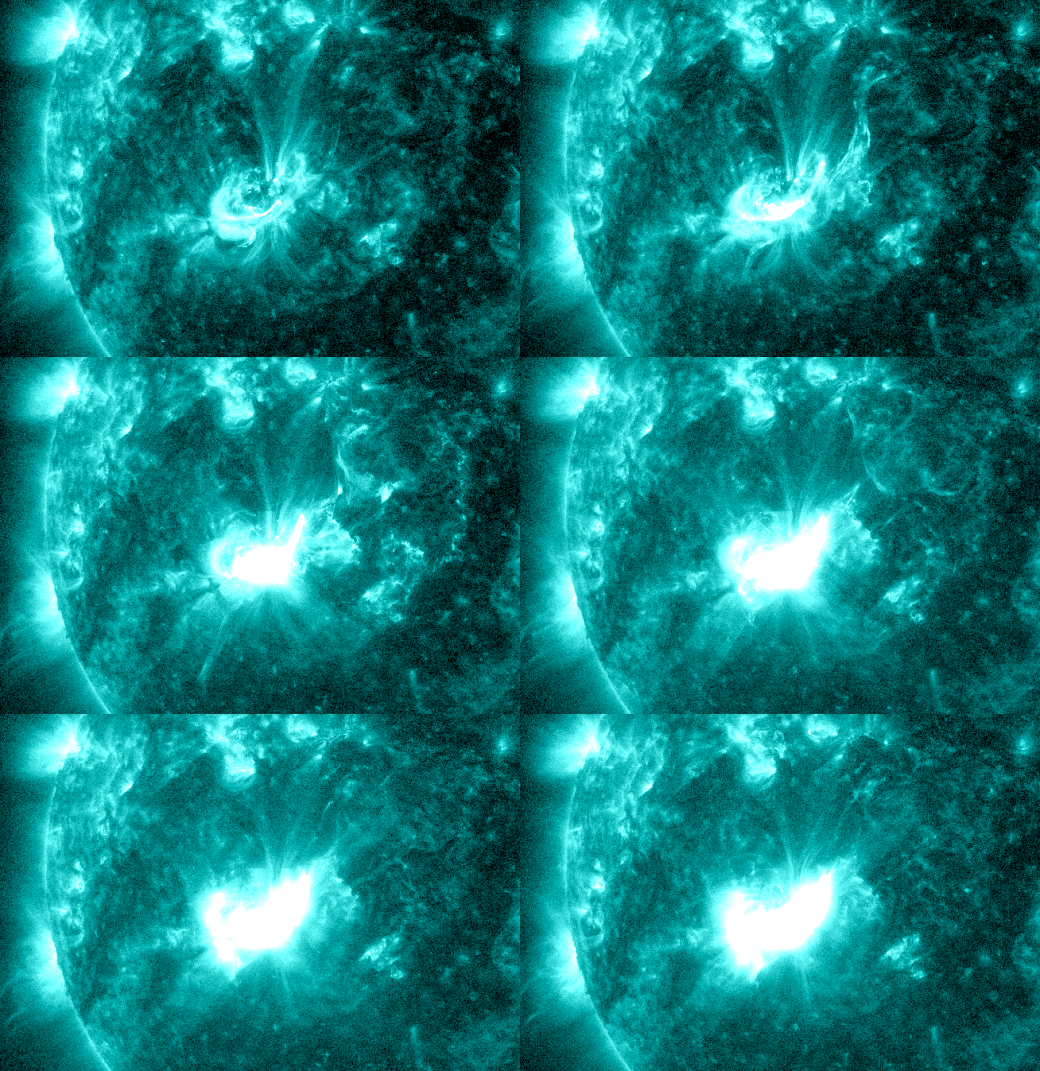
Video from NASA’s Solar Dynamics Observatory spacecraft, showing the X1.9/3b flare at AR4341. — January 18, 2026
One hour after we recorded the images of AR4341, the sunspot exploded with a massive X1.9-class flare. Expansive auroral displays are expected early January 20 though here, in Northeast Ohio, we are expecting cloudy, winter weather.
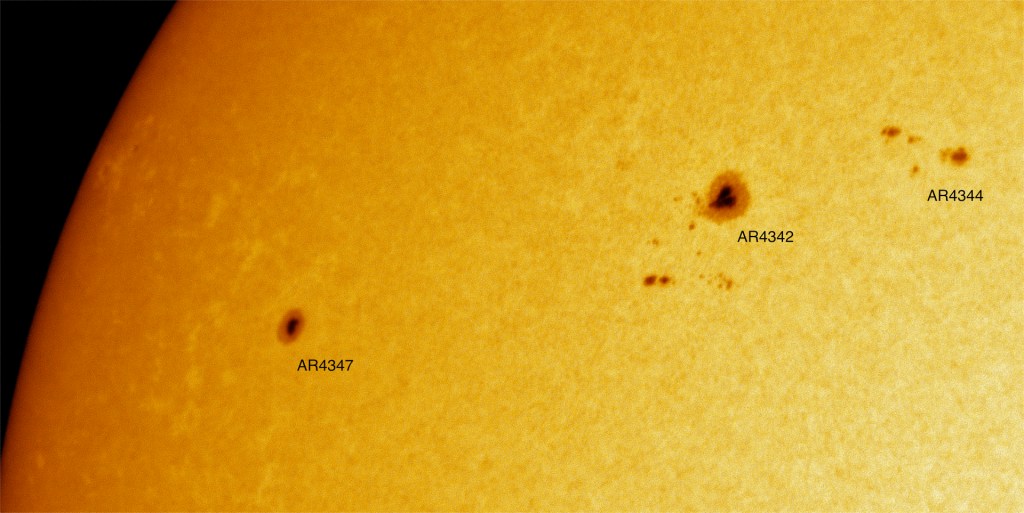
Also appearing on Sun, sunspots at AR4347, 4342, and 4344, shown here in white light (false color applied), in the northern hemisphere. Hydrogen-alpha light reveals features in Sun’s chromosphere, whereas white light imagery shows features, such as sunspots, in Sun’s photosphere — a layer deeper.
Our inland view of the aurora borealis competing with suburban light pollution the night of November 12, 2025. The aurora on the previous night was stronger, raising excitement worldwide; it was cloudy here that night.Just above the treeline in the center of this image may be seen hints of the aurora borealis. Farther north from here, looking out over a dark landscape, the show was probably pretty good!
Here are some views of the sunspot that blew off the CMEs that caused the geomagnetic storms that made the auroras that raised all the hubbub this week.
The sunspot at Active Region 4274 is responsible for all the action. Where we show two sunspots, the smaller one (bottom edge) is AR4275. The first view is in hydrogen-alpha light, the second and third views are in white light; yellow-orange tones are false color applied in processing.
Sunspots and prominences shown via hydrogen-alpha light, false color added.A white light view of AR4274 (top) and much smaller AR4275 (bottom), false color applied.AR4272 close up, with interesting patterns emerging in both the umbra and penumbra areas of the larger spot. Strong winds at the time of imaging reduced resolution somewhat.Here’s a white light image of Sun we made this morning depicting very Active Region 4274 and its less busy neighbors. Rotation is a bit off — rotated southward — but left alone for composition purposes. AR4274 is responsible for a series of coronal mass ejections (CMEs) that resulted in two nights of auroral displays that excited observers worldwide.
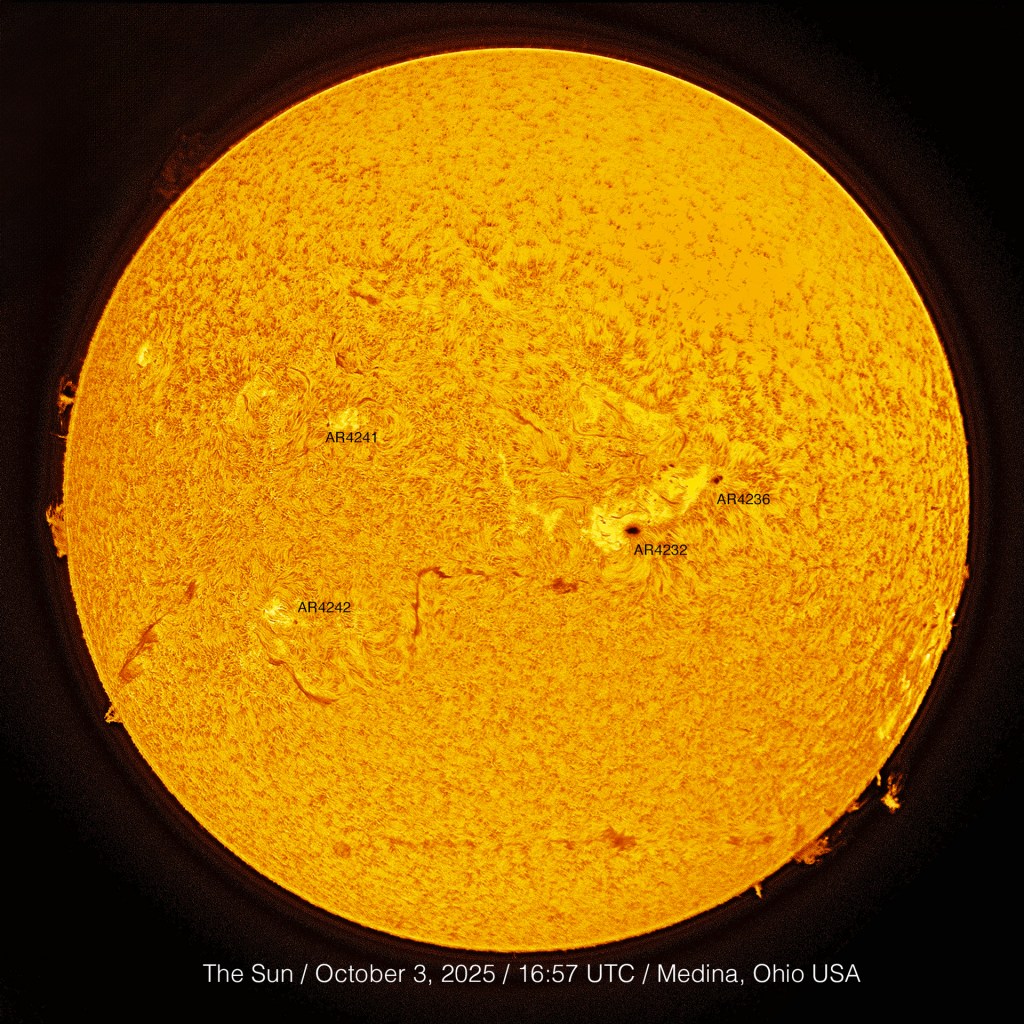
A full-disk image of Sun, as recorded in hydrogen-alpha light. Visible are two large sunspots, several serpentine filaments, and prominences that appear around the star’s limb. Credit: Stella-Luna Observatory / James Guilford
October 3, 2025 — We had been having quit a lot of trouble lately, recording data and reproducing images of Sun with prominences. There was some early success but even those images were a struggle to produce. Taking a look at suggested camera settings found in an article on solar imaging, one thing stood out — gain! We had nudged the camera’s gain setting upward and that’s not helpful and certainly not recommended; the setting should be very low or even zero! A few adjustments in data capture parameters was all it took to make a big difference in image processing and results!
Sun’s northeast quadrant, as recorded in hydrogen-alpha light. Visible are several filaments, as three prominences appear along the star’s limb. The “peach fuzz” appearance of the edge of the solar disk is caused by the presence of innumerable spicules or small prominences.
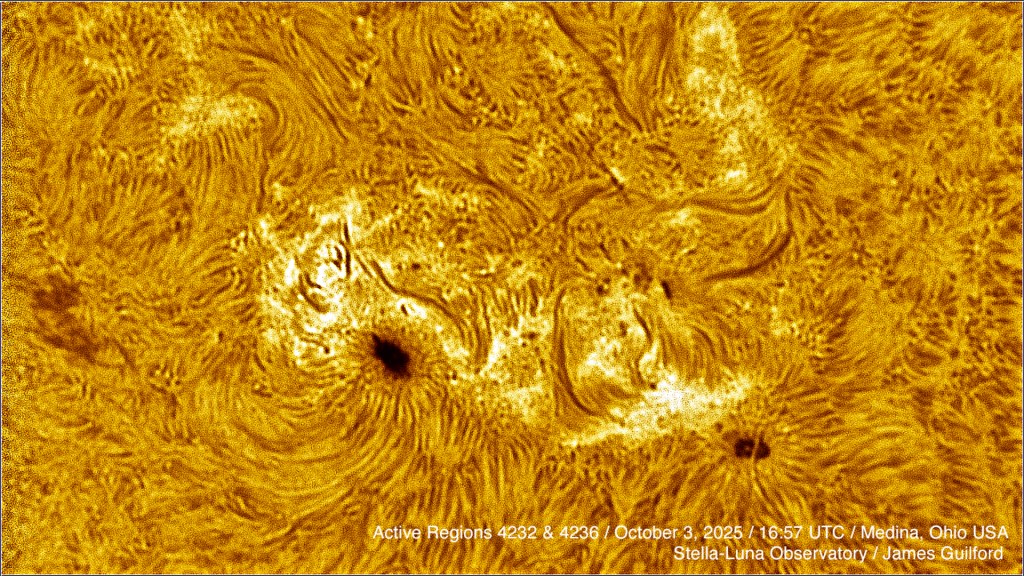
We’re very pleased with Barlow-boosted views, shown here, though we’re still having some issues with achieving even lighting across whole-disk views — just can’t seem to get them tuned right with the Coronado SolarMax III. Visual observing was also very good, especially with the TeleVue 10mm eyepiece. October 3 conditions: Clear sky, temperature of 74°F, light southeast wind.
A close-up view of two large sunspots, as seen in hydrogen-alpha light. Solar plasma follows the intense and curved lines of magnetic force to highlight the turmoil in the vicinity of the spots.
Our temporary observing setups are assembled on the base/floor of the planned observatory. The light orange bucket, at center, protects an empty electrical conduit that will provide utility power to a permanent pier that will be installed there. In the foreground is a table supporting a light shield for the laptop computer. The large tripod next to the table supports the white light imaging scope. In the background is the Sky-Watcher SolarQuest mount with our Coronado hydrogen-alpha solar scope attached.
We’re still doing open-air astronomy though we have a nice, solid, clean, and level space to set up our gear! This is the setup we were using today to record the sunspot at active region 4079 as it is about to roll over the solar limb/horizon. Fortunately, though it’s a very temporary setup, the portable gear we use for casual solar imaging is fairly easy to set up.
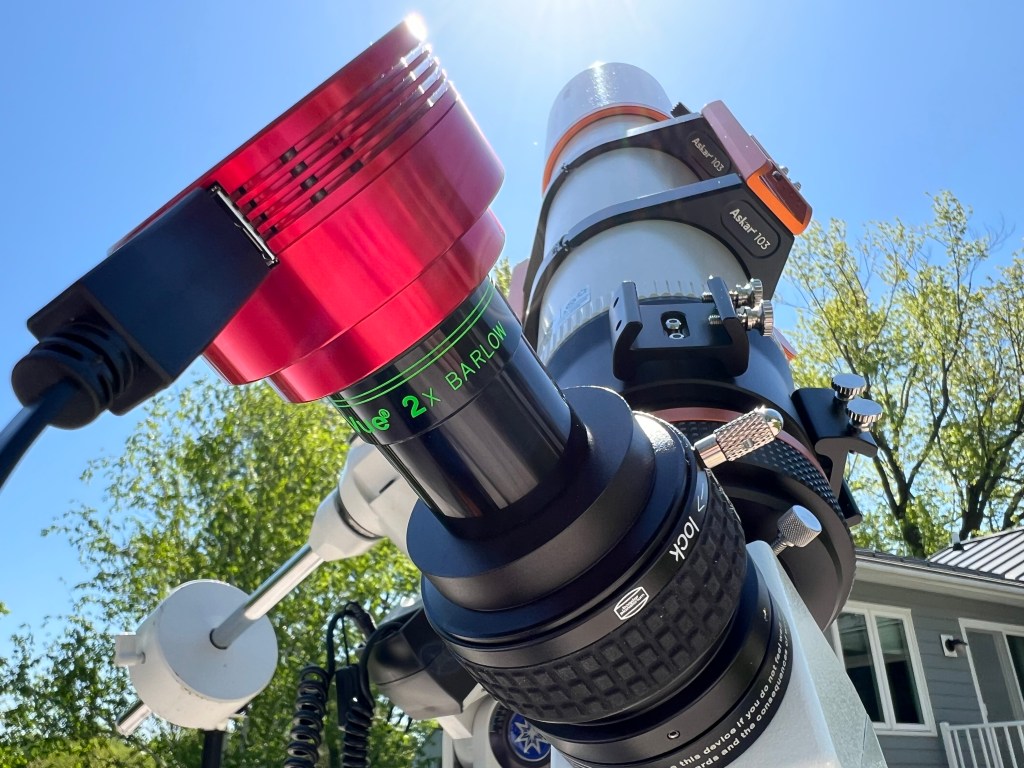
From an unusual vantage point, a picture of the solar setup used today to record the passage of active region 4079 toward Sun’s horizon. The red object is the planetary camera.
We continued experiments to determine what gear will work together for imaging. There were a few surprises and there’s need for more experimentation. What we settled on for today’s solar efforts is pictured above and includes: Askar 103 APO telescope, Meade LXD75 Goto Mount, TeleVue 2X Barlow, Baader Planetarium Safety Herschel Wedge, and ZWO ASI678MM monochrome planetary camera.
The sun as it appeared at 11:32 AM EDT on May 10, 2025. Sunspot/Active Region numbers are labeled in this image with AR4079 very near the solar western limb or edge.
Although the sky was clear, seeing was a bit shaky so once again, sharpness wasn’t what we’d like. Still, in all, we got the shot we wanted and learned a few things about our astronomy equipment. Also, the sky was blue, the air was pleasant, and birds were singing, so not a bad way to spend a couple of hours.
A closeup view of the sunspot at AR4079. There is a bright line splitting the dark central umbra of the sunspot, the gray penumbra radiating in filaments around it. White cloud-like areas surround the sunspot, especially to its north; called plage, they are associated with areas of concentrated magnetic field.
The complete solar disk as recorded in hydrogen-alpha light. The “worm-shaped” shadows seen in several areas are filaments. The dark spots are, yes, sunspots. And around the rim or limb of the solar disk are seen prominences — geysers of solar plasma riding magnetic field lines before crashing back into the sun. False color applied.
In addition to photographing Earth’s Sun in white light nearly every clear day, we occasionally set up the heavy telescope mount and bring out the new hydrogen-alpha (Ha) telescope for a bit of visual observing and unique imaging. It’s a bit of work since, without an observatory building we usually feel we need to take down and store away the mount after each session, so we don’t do that every day.
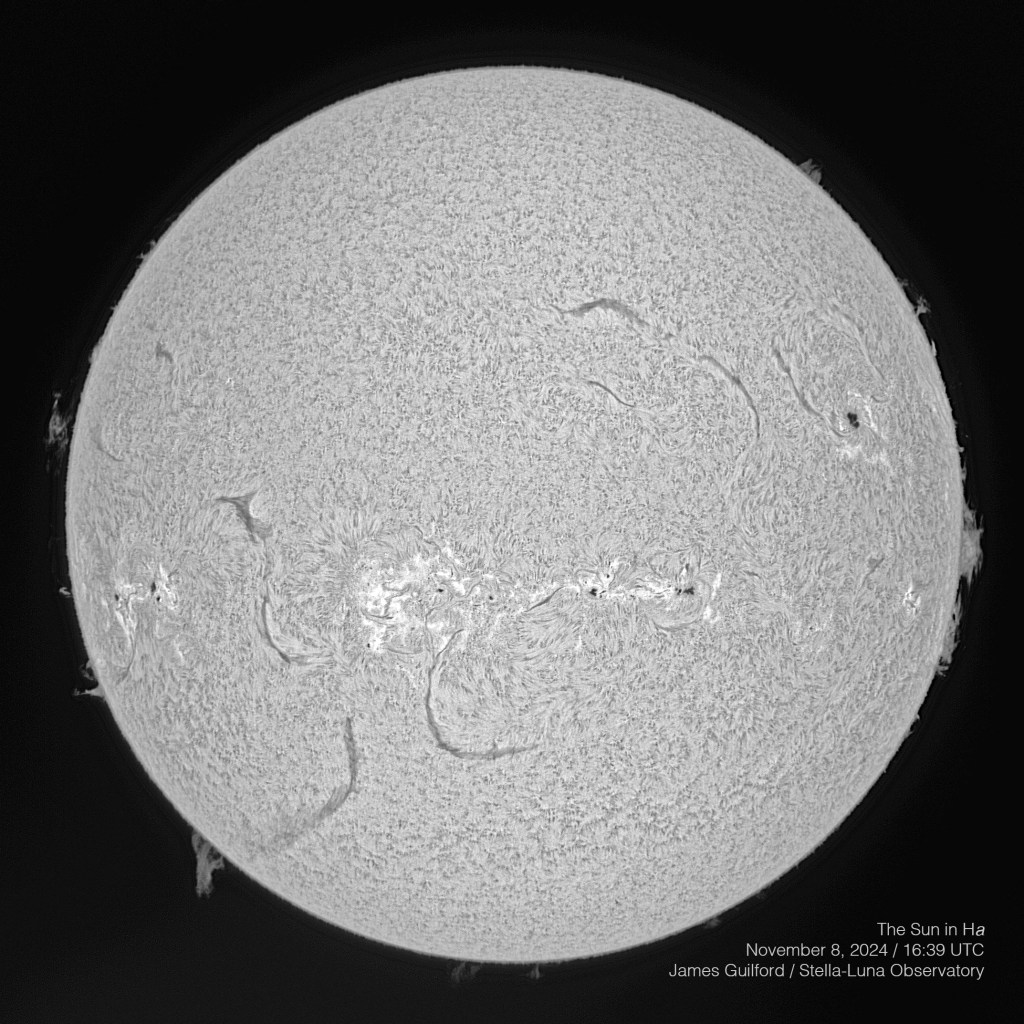
On November 8 we had clear skies, good atmospheric conditions, and the inclination to do the Ha setup and were rewarded with splendid views plus our best Sun images yet.
Using a Barlow lens to zoom for a closer view, we see large and small prominences and hints of spicules along Sun’s limb, and several large filaments. The dark spots in the upper left-hand corner of this picture is a group of sunspots at active region 3889.
Across the solar disk were visible large and distinct filaments — prominence loops seen from “above” — as well as sunspots and swirling patterns in the solar atmosphere around them. All around the Sun’s limb could be seen prominences glowing against a background of black space. Some of the prominences, which are fountain-like sprays and loops of magnetically-charged plasma, were quite large.
A major part of producing good images is what happens away from the telescope. Our usual practice is to record video of the telescope view and use software, in the office, to sort through thousands of video image frames, then stack the best few hundred to form a single still image. The still image is then edited to bring out as much detail and tonal range as possible. This process, which is common in astrophotography, produces a sharper image than what might be acquired via any single photographic “snapshot” owing largely to atmospheric turbulence.
Using a Barlow lens to zoom for a closer view, we see large and small prominences and spicules along Sun’s limb. The dark spot just above the center of this picture is a large sunspot at active region 3879.
There’s room for improvement, and we’re seeing excellent progress, but the images shown here are our best yet of Sun in hydrogen-alpha light.
Note: H-a light is that which Sun is producing in its chromosphere — the solar atmospheric layer between the outer corona and the lower photosphere — and is invisible even to protected human vision and white light cameras. Specialized optics are required to block other wavelengths found in white light and allow observation of Ha. When we observe or image in white light, we’re actually viewing features such as sunspots while looking through both the corona and the chromosphere!
Safety Note: It is not safe to look directly at the sun without specialized eye protection for solar viewing, and safe solar filters for telescope, binocular, or camera use. Permanent damage to vision can result from improper viewing of the sun.
The complete solar disk as recorded in hydrogen-alpha light. The “worm-shaped” shadows seen in several areas are filaments. The dark spots are, yes, sunspots. And around the rim or limb of the solar disk are seen prominences — geysers of solar plasma riding magnetic field lines before crashing back into the sun. Image was recorded and presented here in monochrome.
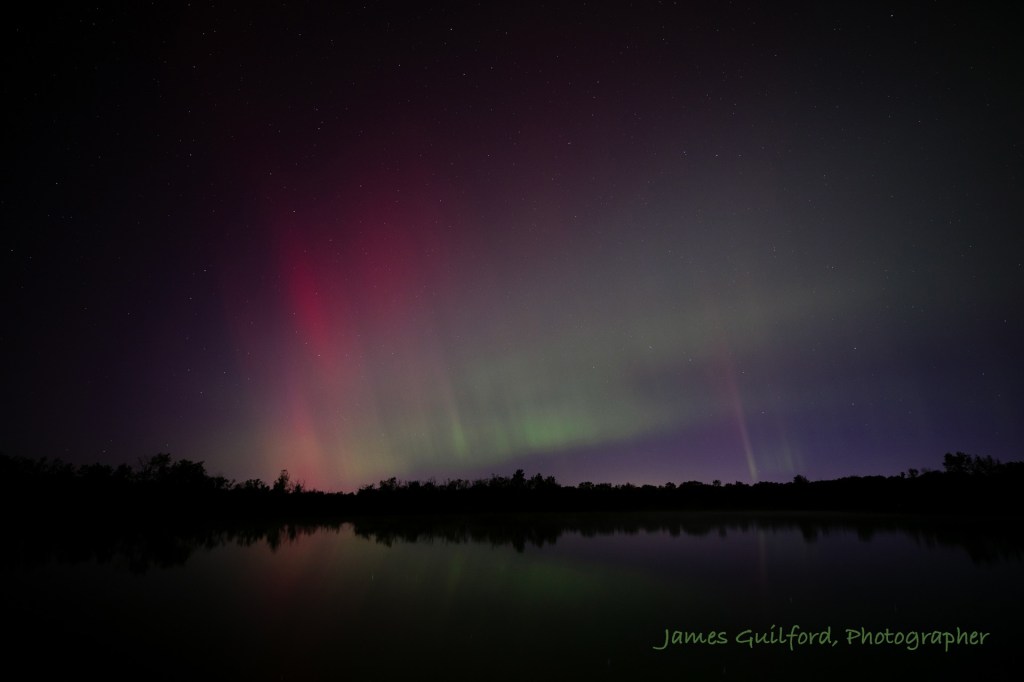
A panoramic view of the aurora borealis as viewed from rural Medina County, Ohio, as a surge in activity occurred. The display is reflected in the still waters of a small lake. The bright light at the right-hand end above the treeline is light pollution from the city of Medina. Photo by James Guilford.
It began on Tuesday, October 8, when a sunspot called AR3848 flared explosively over the course of several hours. The detonation hurled a large and powerful coronal mass ejection (CME) Earthward from Sun. On Thursday, October 10 the magnetically-charged solar plasma hit Earth’s geomagnetic field and fireworks erupted. According to SpaceWeather.com the aurora borealis was seen as far south as Puerto Rico!
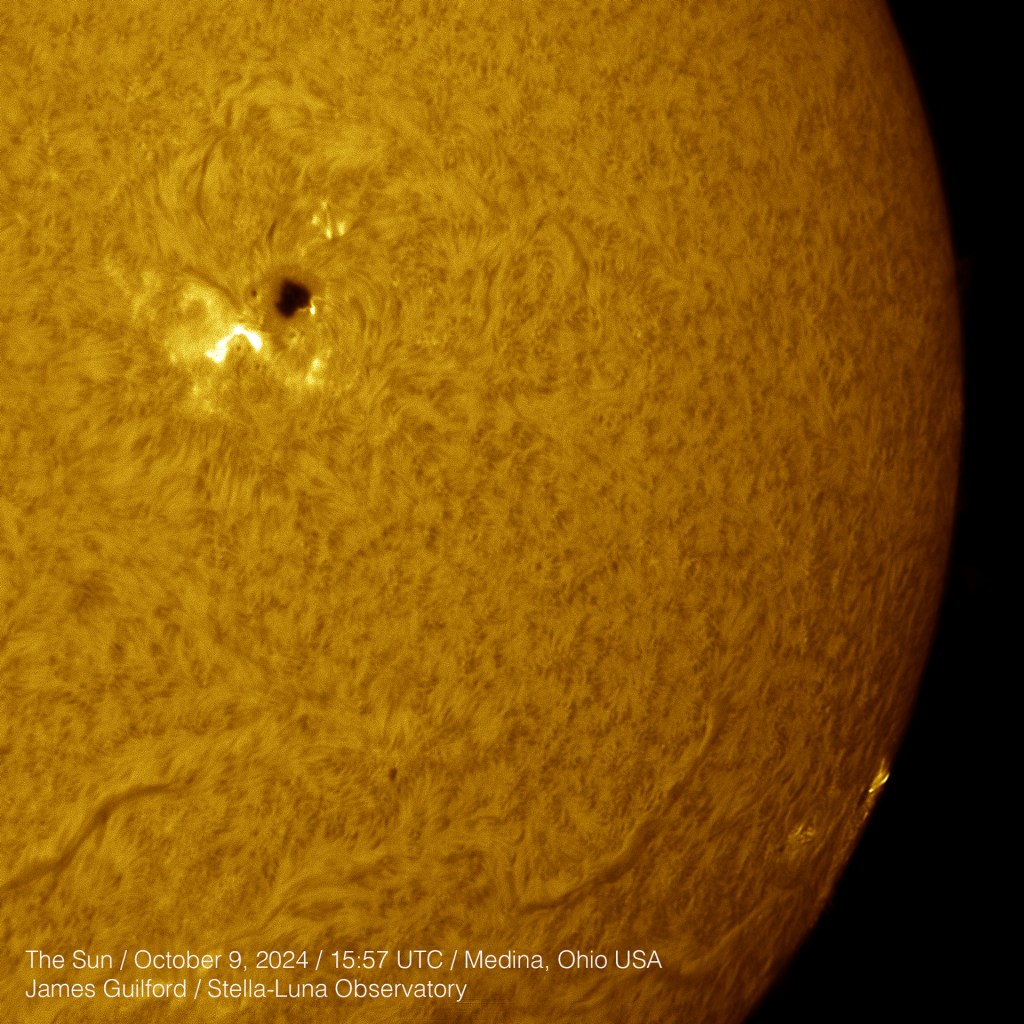
The area in the upper left-hand portion of this photograph is AR3848, the “active region” that produced an enormous solar flare on October 8, 2024. This is a view of Sun in hydrogen-alpha light, which shows the solar coronosphere layer. Photo by James Guilford.
I headed out to a remote county park location, where I have permission to be after dark, and was fortunate enough to be ready when a significant surge in activity occurred — around 10 PM EDT. That peak was amazing with colors, shapes, and movement visible across the entire northern horizon. It was particularly cool to see pillars appearing and disappearing in real time. Light from the aurora reflected upon the still waters of the park’s lake. Adding to the quiet, magical mood, were occasional calls in the darkness from perched birds. A wood duck, out on the lake, piped a sound reminding me of common loons.
During peak activity, looking east, we see intense red crowning a curved green ring, the Northern Lights reflected from the surface of still lake water. Photo by James Guilford.
The auroral surge went on for probably a bit more than half an hour, challenging me to select a spot to photograph. First one area would glow, then one at the other end of the bow-shaped display, pillars of light would appear like searchlights, then fade away. A thrill to witness as light, movement, and delicate colors were visible to the unaided eye. The camera picked up more than my poor eyes could see but I say without reservation this was the grandest aurora I’ve witnessed.
The western end of the coronal arc appeared strongest, as viewed from Medina County, through most of the evening. Here, during the surge, we see typical auroral colors, curtain-like waves of shape, and pillars that look like they reach the ground or might be mistaken for searchlights projecting from the ground. Photo by James Guilford.
All evening there seemed to be more intense activity over the western end of the aurora; that was verified by relatives in northwest Ohio whose photos showed a sky full of color directly overhead.
Although some observers were concerned that moonlight might drown out the aurora, that was not a problem during the peak or as it began to subside. This image shows the waxing Moon, low to the western horizon, with colorful patches of glowing sky nearby. Photo by James Guilford.
While I was at the lake I heard others coming and going from the park, pretty much the entire time I was there. A young couple eventually ventured away from the parking lot and encountered me at my spot around 11:30, seeking what I had found — a dark spot near the water. Their arrival had been delayed by a camera gone bad, and they had gone home to pick up another. Things petered out not long after the peak and, checking NOAA resources, it looked like the auroral ring was retreating back north. The couple had missed the best of the night and I, with frozen fingers and toes, I headed home.
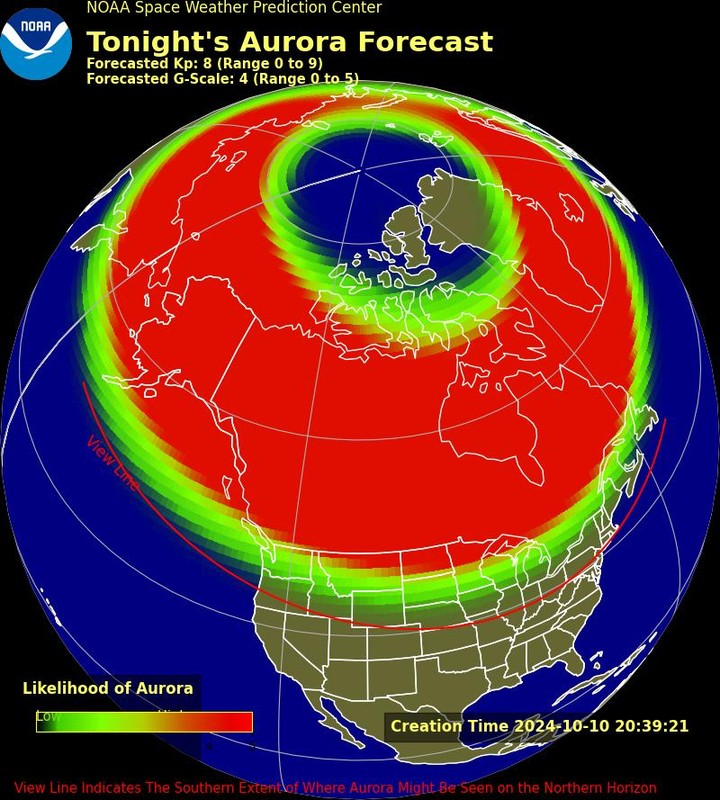
NOAA Space Weather Prediction Center graphic showing the predicted extent of the October 10-11, 2024 aurora borealis. Observers reported seeing portions of the aurora as far south as the Florida Panhandle. According to SpaceWeather.com it was seen as far south as Puerto Rico!
Still working without a dome, our setups are outdoors and temporary so we try and keep them fairly simple. Solar observing and imaging generally lend themselves well to brief observations due to the extreme amount of light available and resultant short photographic exposures. With a couple of clear days and nights available, we took advantage and made some experiments and observations with several successive setups on a single Skywatcher EQ6-R Pro mount.
Southern hemisphere of Sun — First Light image from ZWO ASI678MM planetary camera, via Baader Herschel-Prism, and Askar 103 APO telescope. False color applied.
We began with the Askar 103 APO telescope and its 700mm focal length, attaching our Baader Herschel-Prism, and the new ASI678MM monochrome camera. The setup worked well but for one issue: focus was only just achieved with the focuser racked all the way in with no latitude for adjustment. Image quality was very good but probably would have been better if we’d have had a bit more inward travel. Note: It was only later that we realized we might gain the needed travel if we had switched the camera’s nosepiece from the 1.25-inch to the 2-inch, allowing removal of the thick 1.25-inch adapter ring from the Herschel. A well, duh, moment!
By the way, we continue to be impressed by the build quality and optical excellence of the Askar refractor. It’s a solid instrument with great features, delivering superb results.
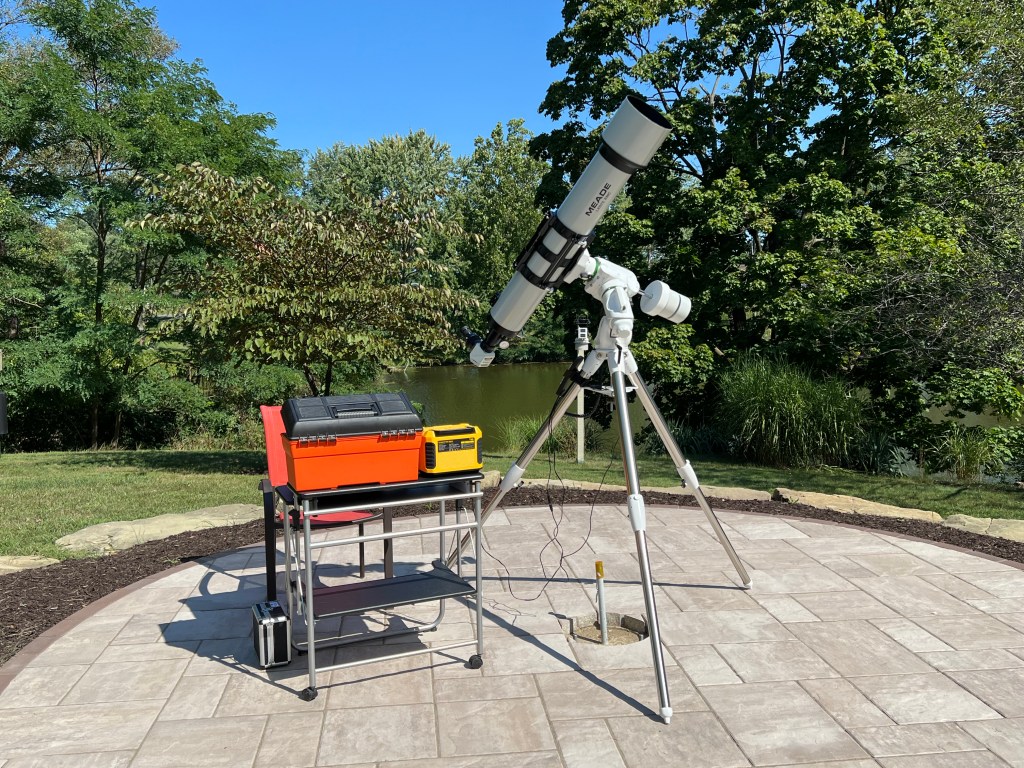
Askar 103 APO telescope, Baader Herschel-Prism, ASI678MM camera, on the Skywatcher mount makes an excellent combination. A Herschel wedge-style optical device does not require a filter be attached in front of the telescope’s objective lens — deflecting, absorbing, and ejecting the bulk of sunlight energy. Internal filters in the Baader apparatus reduce brightness and increase contrast.The Meade 6-inch refractor atop the Skywatcher mount and tripod. Visually, very effective, but the setup did not work with the Herschel-Prism and camera. The circular paved area is to form the floor of the observatory structure, the gray conduit to deliver power to a permanent mounting pier. Yes, the sky really was that blue that day!
The second experiment involved installing our massive Meade 6-inch telescope on the mount. The Skywatcher has a retractable rod for holding counterweights and is, therefore, a bit shorter than it might otherwise be, resulting in less leverage. It took nearly all of our available counterweights to balance the big scope. We installed the Herschel-Prism and a nice eyepiece and got beautiful views of the spotted face of our star. Attaching the ASI678MM, however, we could not reach focus — that inward focuser travel limit again — but we don’t believe the switch to the 2-inch nosepiece will help. That’s a shame! The Meade’s 1,250mm focal length would have provided amazing closeups!
The 11-inch Celestron SCT set up for a nighttime trial. This OTA was part of an integrated mount system that had failed so we “deforked” the telescope and attached a mounting rail for use on an equatorial mount.
With the mount set up we decided to try out the 11-inch Celestron SCT at night. Herschel wedge accessories are not to be used on reflecting telescopes as the concentrated unfiltered incoming sunlight can damage the scope’s secondary mirror. To our disappointment the telescope, which has set in storage for months since we attempted collumnation, displayed rather severe image distortions — comma-shaped stars. After a good bit of frustration we dismounted the telescope and planned to come out the next night with the Vixen Cassegrain telescope.
All good things… A series of clear days and nights came to an end with clouds rolling in to cover Saturn as it emerged from behind neighboring trees.
The following evening looked very promising; the sky was actually more transparent than it had been for the Celestron effort. Saturn would rise from behind trees neighboring our site some time after 11 p.m. so, at the appointed hour, we stepped outdoors and looked. Clouds, heralding a day or two of rain showers, were rolling in — broken at first but rapidly obscuring the entire sky. We tore down the setup, stowed the gear, and called it a night.
Tight crop on sunspots from the planetary camera’s First Light image of September 4. Sunspot umbra, penumbra, details are visible as are faculae and the granulated texture of the solar photosphere. Askar telescope, Baader Herschel-Prism, ZWO ASI678MM camera.
Over the period of a couple of days and nights, much was learned and the new planetary camera proved itself to be an excellent performer. We’ll continue to use the camera and telescope for solar and, probably, lunar views. Next we’ll likely try installing the focal reducer to achieve full-disk images.
Sunspots AR3716, AR3713, and AR3712, imaged June 22, 2024, 12:59 UTC, by James Guilford
I continued my practice of daily imaging of the sun for some weeks now. While still deciding precisely how to use and display the images I’m collecting, I’m also trying to standardize how the images are captured and establish a workflow in editing; that is in an effort to give the daily pictures the same overall size and appearance except for details, such as sunspots, where we want to observe changes. It’s not as easy as it may seem, especially when attempting to constantly improve image quality. This ought to become simpler once I have a permanent setup protected day-to-day within an observatory structure.
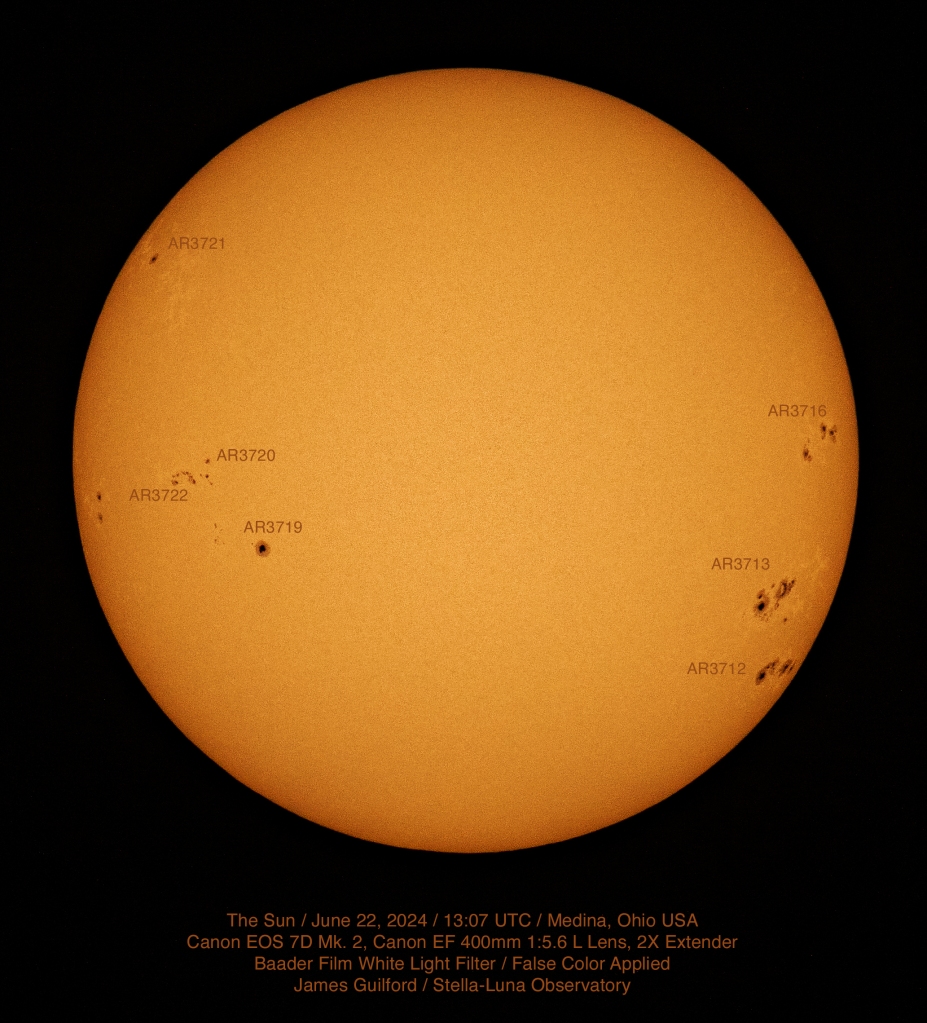
Sunspots AR3713 and AR3712, the more pronounced of the three large groups, have been interesting to watch as they traversed the visible side of Sun. Today (June 22), braving the morning’s already hot and humid conditions, I went to the extra work of setting up the Vixen VC200L Cassegrain telescope in an effort to achieve high quality images of the two — plus AR3716 — big sunspot groups before they disappear over the western solar limb. Both of the active regions reportedly harbor opposing magnetic energies which could, at any time, reconnect and throw off powerful flares but both have been surprisingly quiet. The next few days will be the last when an outburst from AR3713 or AR3712 might affect Earth.
The Sun, June 22, 2024 at 13:07 UTC from Medina, Ohio USA. Equipment: Canon EOS 7D Mk. 2, Canon EF 400mm 1:5.6 L Lens, 2X Extender, and Baader Film White Light Filter. False Color Applied. Image Credit: James Guilford / Stella-Luna Observatory
















 Stella-Luna Observatory