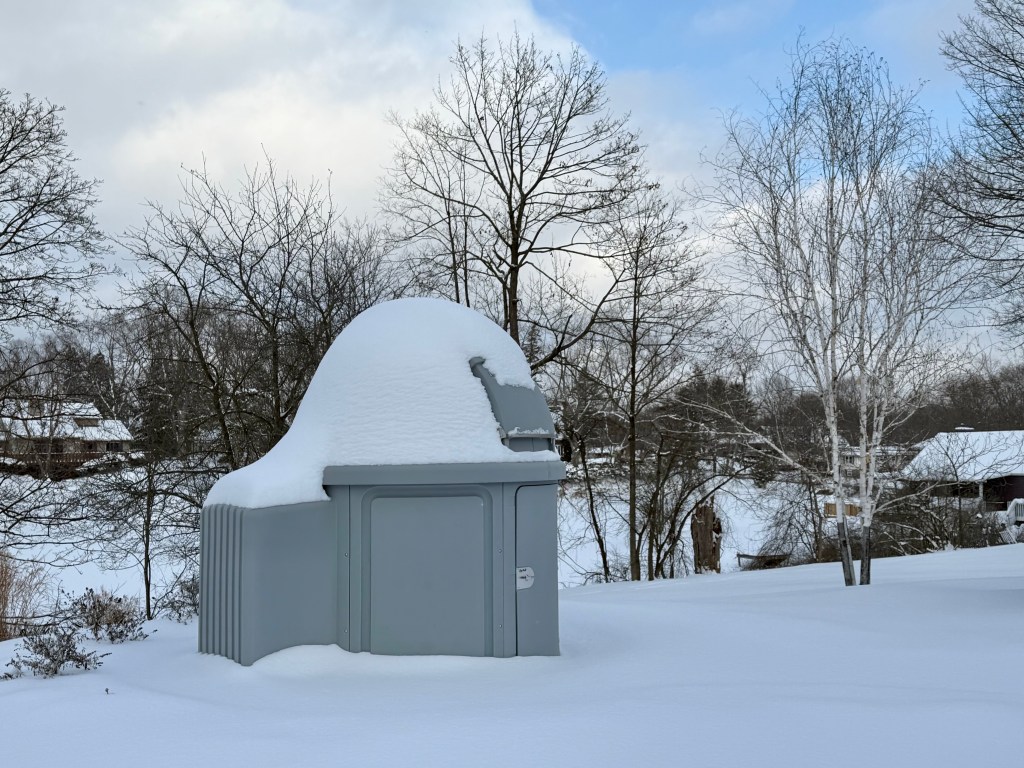
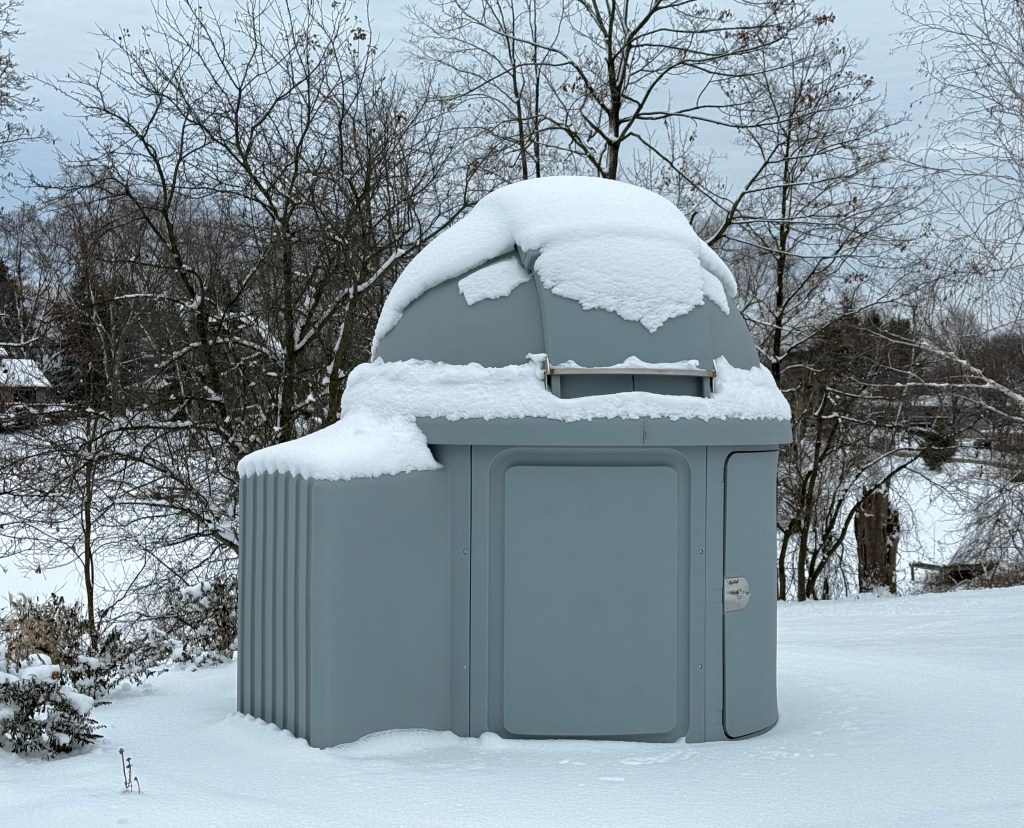
The gray observatory is surrounded by accumulated and drifting snow. The dome itself wears an extra dome of accumulated snow.
Recent arctic-air frigid weather has brought real winter weather to our region for the first time in a few seasons. Snowfall over the past 48 hours amounted to 10 or 12 inches of light, flaky, fluff. Nighttime below-zero low temperatures have erased any thought of going out; skies have been cloudy, anyway, preventing guilt and regret. So the dome remains sealed though pointed to the south for midday solar observations. If we ever see Sun again.
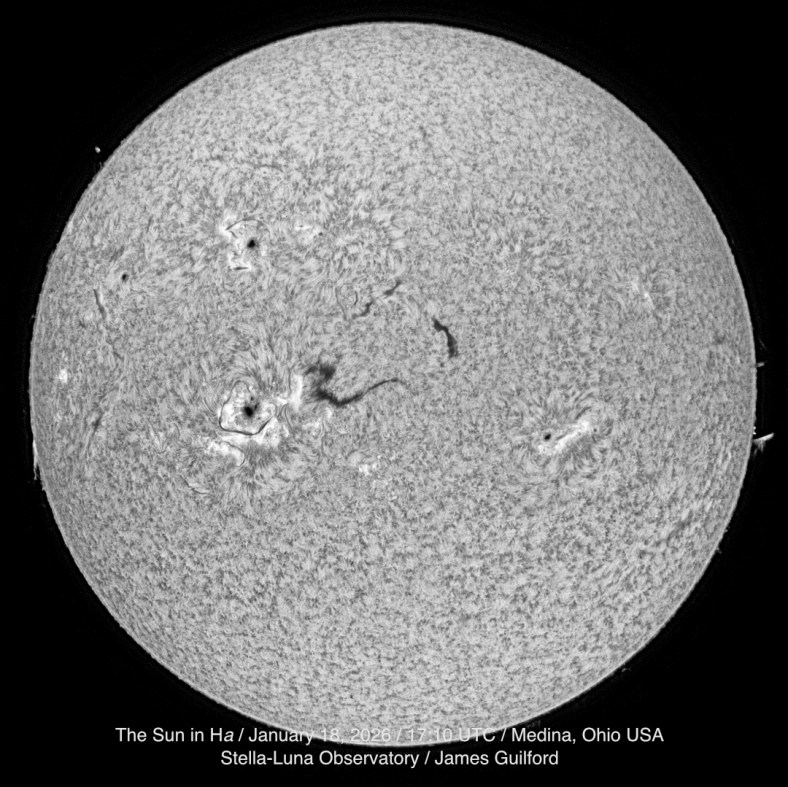
Full disk image of Sun as viewed in hydrogen-alpha light. Snake-like, dark filaments grace the center of the image. Several sunspots are also noted. Dominant in its influence on surrounding plasma features, is Active Region 4341 which exploded with a powerful flare one hour after this image was recorded.
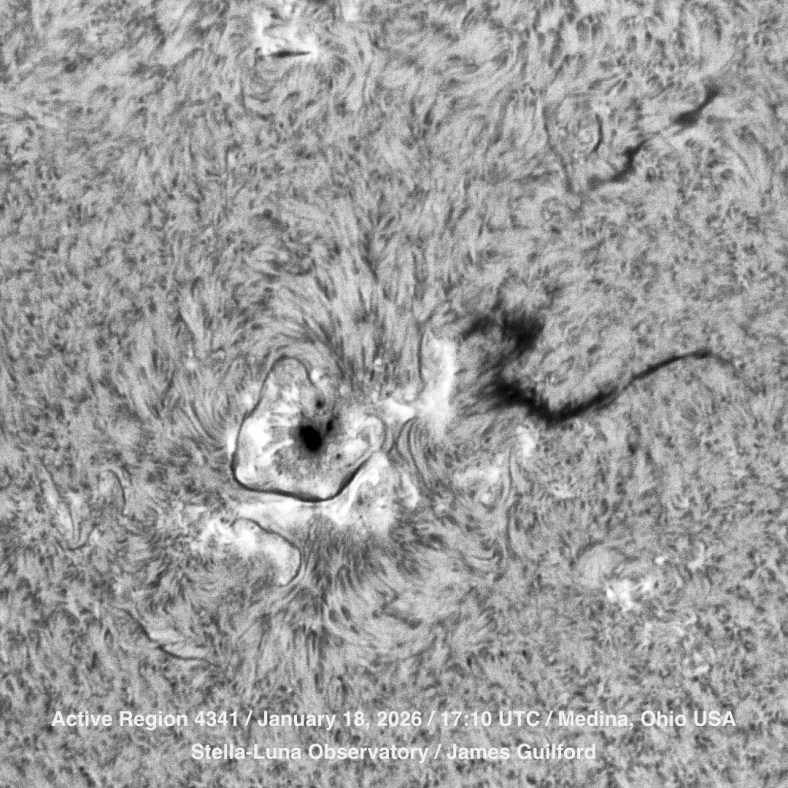
With recent weather, we believed the observatory might be closed until spring. On January18, however, the skies were clear and blue with very little wind. We unsealed the dome, brushed off some of the accumulated snow, and aimed at Sun. The first thing we observed was the presence of large filaments at the center of the disk. One filament, Z-shaped, was in immediate proximity to a large sunspot at Active Region 4341. Also visible were multiple prominences around the disk; Sun is still active! The powerful magnetic forces surrounding AR4341 are made evident by its influence upon Solar plasma — twisting and aligning the visible features like iron filings around a science classroom magnet.
A close-up view of Solar Active Region 4341, in hydrogen-alpha light. Snake-like, dark filaments grace the center of the image. Several sunspots are also noted. Dominant in its influence on surrounding plasma features, AR4341 exploded with a powerful flare one hour after this image was recorded.
While the sky was clear and blue, the temperature was wicked cold for standing around on stone floors. Also, touching metal telescopes, properly allowed to reach the ambient temperature of 19°F, with bare hands is, painful. The laptop computer also found the temperature uncomfortable for, while its battery was charged to about 60% capacity, the system quit complaining of low battery. Attaching the computer’s charger let us finish the session.
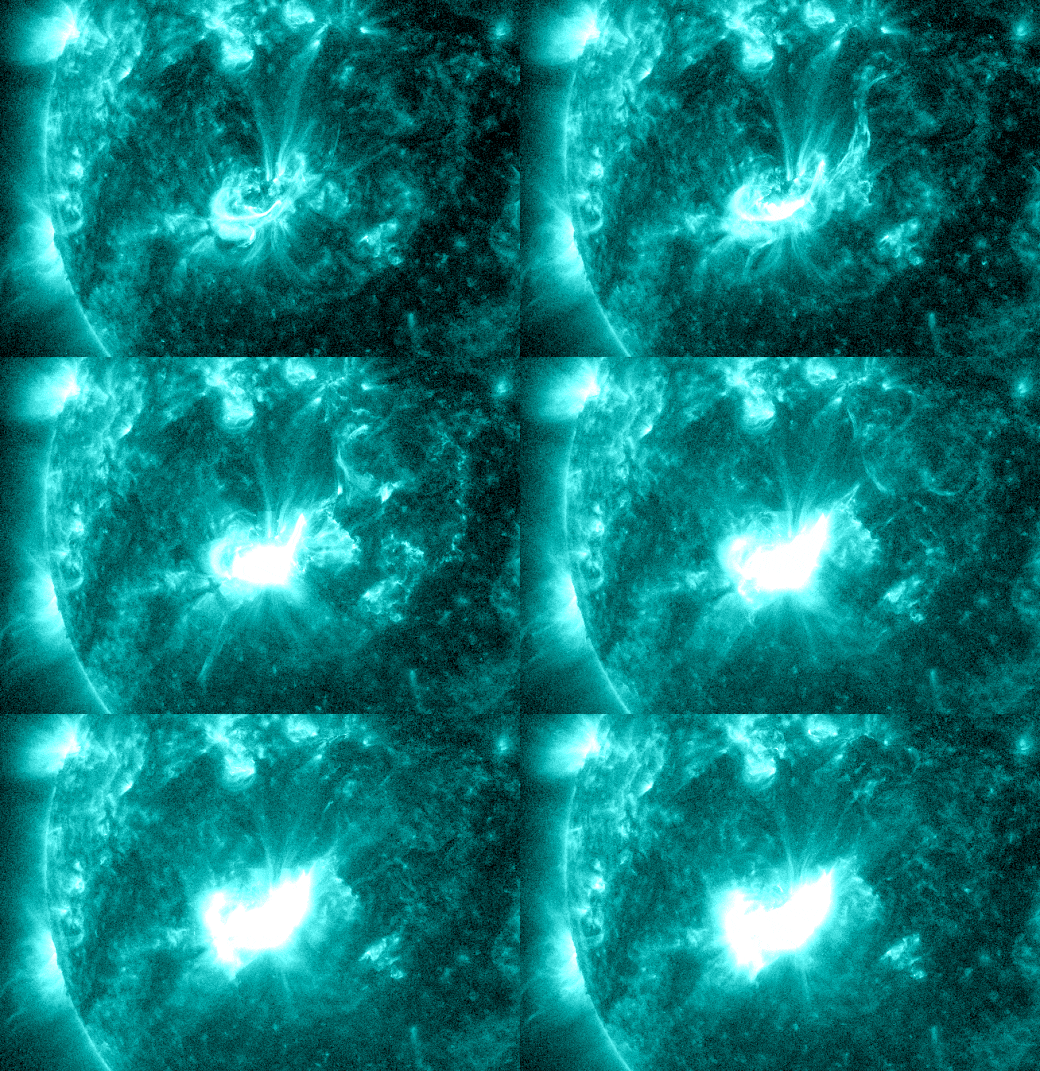
Video from NASA’s Solar Dynamics Observatory spacecraft, showing the X1.9/3b flare at AR4341. — January 18, 2026
One hour after we recorded the images of AR4341, the sunspot exploded with a massive X1.9-class flare. Expansive auroral displays are expected early January 20 though here, in Northeast Ohio, we are expecting cloudy, winter weather.
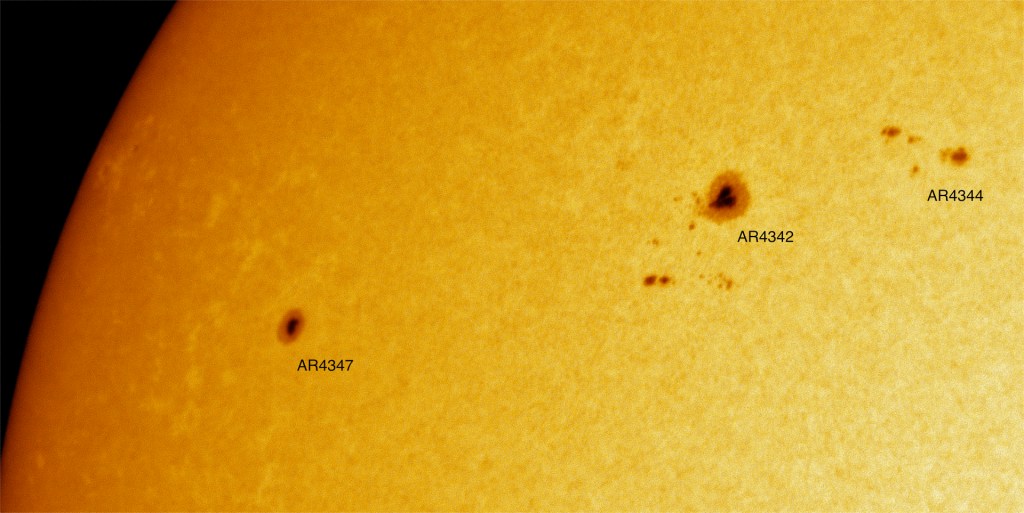
Also appearing on Sun, sunspots at AR4347, 4342, and 4344, shown here in white light (false color applied), in the northern hemisphere. Hydrogen-alpha light reveals features in Sun’s chromosphere, whereas white light imagery shows features, such as sunspots, in Sun’s photosphere — a layer deeper.
First Winter: Stella-Luna with a coating of snow, some of which is sloughing off, closed up and waiting for the occasional day or night with clear skies.
With overcast skies, overnight temperatures of about 9°F, and five-plus inches of snowfall over the past 48 hours, we’re pretty much buttoned down. Of course, changeable as weather is, they’re forecasting sunshine tomorrow, and 47° with rain by Thursday! Yeah, you saw “sunshine” mentioned but we have a healthy level of doubt where clear skies lately are concerned. In the meantime, there is snow to shovel and birds to watch… Oh! That’s a red-bellied nuthatch!
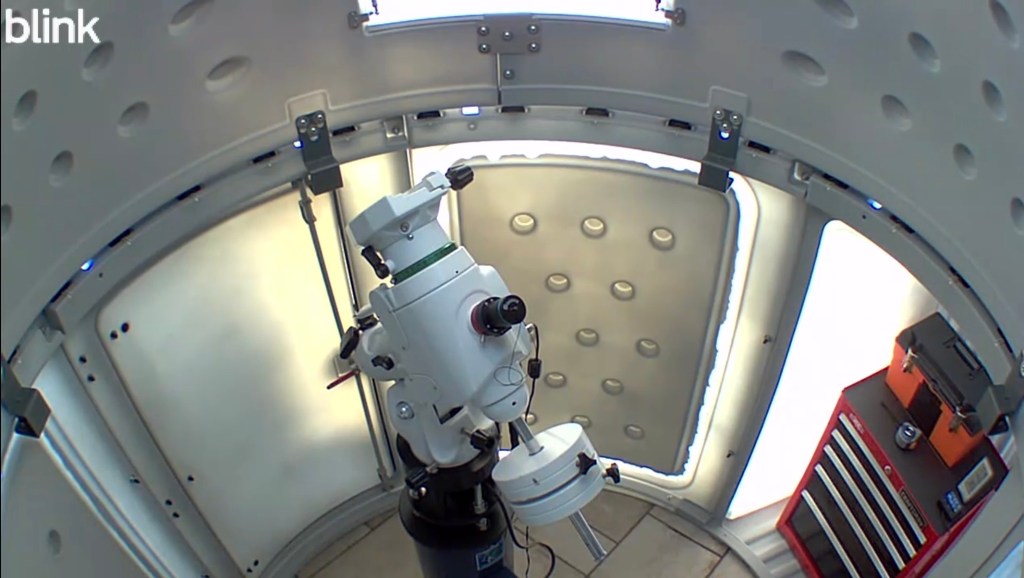
Observatory interior showing the telescope mount without telescope, the instruments having been stowed awaiting better sky conditions. After some test runs we’re still deciding on which scope might be designated as the “permanent” observatory instrument; some shopping is also happening.

 Stella-Luna Observatory