An International Observe the Moon Night promotional graphic. Credit: NASA
Note: The observatory construction is essentially complete with only a few “touch up” items and further outfitting remaining. We’ll eventually get around to writing and illustrating the story of the project. First, though, the 2025 International Observe the Moon Night….
October 4 marked International Observe the Moon Night (IOMN), an event billed as an opportunity to “unite people across the globe in a celebration of lunar observation, science, and exploration.” Coordinated and promoted by NASA, IOMN boasted 1,045 registered events worldwide. That count does not include informal events and individuals who, on their own, observed Earth’s Moon, encouraged by the promotion. Unfortunately, due to a U.S. government shutdown, NASA staff are unable to update the IOMN website and we may never know how it went this year.
While we did not host an outreach event, we did post fresh, new telescopic images depicting lunar details, along with descriptions of those events as our participation. This year, we concentrated our efforts on the Threads social media platform. What follows is what we posted.
Here’s a nice full-disk view of Earth’s Moon, one we made a few months ago with a phase very close to what we see tonight. The phase is called the “waxing gibbous” and is seen between the First Quarter and Full Moon. Moon will reach its full phase the night of October 6, this year.Mare Humorum, aka Sea of Moisture, is the dark circle at the center of this image. It was formed in an impact by an asteroid or comet, the crater filled with basalt. The “sea” is about 264 miles across and is seen here near the terminator — the dividing line between night and day — not long after local lunar sunrise. Crater Gassendi is the circular ring that intersects with Humorum. The crater is about 69 miles in diameter; a smaller crater at its northern edge is called Gassed A.
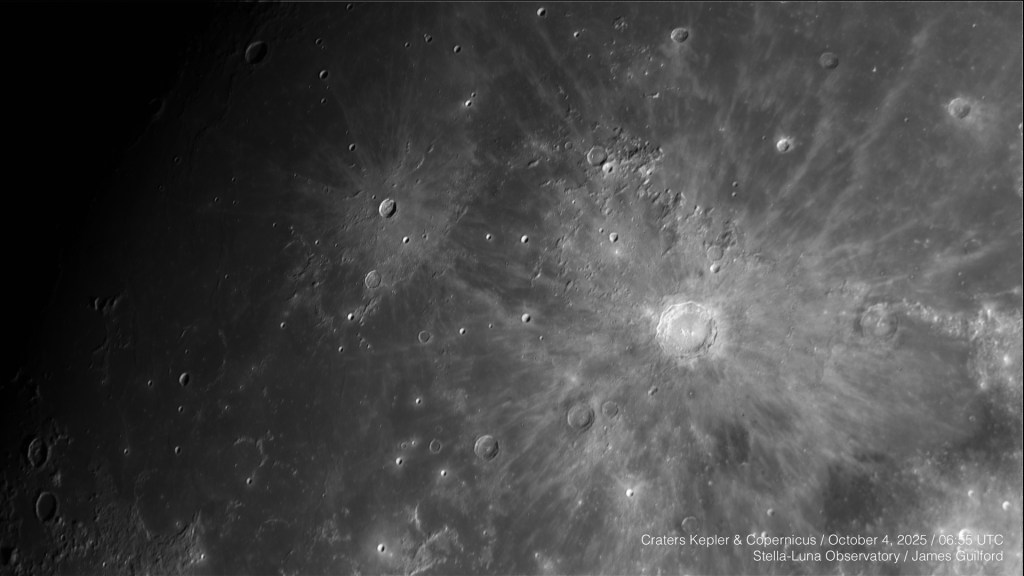
Followup Edit: Spellcheck was convinced we meant to type “Gassed” when what we really wanted was Gassendi A. Maybe it was the chili we had for dinner. Here’s crater Tycho, prominent even in the heavily-bombarded southern lunar highlands. Estimated to be 108 million years old, Tycho is about 53 miles in diameter but easily spotted using binoculars or a small telescope. The crater’s vast field of ejecta rays — the spray of material “splashed” out when an object hit Moon — is bright and forms lines that lead back to their origin. The feature was named after Danish astronomer Tycho Brahe.Also near the terminator, in Moon’s northwest, is this beautiful pair of craters: Kepler (left) and Copernicus. Like Tycho, Copernicus is marked by the prominent lines of ejecta radiating from the impact site, a crater about 58 miles in diameter. Crater Kepler, about 20 miles wide, lies to the west of Copernicus with its western rim shining brightly in the light of the lunar sunrise. For our final image of the night, we’re posting our image of a complex area of Moon at the northern end of the terminator. In the upper right we see crater Anaxagoras and surroundings glowing brightly, contrasted against the stark blackness of space. The smooth band spanning the image is Mare Frigoris. “C” shaped arch marks Sinus Iridum, opening to Mare Imbrium. Crater Plato is the circle with a smooth, dark floor in the lower right. Notice the chain of smaller, satellite craters next to Plato.
Crater Plato is about 63 miles in diameter and about 3.84 billion years old. Once again, see how the western rims of the craters along the terminator shine in the low-angle light from the rising Sun.
We hope you have enjoyed what you have seen and will see online tonight, or were fortunate to attend an International Observe the Moon Night event in person. Outdoors, at home, online, or wherever you may be, we’re glad to have had you with us. We hope IOMN has united people across the globe in a celebration of lunar observation, science, and exploration, under one sky, appreciating one Moon. Goodnight, and keep looking up!





 Stella-Luna Observatory