
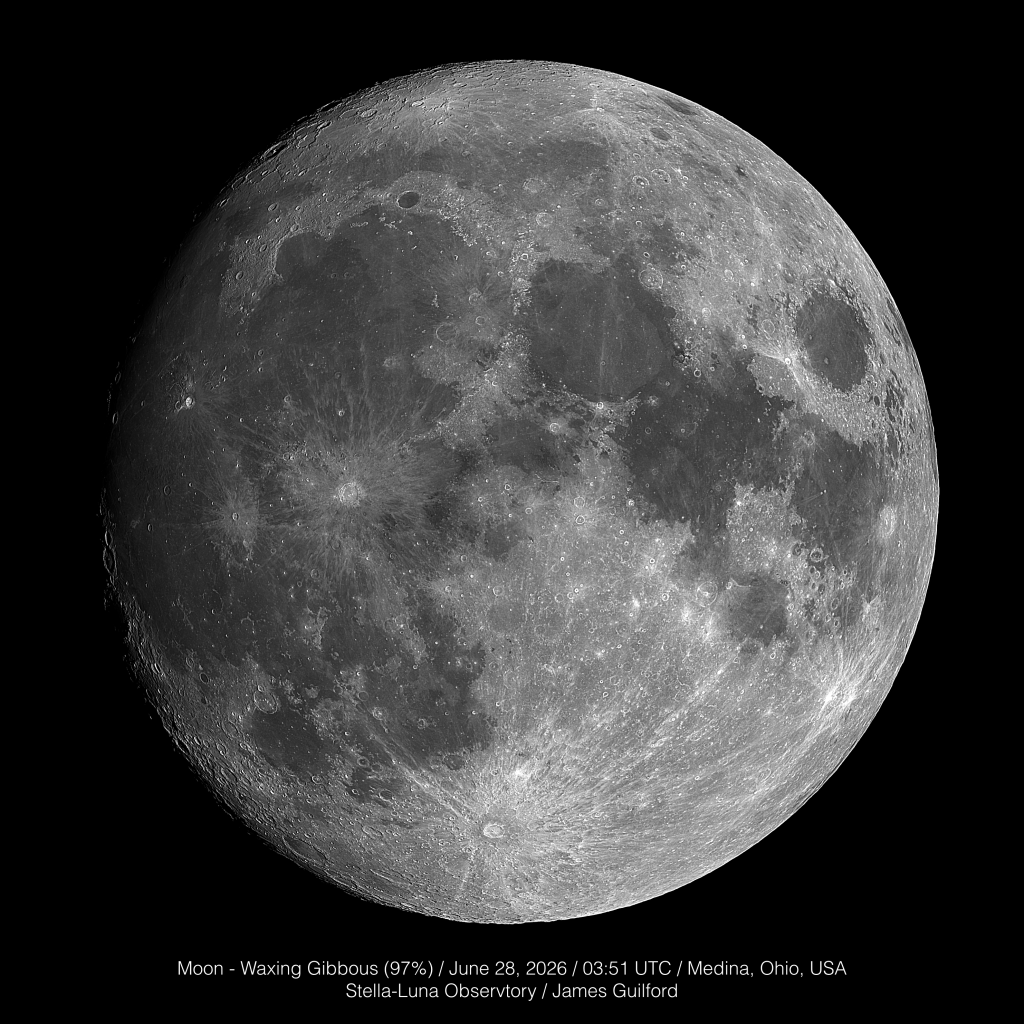
After recent struggles in an effort to get sharp images from the old C11 telescope, it was a pleasure to observe Earth’s Moon through the Askar 103 APO refractor! Clouds drifted through at various densities but — oh, my! — what a fine view! What the little Askar lacks in focal length, it possesses in sharpness. So we excitedly present this image of our Gibbous Moon!

Lunar Crater Copernicus (above), with its expansive web of ejecta rays, dominates this scene captured June 27 (local time). To the left of Copernicus is Crater Kepler, with a smaller but still visible “splat” mark, both contrasting well against the dark field of Mare Insularum. Left still farther, on the terminator, is a figure-eight ring feature formed by Craters Cavalerius (top) and Hevelius (bottom). This is our favorite image from the brief Saturday night session.

