An April SolarQuest — Photobomb Included

The Sun, as it appeared on April 17, 2025, in hydrogen-alpha light. The image was recorded using a Coronado solar telescope, a Sky-Watcher SolarQuest mount, and a ZWO ASI 678MM camera. Photo by James Guilford.

Taking advantage of midday clear skies, Thursday, we set up the hydrogen-alpha telescope and did a little observing and imaging. Seeing conditions were only good but we could make out several prominences along Sun’s limb. (The proms did not record well and we need to figure out how to enhance their visibility in our images.) Most notable, however, was the shear number of filaments in Sun’s northern hemisphere. None visible in the south! Fragments of exploding filaments launched from Sun and produced two CMEs that, when they reached Earth on April 16, caused strong geomagnetic storm activity and widespread auroras. The storm, however, died out before northern lights could be seen here.

The Sky-Watcher SolarQuest mount is shown here aiming our Coronado 60mm hydrogen-alpha solar telescope at Sun.

Aiding in our efforts was a device we used for the very first time in this session: The Sky-Watcher SolarQuest with its HelioFind system. The device is lightweight, easily supported our rather robust Coronado solar telescope, and was exceptionally easy to learn and operate. Essentially, all that was needed was to set the tripod up so that it was level, turn the device on, and let it do its thing! It is powered by four AA batteries, placed inside the unit. As an alt-az mount, no counterweights or muliti-axis balancing was needed; just mount the scope with its balance point at the center of the dovetail clamp. No remote control, no app, the compact and self-contained SolarQuest established GPS contact, leveled the scope, then looked for Sun. The SolarQuest turned and elevated the telescope, quickly acquiring our nearest star. When the motion stopped, we looked through the eyepiece to discover Sun well within the field of view. A few nudges of the system’s adjustment buttons and Sun was centered. Tracking was excellent throughout the observing/imaging session. Provision is made for further refinement of tracking but that adjustment was unnecessary for the day’s activity. The SolarQuest will make our daytime astronomy a whole lot more convenient and enjoyable!

A business-class jet airplane trailing twin contrails is seen in silhouette against the roiling surface of the sun. The image is recorded in hydrogen-alpha light. Photo by James Guilford.

We had just finished setting up for some solar astronomy and tapped the button to begin a video sequence when something flashed across the computer screen. A jet appeared for less than a second, contrails briefly persisting, silhouetted against the roiling solar disk! We’ve only seen this twice while observing Sun, this being the second time, and we only captured this image by shear luck. The first time we witnessed a solar “photo-bombing” was under similar circumstances. Previously, we had completed setup, was refining focus, and just about to begin recording exposures. We missed imaging that encounter by about the same interval as we succeeded this time!
An encounter with the occult(ation)

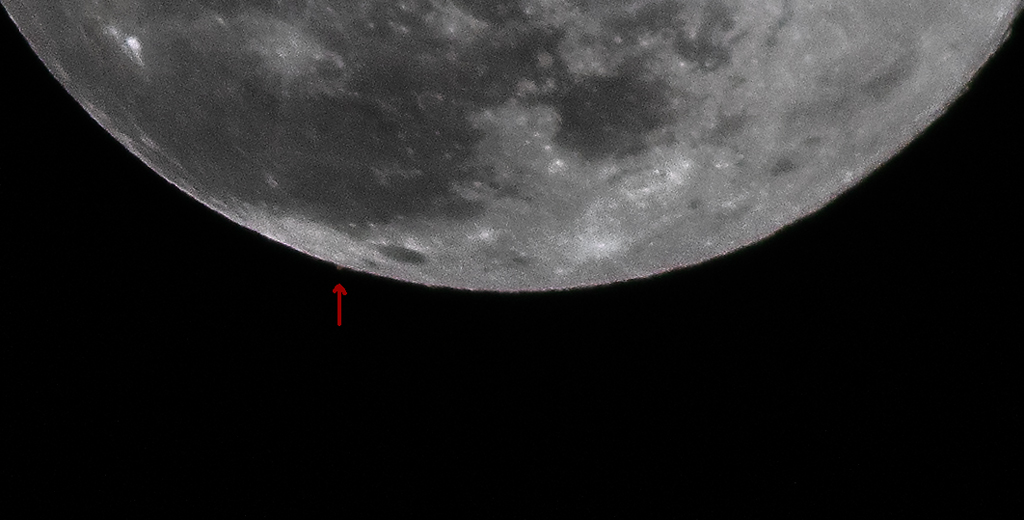
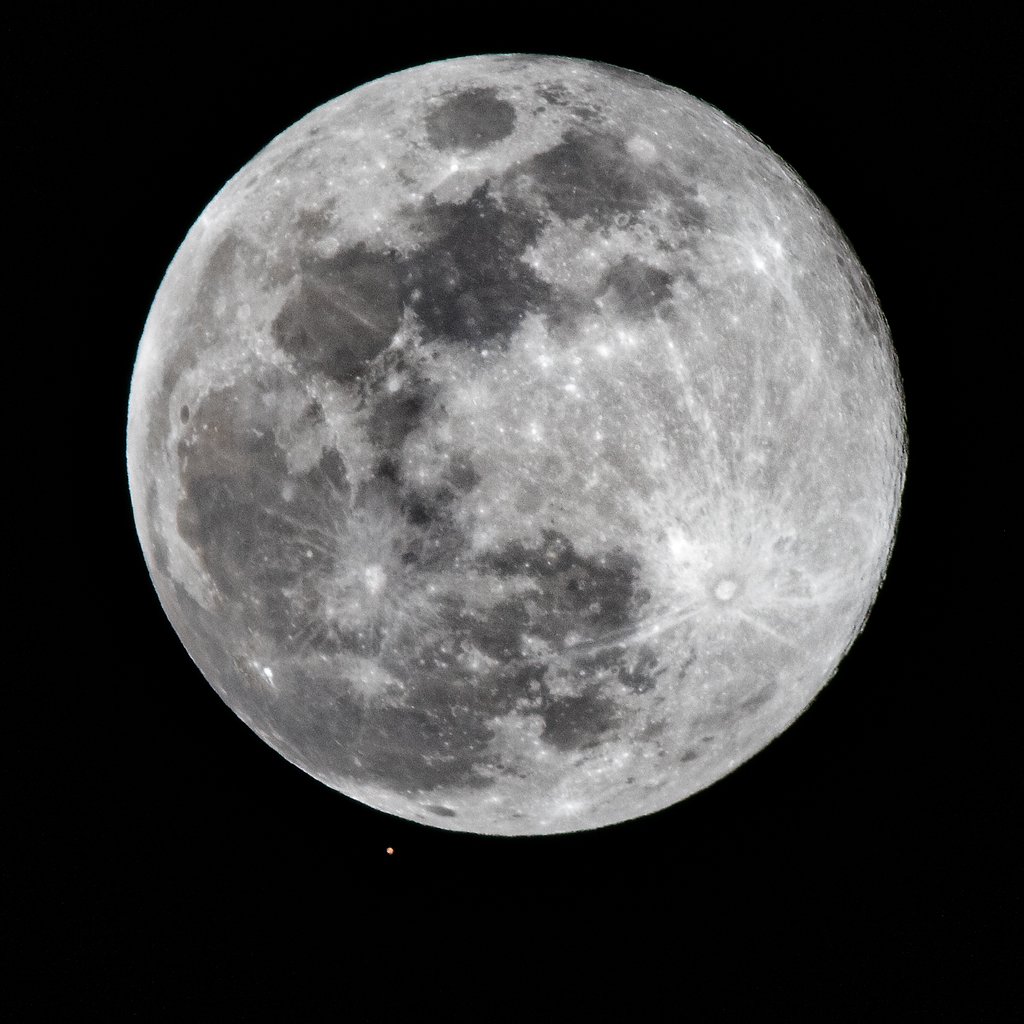
Only a few minutes from occultation, Mars is seen just off the lower edge of the lunar limb in this full-disk image recorded at 9:09 PM EST. The event only occurs with planet Mars about once every 14 years. Photo by James Guilford.

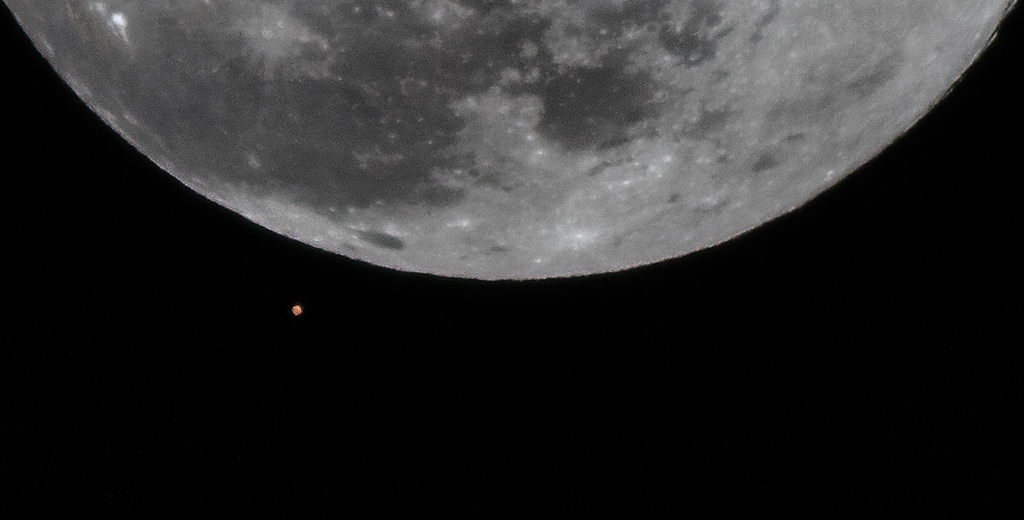
Clouds held off — pretty much — for us to observe the Moon occult* Mars, the reddish dot in the photo above. About once every 14 years or so, everything lines up just right and planet Mars is hidden by Earth’s Moon. Though Mars is about twice as big in diameter as our Moon, it was nearly 60 million miles farther away from Earth during the encounter — to the unaided eye, Mars looked like a tiny bright red star next to the Full Moon.

As predicted by mathematics, Mars and Moon grew nearer and nearer each other until, at 9:12 PM Eastern Standard Time (EST), the Red Planet disappeared behind our brilliant orb.

Mars, the small reddish dot in this image, nearing occultation by Earth’s Moon, as seen at 9:07 PM EST, January 13, 2025. Photo by James Guilford.
A red arrow indicates a ghostly mound that was Mars as it disappears behind Earth’s Moon at 9:12 PM EST, January 13, 2025. The dark oval to the right of Mars’s vanishing point is the lunar basin Grimaldi. Photo by James Guilford.

Passing clouds threatened to obscure the event but thanks to gaps between those clouds, there was enough clearing for observation. Shortly after Mars vanished, so did those inter-cloud gaps. With Moon now cloud-covered, we did not return to the 13℉ night to watch for Mars to emerge.

Technical: Canon 6D Mk. 2 Camera, Canon 400mm EF 1:5.6 L Lens, Canon 2X telextender, ISO 400, f/11, 1/250 second, photographic tripod.

*Occult: To cut off from view by interposing something. Commonly used as a noun to indicate something supernatural that is hidden from ordinary access.

Our best Sun images yet

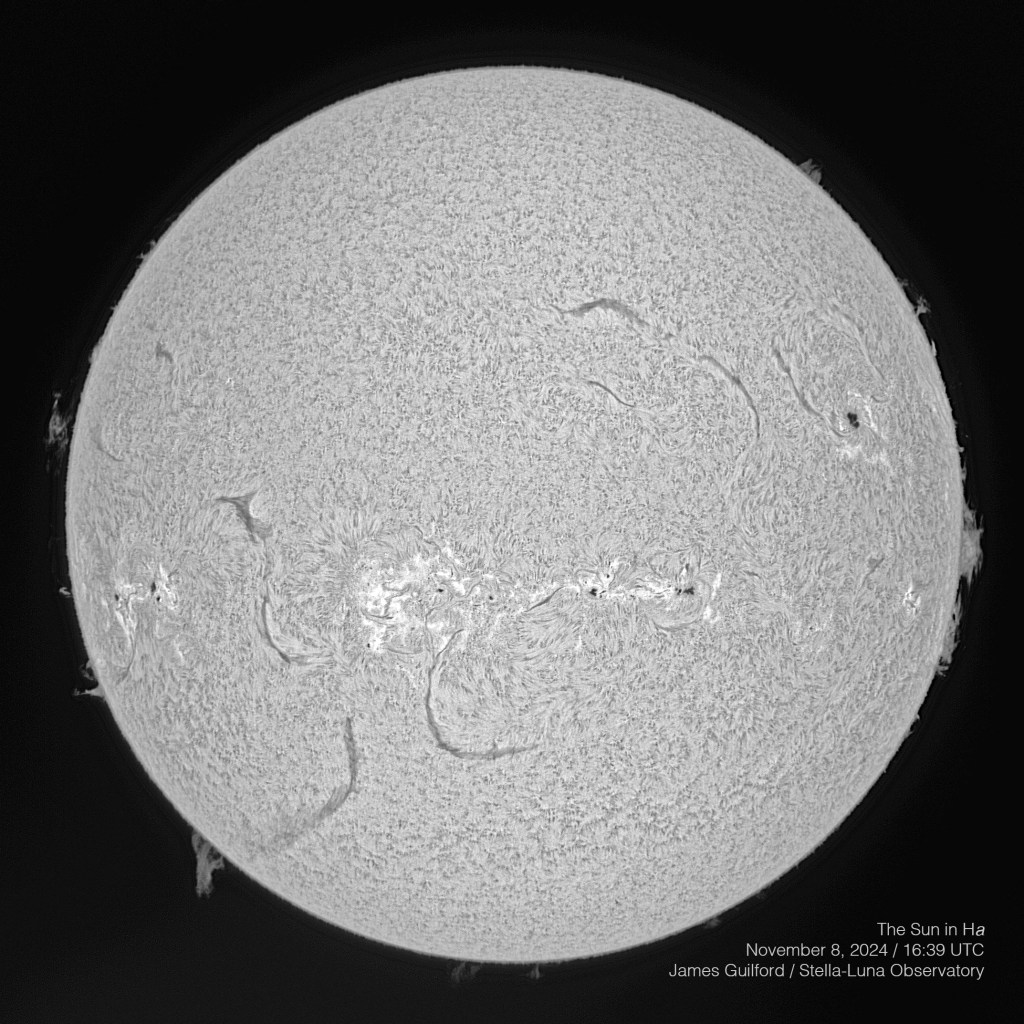
The complete solar disk as recorded in hydrogen-alpha light. The “worm-shaped” shadows seen in several areas are filaments. The dark spots are, yes, sunspots. And around the rim or limb of the solar disk are seen prominences — geysers of solar plasma riding magnetic field lines before crashing back into the sun. False color applied.

In addition to photographing Earth’s Sun in white light nearly every clear day, we occasionally set up the heavy telescope mount and bring out the new hydrogen-alpha (Ha) telescope for a bit of visual observing and unique imaging. It’s a bit of work since, without an observatory building we usually feel we need to take down and store away the mount after each session, so we don’t do that every day.

On November 8 we had clear skies, good atmospheric conditions, and the inclination to do the Ha setup and were rewarded with splendid views plus our best Sun images yet.

Using a Barlow lens to zoom for a closer view, we see large and small prominences and hints of spicules along Sun’s limb, and several large filaments. The dark spots in the upper left-hand corner of this picture is a group of sunspots at active region 3889.

Across the solar disk were visible large and distinct filaments — prominence loops seen from “above” — as well as sunspots and swirling patterns in the solar atmosphere around them. All around the Sun’s limb could be seen prominences glowing against a background of black space. Some of the prominences, which are fountain-like sprays and loops of magnetically-charged plasma, were quite large.

A major part of producing good images is what happens away from the telescope. Our usual practice is to record video of the telescope view and use software, in the office, to sort through thousands of video image frames, then stack the best few hundred to form a single still image. The still image is then edited to bring out as much detail and tonal range as possible. This process, which is common in astrophotography, produces a sharper image than what might be acquired via any single photographic “snapshot” owing largely to atmospheric turbulence.

Using a Barlow lens to zoom for a closer view, we see large and small prominences and spicules along Sun’s limb. The dark spot just above the center of this picture is a large sunspot at active region 3879.

There’s room for improvement, and we’re seeing excellent progress, but the images shown here are our best yet of Sun in hydrogen-alpha light.

Note: H-a light is that which Sun is producing in its chromosphere — the solar atmospheric layer between the outer corona and the lower photosphere — and is invisible even to protected human vision and white light cameras. Specialized optics are required to block other wavelengths found in white light and allow observation of Ha. When we observe or image in white light, we’re actually viewing features such as sunspots while looking through both the corona and the chromosphere!

Safety Note: It is not safe to look directly at the sun without specialized eye protection for solar viewing, and safe solar filters for telescope, binocular, or camera use. Permanent damage to vision can result from improper viewing of the sun.

The complete solar disk as recorded in hydrogen-alpha light. The “worm-shaped” shadows seen in several areas are filaments. The dark spots are, yes, sunspots. And around the rim or limb of the solar disk are seen prominences — geysers of solar plasma riding magnetic field lines before crashing back into the sun. Image was recorded and presented here in monochrome.

A comet added to our “life list”

C/2023 A3 (Tsuchinshan-ATLAS) seen against a starry night sky on the night of October 17, 2024.

C/2023 A3 (Tsuchinshan-ATLAS) has faded so very much in just a few days! We wish that we could have seen it early in the week — right after it became an evening object here — but rain and clouds ruined the first nights and, as I just said, that comet is fading *fast* as it retreats toward the outer regions of our Solar System. Comet C/2023 A3 had what seemed to be an extraordinarily long tail and, while we were unable to capture its extent, you can see hints of it leading far beyond its bright nucleus. Visual sightings, for us, were binocular-assisted only and when we could finally see it, C/2023 A3 wasn’t exactly “spectacular”but it was another comet to add to our “life list”.

C/2023 A3 (Tsuchinshan-ATLAS) the night of October 18, 2024, seen above moonlit, autumn-colored trees reflected in still lake waters. Photo by James Guilford.
C/2023 A3 (Tsuchinshan-ATLAS) the night of October 18, 2024. Photo by James Guilford.

A grand aurora

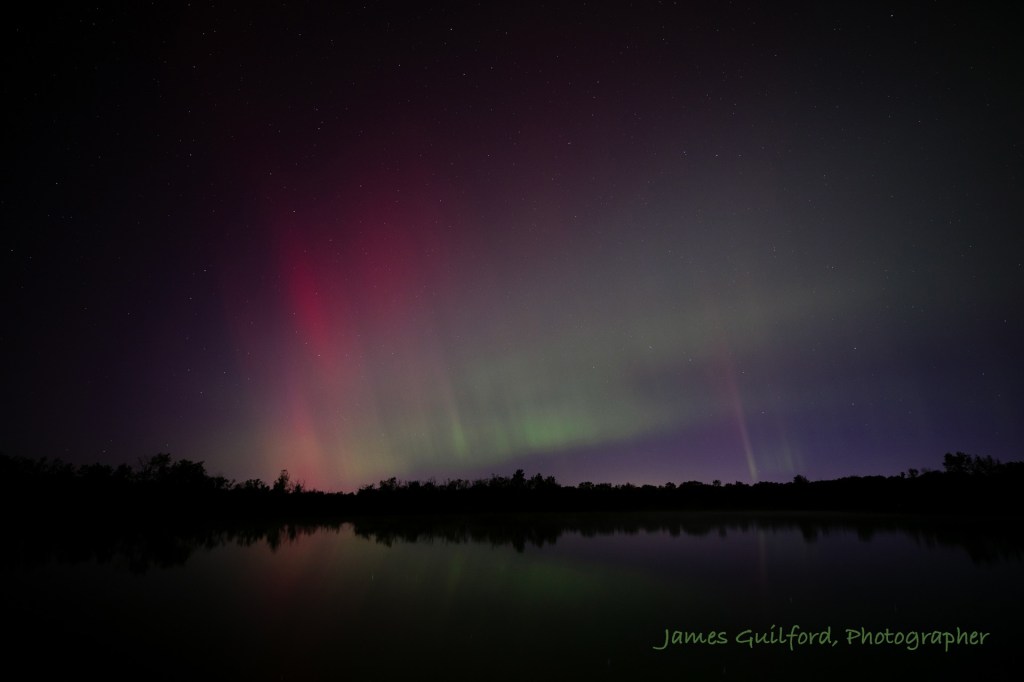
A panoramic view of the aurora borealis as viewed from rural Medina County, Ohio, as a surge in activity occurred. The display is reflected in the still waters of a small lake. The bright light at the right-hand end above the treeline is light pollution from the city of Medina. Photo by James Guilford.

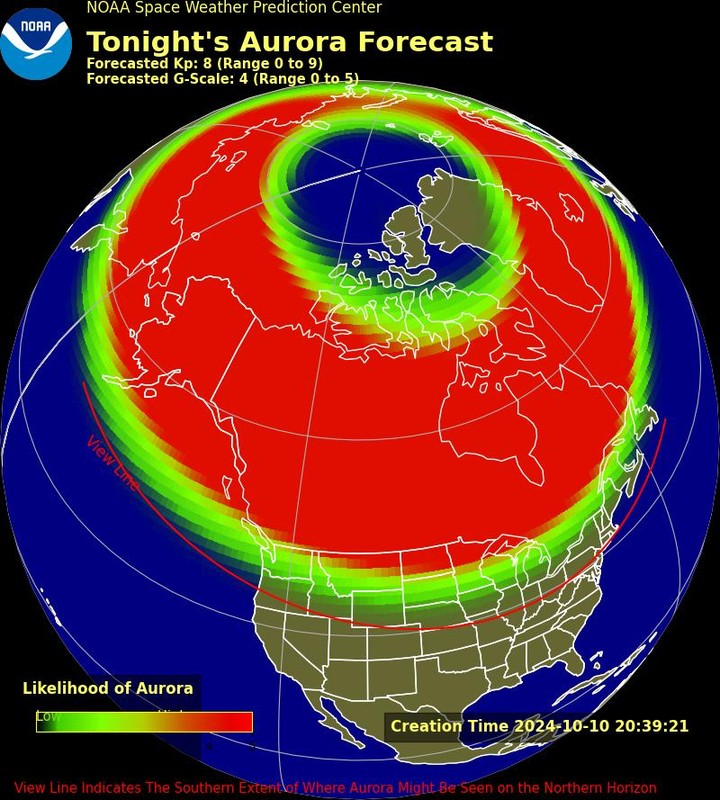
It began on Tuesday, October 8, when a sunspot called AR3848 flared explosively over the course of several hours. The detonation hurled a large and powerful coronal mass ejection (CME) Earthward from Sun. On Thursday, October 10 the magnetically-charged solar plasma hit Earth’s geomagnetic field and fireworks erupted. According to SpaceWeather.com the aurora borealis was seen as far south as Puerto Rico!

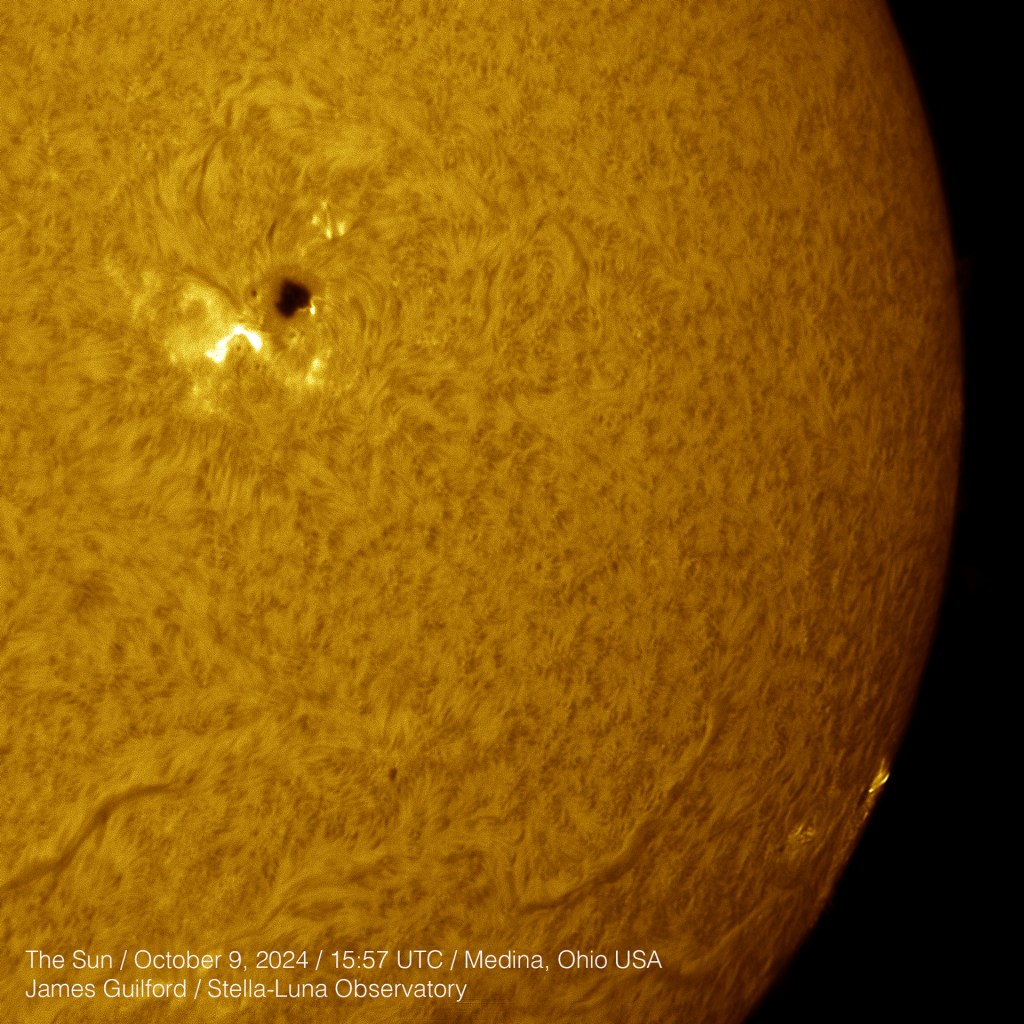
The area in the upper left-hand portion of this photograph is AR3848, the “active region” that produced an enormous solar flare on October 8, 2024. This is a view of Sun in hydrogen-alpha light, which shows the solar coronosphere layer. Photo by James Guilford.

I headed out to a remote county park location, where I have permission to be after dark, and was fortunate enough to be ready when a significant surge in activity occurred — around 10 PM EDT. That peak was amazing with colors, shapes, and movement visible across the entire northern horizon. It was particularly cool to see pillars appearing and disappearing in real time. Light from the aurora reflected upon the still waters of the park’s lake. Adding to the quiet, magical mood, were occasional calls in the darkness from perched birds. A wood duck, out on the lake, piped a sound reminding me of common loons.

During peak activity, looking east, we see intense red crowning a curved green ring, the Northern Lights reflected from the surface of still lake water. Photo by James Guilford.

The auroral surge went on for probably a bit more than half an hour, challenging me to select a spot to photograph. First one area would glow, then one at the other end of the bow-shaped display, pillars of light would appear like searchlights, then fade away. A thrill to witness as light, movement, and delicate colors were visible to the unaided eye. The camera picked up more than my poor eyes could see but I say without reservation this was the grandest aurora I’ve witnessed.

The western end of the coronal arc appeared strongest, as viewed from Medina County, through most of the evening. Here, during the surge, we see typical auroral colors, curtain-like waves of shape, and pillars that look like they reach the ground or might be mistaken for searchlights projecting from the ground. Photo by James Guilford.

All evening there seemed to be more intense activity over the western end of the aurora; that was verified by relatives in northwest Ohio whose photos showed a sky full of color directly overhead.

Although some observers were concerned that moonlight might drown out the aurora, that was not a problem during the peak or as it began to subside. This image shows the waxing Moon, low to the western horizon, with colorful patches of glowing sky nearby. Photo by James Guilford.

While I was at the lake I heard others coming and going from the park, pretty much the entire time I was there. A young couple eventually ventured away from the parking lot and encountered me at my spot around 11:30, seeking what I had found — a dark spot near the water. Their arrival had been delayed by a camera gone bad, and they had gone home to pick up another. Things petered out not long after the peak and, checking NOAA resources, it looked like the auroral ring was retreating back north. The couple had missed the best of the night and I, with frozen fingers and toes, I headed home.

NOAA Space Weather Prediction Center graphic showing the predicted extent of the October 10-11, 2024 aurora borealis. Observers reported seeing portions of the aurora as far south as the Florida Panhandle. According to SpaceWeather.com it was seen as far south as Puerto Rico!