

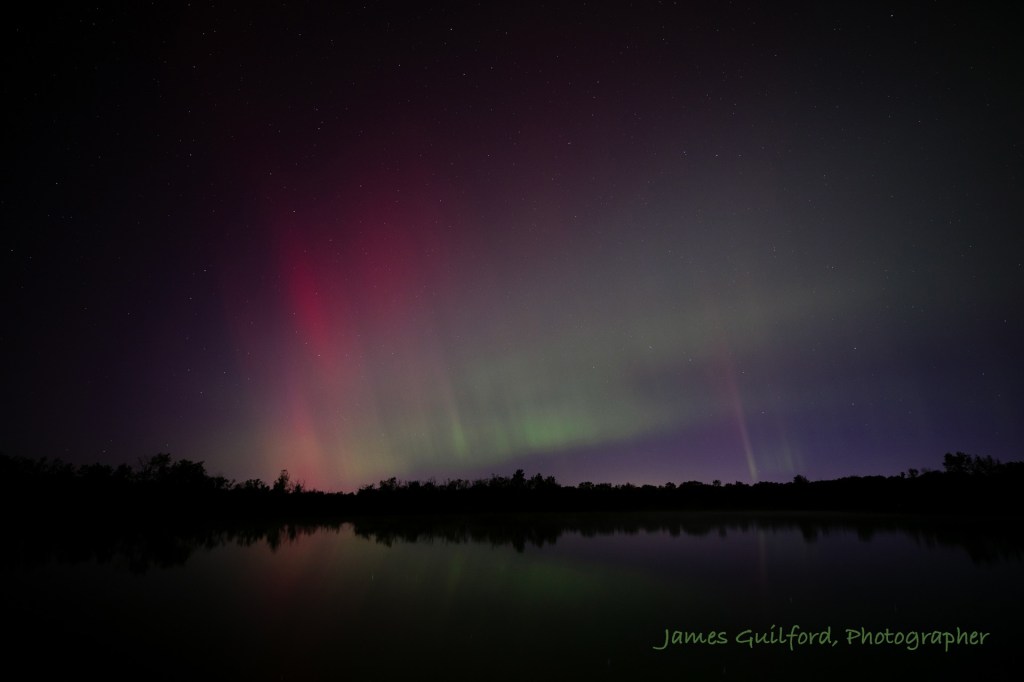
A panoramic view of the aurora borealis as viewed from rural Medina County, Ohio, as a surge in activity occurred. The display is reflected in the still waters of a small lake. The bright light at the right-hand end above the treeline is light pollution from the city of Medina. Photo by James Guilford.
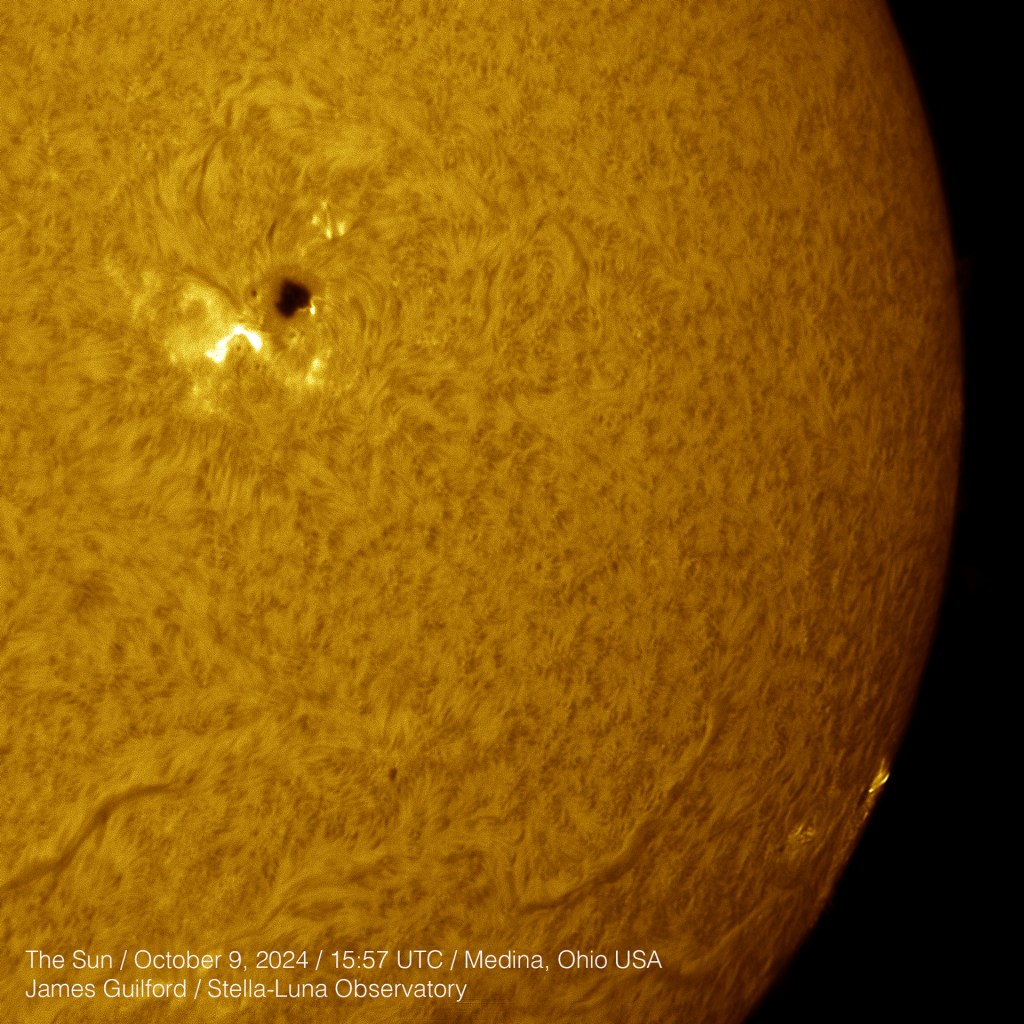
It began on Tuesday, October 8, when a sunspot called AR3848 flared explosively over the course of several hours. The detonation hurled a large and powerful coronal mass ejection (CME) Earthward from Sun. On Thursday, October 10 the magnetically-charged solar plasma hit Earth’s geomagnetic field and fireworks erupted. According to SpaceWeather.com the aurora borealis was seen as far south as Puerto Rico!
I headed out to a remote county park location, where I have permission to be after dark, and was fortunate enough to be ready when a significant surge in activity occurred — around 10 PM EDT. That peak was amazing with colors, shapes, and movement visible across the entire northern horizon. It was particularly cool to see pillars appearing and disappearing in real time. Light from the aurora reflected upon the still waters of the park’s lake. Adding to the quiet, magical mood, were occasional calls in the darkness from perched birds. A wood duck, out on the lake, piped a sound reminding me of common loons.

The auroral surge went on for probably a bit more than half an hour, challenging me to select a spot to photograph. First one area would glow, then one at the other end of the bow-shaped display, pillars of light would appear like searchlights, then fade away. A thrill to witness as light, movement, and delicate colors were visible to the unaided eye. The camera picked up more than my poor eyes could see but I say without reservation this was the grandest aurora I’ve witnessed.
All evening there seemed to be more intense activity over the western end of the aurora; that was verified by relatives in northwest Ohio whose photos showed a sky full of color directly overhead.

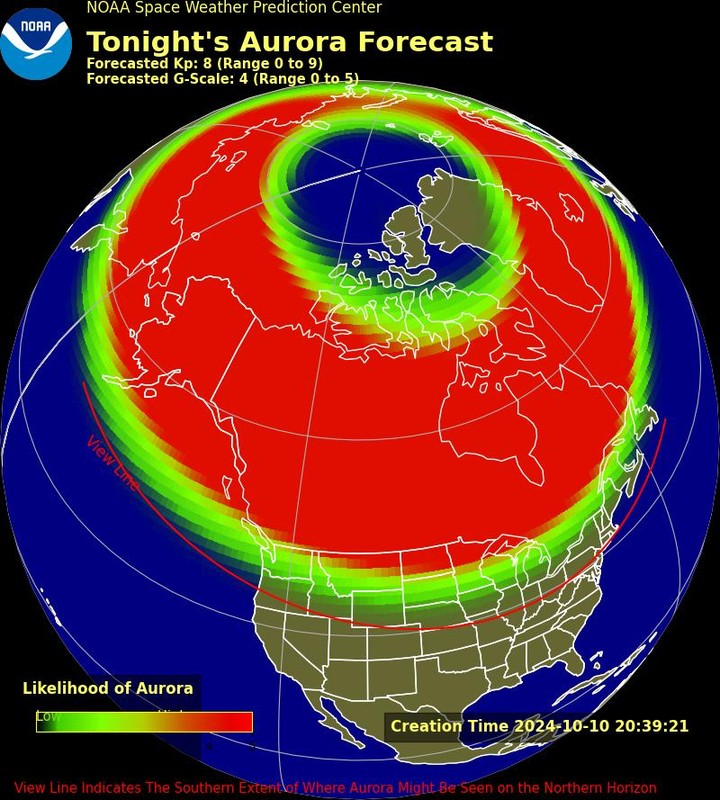
While I was at the lake I heard others coming and going from the park, pretty much the entire time I was there. A young couple eventually ventured away from the parking lot and encountered me at my spot around 11:30, seeking what I had found — a dark spot near the water. Their arrival had been delayed by a camera gone bad, and they had gone home to pick up another. Things petered out not long after the peak and, checking NOAA resources, it looked like the auroral ring was retreating back north. The couple had missed the best of the night and I, with frozen fingers and toes, I headed home.
 Stella-Luna Observatory