

In addition to photographing Earth’s Sun in white light nearly every clear day, we occasionally set up the heavy telescope mount and bring out the new hydrogen-alpha (Ha) telescope for a bit of visual observing and unique imaging. It’s a bit of work since, without an observatory building we usually feel we need to take down and store away the mount after each session, so we don’t do that every day.
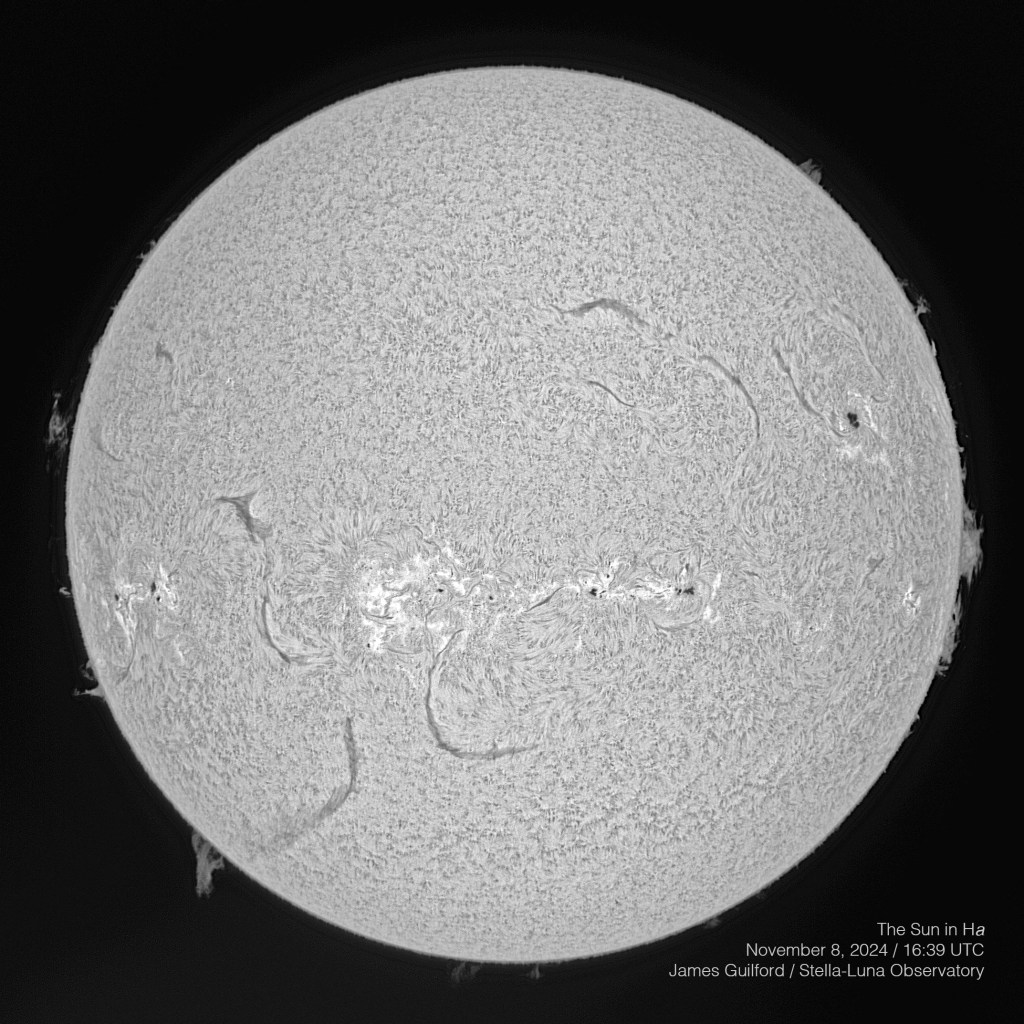
On November 8 we had clear skies, good atmospheric conditions, and the inclination to do the Ha setup and were rewarded with splendid views plus our best Sun images yet.

Across the solar disk were visible large and distinct filaments — prominence loops seen from “above” — as well as sunspots and swirling patterns in the solar atmosphere around them. All around the Sun’s limb could be seen prominences glowing against a background of black space. Some of the prominences, which are fountain-like sprays and loops of magnetically-charged plasma, were quite large.
A major part of producing good images is what happens away from the telescope. Our usual practice is to record video of the telescope view and use software, in the office, to sort through thousands of video image frames, then stack the best few hundred to form a single still image. The still image is then edited to bring out as much detail and tonal range as possible. This process, which is common in astrophotography, produces a sharper image than what might be acquired via any single photographic “snapshot” owing largely to atmospheric turbulence.

There’s room for improvement, and we’re seeing excellent progress, but the images shown here are our best yet of Sun in hydrogen-alpha light.
Note: H-a light is that which Sun is producing in its chromosphere — the solar atmospheric layer between the outer corona and the lower photosphere — and is invisible even to protected human vision and white light cameras. Specialized optics are required to block other wavelengths found in white light and allow observation of Ha. When we observe or image in white light, we’re actually viewing features such as sunspots while looking through both the corona and the chromosphere!
Safety Note: It is not safe to look directly at the sun without specialized eye protection for solar viewing, and safe solar filters for telescope, binocular, or camera use. Permanent damage to vision can result from improper viewing of the sun.
 Stella-Luna Observatory