

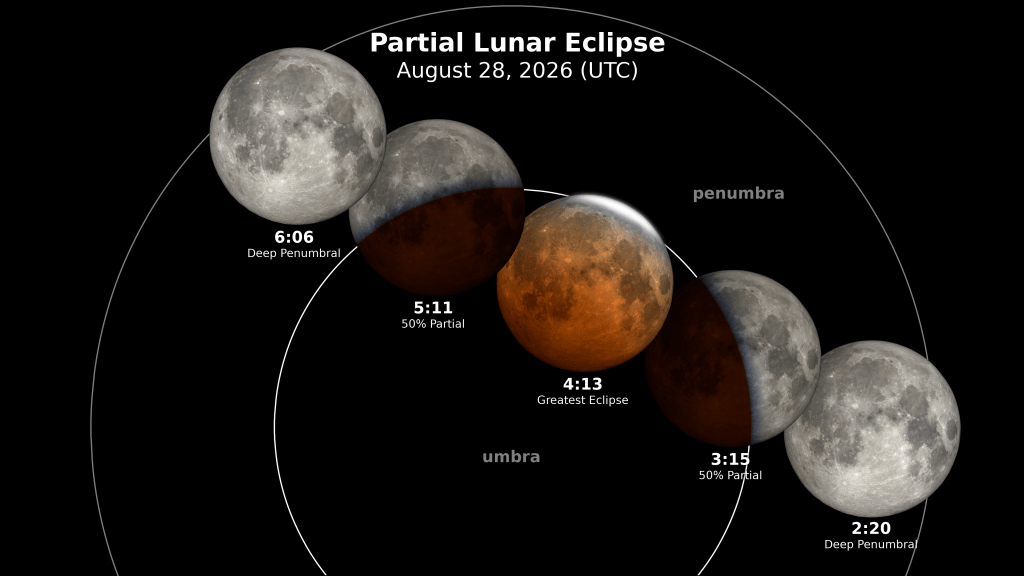
The night of August 27 – 28, 2026 brings an opportunity for eclipse viewing: a deep partial lunar eclipse. Just shy of a total lunar eclipse, the night’s Full Moon will be deep within Earth’s shadow, 96 percent covered by Earth’s dark inner shadow or umbra.
Given clear skies, we are in a favorable position to see the eclipse in its entirety. In Northeast Ohio, the eclipse begins at 9:24 PM as Moon edges into Earth’s soft outer shadow or penumbra. At 10:34 PM the show really begins with Earth’s deep umbra visibly darkening the edge of the lunar disk. Maximum eclipse begins at 12:13 AM, August 28 with the southern portion of Moon very dark and its northern edge relatively bright; hopefully, coppery coloration will be visible on areas of the lunar disk between.
Moon continues its movement through Earth’s shadow, reversing the eclipse process. The partial eclipse ends at 1:52 AM, and the penumbral eclipse ends at 3:02 as the bright Full Moon shines. If you are eclipse watching from a location other than ours, you can check out TimeAndDate.com which can calculate event timings for your spot on the map.
A lunar eclipse occurs when the moon’s orbit carries it through the shadow cast into space by Earth. A solar eclipse occurs when the moon’s orbit carries it between Earth and Sun and Moon’s shadow falls upon Earth’s surface. Unlike solar eclipses, lunar eclipses are perfectly safe to view with no special precautions needed — it’s moonlight — and no telescope is required. Binoculars may add to the experience but are also not required for lunar eclipse watching.

