
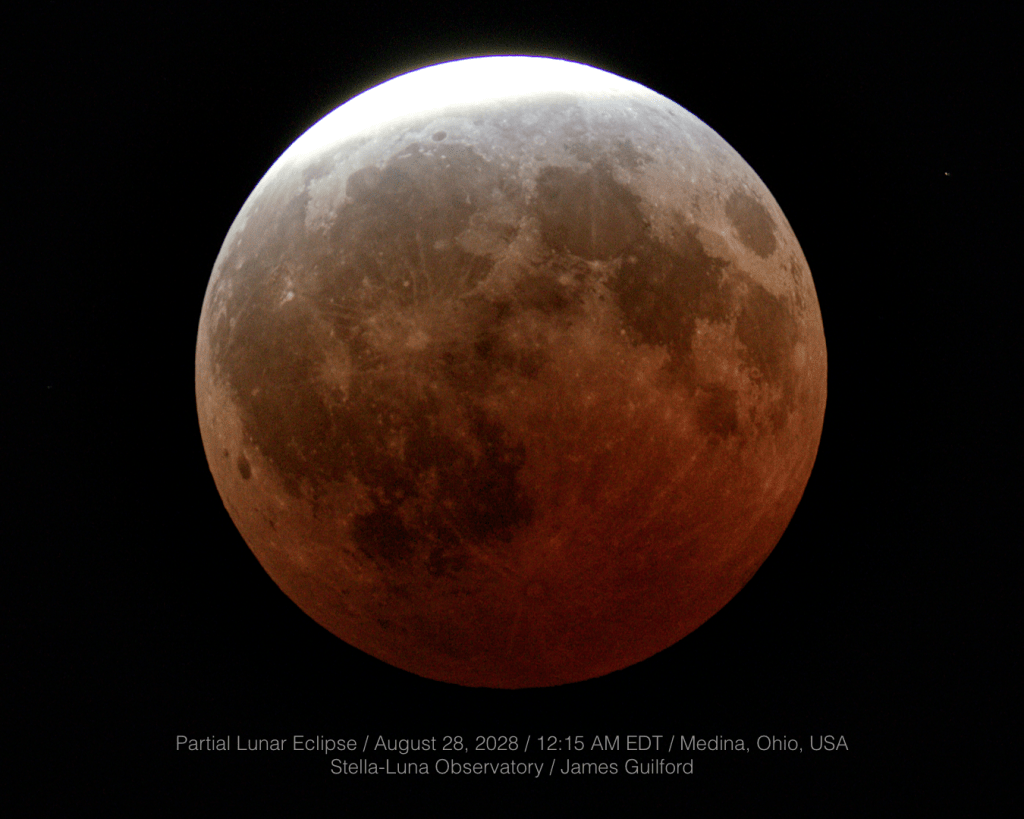
The August 27 – 28 partial lunar eclipse was enjoyable to watch but presented some challenges to photograph. Before nightfall, we set up a modestly sized telescope, the Askar 103APO, outside the observatory. The scope has a shorter focal length, less magnification, which would allow its camera to record the entire disk of Moon during the eclipse. The large observatory telescope, with nearly twice the focal length, would show less of the lunar disk because of its higher magnification. This outdoor setup seemed like a good idea and it was, in principle. But Moon and nearby trees presented our first challenge of the night.
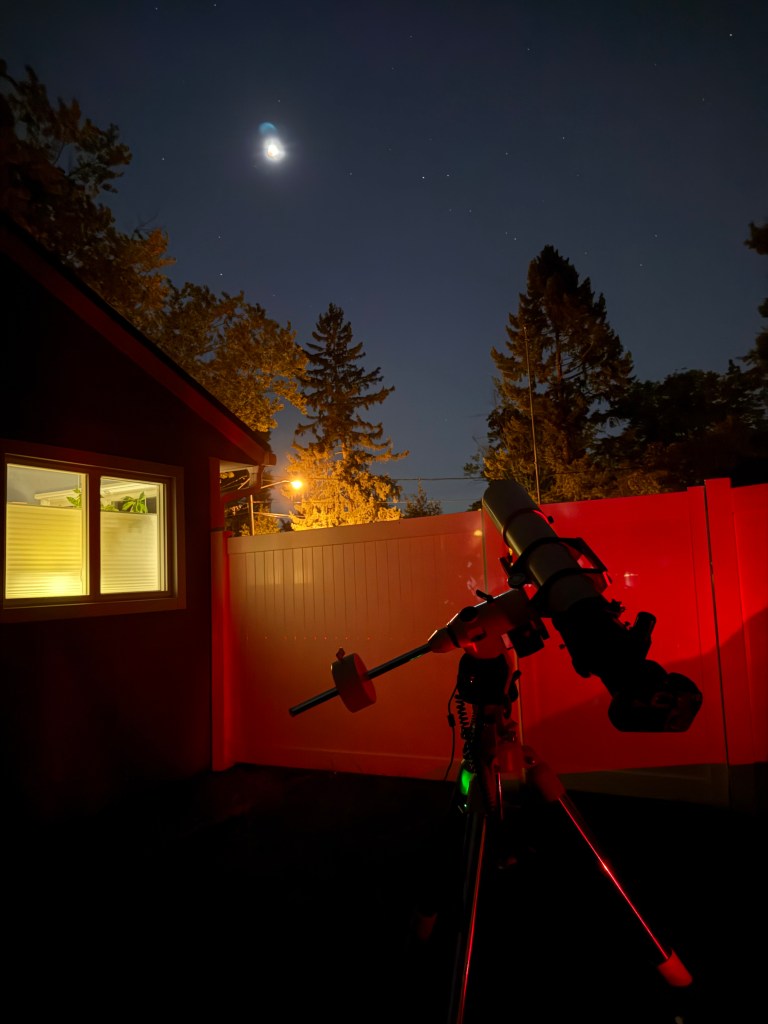
Moonrise was at 8:01 PM EDT and its altitude from the horizon was going to be fairly low. The mature neighboring trees are quite tall and wide. The combination was not good and, as Moon climbed higher and eclipse time approached, time was running out. From the vantage point of the telescope outside the observatory, Moon would be behind the trees during the entire first half of the event. We had to move it.
Scouting out a new location that allowed a clear view of the sky, we located one near enough to facilities to connect to utility electric power. In darkness we moved the imaging setup.
The dark umbra of Earth’s shadow was already taking a substantial bite out of the night’s full Moon as we finished setup at the new location. We were impressed at how well our old (ca. July 2005) Meade LXD75 mount performed, tracking accurately with minimal alignment; it was a real champ! One camera automation accessory did not function as expected so we removed it and ran the Canon EOS 7D Mk. 2 camera manually. Things went well from that point on with an unobstructed view of a clear sky and a darkening Moon. The night was quiet and mild, not even a jacket was necessary, as we gazed at the dimming Moon and listened to night sounds.
This was to be a partial eclipse, meaning not all of the lunar disk would be within the deep umbra — a bright sliver of sunlight would be seen at one edge, while the opposite side of the disk would be dark, and hopefully colorful. Peak coverage was to be reached at 12:13 AM EDT. It was about 20 minutes before peak when we spotted it: a bank of clouds drifting in from the north, illuminated by ground-based light pollution, headed in to spoil the night!
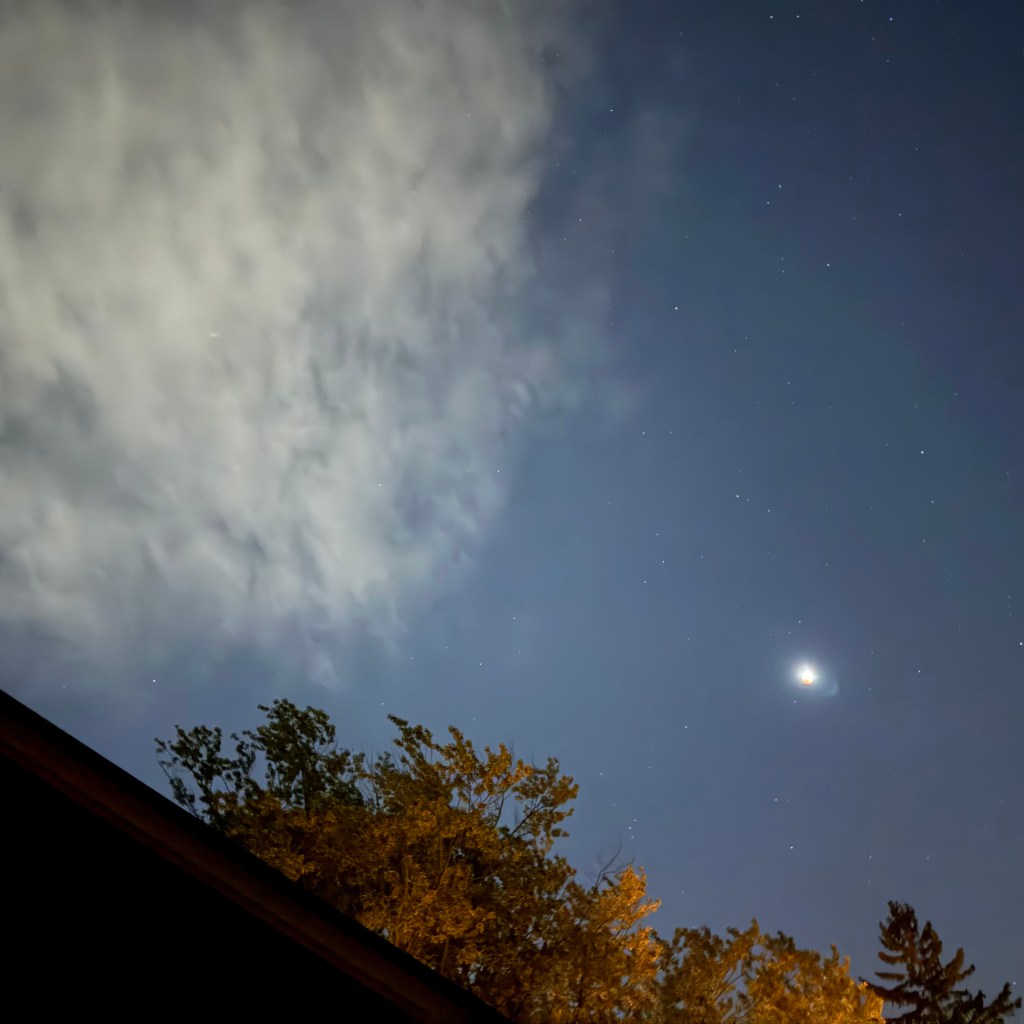
That is how it goes, sometimes. Clouds, missteps, or mishaps spoil an otherwise exciting occasion. It doesn’t help to curse the clouds but that did not help to stop the whispered oaths! Happily, gaps were present in the cloudy mess, clear sky visible through them, hopefully allowing peeks at the eclipse. The clouds arrived, mostly blocking but indeed occasionally teasing glimpses at the then fully-developed event. We made images from about two minutes before the peak, and images from about two minutes after, but nothing from the peak moment.
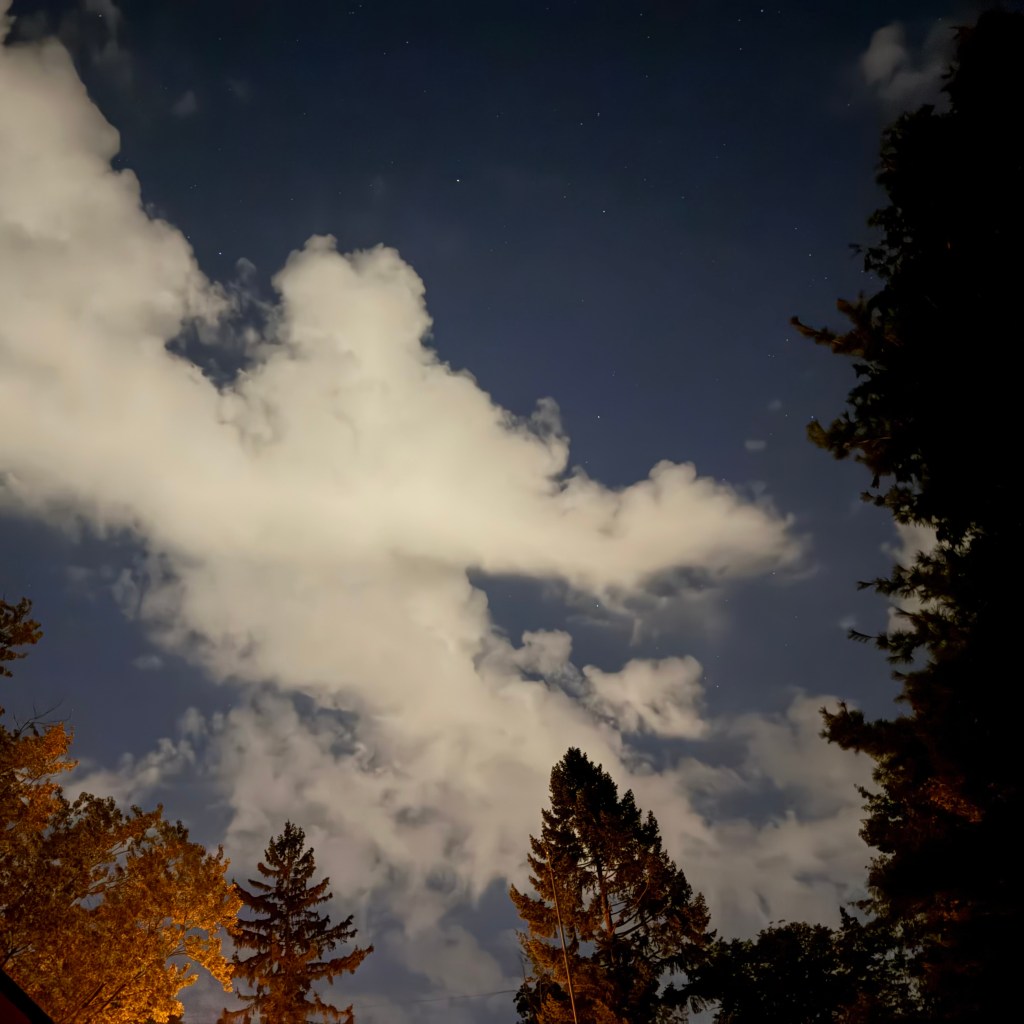
An extended period of clarity followed, as the cloud bank continued on its southbound journey. We shot more images of the eclipsed Moon, rapidly changing exposure settings, seeking to record a wide range of graphic data against future processing efforts before the scene changed much. Imaging done, we took one last look, parked the telescope, then stowed and secured gear for the night. It was late and we had daytime promises to keep.
So that was another lunar eclipse in the books. There was frustration, to be sure, but there were rewards. There won’t be another lunar eclipse visible here until January 12, 2028 (a weak partial eclipse), with the next total lunar eclipse on June 26, 2029. One has the opportunity to see just so many eclipses in their lifetime, so we try and see every one we can!
P.S. At 12:30 AM, the diminishing eclipse became visible from the spot where we first set up the small telescope. And the sky was clear.

