
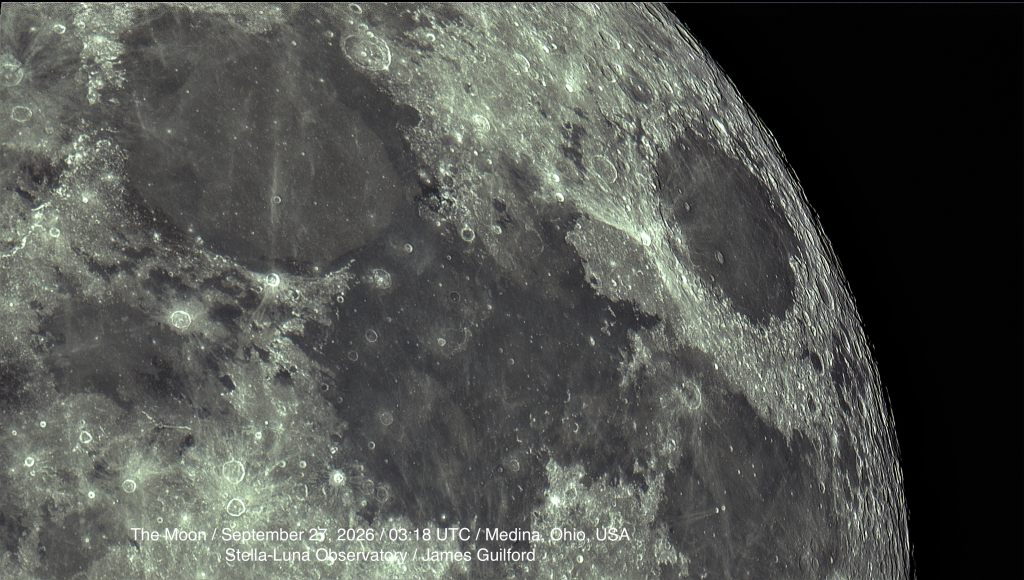
First light for our new planetary camera was Earth’s Moon. The camera was really intended for use in capturing image data of, well, planets. Moon was available before Saturn showed up and so became the target. Poor seeing contributed to our later first efforts at Saturn being not so impressive.
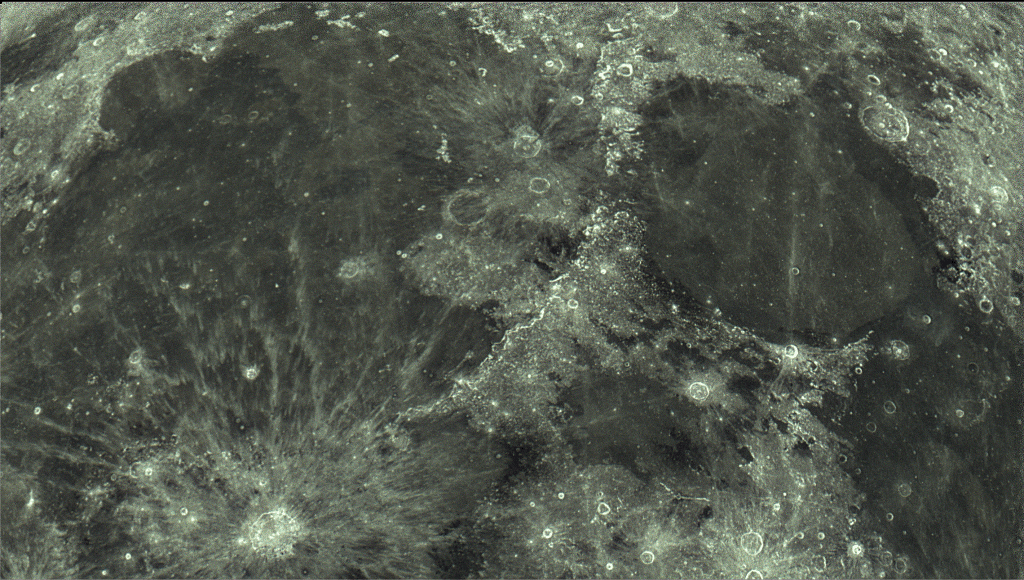
The large, circular dark area on the left side of this picture is Mare Imbrium — the Sea of Showers — as it appeared the night of September 27, 2026. There is much to see in that area making it one of our favorite spots on our Moon. It’s also a popular landing site for lunar exploration: Russia’s Luna 2 & 17, China’s Chang’e 3, and the U.S. Apollo 15 touched down there. Observing Moon during its Full phase is a different experience from other times. During that phase, sunlight is striking the Lunar surface from directly overhead with the Sun from over our shoulders, so to speak. That means few shadows to highlight crater walls, mountains, rilles, etc. Take a look at our two images above and notice — most craters are seen as circles, or Oes; we see the tops of the crater rims without any shadows to illustrate their depth — an interesting effect, though fully understandable.
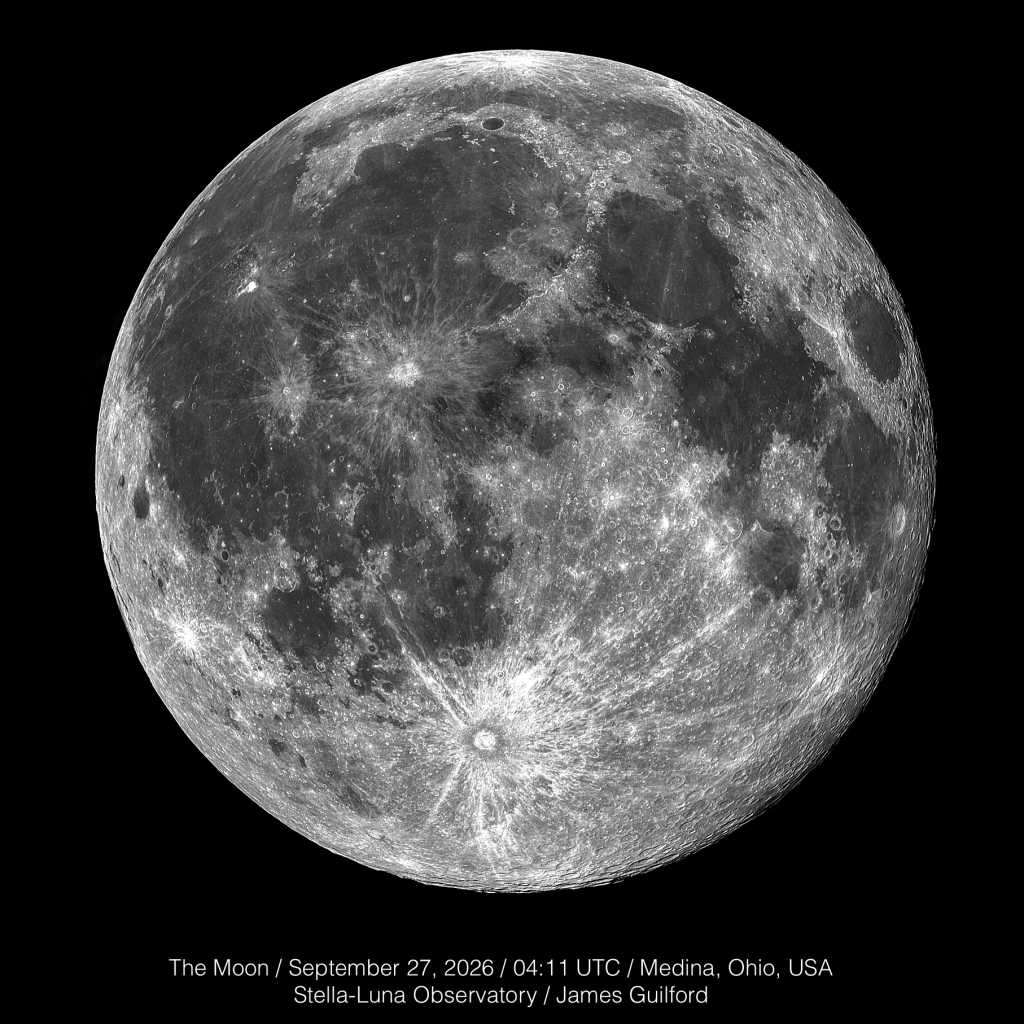
Big Splats. Our image of Earth’s Full Moon has been processed to emphasize the ejecta rays projecting from newer craters. The ejecta networks are composed of material splashed out — ejected — from the points impacted by asteroids, or comets across the darker regolith surface. Most prominent here is crater Tycho in the southern portion of our picture. The crater itself is around 53 miles (85 km) in diameter, and about 3 miles (4.7 km) deep. The impact that created crater Tycho excavated and ejected heavy materials that resulted in a multitude of secondary craters — perhaps a warning to future human denizens of our Moon to have a very strong roof, just in case!

