
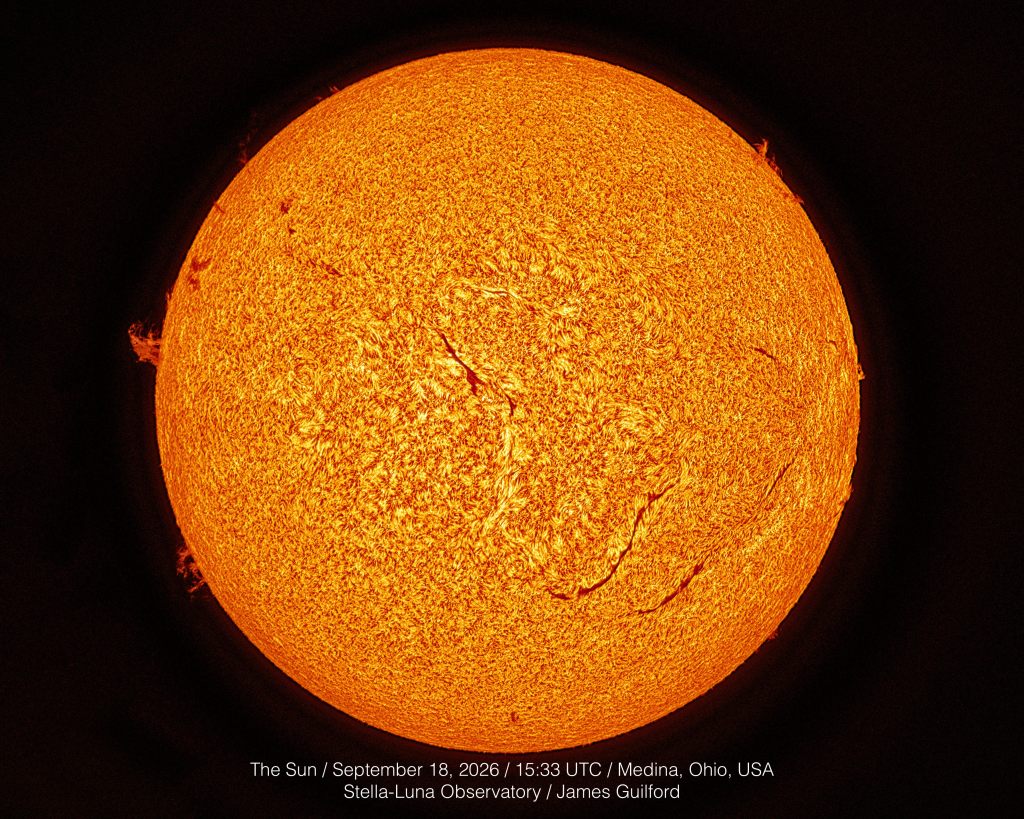
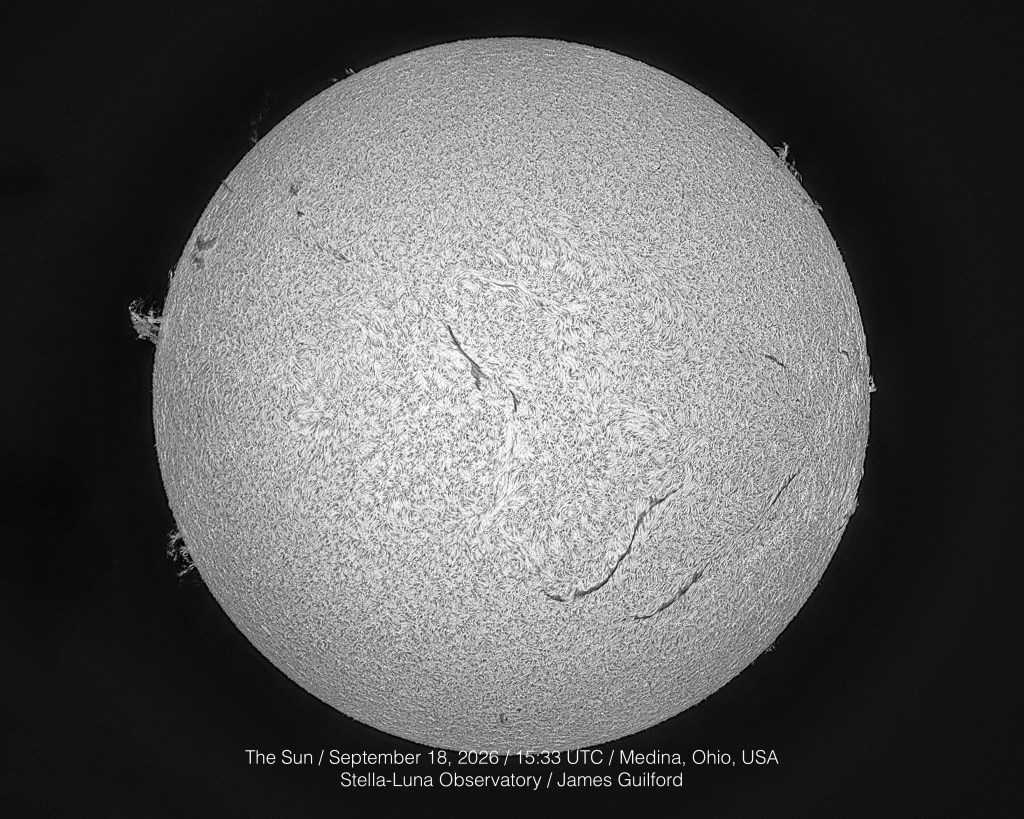
A clear morning sky, a rarity lately, allowed solar observing and experimentation with new settings for image capture. While the quieting Sun in white light showed no sunspots in the photosphere, the chromosphere, viewed via hydrogen-alpha (Ha) light, was a busy place. Prominances large and small were visible around the Solar limb, filaments floated above the roiling plasma surface, and despite shaky seeing conditions, spicules were recorded all along the limb.
We started out, some time ago, employing the lucky imaging technique via .AVI video recordings and using exposures in the double-digit millisecond range, and video gain set at zero or at very low single-digit levels; early experience seemed to indicate that was the way. Listening to how others approach imaging, we tried reducing the exposure/shutter speed to mid or low single-digits, and boosting video gain into low triple-digits. We saw improvements in both image quality and ease of processing! We still have much to learn and to refine, and working with Ohio’s less-than-optimal sky conditions is … challenging … but we’re getting there.
Tech Info: Telescope – Sky-Watcher Heliostar 76Ha, Camera – ZWO ASI183MM Pro, Exposure – 5ms, Gain – 117. Video frames stacked in ASI VideoStack. Color image processed in PixInsight + Solar Toolbox. Monochrome processed in Pixelmator Pro.
 Stella-Luna Observatory