Another eclipse in the books

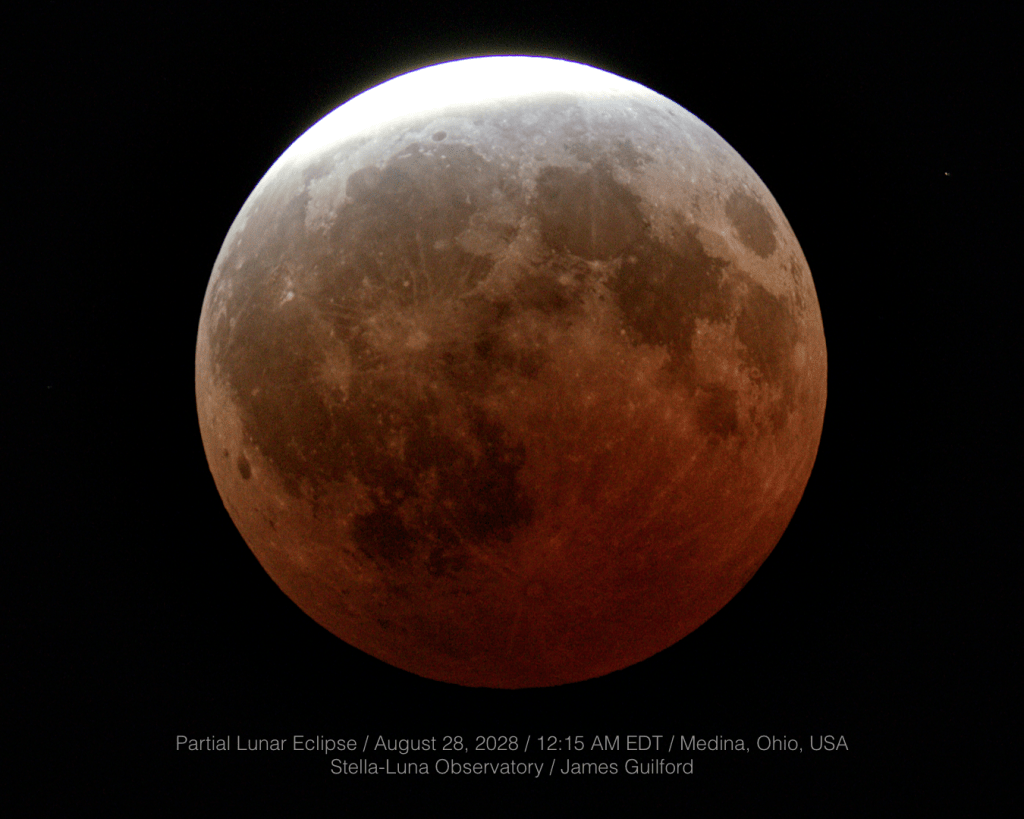
A stack of images taken two minutes after the eclipse peaked (delayed due to cloud cover) illustrates the approximate 96 percent eclipse. The brightest area at top is direct sunlight, the gray area beneath it is penumbral shadow, with transition to the coppery-colored umbral shadow where no direct sunlight reaches the lunar surface.

The August 27 – 28 partial lunar eclipse was enjoyable to watch but presented some challenges to photograph. Before nightfall, we set up a modestly sized telescope, the Askar 103APO, outside the observatory. The scope has a shorter focal length, less magnification, which would allow its camera to record the entire disk of Moon during the eclipse. The large observatory telescope, with nearly twice the focal length, would show less of the lunar disk because of its higher magnification. This outdoor setup seemed like a good idea and it was, in principle. But Moon and nearby trees presented our first challenge of the night.
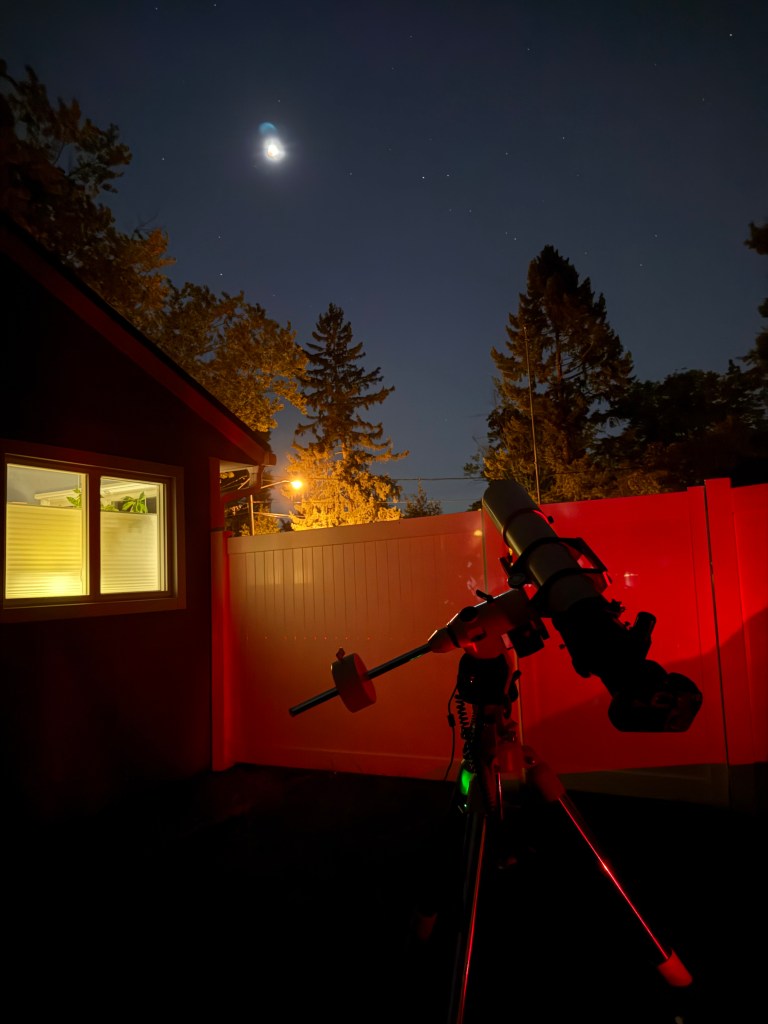
Trees blocked the view from the observatory so a telescope was set up in a more hospitable site. A 100-foot extension cord allowed utility power to run the telescope mount. A blue lens flare is visible above the bright dot that is Moon.

Moonrise was at 8:01 PM EDT and its altitude from the horizon was going to be fairly low. The mature neighboring trees are quite tall and wide. The combination was not good and, as Moon climbed higher and eclipse time approached, time was running out. From the vantage point of the telescope outside the observatory, Moon would be behind the trees during the entire first half of the event. We had to move it.

Scouting out a new location that allowed a clear view of the sky, we located one near enough to facilities to connect to utility electric power. In darkness we moved the imaging setup.

The dark umbra of Earth’s shadow was already taking a substantial bite out of the night’s full Moon as we finished setup at the new location. We were impressed at how well our old (ca. July 2005) Meade LXD75 mount performed, tracking accurately with minimal alignment; it was a real champ! One camera automation accessory did not function as expected so we removed it and ran the Canon EOS 7D Mk. 2 camera manually. Things went well from that point on with an unobstructed view of a clear sky and a darkening Moon. The night was quiet and mild, not even a jacket was necessary, as we gazed at the dimming Moon and listened to night sounds.

This was to be a partial eclipse, meaning not all of the lunar disk would be within the deep umbra — a bright sliver of sunlight would be seen at one edge, while the opposite side of the disk would be dark, and hopefully colorful. Peak coverage was to be reached at 12:13 AM EDT. It was about 20 minutes before peak when we spotted it: a bank of clouds drifting in from the north, illuminated by ground-based light pollution, headed in to spoil the night!
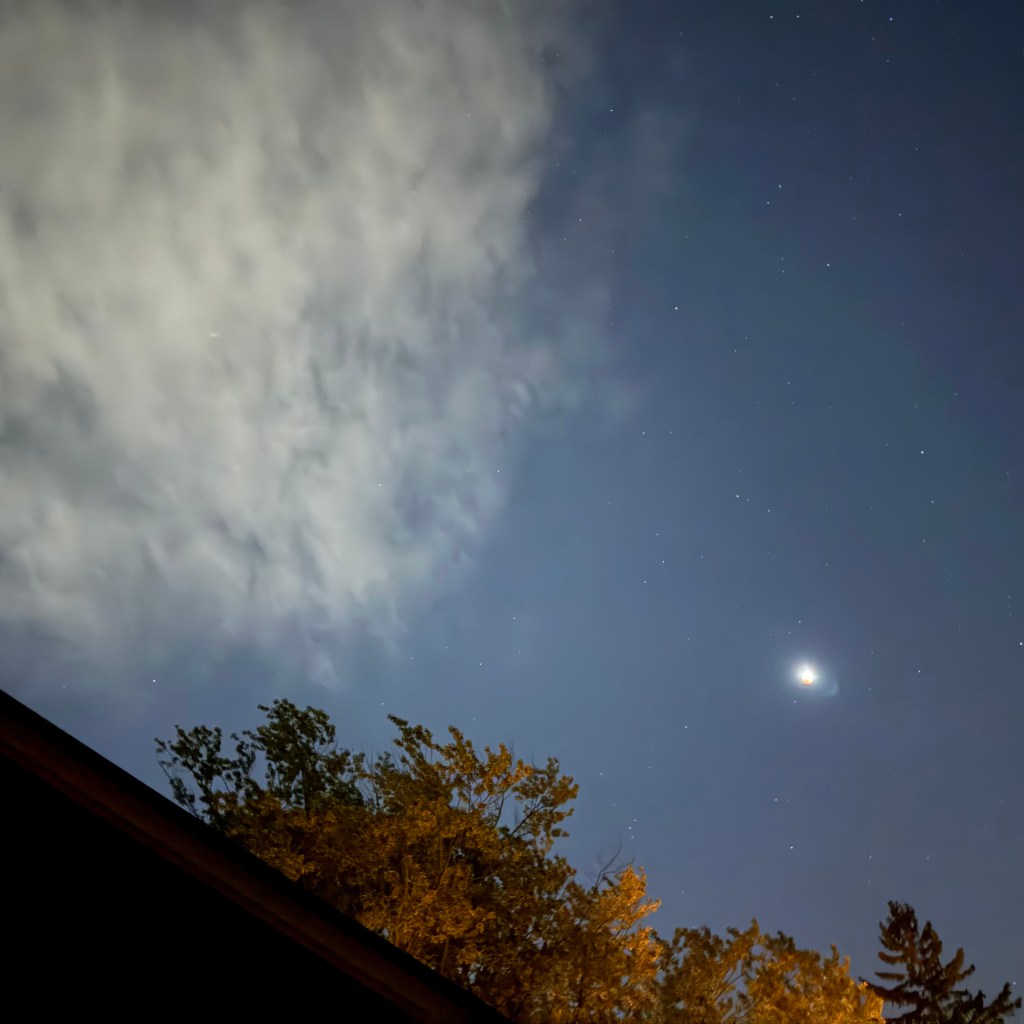
A bank of clouds approached the eclipsing Moon as the hour of peak eclipse neared. A lens flare is visible to the lower right of the bright lunar dot, and a view stars can be seen in the sky.

That is how it goes, sometimes. Clouds, missteps, or mishaps spoil an otherwise exciting occasion. It doesn’t help to curse the clouds but that did not help to stop the whispered oaths! Happily, gaps were present in the cloudy mess, clear sky visible through them, hopefully allowing peeks at the eclipse. The clouds arrived, mostly blocking but indeed occasionally teasing glimpses at the then fully-developed event. We made images from about two minutes before the peak, and images from about two minutes after, but nothing from the peak moment.
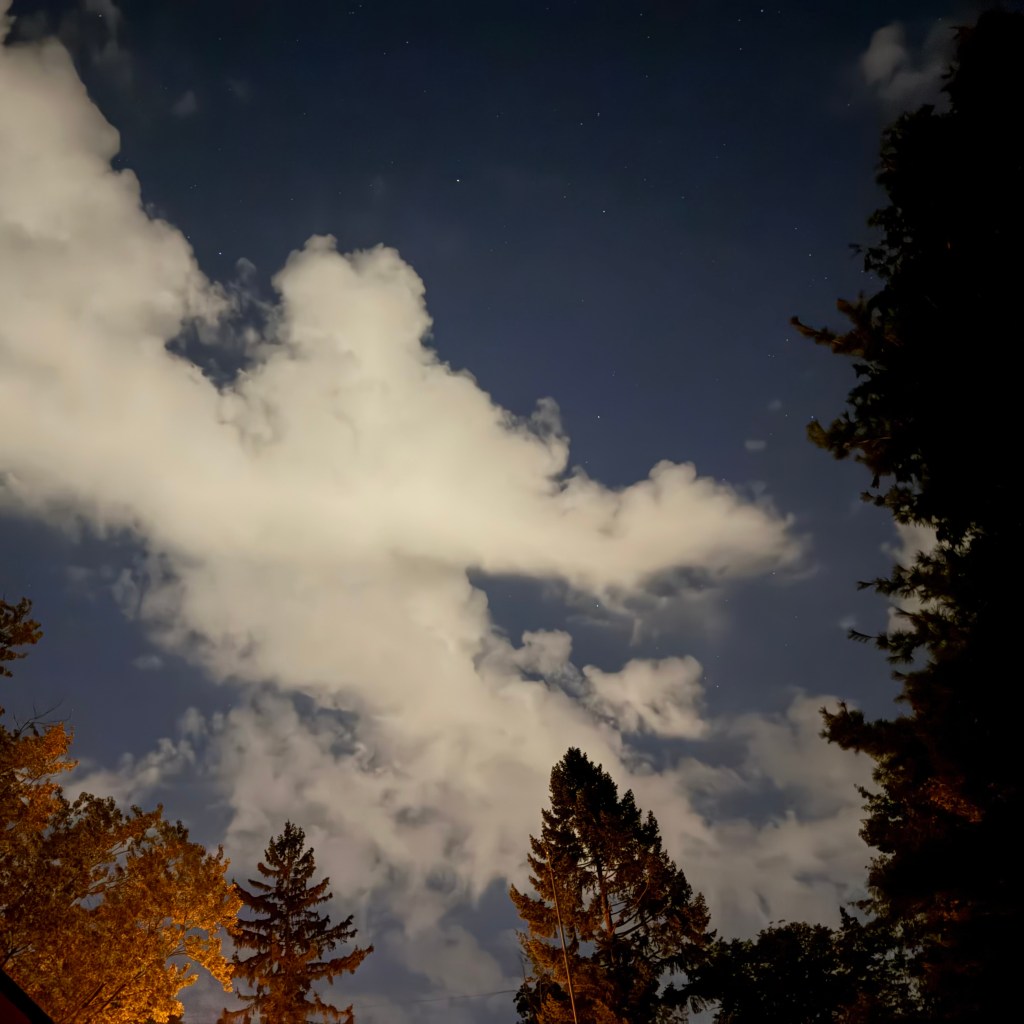
Peak eclipse, at 12:13 AM EDT. Very, very eclipsed as the clouds obscured the view. Gaps in the cloud cover allowed images to be made before and after the astronomical peak coverage was reached.

An extended period of clarity followed, as the cloud bank continued on its southbound journey. We shot more images of the eclipsed Moon, rapidly changing exposure settings, seeking to record a wide range of graphic data against future processing efforts before the scene changed much. Imaging done, we took one last look, parked the telescope, then stowed and secured gear for the night. It was late and we had daytime promises to keep.

So that was another lunar eclipse in the books. There was frustration, to be sure, but there were rewards. There won’t be another lunar eclipse visible here until January 12, 2028 (a weak partial eclipse), with the next total lunar eclipse on June 26, 2029. One has the opportunity to see just so many eclipses in their lifetime, so we try and see every one we can!

P.S. At 12:30 AM, the diminishing eclipse became visible from the spot where we first set up the small telescope. And the sky was clear.

August 27 brings deep partial lunar eclipse

Late on the night of August 27, Moon will resemble this view of the March 14, 2025 lunar eclipse. Photo by James Guilford

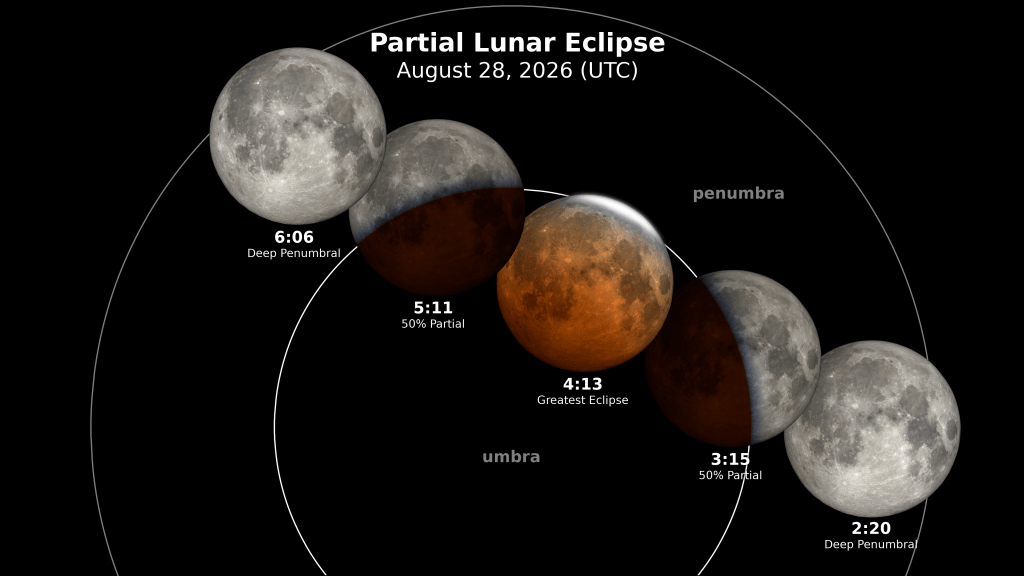
The night of August 27 – 28, 2026 brings an opportunity for eclipse viewing: a deep partial lunar eclipse. Just shy of a total lunar eclipse, the night’s Full Moon will be deep within Earth’s shadow, 96 percent covered by Earth’s dark inner shadow or umbra.

Given clear skies, we are in a favorable position to see the eclipse in its entirety. In Northeast Ohio, the eclipse begins at 9:24 PM as Moon edges into Earth’s soft outer shadow or penumbra. At 10:34 PM the show really begins with Earth’s deep umbra visibly darkening the edge of the lunar disk. Maximum eclipse begins at 12:13 AM, August 28 with the southern portion of Moon very dark and its northern edge relatively bright; hopefully, coppery coloration will be visible on areas of the lunar disk between.

Moon continues its movement through Earth’s shadow, reversing the eclipse process. The partial eclipse ends at 1:52 AM, and the penumbral eclipse ends at 3:02 as the bright Full Moon shines. If you are eclipse watching from a location other than ours, you can check out TimeAndDate.com which can calculate event timings for your spot on the map.

Partial eclipse timings and projected appearances are giving in this graphic, with time expressed as UTC. Graphic Credit: NASA Scientific Visualization Studio

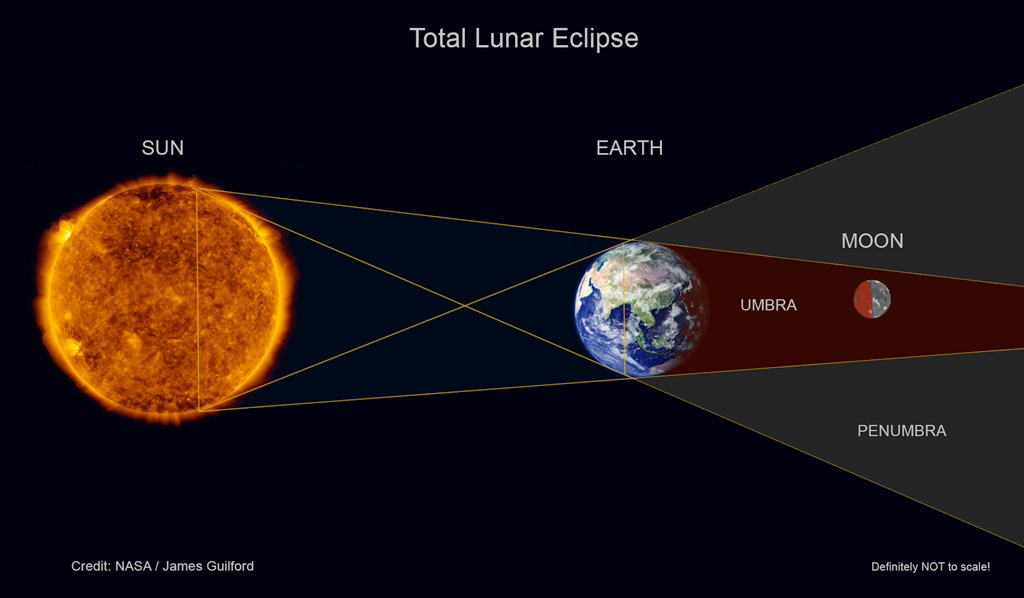
A lunar eclipse occurs when the moon’s orbit carries it through the shadow cast into space by Earth. A solar eclipse occurs when the moon’s orbit carries it between Earth and Sun and Moon’s shadow falls upon Earth’s surface. Unlike solar eclipses, lunar eclipses are perfectly safe to view with no special precautions needed — it’s moonlight — and no telescope is required. Binoculars may add to the experience but are also not required for lunar eclipse watching.

A total lunar eclipse, not in “prime time”

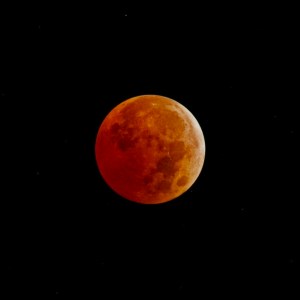
The coppery totality of the November 8, 2022 total lunar eclipse. The disk is darkest around the lower left, and lightest in the upper right-hand areas. Photo by James Guilford.
The total lunar eclipse of November 8, 2022, as viewed from Medina County. Photo by James Guilford.

In the wee hours of Friday, March 14, the Full Moon will pass through Earth’s shadow in space resulting in the coppery-red colors of a total lunar eclipse. While skies are expected to be clear for the event and temperatures tolerable, the show won’t be in “prime time” — maximum eclipse and color will be on display at about 2:58 AM (EDT) Friday. This will be the only total lunar eclipse of 2025.

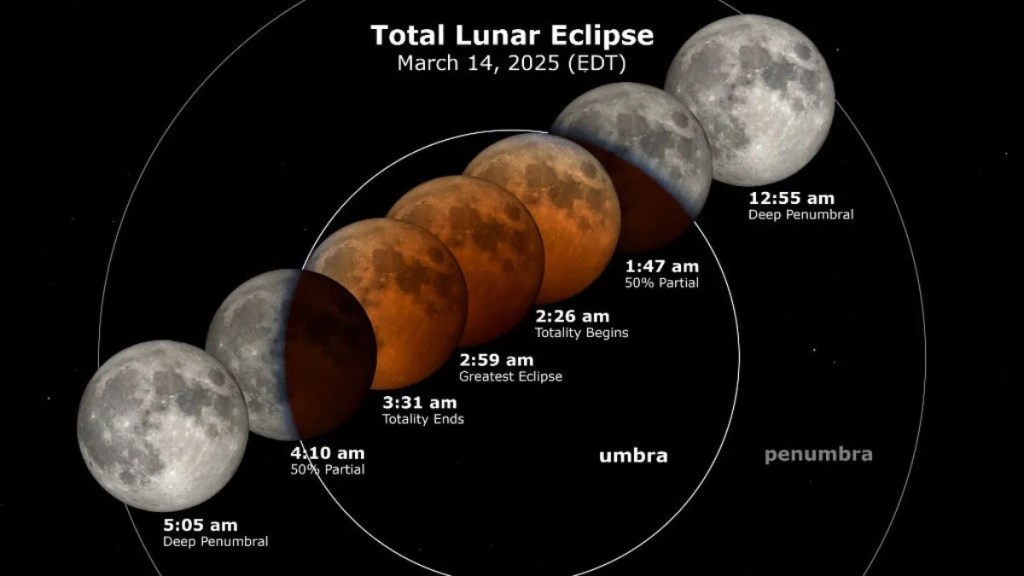
While the timing of this year’s eclipse may be brutal, it also means the entirety of the process will be visible. By 12:55 AM (an hour after midnight, to be clear) Moon will have a strangely soft, faded appearance, then lit by the diffuse light of Earth’s outer shadow or penumbra.

The partial eclipse begins at 1:09 AM and by 1:47 AM, half of the lunar disk will be dark, hidden in Earth’s deep inner shadow called the umbra. Darkness will progress across Moon and as the last light fades from the lunar surface, color will begin to appear with the onset of totality.

A total lunar eclipse occurs when Moon passes through the central portion of Earth’s shadow, known as the umbra, where all direct light from Sun is blocked and Moon is illuminated only by scattered light passing through Earth’s atmosphere.

At 2:26 AM, with Moon totally inside the umbra, the spooky beauty will be on full display. Earth’s inner shadow is full of colored light — sunlight scattered through the planet’s atmosphere bearing the scattered colors of the globe’s sunrises and sunsets — the source of a total lunar eclipse’s hues.

Maximum eclipse is reached at 2:58 – 2:59 AM and Moon will be as dark and colorful as it can be during the process. The eclipse sequence begins to reverse after the maximum as Moon continues its passage through Earth’s shadow. Observers will note the darker and lighter portions of Moon’s face subtly rotating as the event unfolds because Moon is not passing directly through the center of the umbra — the upper portion of the disk will be near the edge of the shadow area, the lower portion closest to the center and darkest region.

The timing and appearance of the March 14, 2025 total lunar eclipse is illustrated here. Note the penumbra and umbra shadow areas and the rotating shadow distribution on the lunar surface. Movement is right to left. Illustration Credit: NASA Scientific Visualization Studio

By 6:00 AM Moon will have returned to its Full illumination as if nothing had happened. Those who potentially lost sleep watching, however, will perhaps yawn but be will gratified to have seen one of the most impressive and beautiful astronomical events available to us.