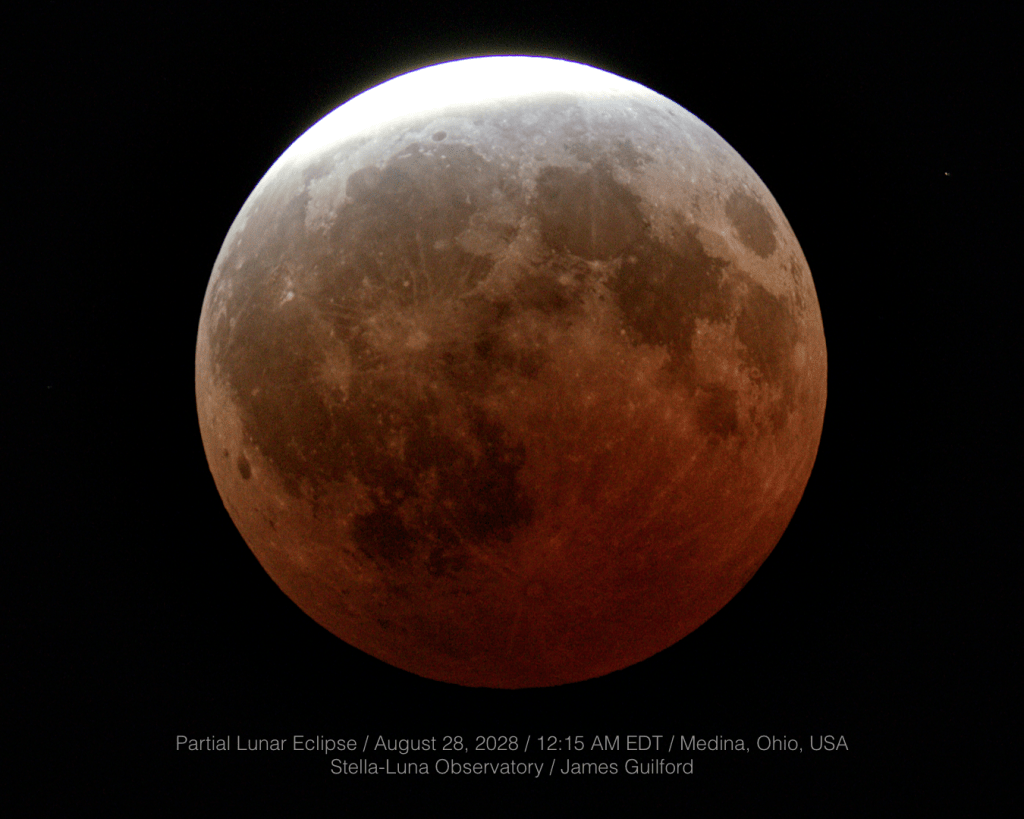
Another eclipse in the books

A stack of images taken two minutes after the eclipse peaked (delayed due to cloud cover) illustrates the approximate 96 percent eclipse. The brightest area at top is direct sunlight, the gray area beneath it is penumbral shadow, with transition to the coppery-colored umbral shadow where no direct sunlight reaches the lunar surface.

The August 27 – 28 partial lunar eclipse was enjoyable to watch but presented some challenges to photograph. Before nightfall, we set up a modestly sized telescope, the Askar 103APO, outside the observatory. The scope has a shorter focal length, less magnification, which would allow its camera to record the entire disk of Moon during the eclipse. The large observatory telescope, with nearly twice the focal length, would show less of the lunar disk because of its higher magnification. This outdoor setup seemed like a good idea and it was, in principle. But Moon and nearby trees presented our first challenge of the night.
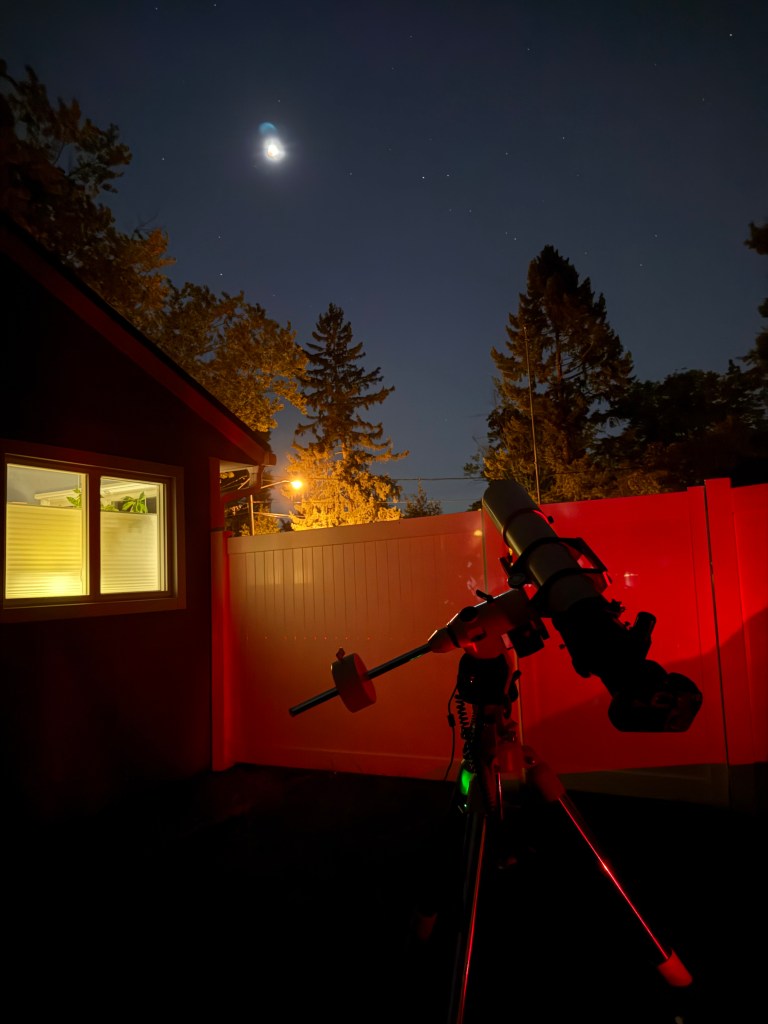
Trees blocked the view from the observatory so a telescope was set up in a more hospitable site. A 100-foot extension cord allowed utility power to run the telescope mount. A blue lens flare is visible above the bright dot that is Moon.

Moonrise was at 8:01 PM EDT and its altitude from the horizon was going to be fairly low. The mature neighboring trees are quite tall and wide. The combination was not good and, as Moon climbed higher and eclipse time approached, time was running out. From the vantage point of the telescope outside the observatory, Moon would be behind the trees during the entire first half of the event. We had to move it.

Scouting out a new location that allowed a clear view of the sky, we located one near enough to facilities to connect to utility electric power. In darkness we moved the imaging setup.

The dark umbra of Earth’s shadow was already taking a substantial bite out of the night’s full Moon as we finished setup at the new location. We were impressed at how well our old (ca. July 2005) Meade LXD75 mount performed, tracking accurately with minimal alignment; it was a real champ! One camera automation accessory did not function as expected so we removed it and ran the Canon EOS 7D Mk. 2 camera manually. Things went well from that point on with an unobstructed view of a clear sky and a darkening Moon. The night was quiet and mild, not even a jacket was necessary, as we gazed at the dimming Moon and listened to night sounds.

This was to be a partial eclipse, meaning not all of the lunar disk would be within the deep umbra — a bright sliver of sunlight would be seen at one edge, while the opposite side of the disk would be dark, and hopefully colorful. Peak coverage was to be reached at 12:13 AM EDT. It was about 20 minutes before peak when we spotted it: a bank of clouds drifting in from the north, illuminated by ground-based light pollution, headed in to spoil the night!
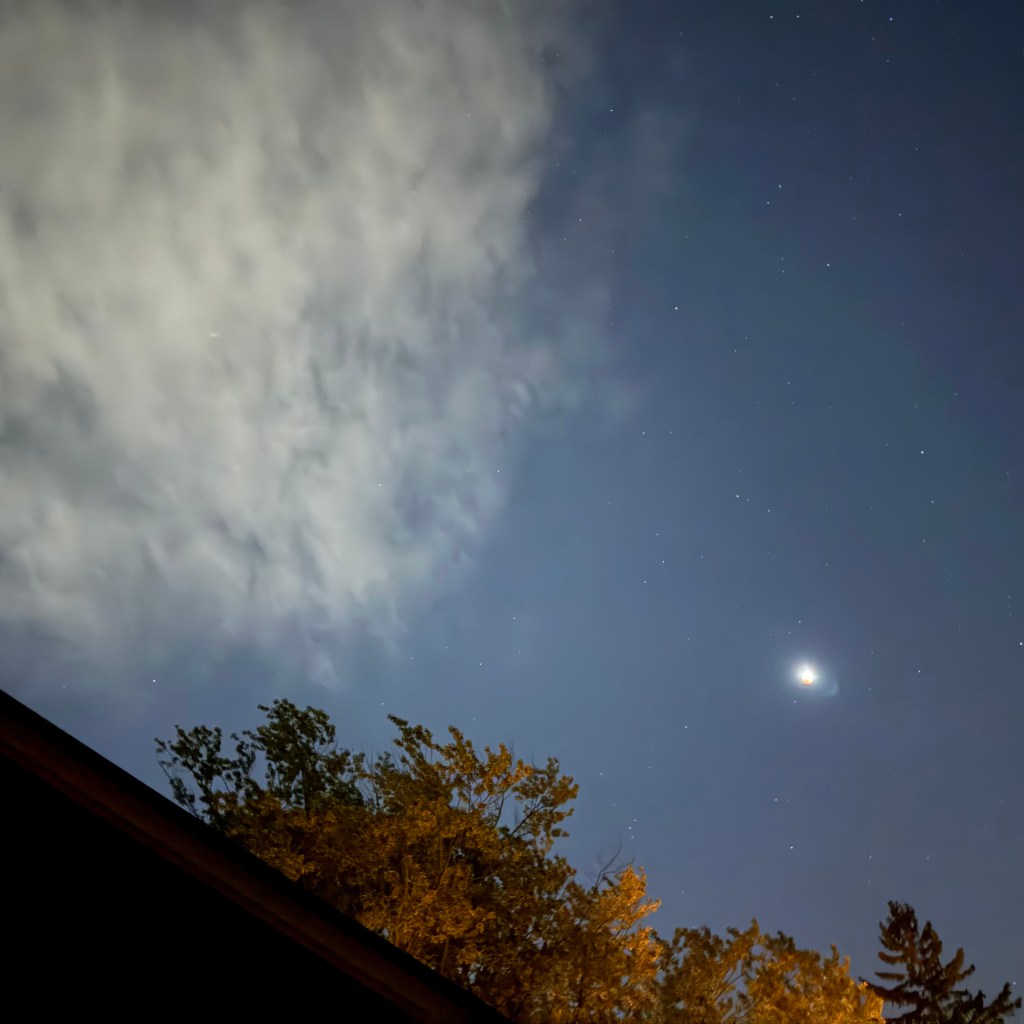
A bank of clouds approached the eclipsing Moon as the hour of peak eclipse neared. A lens flare is visible to the lower right of the bright lunar dot, and a view stars can be seen in the sky.

That is how it goes, sometimes. Clouds, missteps, or mishaps spoil an otherwise exciting occasion. It doesn’t help to curse the clouds but that did not help to stop the whispered oaths! Happily, gaps were present in the cloudy mess, clear sky visible through them, hopefully allowing peeks at the eclipse. The clouds arrived, mostly blocking but indeed occasionally teasing glimpses at the then fully-developed event. We made images from about two minutes before the peak, and images from about two minutes after, but nothing from the peak moment.
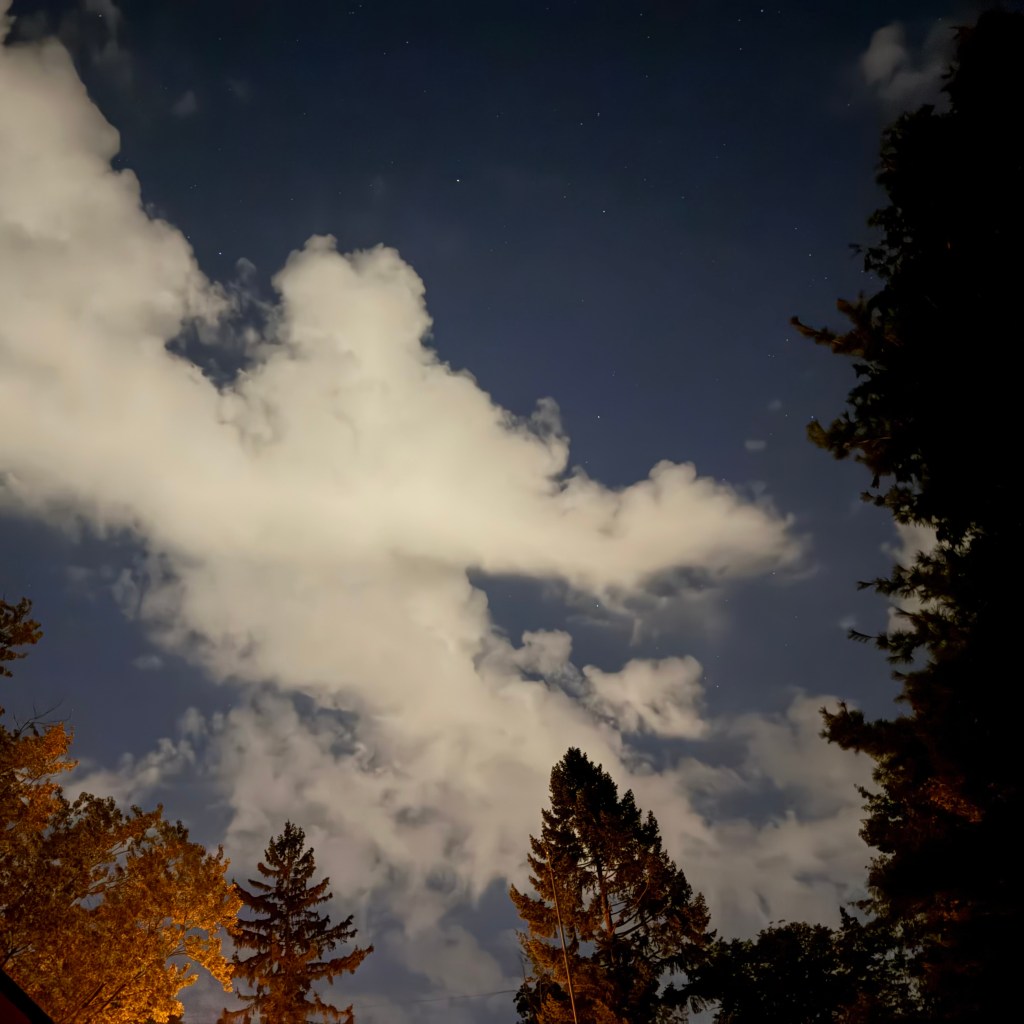
Peak eclipse, at 12:13 AM EDT. Very, very eclipsed as the clouds obscured the view. Gaps in the cloud cover allowed images to be made before and after the astronomical peak coverage was reached.

An extended period of clarity followed, as the cloud bank continued on its southbound journey. We shot more images of the eclipsed Moon, rapidly changing exposure settings, seeking to record a wide range of graphic data against future processing efforts before the scene changed much. Imaging done, we took one last look, parked the telescope, then stowed and secured gear for the night. It was late and we had daytime promises to keep.

So that was another lunar eclipse in the books. There was frustration, to be sure, but there were rewards. There won’t be another lunar eclipse visible here until January 12, 2028 (a weak partial eclipse), with the next total lunar eclipse on June 26, 2029. One has the opportunity to see just so many eclipses in their lifetime, so we try and see every one we can!

P.S. At 12:30 AM, the diminishing eclipse became visible from the spot where we first set up the small telescope. And the sky was clear.
A little flip helps a lot

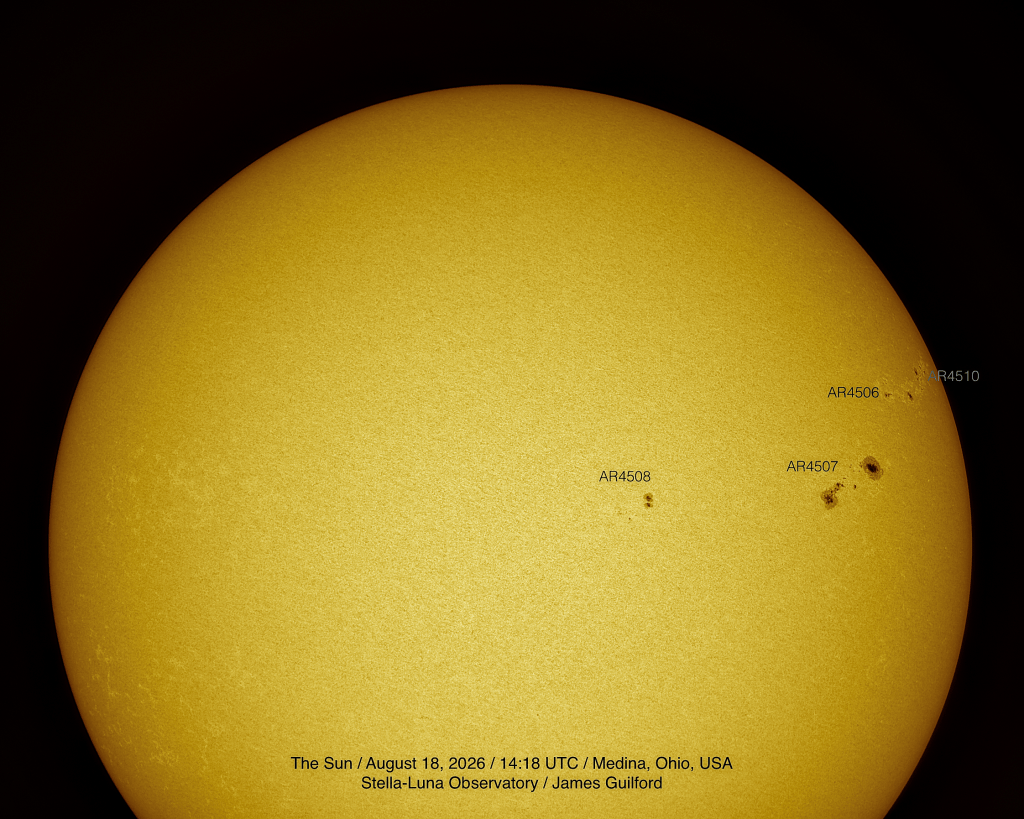
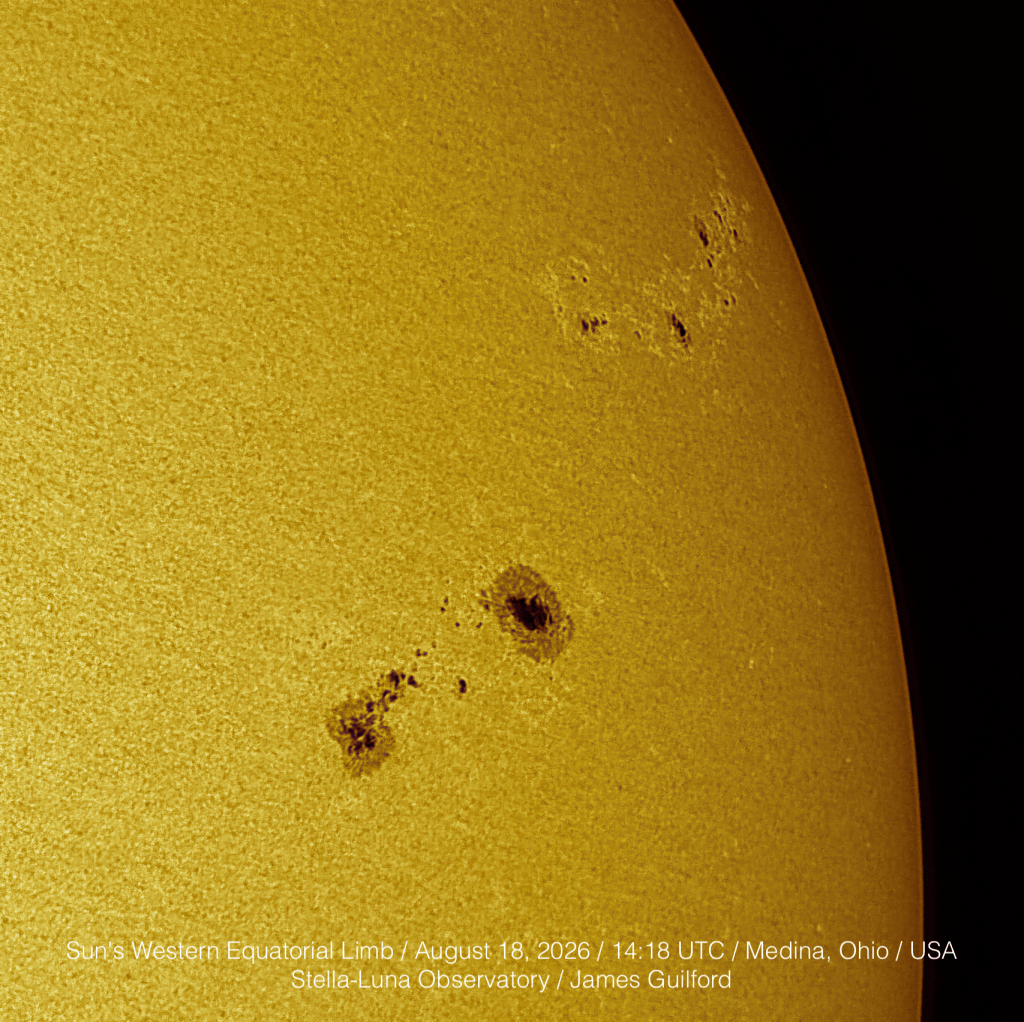
We observed several active regions, all in the western hemisphere, no sunspots in the eastern hemisphere, and all were confined to the solar equatorial area. This solar cycle appears to be fading away. White light Baader film solar filter, with false color applied in processing. August 18, 2026.

Skies, time, and tech finally aligned allowing us to observe Sun this morning. With mid-summer behind us, Sun clears the trees later these days meaning we observe later with more turbulent air — only fair seeing today! Still, we imaged four active regions with spots, all headed toward the western horizon. There were no sunspots in the eastern hemisphere, and the active regions were confined to the solar equatorial area. This solar cycle appears to be fading away.

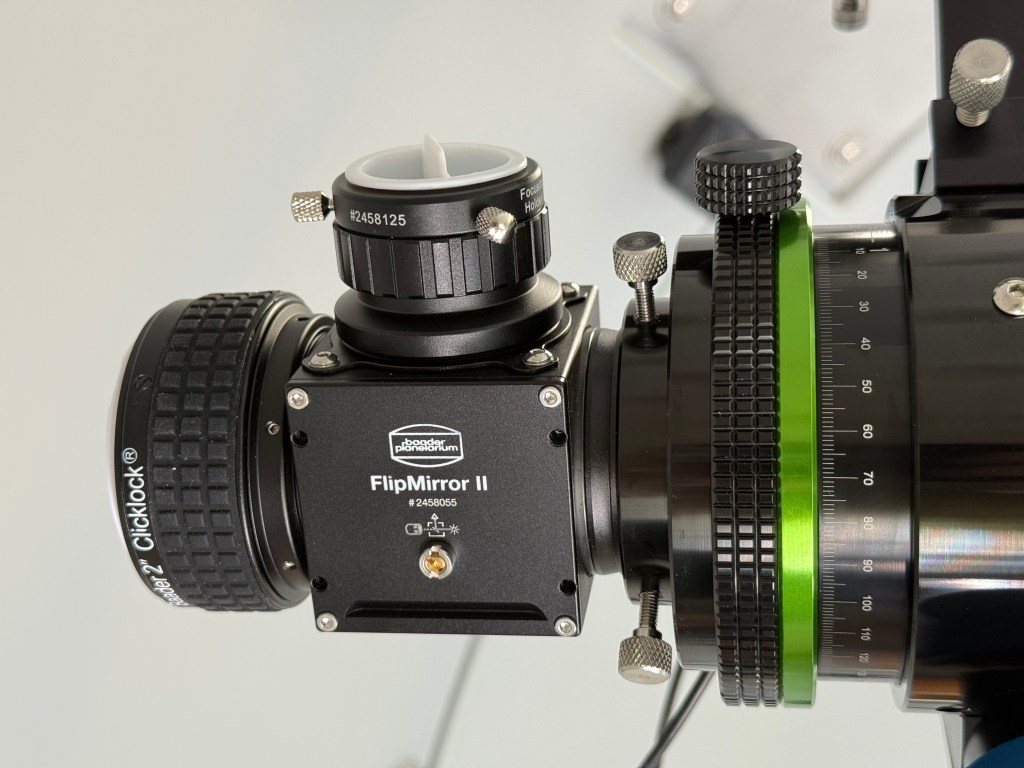
Aiding the day’s observations, and the equipment’s first light, was the addition of our new Baader Planetarium FlipMirror 2. We found that the flip mirror we used with the Vixen Cassegrain telescope had too much extension — we needed something more compact to achieve focus and have a little room for adjustment. Setting up the Baader FlipMirror was a challenge. The main component, containing the mirror, is shipped with adapter rings only — no nosepiece, eyepiece holders, or anything else. While the bare-bones component is versatile, selecting the correct set of add-ons was a worrisome exercise (components are not cheap) and the retailer offered no assistance when asked. After a good deal of shuffling between the owner’s guide, the product box illustrations, and the Baader and retailer’s websites, we made our selections. Happily our purchases were correct. The FlipMirror really is a well-made and even superior product.

The Baader FlipMirror 2 connected to the telescope focuser. Clicklock eyepiece holder/clamp, and focusing eyepiece holder are sold separately

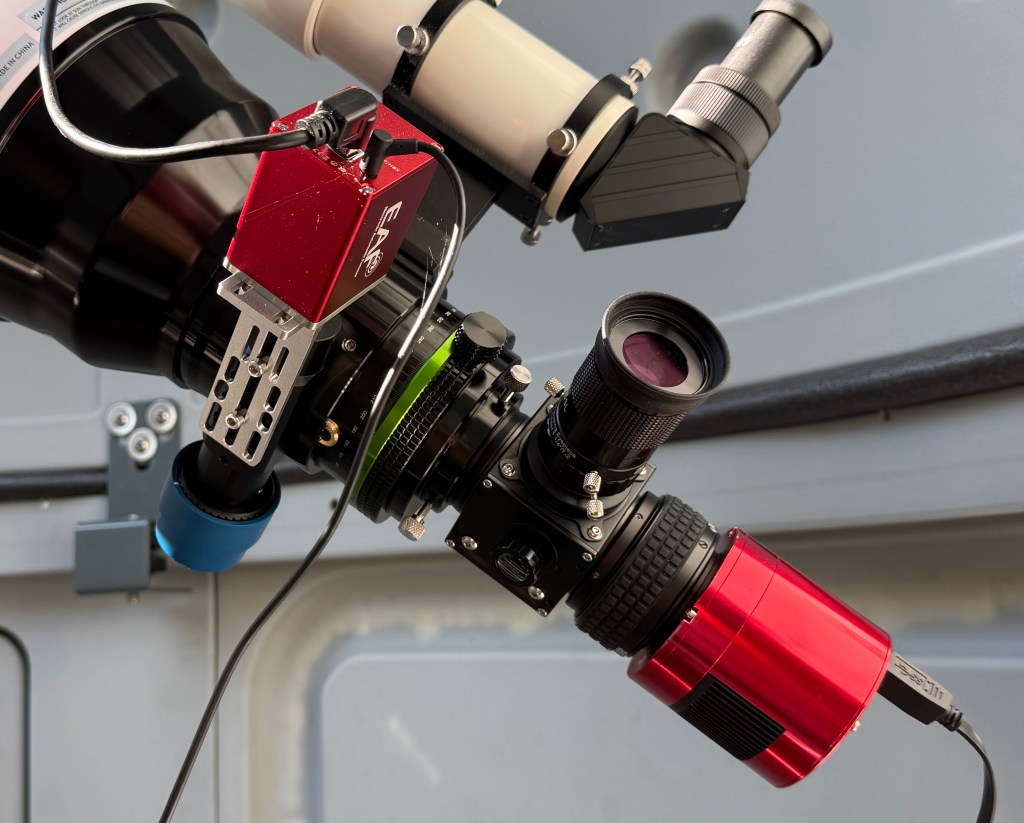
Why a flip mirror? Those devices allow two, or more, observation or imaging pieces to be attached to the telescope at once: a camera and an eyepiece, two eyepieces and differing angles, two cameras (we suppose), with only the twist of a mirror-flipping knob to switch between them. In fact, the Baader device has a third connection place, located on the underside of the mirror box, for addition of a guide camera! The mirror never covers the light path for an attached off-axis guide camera … an interesting feature.

The Baader FlipMirror 2 installed and in use with eyepiece and camera connected.

At any rate, we were able to easily center Sun in the field of view using the eyepiece, flip the mirror out of the way to allow a direct light path to the camera, and image. Centering the sun was no big deal but using an eyepiece to center distant stars, planets, etc. is made much easier through its use. It’s also nice to just take a look, observing directly with one’s own eyes!

Mare Imbrium, morning here, evening there

Mare Imbrium, the Sea of Showers, as it appeared during Moon’s Last Quarter phase on the morning of August 5, 2026. The distinct crater with spidery ejecta lines radiating from it is Copernicus. With a diameter of about 711 miles, Imbrium is one of the largest craters in the Solar System. A colossal impact from a protoplanetary object during the Late Heavy Bombardment produced the huge ring nearly four billion years ago. Image Credit: Stella-Luna Observatory / James Guilford

Continuing to explore daytime imaging of Moon, August 5 presented us with good skies and a Last Quarter lunar phase. One of our favorite areas to observe is Mare Imbrium, filled with subtle detail and a mountainous arc, the Montes Apenninus defining much of its shape. Last Quarter occurs when the light on Moon’s Earth-facing side has proceeded half way from Full to New — in other words, it’s afternoon or late day at Imbrium. The setting Sun brightly illuminates the mountain tops of Iridium’s eastern edge, along with the eastern walls of craters within or nearby. A “bonus feature” is crater Copernicus, just south of Iridium‘s defining mountains, with its deep, textured walls, central peaks, and expansive ejecta rays. The Sea of Showers has much to offer viewers.

First Light: A new telescope means a new beginning

First light image of Messier 57: The Ring Nebula. For the occasion, only 60 light frames and 30 dark frames, 15 seconds each frame, were captured and stacked. Affinity Photo 2 was used to create the stack and Pixelmator Pro for editing. M57 is a planetary nebula in constellation Lyra and was formed during the death throes of a Sun-like star.

We had been considering what our next step might be in outfitting the observatory with a more-or-less permanently mounted telescope. Would a very long focal length Cassegrain suit our needs? Both the C11 SCT and the Vixen Modified Cassegrain were available, already on hand but both had issues. After struggling with collimation on both telescopes, we were leaning toward a high-quality refractor as the solution. Long focal length on a refractor, though, means a long tube and we have limited space. The incident that damaged the Vixen pretty much forced our hand. Frustrated with collimation issues, and telescope repairs we doubt we could perform, we made the decision to go with a new refractor.

What ultimately steered us toward Askar and helped ease some (not all) doubt concerning focal lengths was the wonderfully high quality image of the “daytime Moon” we had captured with the smaller Askar 103APO — images with that level of quality can be cropped to make up for some lack of focal length. Watching YouTube reviews of some Askar’s bigger telescopes offered further assurance we were headed in the right direction.

The new Askar 151PHQ telescope installed on the observatory’s pier. At the eyepiece end is a ZWO ASIAir Plus computer and ZWO Automatic Electronic Focuser. We anticipate moving the computer to a different location on the telescope as cable management becomes a priority.

Inside doubled shipping boxes, the telescope was delivered in a solid transport case, packed in form-fit dense foam padding. The case is very high quality, very heavy, and bears multiple hand grips; it will now be set aside, stored some place against the day the telescope is taken out of service for some reason. If the case was an optional item, in our case we aren’t sure we would want it.

The Askar 151PHQ is doubtless the highest-quality telescope we have ever owned or used. It is a quadruplet astrograph, featuring a 151mm (six inch) aperture and a 1057mm focal length for an f/7 focal ratio, and designed to produce flat field images without add-on optics.

Taking advantage of a rare, relatively clear night, we went for first light using the big instrument with minimal configuration: no finder scope, no automatic tracking, no camera cooling, etc. While we had installed the ZWO AEF purchased years ago, and the ASI AirPlus, we used them only for manual electric focusing which, by the way, was a big improvement in itself! The optional hand controller was a wonderful thing to have, allowing us to watch through the eyepiece or on the computer screen and make smooth, minute adjustments to focus without telescope vibration. Yes, wonderful!

Under Bortle 6/7 skies pinpoint stars shown brightly through the eyepiece as we focused on Arcturus, then searched for M57. Our hazy skies, made worse by light pollution (maybe a Bortle 8 night), didn’t make things easy but with a little patience, a tiny, ghostly ring appeared in the field of view. We swapped out the eyepiece for the one-shot color camera, refocused, and began the imaging run. While we have much to learn about processing deep sky objects, we were happy to see the quality of the resulting stacked image: round stars and lots of them (many more stars than we’re used to seeing there), good detail in the ring, and decent color — all in 60 light, and 30 dark 15-second frames. The Moon eluded us that night, still down in the trees at midnight, but we tried solar first light the next morning.

First images of our Sun via the Askar 151PHQ were recorded under poor seeing conditions but, with some work, produced some pretty impressive results. A TeleVue Powermate 2.5X Barlow was employed here. We hope to refine our setup for the new telescope for better edge-to-edge focus. The telescope was equipped with a Baader white light solar film filter and monochrome camera; false color applied during processing.

Placing a Baader Solar film filter over the Askar’s objective and aiming the scope at Sun, we quickly saw beautiful detail in the sunspots that marked the surface on July 31. Imaging was routine and easy, though seeing was poor. The telescope’s 1,057mm focal length did not allow a full disk image of our star on the ASI astronomical camera’s sensor but installing a Barlow lens we achieved some dramatic detail views. We can hardly wait to try again under better skies!

Long focal length produces a Solar image too large to entirely fit on the astronomy camera’s sensor. With quality like this, however, we won’t complain. This is Sun on July 31, 2026, imaged via white light solar filter and monochrome camera, false color applied during processing.

Nearly too large! When observing low elevation targets, the telescope fits snugly within the observatory walls. Fortunately, the tall pier and large mount elevate the assembly enough that normal observing is at a comfortable height and (M57 was at the zenith during First Light!) high elevation targets do not cause us to lay on the floor or scrape the camera there! We suspect this scope on a tripod might present some problems for high elevation object observing.

Thus far the only negative, something unanticipated, is that because of the Petzval design, an optical element is located deep within the OTA making use of our beloved Herschel Wedge a risk to the telescope; that optical element is at a point in the light path where focused and unfiltered sunlight could overheat and damage the lens! We’re working around it and will assign the Herschel to the Askar 103 when desired. As we anticipated, we’d love to have much more focal length but without collimation to worry about and high quality images to work with, we’ll hope to get by … maybe with the help of a really good Barlow lens?

Daytime Moon redux

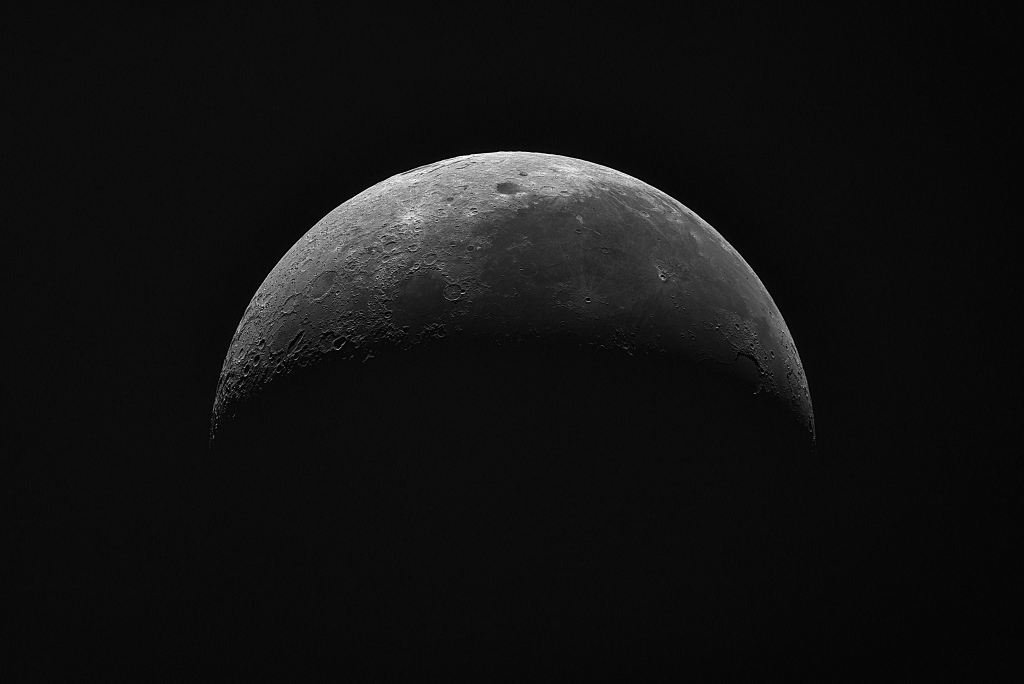
Earth’s Waning Crescent Moon, July 9, 2026, at 15:05 UTC / 11:05 AM EDT. The image was rotated clockwise by 90° for aesthetic reasons. Credit: Stella-Luna Observatory / James Guilford.

Once again, following a Solar observing session, we turned our telescope to Moon during daytime. This time, we employed the same monochrome camera we used imaging Sun but, after removing the solar protections, added an infrared pass filter. The result, via the Askar 103 APO telescope, was spectacular! Only minimal processing was needed to achieve a sharp, contrasty, detailed image of Earth’s nearest neighbor.

Sun and Moon

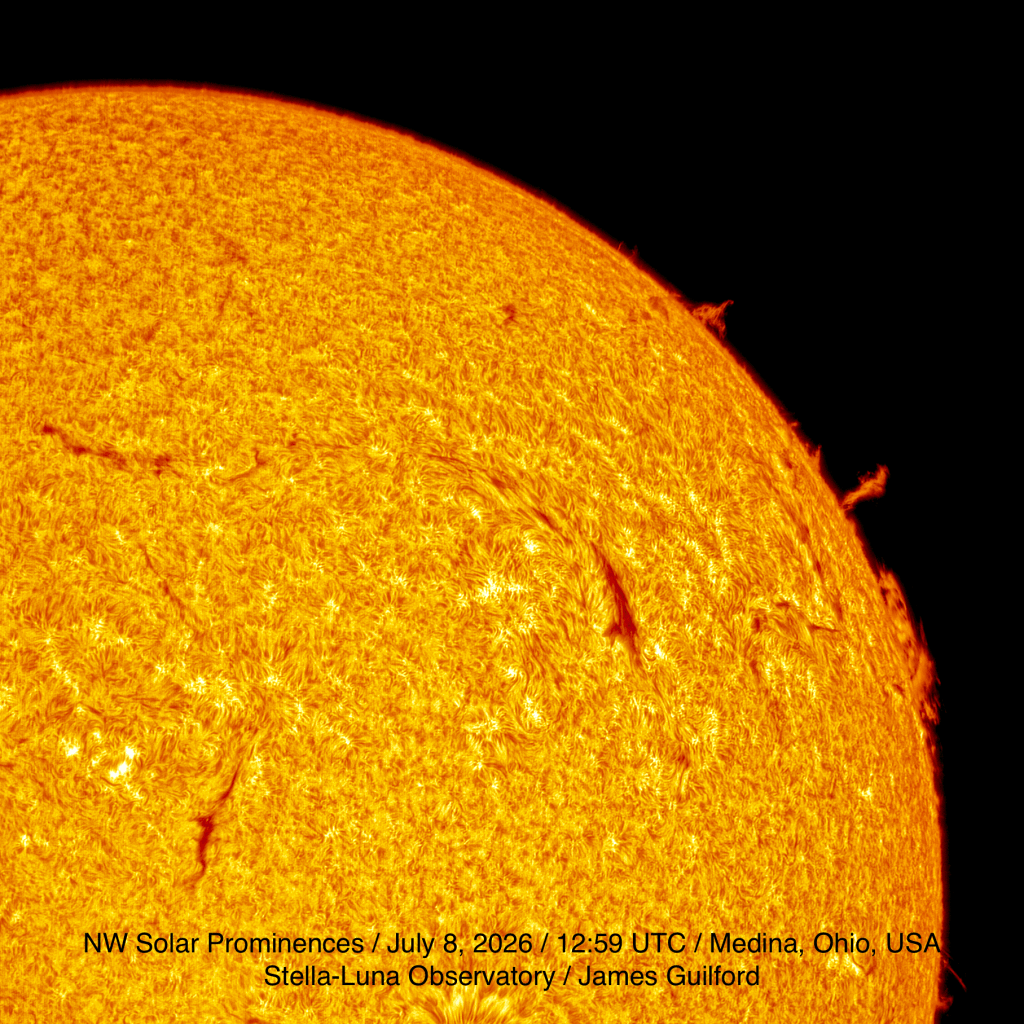
The northwestern Solar quadrant shown via hydrogen-alpha light, false color applied, shows the chaotic surface of the chromosphere, with several filaments visible. Along the rim are prominences contrasted against the blackness of space.

The morning presented an excellent opportunity for Solar observing and imaging — the sky was clear and, these days, Sun is rising between trees instead of behind them! While we have been following our star’s singular large sunspot for a few days, it turned out our best image from the morning was of the northwest Solar quadrant. Details in the chromosphere were beautifully rendered and several interesting prominences of various shapes and sizer graced the rim.

During one of the Solar imaging runs, we looked up and out through the dome aperture at the deep blue morning sky. There, floating on the denim background, was the Last Quarter Moon. Once finished with Sun, we aimed the scope at Moon, removed the solar gear from the white light telescope, and did a portrait of old Luna. We’ve done this not so long ago but still get a kick out of our daytime Moon.

Earth’s Moon in its Last Quarter phase is shown in this two-panel image made at 9:15 AM EDT, July 8, 2026.

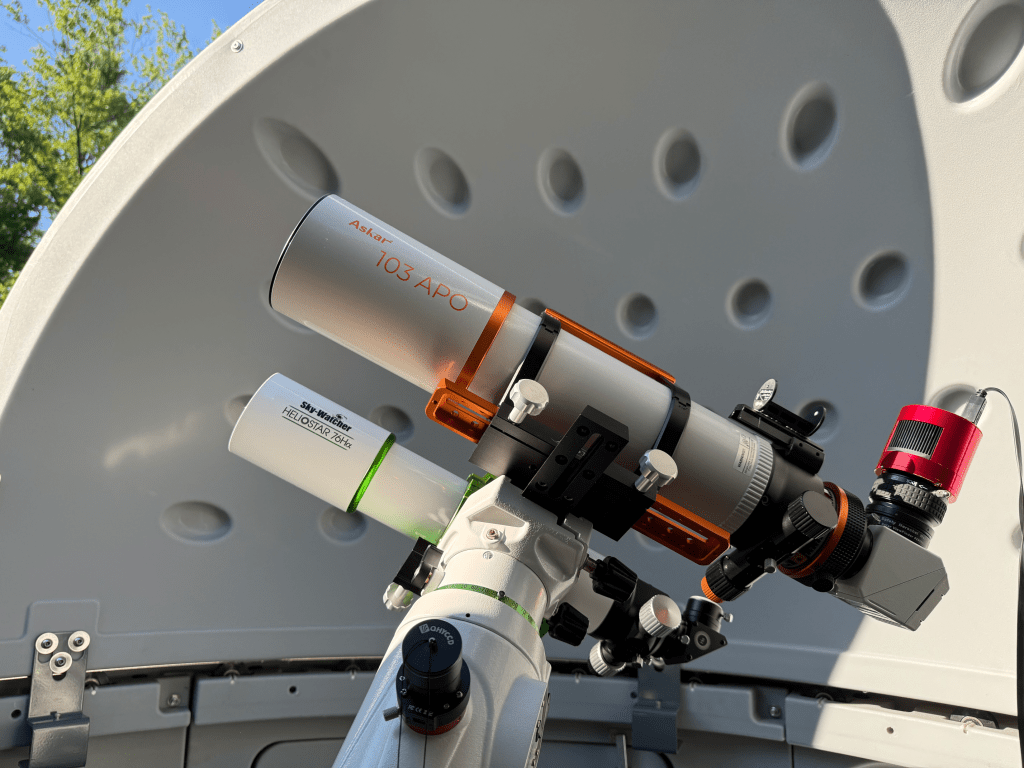
By the way, the latest addition to our setup is a rig by ADM that allows two scopes to be held simultaneously on a single mount; that has been a wonderful way to quickly change between Solar wavelengths, and to use the individual telescopes without swapping out and rebalancing the system. The ADM rack is very well made, fully adjustable, and we have no fear of equipment coming loose and crashing to the ground — possibly the most important feature!

Multi-telescope rack by ADM allows two telescopes to ride the pier mount at the same time, delivering flexibility and efficiency to our setup.

Three (very) active regions mark the sun’s surface

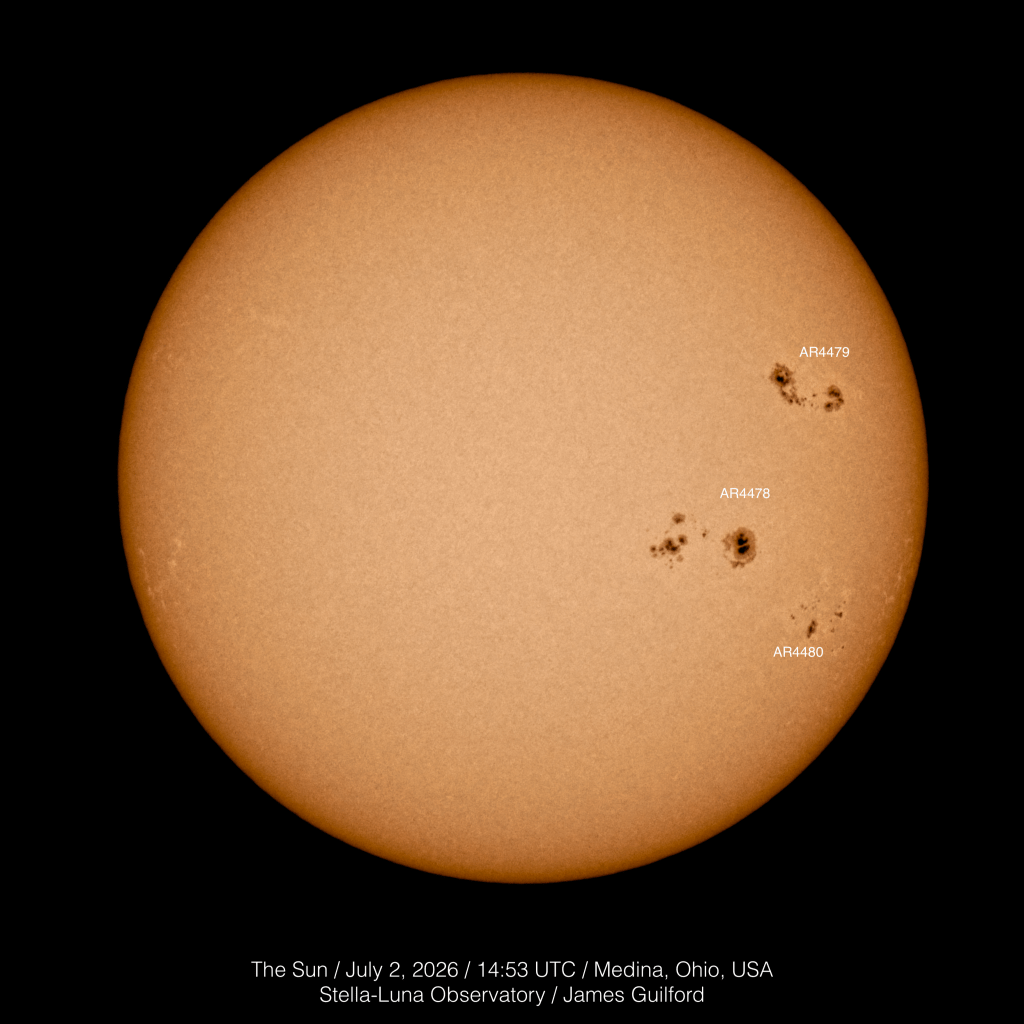
Whole-disk view of Sun as it appeared late morning July 2, 2026. The sunspots are nearing Sun’s western horizon (right) but still pose a threat of geomagnetic storms from their flares. This image was captured using our Canon EOS 5D Mk. 4 DSLR, 400mm telephoto lens with 2X extender, and white light Baader film solar filter. False color added.

Three active regions nearing the western solar horizon have been busy, exploding with multiple flares and coronal mass ejections (CMEs). That solar material is expected to reach Earth beginning July 3 and continuing into the U.S. Independence Day weekend. The CMEs impacting Earth’s magnetosphere could produce auroras. Those blessed with clear night skies should be alert for a possible *quiet* fireworks display! Respect.

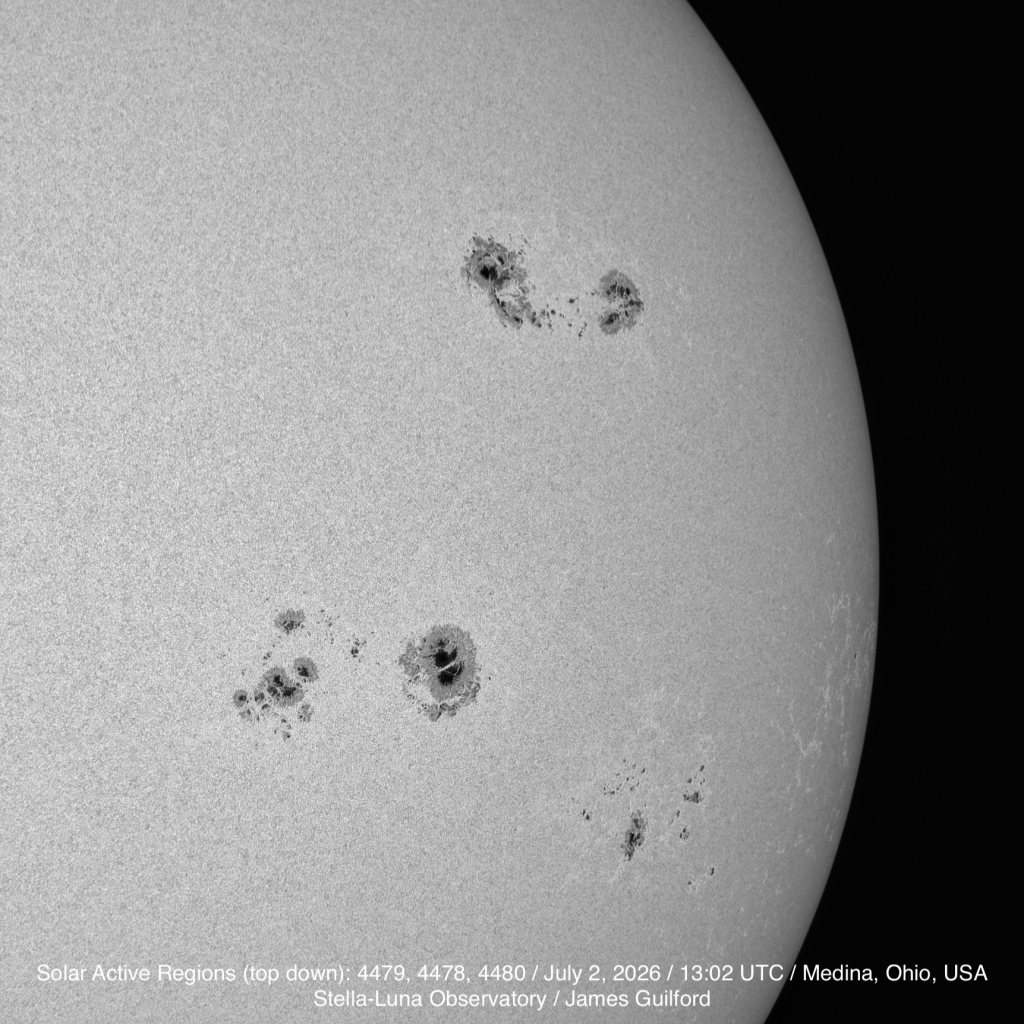
A closeup view of the three active regions mentioned in this post was recorded using our Askar 103APO telescope, and Baader Planetarium Herschel safety wedge. The image was recorded the morning of July 2, 2026 in monochrome and is reproduced here in that state. Photosphere granulation, faculae, and sunspot details are visible here.

Impressive sunspot commands attention in midday heat

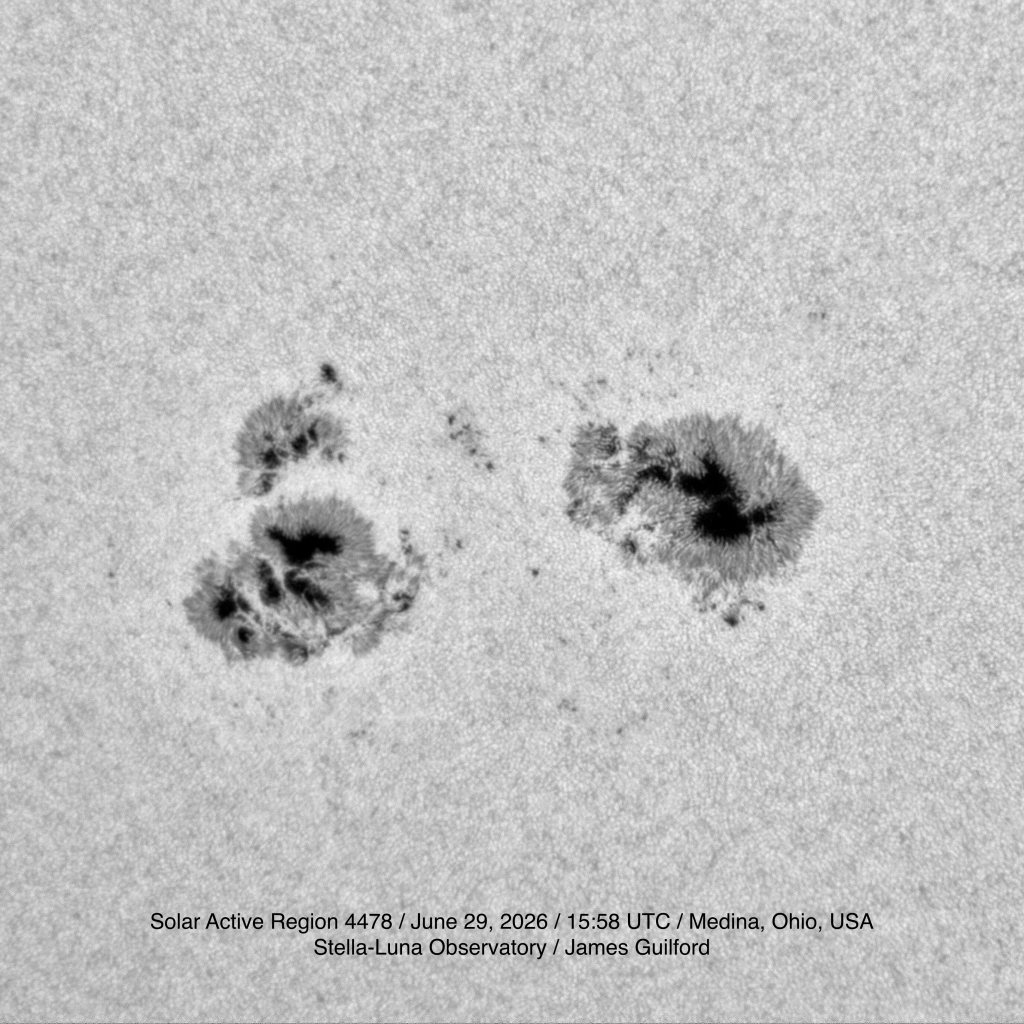
Sunspots at Solar Active Region 4478 imaged with an Askar 103APO telescope, Herschel wedge, and Tele Vue Powermate 5X under poor seeing conditions. Credit: James Guilford

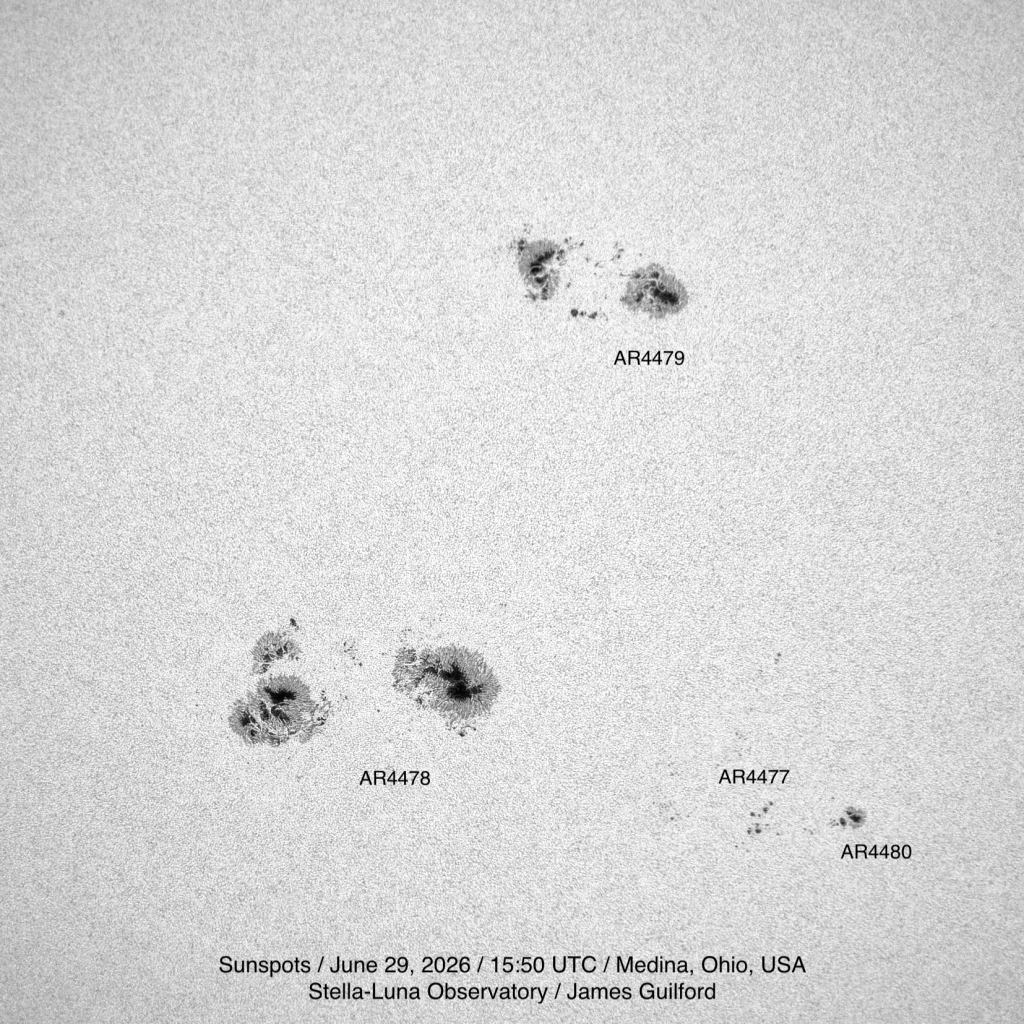
June 29, 2026 — Morning clouds and the usual trees kept us from working in the cooler, quieter air today so, nearing local (EDT) noon in heat and roiling atmosphere, we took our first shot at Solar Active Region 4478. The region featured a pair of massive sunspots that have been exciting observers lately. Using the Askar 103APO telescope with Baader Planetarium Herschel wedge in white light, we caught the impressive sight. Now aimed squarely at Earth, both AR4478 and 4479 pose a threat of powerful X-Class flares.

Several of the sunspots in Solar active regions as imaged via Askar 103APO telescope, Herschel wedge, and Tele Vue Powermate 2X under poor seeing conditions. Credit: James Guilford

Small scope provides big results in moonshot

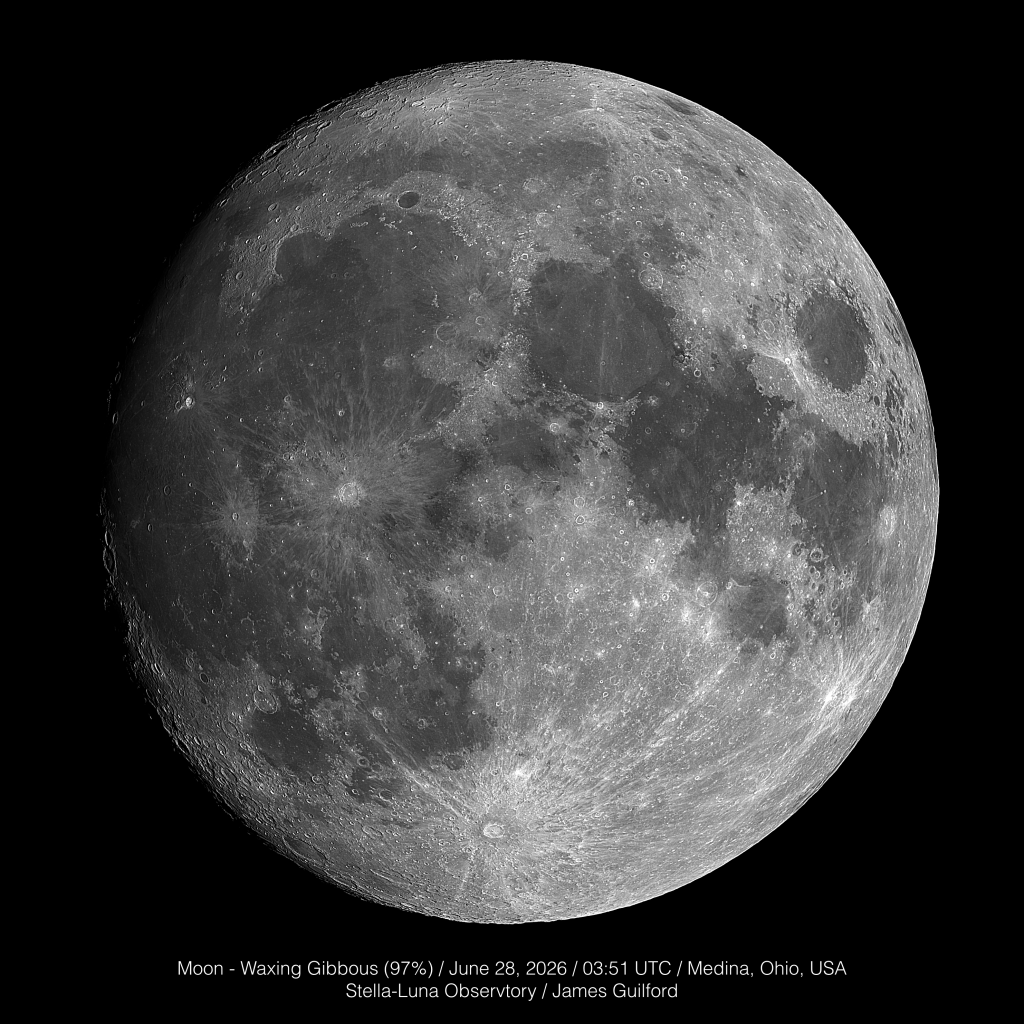
Full disk image of Earth’s Moon at 97 percent illumination, as imaged on June 27, 2026, at 11:51 PM EDT local time! Askar 103 APO refractor, ProPlanet 642 nM IR pass filter.

After recent struggles in an effort to get sharp images from the old C11 telescope, it was a pleasure to observe Earth’s Moon through the Askar 103 APO refractor! Clouds drifted through at various densities but — oh, my! — what a fine view! What the little Askar lacks in focal length, it possesses in sharpness. So we excitedly present this image of our Gibbous Moon!


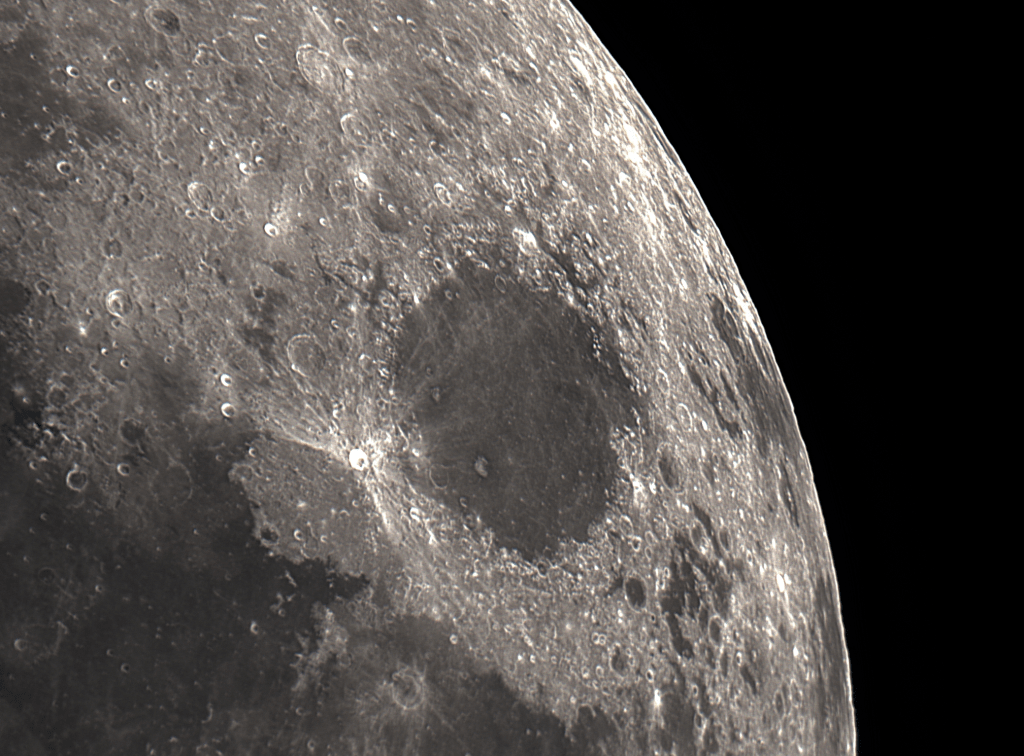
Crater Copernicus and vicinity, with Moon at waxing Gibbous phase, 97 percent illumination. Askar 103 APO refractor, ProPlanet 642 nM IR pass filter, Tele Vue 2X Barlow. Image Credit: James Guilford

Lunar Crater Copernicus (above), with its expansive web of ejecta rays, dominates this scene captured June 27 (local time). To the left of Copernicus is Crater Kepler, with a smaller but still visible “splat” mark, both contrasting well against the dark field of Mare Insularum. Left still farther, on the terminator, is a figure-eight ring feature formed by Craters Cavalerius (top) and Hevelius (bottom). This is our favorite image from the brief Saturday night session.

Southern Moon and telescope trial

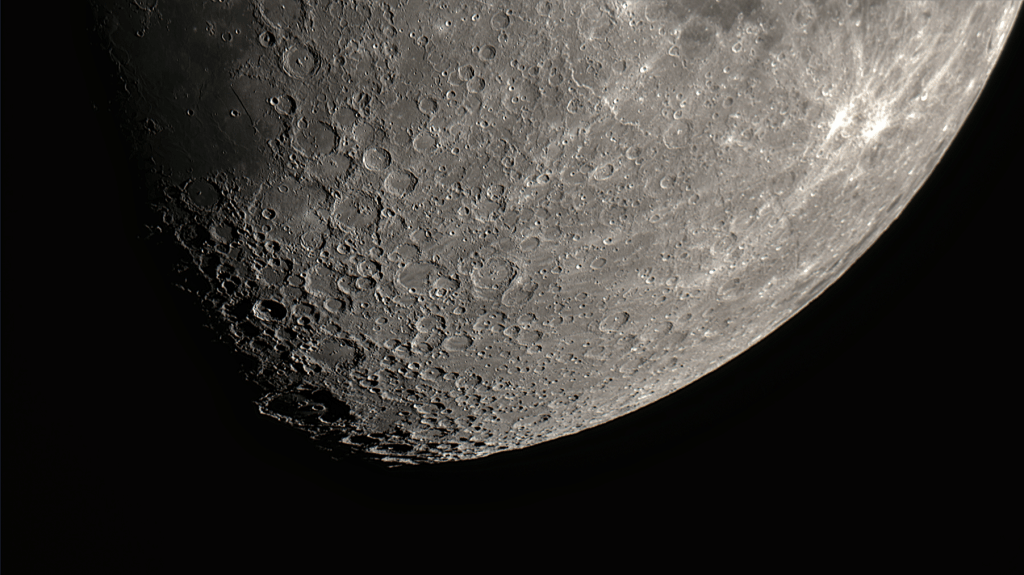
The heavily-cratered south-eastern area of Earth’s Moon is seen here, imaged just before midnight, June 23, 2026. Stella-Luna Observatory / James Guilford

This is the southern end of Earth’s waxing gibbous phase Moon, as imaged late Tuesday night. The heavily-cratered area along the terminator includes Crater Tycho — with a central peak lit by the rising Sun — and the dark circular expanse of Clavius, with the top of its western crater wall extending into the deep shadows of the terminator. We used the old Celestron C11 for this session as we continue to evaluate its performance and condition. We continue to be concerned about whether the telescope’s focus issue is simple collimation or some more serious combination of problems.

Not in the southern area of our Moon but certainly visible, even without a telescope, is Mare Crisium, shown at the center of this image made light night June 24, 2026. Stella-Luna Observatory / James Guilford.